
Doha · Qatar
Somewhere Between a Marble Factory and a Masterpiece
On the art world's transparency problem, the extraordinary markets the world is only beginning to discover, and why we decided to build a map.
February 2026, Doha. Msheireb Downtown — the old business district that Qatar has been quietly transforming into something between a cultural quarter and an urban experiment. Two things are happening simultaneously in this same compact neighbourhood, within walking distance of each other: Web Summit, which has descended on Doha with its usual cargo of founders, VCs and startup energy, and Art Basel Qatar, the brand's first-ever Middle East edition, which has just opened its doors at M7 and the Doha Design District.
The contrast is disorienting in the best possible way. Outside Web Summit, the kind of conversations you'd recognise from any tech conference anywhere in the world. But a short tram ride away, something different: 87 galleries from 31 countries, including 16 making their Art Basel debut, showing work by artists most of the world has never heard of. Egyptian artist Wael Shawky has designed the whole fair around an "open format" — no rigid booth grid, no conventional stand structure, just art and space and the feeling that something is being figured out in real time. And there, at the edge of it all, outside % Arabica — the Japanese specialty coffee chain from Kyoto, 207 locations worldwide, somehow always in exactly the right city at exactly the right moment — conversations about art that feel nothing like the art world conversations I'd had anywhere else.
At Web Summit, everyone is talking about what's next. At Art Basel Qatar, everyone is talking about what's been overlooked.
I fly to Dubai two months later with that contrast still in my head.
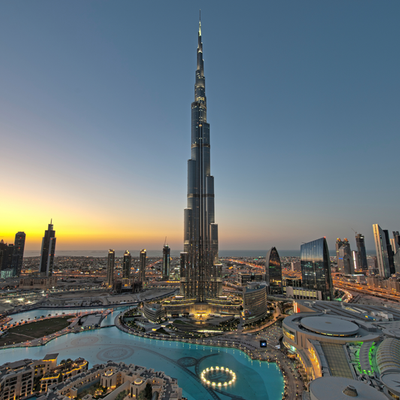
I'm staying in the Opera District — the neighbourhood that has grown up around Dubai Opera on Sheikh Mohammed bin Rashid Boulevard, a stretch of towers and public space and galleries that didn't exist fifteen years ago and now feels like the most cosmopolitan quarter of one of the most cosmopolitan cities on earth. I'm walking the boulevard almost every day, past the Burj Khalifa reflected in the fountains, past the outdoor sculptures and the gallery windows. There are more art spaces here than I expected. There are more art spaces here than most people who've visited Dubai know about.
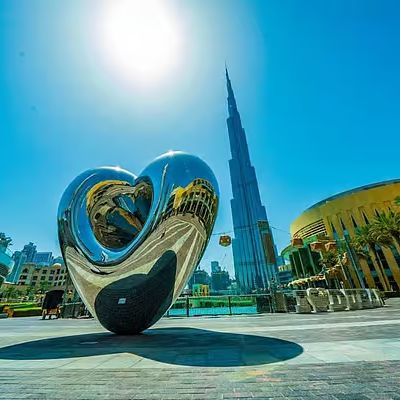
One afternoon I wander into JD Malat Gallery. I thought they were London only — I'd seen the space in Mayfair, knew the program. But here they are, on the ground floor of ACT TWO tower, right on the boulevard. The curator — warm, genuinely enthusiastic, not performing enthusiasm — takes us through the show. At some point she shows us a small work: a miniature rendering of the Dubai Heart ("Love Me", Richard Hudson), the city's unofficial symbol, the kind of thing you see on taxis and storefronts, but here transformed into something precise and considered and oddly moving. A city's image of itself, held in miniature.
I ask her about the gallery's decision to open here. She talks about the collector base, the energy, the sense that something is being built. A few weeks later, I find out that Sotheby's is about to open a permanent space in Dubai. And something clicks — not just about the city, but about the gap between what this market actually is and what most of the world thinks it is.
Because most of the world doesn't know any of this.
And even those who do often can't find their way in. By my third week in Dubai I had bookmarked a dozen websites, followed fifteen gallery Instagram accounts, added thirty pins to a Google Map, and still couldn't answer a simple question: if I have one afternoon and I want to understand what's actually happening in this city's art scene — not just see galleries, but understand how they fit together, what they mean, who the artists are and why any of it matters — where do I go? The information existed. The scene existed. What didn't exist was the map.
That gap is what we're building Exhibo to close.
Exhibo is the discovery infrastructure layer for emerging art markets. Starting in the UAE and expanding across MENA and beyond, we make local art scenes legible to global collectors, galleries and cultural institutions through structured geographic intelligence — connecting demand that exists to supply that is invisible.
The Numbers That Tell the Story Nobody's Telling
The global art market returned to growth in 2025 after two consecutive years of contraction. The Art Basel and UBS Global Art Market Report 2026 — the most comprehensive annual survey of the global art trade, authored by cultural economist Dr. Clare McAndrew — shows total sales rising 4% to $59.6 billion. Public auction sales increased 9%. Art fair sales reached their highest share of dealer turnover since 2022. Optimism heading into 2026 is measurably stronger: 43% of dealers expect sales to improve this year, up 10 percentage points from a year ago.
Good news. But the recovery is uneven in ways that matter enormously for understanding what's actually happening in the art world right now.
The same report reveals that 66% of high-net-worth collectors in 2025 bought works by artists they were discovering for the first time — up from 43% in 2022. Two thirds of serious buyers are actively, explicitly looking for artists they've never encountered. Discovery has become the dominant mode of acquisition. And this shift is driven by younger collectors: millennials leading in prints, photography and works on paper; Gen Z collectors engaging especially with digital art and new media; both demographics far more open to artists from underrepresented regions than their predecessors.
HNW collectors allocated an average of 20% of their wealth to art in 2025, up from 15% the prior year. 49% of gallery buyers in 2025 were entirely new to the gallery, compared to 44% in 2024. Among smaller galleries, 60% of buyers were first-timers. The market is not just recovering. It is being rebuilt from the ground up by people who have no loyalty to the old geography — and no attachment to the idea that "serious art" can only come from New York, London or Paris.
And yet — only 17% of collectors globally believe the art market caters "very well" to them. Only 16% say their local market "completely" meets their needs. 69% of collectors have hesitated to buy art due to lack of transparency. Only 44% of galleries display prices for all available works online. A quarter of galleries still require collectors to "inquire within" for basic pricing information.
The art market is growing. The appetite for discovery is at a historic high. And the infrastructure for connecting that appetite to the art that would satisfy it remains, in much of the world, essentially nonexistent.
This is the gap. And the gap is widest precisely where the art is most interesting.
What's Happening in the MENA Region — and Why the World Is Finally Paying Attention
Christie's reports that sales of modern Middle Eastern art tripled in value between 2020 and 2024. In Q1 2025, contemporary Middle Eastern art sales in London rose 89% year-on-year. At Sotheby's dedicated MENA sales in 2025, collectors from 23 countries participated — with 33% of buyers entirely new to the platform. A ten-year study of MENA auction results shows growth of 30–40% between 2013 and 2023.
Bain & Company's 2025 luxury analysis named the Middle East the global luxury market's "brightest performer," with projected growth of 4–6% against a backdrop of broader contraction. The UAE government has committed close to $5.3 billion to arts and cultural infrastructure. Abu Dhabi's sovereign wealth fund ADQ took a minority stake in Sotheby's. Art Basel launched a Qatar edition — its first permanent Middle East footprint in the fair's 56-year history. Frieze is launching in Abu Dhabi in November 2026. The Guggenheim Abu Dhabi, designed by Frank Gehry, opens this June.
And from a purely structural perspective, the UAE's advantages for collectors are real and specific. Zero personal income tax. Zero capital gains tax on art. A free trade zone infrastructure that enables bonded storage and efficient cross-border transacting. Christie's reports that 15% of its new global clients over the past three years came from the Middle East and Africa — buyers who arrive at major Western auctions not as occasional guests but as regular participants with long-term collecting intent. This is not a market of opportunistic buyers. It is a market of people building collections with intent and holding power.
Art Basel's global fair director Vincenzo de Bellis described the moment to The Art Newspaper with unusual directness: "There is incredible talent across the region that is underrepresented in the global market, unprecedented investment in cultural infrastructure and a rapidly growing collector base."
Underrepresented in the global market. That phrase is doing a lot of work, and it's worth sitting with.
A Marble Factory in Al Quoz
The story of how Dubai became a serious art city is not the story most people tell about it — and it starts not with a government announcement or a museum opening but with a family business and a set of industrial warehouses that nobody wanted.
In 2007, an Emirati businessman named Abdelmonem Bin Eisa Alserkal owned a marble factory and a cluster of warehouses in Al Quoz — a dusty, unglamorous district that the art world had never thought to look at. His idea was deceptively simple: offer subsidised warehouse spaces to galleries and creative businesses willing to establish permanent operations in Dubai. Not a pop-up. Not a fair booth. A real, year-round, committed presence.
Ayyam Gallery moved in first in 2008, bringing with it a program focused on contemporary art from Syria and the broader Arab world. Then Carbon 12. Then Mojo. Then Isabelle van den Eynde. Within three years, the most active contemporary galleries in the region were running programming out of converted warehouses — programming that was being noticed in London, Paris and New York. By 2015, Alserkal had expanded to 500,000 square feet. Today the Avenue is home to more than 100 galleries, studios and cultural organisations drawing over two million visitors a year. In November 2025, Alserkal received the Abu Dhabi Award — the UAE's highest civilian honour — for his contributions to the country's cultural development.
In the same year that Alserkal was making his bet in Al Quoz, Art Dubai launched its first edition at Madinat Jumeirah. Two bets, same year, same proposition: that Dubai could be a serious art city, not just a luxury tourism destination with gallery-adjacent hotel lobbies.
What followed over the next fifteen years was the emergence of something genuinely layered. The Third Line became one of the first galleries from the UAE to be accepted into Art Basel. Lawrie Shabibi built an international reputation representing artists from MENA and the Global South. Grey Noise developed a practice around conceptual and experimental work that is now discussed alongside galleries in London and Berlin. Tabari Artspace, operating since 2003, has championed modern and contemporary Middle Eastern art for over two decades.
And the artists themselves. Hassan Sharif — who died in Dubai in 2016 — is now widely regarded as the father of conceptual art in the Gulf, a figure whose Objects series — everyday items wrapped in thread, transformed into strange, obsessive studies of materiality and language — Gallery Isabelle was still revisiting at Alserkal Art Week in April 2025. Mohammed Kazem, whose GPS-mapped coordinates of ocean surfaces became a digital commission at Art Dubai 2025. Sama Alshaibi, showing LiDAR-rendered visions of Baghdad's shifting terrain at Ayyam Gallery this spring — a city simultaneously present and disappearing, mapped by technology and unmapped by time. The South Asian artists who built serious practices on Alserkal Avenue — Maryam Hoseini's fragmented female figures at Green Art Gallery, Seher Shah's architectural drawings that turn city planning into elegy — while most of the Western art world wasn't paying attention.
"In the last 20 years, what was perceived to be the periphery has become the center," Antonia Carver, director of Jameel Arts Centre, told ARTnews at Art Dubai 2025. "And that means the city of Dubai itself, and the fair along with it."
This is what I was walking through in April. This is what most of the world doesn't know.
The Problem That Growth Doesn't Solve
ArtTactic's 2025 Gulf report made the point that I keep returning to: "For decades, regional artists have worked within fragmented systems: limited galleries, and few collectors. The real test lies in translating visibility into long-term engagement and a viable commercial ecosystem for galleries."
Money and ambition are necessary. They are not sufficient.
In Dubai today, there are over 60 commercial galleries operating across five distinct districts. Alserkal Avenue alone houses more than 30. The DIFC Gate Village — where Perrotin, Tabari Artspace, Christie's, Sotheby's and a dozen other serious spaces cluster within walking distance of each other — has become one of the densest concentrations of gallery infrastructure outside of a handful of global art capitals.
And yet.
The collector arriving from Singapore who read about Arab Modernism in the Financial Times. The gallerist visiting from São Paulo who heard The Third Line mentioned at a panel discussion. The person who lands in Dubai for the first time and wants to understand what's actually happening here, not just where to go but why it matters — they face a familiar problem: the information exists, but it's scattered. Artsy covers the region from a global altitude that misses most of what's happening at street level — and its directory reflects only the galleries that pay to be partner institutions, leaving a significant portion of the scene invisible. Ocula lists exhibitions but doesn't explain why a program matters. Google Maps sorts by review volume, not curatorial significance. A dozen good sources, none of them designed around discovery, none of them built to give a new collector the context they actually need. The result is that most collectors find their way into this scene the same way people have always found their way into art: through a personal introduction, a chance encounter, a friend who happened to know someone. In a market growing as fast as Dubai's, that's an enormous amount of value left on the table.
And this pattern is not unique to Dubai. In Beirut, where galleries have continued to show and build — one of the most intellectually serious contemporary art scenes in the world, with deep roots and remarkable resilience — with almost no structured channel to the global collector base that is increasingly paying attention. In Cairo. In Lagos. In Karachi. In Amman. In every city where serious art is being made and shown and sold, and where the potential for connecting that scene to the world is still largely untapped.
The Cairo Review noted in 2021 that many UAE galleries had already closed before the pandemic — victims of rising rents and the absence of corporate buying that sustains gallery ecosystems in New York or London. Majlis Gallery, which had operated for over thirty years, closed in 2020. The economic conditions for mid-size galleries haven't fundamentally changed. What has changed is the external demand — Christie's tripling MENA sales, Sotheby's reporting 33% new buyers, Art Basel arriving in Doha. The supply of serious gallery infrastructure is real and growing. The knowledge layer that would allow external demand to actually find that supply remains the missing piece.
It comes up in almost every conversation here. How do international collectors typically find their way to artists working in the city's residency programs, its smaller spaces, the galleries that haven't yet done an Art Basel booth? The answer, consistently, is: they don't — unless they already know someone, unless they happen to be at the right fair in the right week, unless a friend sends a link. The artists are serious. The work is serious. The path to finding it is almost entirely accidental.
That's the infrastructure gap. And it's entirely solvable.
What Every Art Market Learns Eventually
Hans Neuendorf founded Artnet in 1989 because he was frustrated by the opacity that surrounded even the most basic question of what art was worth. His logic has never stopped being right: "One of the reasons I founded Artnet was the lack of price transparency in the art market. It's a prerequisite of every functioning market."
What followed from that decision — the structuring of price data, the creation of a shared information layer — helped transform what had been a market of 500,000 post-war collectors into a global ecosystem projected to reach 270 million art buyers by 2030. The average age of market participants dropped from 58 in the 1990s to 39 in 2024. Transparency is a market expansion mechanism, not just an ethical preference.
Every art market in history has had to learn this. New York's SoHo needed critics and publications and a shared language before the commercial gallery model could sustain itself. London's YBA generation needed auction houses willing to take risks and a press willing to cover it as culture, not just commerce. Beijing's 798 district generated extraordinary energy in the 2000s but needed galleries, collectors and institutional frameworks before it could become a market rather than just a scene.
What made these moments stick — what turned cultural energy into lasting commercial ecosystems — was always the same thing: trusted knowledge infrastructure, built alongside the galleries themselves. A place where information lived, where discovery happened, where someone who wasn't already an insider could find their footing.
The MENA region, and the dozens of other art markets with extraordinary work and growing collector bases, are at exactly this inflection point. The galleries are there. The artists are there. The collectors, increasingly, are there — or actively looking. The map doesn't exist yet.
What We're Building, and Why
Standing in JD Malat in April, watching that curator explain the miniature Dubai Heart, I found myself thinking about what it would take for someone who had never been here — who had read one article about the Gulf art market, or heard Tabari Artspace mentioned at a panel — to actually find their way in. To understand not just that these galleries exist but what they mean. To discover not just JD Malat but the fifteen other serious spaces within walking distance, and the thirty more across the city, and the artists they represent, and what any of it says about where contemporary art in the twenty-first century is actually going.
That thinking is what became Exhibo — and not just for Dubai.
Exhibo is built as a global platform — for the art markets that are rich in work and underserved in infrastructure. It launches in the Gulf — Dubai and Abu Dhabi, where the density of serious gallery programming is genuinely world-class — and expands from there to every city where the gap between the quality of the scene and its international visibility is widest: Beirut, Cairo, Lagos, Karachi, Nairobi, Amman and beyond.
The design logic is different from existing platforms. We build the maps that turn art scenes into markets — connecting collectors to galleries, giving galleries visibility beyond their own four walls, and giving the scenes themselves a voice in the global conversation they deserve.
The map is only the beginning. Collectors can follow galleries, artists, districts and entire cities — and receive curated updates when something opens, something sells, or something matters. Journalists can subscribe to press releases from specific regions, filtered by city, theme or medium, making Exhibo a direct channel between galleries and the press that covers them. Galleries gain a persistent presence that continues working long after an exhibition closes — their history, their artists, their institutional weight, all searchable and discoverable on a permanent basis. Every layer is designed around a single idea: making discovery easier without flattening what makes a local scene unique.
The problem we're solving is depth and context. Curatorial intelligence at city level — the kind that tells a collector not just where a gallery is but what its program means, where its artists sit in the market, what this particular exhibition says about where regional contemporary art is heading. Structured by geography in the way people actually move through a city: by district, by neighborhood, by the kind of experience you're looking for. Alserkal Avenue as a full cultural destination, with real context about every space. DIFC Gate Village as a circuit you can plan. Al Fahidi as a different kind of afternoon entirely.
You open Exhibo in a city you've never visited for art before. You see not a list of names but a map of a scene — galleries organised by district, each with its current exhibition, its program notes, its artists and where they've shown internationally. You click on Lawrie Shabibi and understand in thirty seconds why it matters: which artists it represents, what the current show is, how it connects to what sold at Christie's last season. You find a gallery you've never heard of two blocks away — smaller, newer, showing an artist who just had a residency at Tashkeel — and you go. That's the experience we're building toward. Launching first in Dubai and Abu Dhabi in 2026, expanding across MENA and beyond.
Alongside the directory, an editorial voice — not "top ten galleries" lists that exist everywhere and add nothing, but the writing that gives art markets a voice in the global conversation they deserve. The history of how Dubai built a serious art scene in an industrial zone and made it matter internationally. What the rise of Arab Modernism at Christie's means for collectors who arrived in this market last year. Why a gallery in Beirut showing right now is producing some of the most significant contemporary art being made anywhere. How to actually navigate buying art in the UAE, from VAT to provenance to secondary market. This editorial layer is open — to gallerists who want to write about their program, to curators who want to contextualise a show, to art advisors who want to share what they're seeing in the market. The platform is a place for the people who know these scenes best to speak directly to the people who most want to understand them.
The model is built around partnership rather than extraction. We've spent months walking these districts, talking to gallerists, understanding what they actually need — and what emerges consistently is a version of the same problem: galleries invest enormous effort in producing exhibitions that disappear from public visibility within weeks. The opening happens, the reviews come or don't, and then the show is gone — invisible to the collector in Singapore who would have cared, the journalist in London who missed the announcement, the institution in Berlin that was looking for exactly this artist. Exhibo is designed to extend the lifespan of that work. Exhibitions, artists, institutional history — all of it remains searchable and discoverable long after opening night, building a permanent record of a gallery's program that grows more valuable over time. And critically: that record is seen by the collectors, journalists and institutions who are actively following your city — not stumbling across it by accident, but subscribing to it, tracking it, building their knowledge of the scene around it. This is not passive visibility. It is structured access to an audience that is already looking.
The 66% of high-net-worth collectors who are actively discovering artists they've never encountered are looking for exactly what the MENA region, and a dozen other undervalued markets around the world, have to offer. The connection between that appetite and that supply — that is what we're building.
On Dubai in May, and What the Market Does Under Pressure
Art Dubai's 20th anniversary edition was postponed from April to May 2026 and scaled back from 120 galleries to 50 following regional conflict that disrupted travel, logistics and gallery participation across the Gulf. Art freight stopped moving in or out of the Middle East entirely for several weeks. Roughly 75 galleries withdrew from the originally planned edition.
And yet the fair drew over 25,000 visitors — a new record for public attendance. Taymour Grahne Gallery sold out its entire solo booth of Emirati artist Roudhah Al Marzouei within the first hours of opening. Maliha Tabari of Tabari Artspace said: "While sales exceeded expectations, what stood out most was the depth of engagement." The collector base that showed up was primarily from the Gulf states and the wider Middle East — not flown in, not dependent on international validation, just people for whom this is their scene, their market, their art.
Artlyst described the reduced edition as something that had leaned into its strength: a genuinely engaged local and regional collector base. Fewer galleries, more intimacy, more real relationships. The fair ran as a cultural gathering rather than a commercial spectacle — and it worked better for it.
This is what markets that are built on real foundations do under pressure. They hold.
None of this is to say the market is without its complications — and it would be dishonest to write a launch piece for a platform built on this region without saying so plainly. Liquidity for most regional artists remains thin; the secondary market is still shallow compared to the primary market's growth. Export logistics and insurance infrastructure lag significantly behind the pace of gallery expansion. A disproportionate share of the cultural investment that has built this ecosystem comes from state sources rather than organic commercial demand — which means the ecosystem is more exposed to shifts in government priorities than a mature Western market would be. And the political risks, as 2026 has demonstrated, are real and not merely theoretical.
We are aware of all of this. And we think it makes the case for infrastructure like Exhibo stronger, not weaker. The gap between state investment in cultural supply and organic collector demand is precisely what a knowledge layer closes. Transparency and structured discovery don't just make a growing market more convenient to navigate — they are what convert government-built cultural infrastructure into a self-sustaining commercial ecosystem. Every mature art market has made that transition at some point. The MENA region is in the middle of making it now. That is exactly when the map matters most.
The National reported that galleries across the UAE maintained exhibitions and programming throughout the disruption. Kwame Mintah of Efie Gallery: "At moments like this, it feels important to sustain spaces for reflection and engagement." The galleries that have been doing serious work in Alserkal Avenue for fifteen years did not build those programs on the assumption that geopolitics would always be smooth. They built them because they believed in the art, the artists and the collectors they were serving.
And for platforms — for the kind of digital infrastructure that connects collectors anywhere in the world to the scene regardless of whether flights are running or art freight is moving — disruption doesn't diminish the value. It amplifies it. The collector in London who is interested in MENA art but uncertain about travel should be able to understand what's showing right now, discover which artist they want to follow, read what it means, and maintain a relationship with a gallery — all without requiring a personal introduction or a flight. That function is more valuable when the physical access is complicated.
What Comes Next
The structural outlook is stronger than the noise.
The global art market returned to growth in 2025, led by a recovery at the high end and continued strength in the mid-market. The collector base is expanding — new buyers, younger buyers, buyers from new geographies — faster than at any point in the past decade. Discovery appetite is at a historic high. Art Basel is in Doha. Frieze Abu Dhabi is launching in November 2026 at Manarat Al Saadiyat. The Guggenheim Abu Dhabi, designed by Frank Gehry, is opening in 2026. Sotheby's has a permanent space in Dubai. Christie's has been here since 2005 and keeps growing.
The MENA region has built, in fifteen years, what other art cities took generations to develop — through the commitment of individual gallery founders, curators, artists and collectors who believed the scene was worth building and kept building it.
We are building Exhibo because that scene — and all the other scenes like it, in every city the global art world is only beginning to discover — deserves to be found.
We are starting with Dubai and Abu Dhabi not because they are the end point, but because they are the clearest example of a global pattern. Every year extraordinary art scenes emerge faster than the infrastructure required to understand them — in Lagos, in Beirut, in Karachi, in cities whose gallery ecosystems are serious and growing and almost entirely invisible to the international collectors who would engage with them if they could find them. The Gulf is first. It will not be the last.
If you're a gallery, a curator, an institution, or a collector who recognises this scene — who has walked Alserkal Avenue or stood in a gallery in Beirut or Nairobi and felt that the world should know about this — we'd like to hear from you. If you collect, or are starting to, and want a better way to navigate these markets, Exhibo is being built for you too. Exhibo is launching in Dubai and Abu Dhabi in 2026. The rest of the map comes after.
The map doesn't exist yet. We're making it.
Key sources: Art Basel & UBS Global Art Market Report 2026; Art Basel & UBS Global Art Market Report 2025; Artsy Art Market Trends 2025; ArtTactic, "Culture at Scale: Can the Gulf Turn Investment into Depth?" 2025; Sotheby's Modern & Contemporary Middle East; The Art Newspaper, "Art Dubai Is Cementing Its Position as the Region's Key Art Market"; Art Basel Qatar closes inaugural edition; Art Dubai 2026 record attendance; NASO Art Journal, "Building a Sustainable Market in the Age of the New Buyer"; Artnet, "To Understand the Gulf's Growing Art Market, Leave Old Assumptions Behind"; The Cairo Review of Global Affairs, "The UAE Art Scene: Challenges and Opportunities".
Galleries mentioned




Museums mentioned


Places mentioned
Related reading
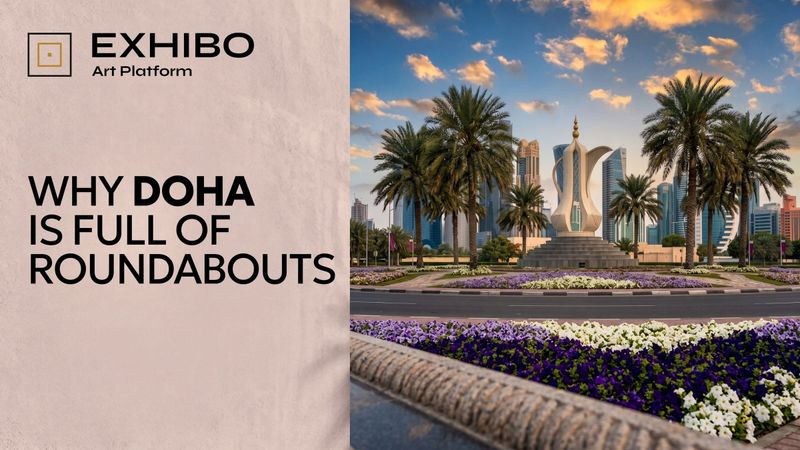
Why Doha Is Full of Roundabouts
An old circle at a crossroads, sharpened by British road engineering, became the way an Arabian city found its way and remembered itself — and it took the bulldozers to reveal it.
In a city where a landmark was more useful than an address, Doha's roundabouts became its navigation, its landscaping and its national image all at once. Now they're being torn out for signalled junctions — and the affection for them arrived, as one scholar put it, only posthumously.
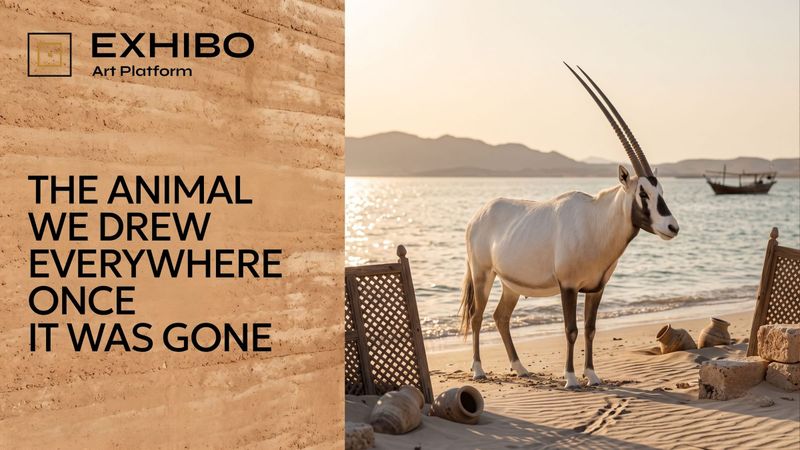
The Animal We Drew Everywhere Once It Was Gone
From Neolithic rock to airline tailfin — how the Arabian oryx vanished from the desert, came back from nine animals, and multiplied everywhere as a symbol in the very decades it was gone.
The last wild Arabian oryx was shot in 1972. By then it was already a picture — carved on Bronze Age tombs, mistaken by the ancients for a unicorn, praised by poets as the eyes of the beloved. This is the story of an animal that went extinct in the wild and was brought back from nine survivors, and of the strange gap between the creature and the emblem it became: fast, sharp and ascendant on a nation's tailfin, while the animal itself survives by standing still in the shade.
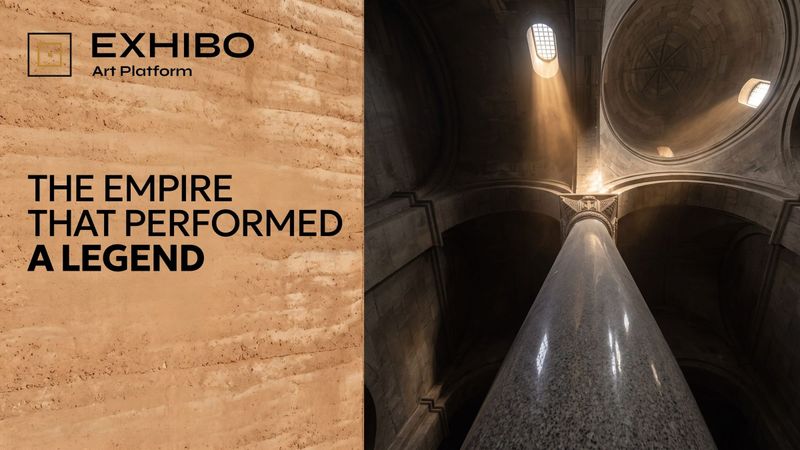
Seventy Thousand Solomons: The Empire That Performed a Legend
A demon catalogue in the conqueror's library, a sixteenth-century text where kingship is an office held seventy thousand times, and the columns a sultan dragged across three provinces to prove he held it.
Mehmed II kept a Greek catalogue of demons in his library at Topkapı. Seventy years later a sultan named for a prophet was rebuilding the walls of Jerusalem and hauling Roman columns out of Egypt and the Lebanon into a mosque above the Golden Horn. In between, Ottoman writers turned Solomon from a warning into a job — and the empire applied for it in stone.