
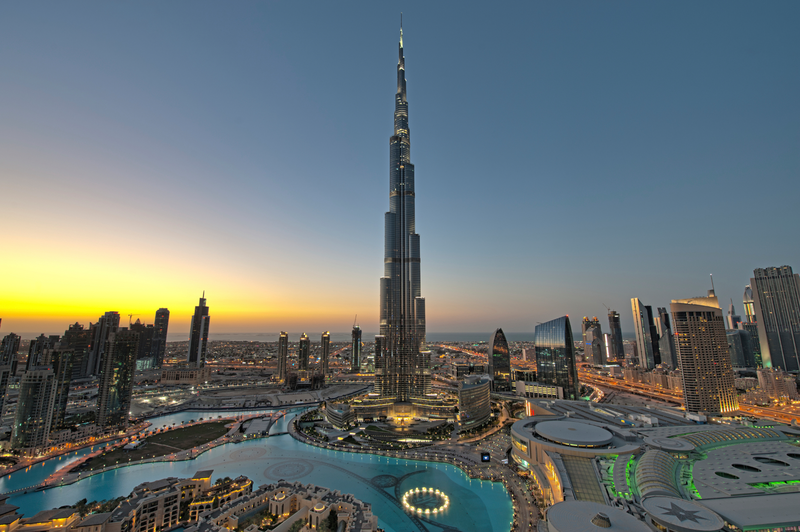
Burj Khalifa is the tallest building in the world — 828 metres, 163 floors — and the centrepiece of Downtown Dubai. Designed by Adrian Smith at Skidmore, Owings & Merrill, engineered by Bill Baker, developed by Emaar Properties, opened 4 January 2010. Its Y-shaped plan steps back twenty-six times in a spiral as it rises. Below it sit the Dubai Fountain, Dubai Mall, Dubai Opera and Burj Park.
The southeast face, overlooking Burj Lake, carries one of the largest architectural lighting installations ever built. LED strips run vertically along the tower's stainless steel fins across roughly 33,000 square metres, every node individually addressable — turning the full 828-metre elevation into a screen that displays animation, text and colour, visible from more than ten kilometres across the city.
The system has been rebuilt several times. A media facade was first installed in the mid-2010s as a temporary rig for special events. In 2017 Emaar commissioned lighting consultancy CD+M to design a permanent replacement, installed by 3S Lighting and SACO on custom clips rather than screws or adhesive, so nothing permanently marks the building. CD+M returned in 2022 for an architectural lighting upgrade focused on keeping the tower legible against an increasingly bright skyline.
The facade is illuminated nightly and free to watch from any public space in Downtown Dubai. Programmed shows typically begin around 19:45 and repeat through the evening, synchronised with the Dubai Fountain — hourly on weekdays, roughly every 30 minutes Thursday to Saturday, until about 22:45. Timings shift during Ramadan, public holidays and special events. The tower is also lit for national days and global causes, and anchors an annual New Year's Eve fireworks, laser and drone show.
Inside, the tower is private — residences, offices and the Armani Hotel — apart from the ticketed At the Top observation decks on levels 124, 125, 148 and 152–154 (from AED 189, daily 10:00–20:00, entry via the Lower Ground floor of Dubai Mall) and restaurants including At.mosphere on level 122.
Best free viewing: the Dubai Mall waterfront promenade for the head-on view, the Souk Al Bahar bridge for photography, Burj Park for space.
Note on figures: LED counts published by contractors and press vary widely — from around 51,000 pixels to over 1.2 million individual diodes, depending on whether nodes, pixels or diodes are counted and which generation of the system is described. Surface area is consistently around 33,000 m².
Exhibo editorial
Nothing on the tallest building in the world is allowed to leave a permanent mark on it, so the lighting that half of Dubai watches every night hangs on custom brackets, gripping the stainless steel fins that run up the elevation. A rope-access team put every one of them there by hand, working down the face of the tower in a city that produces wind, heat and sandstorms in rotation. In daylight you would never know. The people living inside had no idea the lights were on their building.
The operation behind the show is charmingly small. A media file plays off a laptop into a server, and the server tells the pixels what to do. Every sequence gets tested indoors on a monitor first — if it looks right there, it will look right on the tower — which spares the technicians from rehearsing at night in front of the entire city. You picture a control room the size of a stadium. It's a desk.
There's something lovely in that inversion. The building is permanent: half a million tonnes of it, settled onto its foundation by three centimetres and staying exactly there. What the building says is not. The lighting has been pulled out and replaced more than once in fifteen years, each time for a different reason — first for spectacle, then to make it permanent, then simply to stay legible, because the skyline filled in around it and being the tallest stopped being enough to be the most visible.
So the tower gets rewritten. Not the structure. The message.
And here's the part worth knowing before you go: the piece of the Burj Khalifa that belongs to everyone is the piece nobody needs a ticket for. Everything above the lobby is someone's apartment, someone's office, or a queue. The surface is free. It's the largest surface in the country, and every evening it shows whatever the city has decided is worth looking at tonight.
Bring someone. Get there before the light goes, so you see it both ways.
How to find it
You do not go inside. The facade is best seen from across the water.
Dubai Mall waterfront promenade — the head-on view across Burj Lake with the fountains in the foreground. Exit Dubai Mall at Ground level toward the fountain terrace. Busiest spot; arrive 20–30 minutes before a show.
Souk Al Bahar bridge — cross the lake on the pedestrian bridge from Dubai Mall. Best photographic angle, centred on the tower. The bridge itself compresses badly 10–15 minutes before each show.
Burj Park — the open lawn on the north side of the lake. Most space, easiest with children or strollers, slightly oblique angle.
Sheikh Mohammed bin Rashid Boulevard — street-level view of the full height from base to spire, without the lake in frame.
Avoiding the crush: most people exit Dubai Mall through the central doors beneath the Apple store. Use the Lower Ground floor exit at the Fashion Avenue end instead — far less crowded, and well positioned for both tower and fountains.
By metro: Burj Khalifa/Dubai Mall station, Red Line, then the air-conditioned link bridge — about 800 metres, 10–15 minutes on foot.
Timing: arrive before dusk to see the tower in both states.
Similar places
All places
News by Exhibo
Editorial coverage on Exhibo
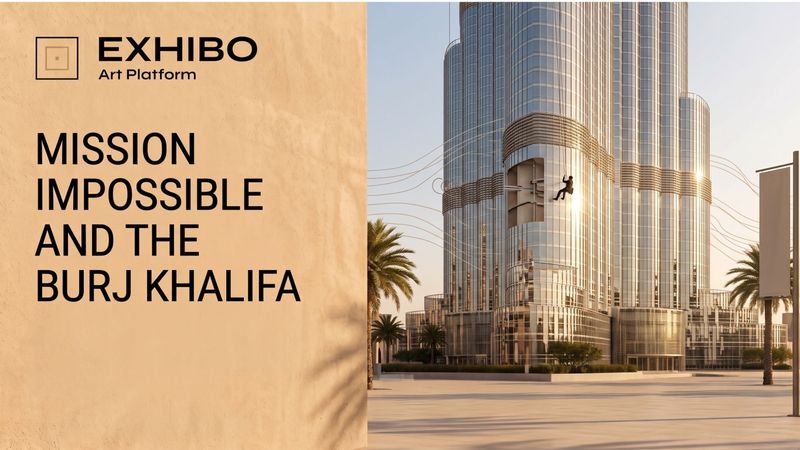
Mission Impossible and the Burj Khalifa
What the world's most famous building stunt tells you about everything it was filmed on
A film crew drilled into the world's tallest building to hang a man off the side of it. Behind that decision sits wind physics, a hundred-year-old cooling technology, a height race Dubai has quietly stepped away from, and an art scene older than the tower.
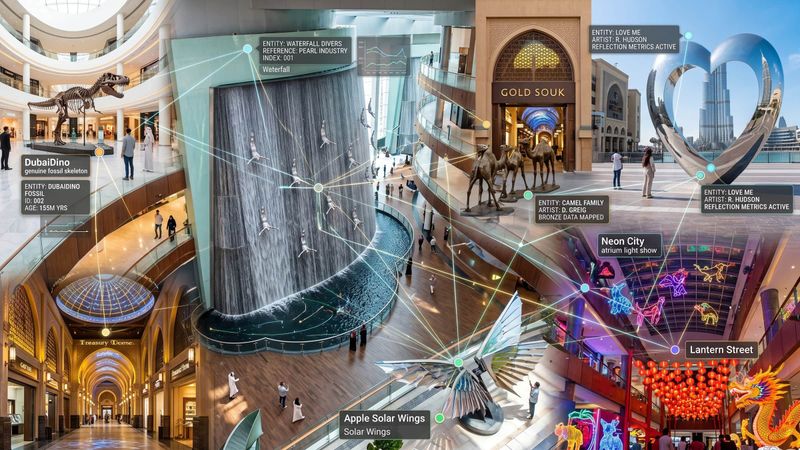
Art Installations in The Dubai Mall: A Complete Guide to Every Sculpture and Feature
From a four-storey waterfall of pearl divers to a real 155-million-year-old dinosaur — a guide to every permanent artwork inside the world's most visited building.
Every permanent sculpture, kinetic installation and immersive district in the mall — who made them, what they mean and how to see them all in two hours.
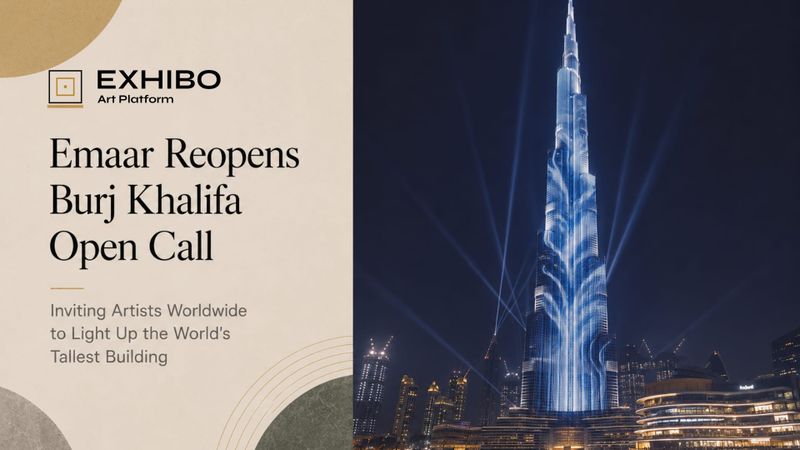
Emaar Reopens Burj Khalifa Open Call, Inviting Artists Worldwide to Light Up the World's Tallest Building
This year's projection design competition drops the AED 100,000 cash prize of 2025 in favour of a longer, fully global submission window — and rules out any AI-generated entries.
Emaar has reopened its Burj Khalifa Open Call, inviting artists, designers and creatives from the UAE and around the world to submit original audio-visual projections for a chance to see their work displayed on the facade of the world's tallest building. Submissions close on 18 August 2026.