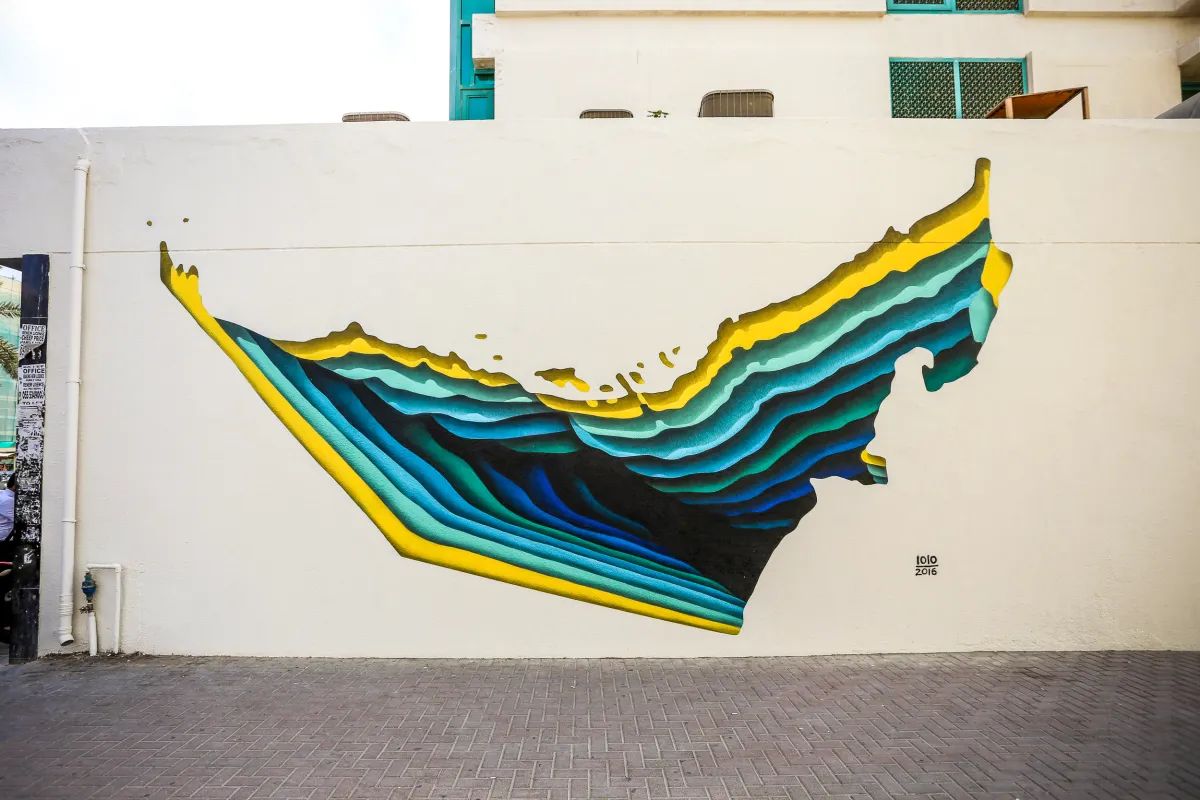
This mural on 2nd of December Street in Satwa is by the German artist known as 1010, painted in 2016 for the first phase of the Dubai Street Museum, the Brand Dubai and Dubai Municipality project curated by Rom Levy of StreetArtNews and Sanaz Askari of MINE Gallery.
1010, who works anonymously and is associated with the Hamburg scene, is internationally known for a single, striking illusion: concentric bands of graded colour, painted with hard edges in nested organic shapes, which read as an impossibly deep cavity opening into the surface. The effect turns a flat facade into what appears to be a portal or abyss, and depends on precise control of colour value and edge to sustain the depth from a distance.
Among the sixteen murals of the project's first phase — dominated by figurative heritage imagery — his contribution is purely optical, offering an abstract counterpoint on a residential wall in one of the city's oldest neighbourhoods.
Exhibo editorial
Everything else on this street is a picture of something. 1010 painted a hole.
It shouldn't work — concentric bands of colour on a flat wall — but the edges are so exact that your eye refuses the evidence and insists there's a cavity there, metres deep, opening into the building. People walk up and put a hand out to check. That's the whole trick and the whole pleasure of it, and on a street devoted to falcons, abras and founding fathers, the wall that simply appears to have been punctured is a welcome piece of nonsense.
How to find it
The 1010 mural is on a wall along 2nd of December Street (formerly Al Diyafah Street) in Satwa. Look for the abstract piece of nested, graded colour bands — the depth illusion is strongest viewed straight on from a few metres back, and flattens noticeably if you approach at an angle.
Similar places
All places
News by Exhibo
Editorial coverage on Exhibo
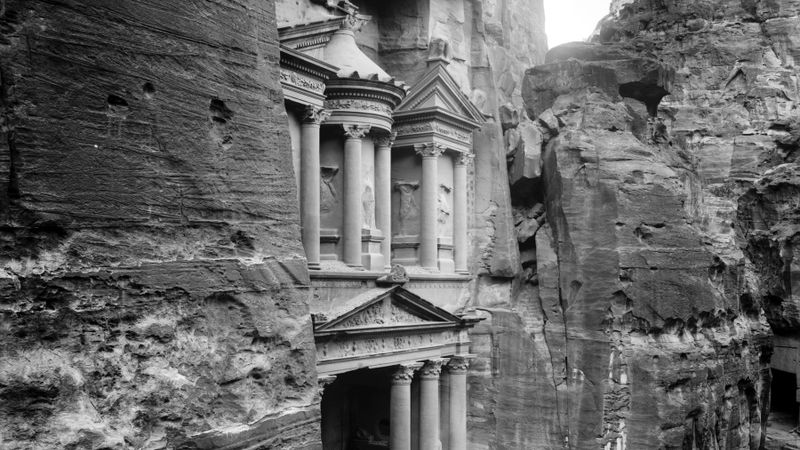
Filmed, but Not Recorded: The Arab World’s Missing Film Locations
Wikidata knows Gladiator was filmed in Morocco. It doesn’t know where.
Ouarzazate is the second most filmed place in the Middle East and North Africa, yet 25 of its 27 productions are recorded only in Wikipedia prose. We compared filming records worldwide and found that in the Arab world, Wikidata usually knows the country but not the place.
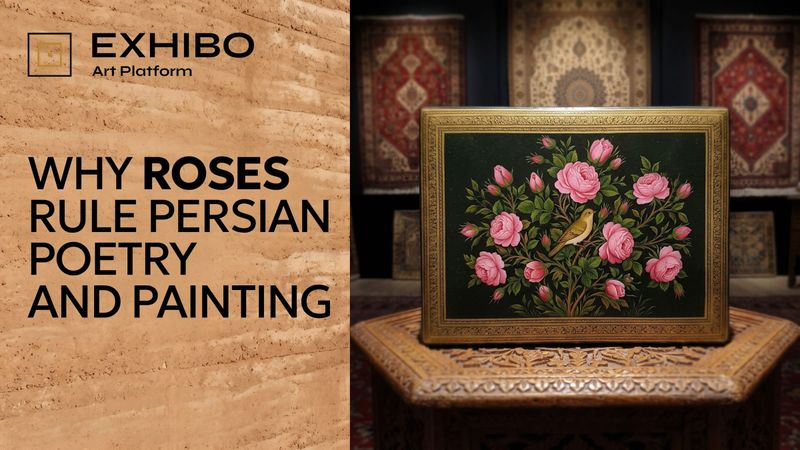
The Flower That Was Never Only Beautiful
The rose rules Persian poetry and painting — but under the sweetness sits a thorn, a bleeding bird, and a national emblem quietly assembled out of Chinese, European and Persian parts. A history of gol o bolbol, from a medieval still to a Dubai gallery.
Gol o bolbol — the rose and the nightingale — is among the most beautiful images in a thousand years of Persian art, and in modern Persian it also means sweet, empty talk. Under the tile, the picture is darker: a bird singing in blood for a flower that will not answer and will not last.
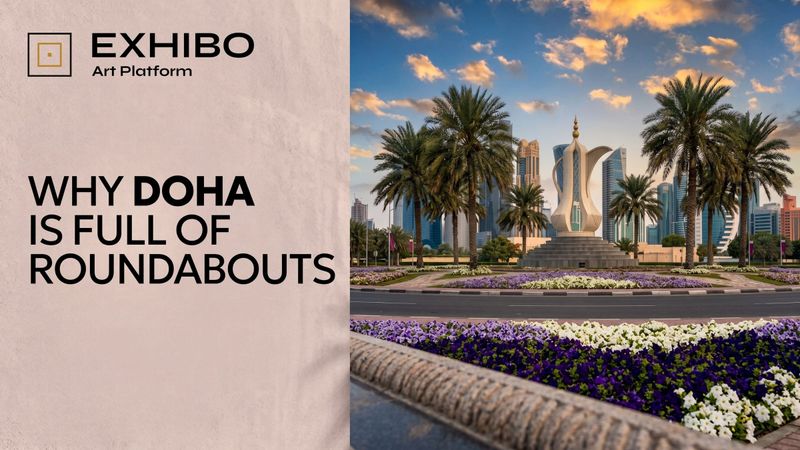
Why Doha Is Full of Roundabouts
An old circle at a crossroads, sharpened by British road engineering, became the way an Arabian city found its way and remembered itself — and it took the bulldozers to reveal it.
In a city where a landmark was more useful than an address, Doha's roundabouts became its navigation, its landscaping and its national image all at once. Now they're being torn out for signalled junctions — and the affection for them arrived, as one scholar put it, only posthumously.