
Dubai · United Arab Emirates
Art Installations in The Dubai Mall: A Complete Guide to Every Sculpture and Feature
From a four-storey waterfall of pearl divers to a real 155-million-year-old dinosaur — a guide to every permanent artwork inside the world's most visited building.
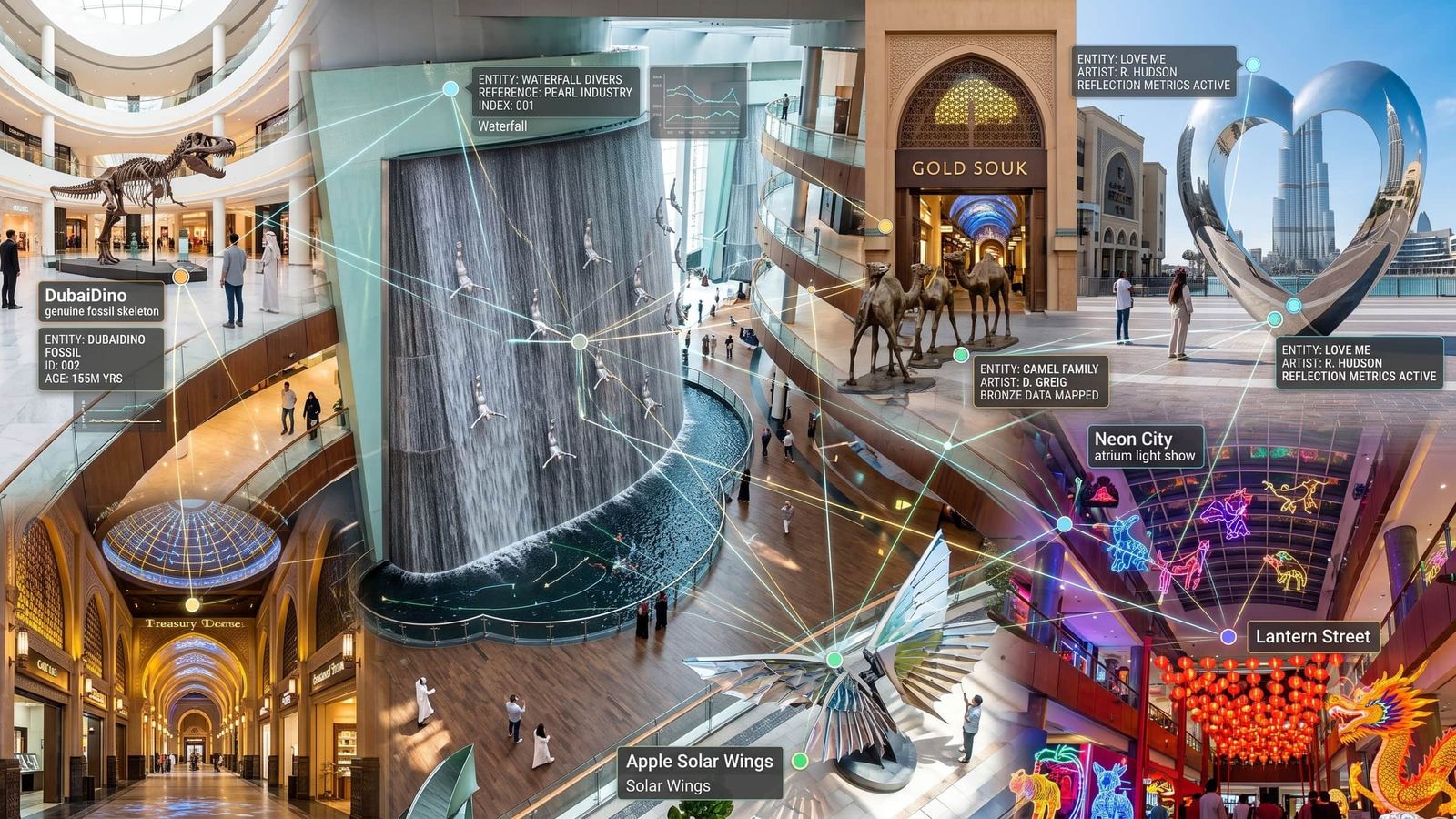
The Dubai Mall is the most visited place on earth — it drew 111 million visitors in 2024 — but beyond the 1,200-plus shops, it doubles as one of the largest free public-art spaces in the city. From a four-storey indoor waterfall of diving figures to a kinetic falcon-inspired screen on the Apple store, a real 155-million-year-old dinosaur and a Chinese-zodiac light show, the mall is full of permanent installations that most visitors walk straight past on the way to the next store.
That isn't an accident. Emaar, the developer behind the mall and the Burj Khalifa, runs an ongoing public-art programme (branded Art Emaar) across Downtown Dubai, commissioning and collecting work from international and regional artists — the same impulse that put Jorge Marín's wings in Burj Plaza and Richard Hudson's mirror heart on the promenade. Inside the mall, the art splits roughly into three families: monumental sculptures that double as photo landmarks, kinetic and light installations engineered into the architecture, and immersive themed districts designed as walk-through environments. Several of the pieces are, by their makers' own claims, among the largest of their kind in the world.
This guide covers every major permanent art installation, sculpture and immersive feature inside and around The Dubai Mall — what each one is, who made it, the details worth knowing, and exactly where to find it. Almost all are free to see. At the end, there's a note on the temporary and seasonal works that rotate through the mall, so you know what's permanent and what isn't.
A quick orientation. The mall's art clusters in three zones. Near the Dubai Ice Rink you'll find the Waterfall, DubaiDino and the Chinatown district. The Gold Souk is a single themed route with the camels, the Arabian stallion and the Treasury Dome. And on the fountain-facing side — partly outdoors — sit LOVE ME, Wings of Mexico and the Apple Solar Wings. Plan your walk around those three clusters and you'll see almost everything without doubling back.
Quick reference: art and installations in The Dubai Mall
| Installation | Type | Artist / Studio | Where |
|---|---|---|---|
| The Waterfall (Human Waterfall) | Sculptural water feature | DP Architects | Near the ice rink, spans 4 floors |
| LOVE ME | Mirror sculpture | Richard Hudson | Waterfront Promenade (outside) |
| Wings of Mexico | Bronze sculpture | Jorge Marín | Burj Plaza (outside) |
| Apple Solar Wings | Kinetic installation | Foster + Partners | Apple store terrace |
| The Fashion Catwalk | Kinetic LED installation | Square Peg Design | Fashion Avenue atrium |
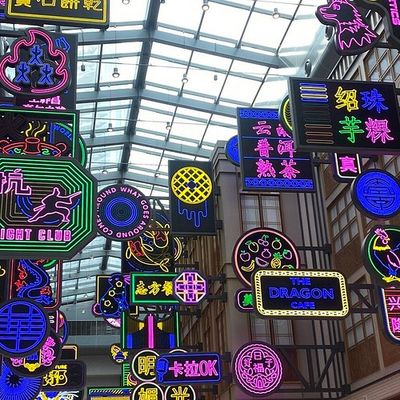
| Neon City light show | Media-art installation | Jason Bruges Studio | Chinatown atrium |
| Camel Family | Bronze sculpture | Donald Greig | Gold Souk, north entrance |
| Arabian Stallion | Bronze sculpture | — | Gold Souk, south entrance |
| Treasury Dome | Projection ceiling | Northpoint architects | Gold Souk, centre |
| DubaiDino | Fossil skeleton | (natural) | Near the ice rink |
| Chinatown | Immersive design district | Kokaistudios | First floor, opp. ice rink |
The headline installations
The Waterfall (Human Waterfall)
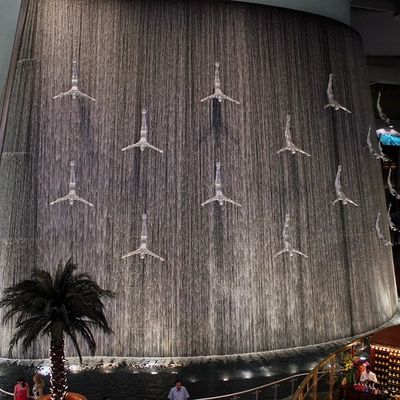
The mall's signature artwork, and one of the most photographed spots in all of Downtown Dubai. The Waterfall runs the full height of the building across four levels: two curved cylindrical walls, each about 24 metres tall and roughly 30 metres across, over which recycled water pours in a continuous, glassy sheet. Set into the water are life-size fibreglass figures of divers, arms swept back, caught mid-leap and arranged so they seem to plunge downward in unison — the flow is engineered as an optical illusion, so that if you stand and watch, it's the divers who appear to move while the water holds still.
The subject is deliberate, and it's the reason the piece matters beyond the photo op. The figures are pearl divers, and pearl diving was the main livelihood of this coast before oil — the industry on which both Dubai and Abu Dhabi were originally built, men going over the side of a boat on a single breath to bring up oysters from the Gulf floor. Placing that history at the centre of the world's largest shopping mall is a pointed act of memory: a city synonymous with the future, choosing to fall, floor after floor, back toward the sea it came from. Designed by Singapore's DP Architects (who also designed the mall itself), it opened in early 2009, months after the mall.
Find it on the south-eastern side near the Dubai Ice Rink. The move that most visitors miss: approach from the lowest level first, stand at the base and let the scale and sound land, then ride up and look down on the divers from above — the same courage read from the opposite angle. Surrounding cafés are positioned to give you the view.
DubaiDino
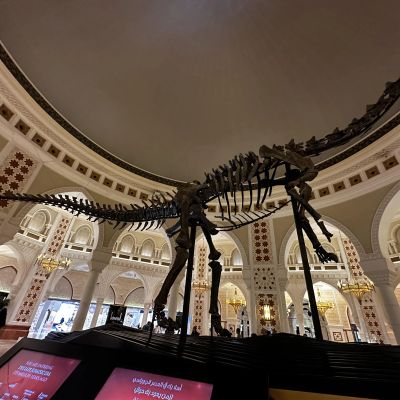
Not art in the strict sense, but unmissable, and one of the mall's biggest draws: a genuine fossil skeleton of a Diplodocus longus, a long-necked, whip-tailed sauropod that lived in the late Jurassic, around 155 million years ago. It measures about 24.4 metres from nose to tail-tip, stands roughly 7.6 metres tall, and in life would have weighed about as much as five elephants.
What makes it genuinely rare is its completeness. The remains were discovered in a sleeping position in 2008 at the Dana Quarry in Wyoming, and around 90 per cent of the bones are original and intact — extraordinary for this species, where a typical mounted skeleton contains only about 30 per cent real bone. It's described as the first sauropod skeleton of actual fossil bone mounted upright in a standing pose, and even the double-beamed tail bones that give the Diplodocus its name survive, some broken in ways that hint at a predator's bite or a tail fight 155 million years ago. Unveiled in 2014, it has moved around the mall over the years — long the centrepiece of the Grand Atrium, more recently relocated near the ice rink. In 2019 it was even briefly put up for auction with a starting price of over Dh14 million, but it stayed. Free to view; read the on-site panels for the Wyoming excavation story.
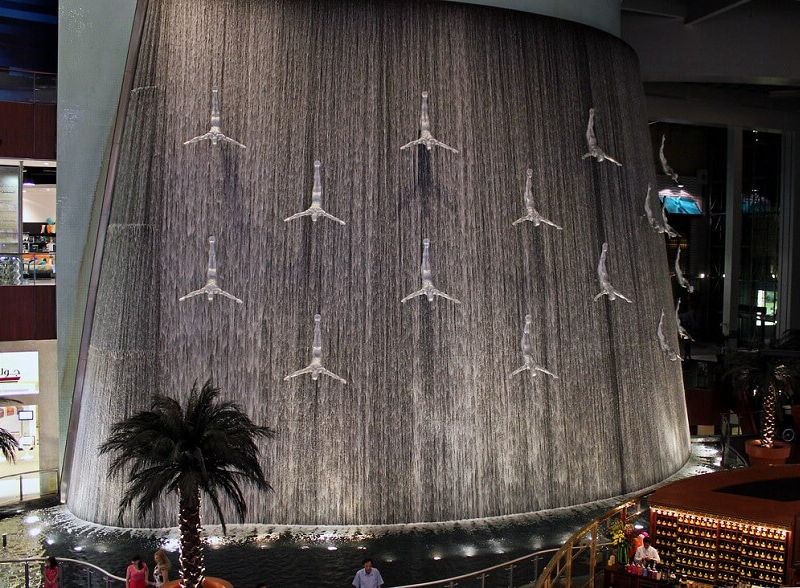
The Waterfall (Human Waterfall)
A four-storey indoor cascade of diving figures — Dubai's pearl-diving past, cast in fibreglass and falling water.
Approach it from the lower level first — stand at the base and let the scale and the sound of the water land — then ride up and look down on the divers from above, reading the same courage from the opposite angle. The surrounding cafés and restaurant terraces are built to give you the view; it's a natural place to pause mid-mall. Free, always on, and busiest on weekends and evenings. It sits near Fashion Avenue and the waterfront promenade, a short walk from the Dubai Aquarium and the Dubai Fountain outside.
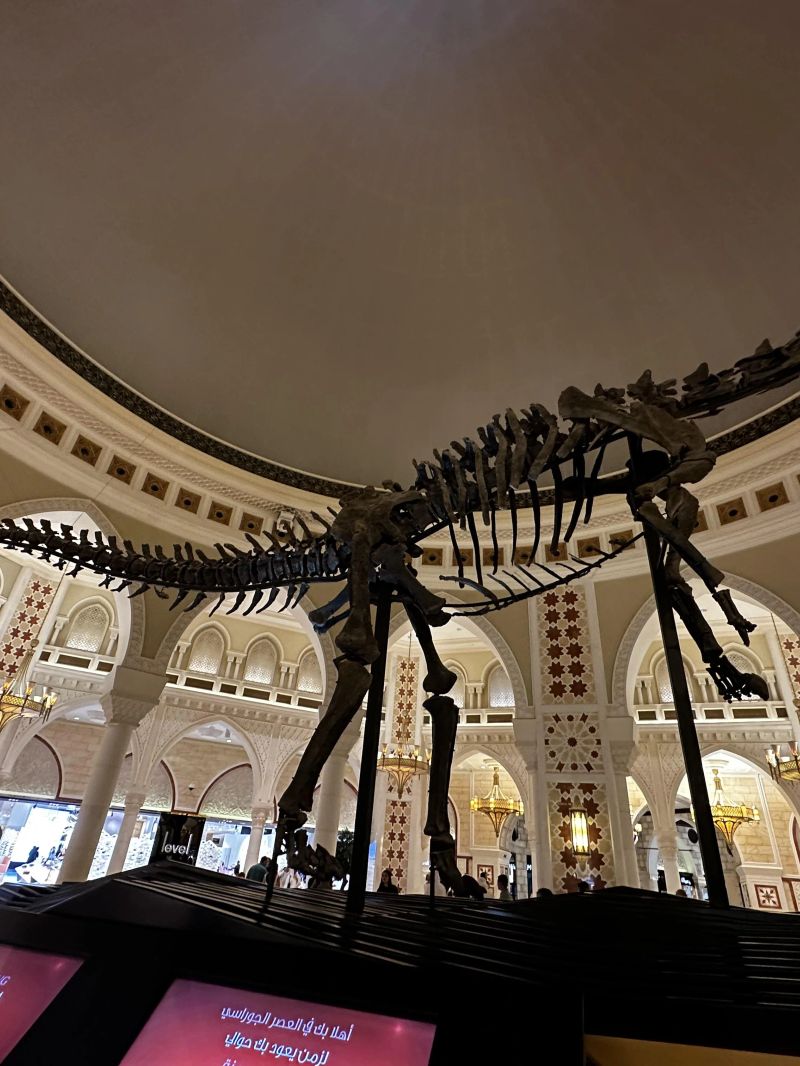
DubaiDino
A real 155-million-year-old Diplodocus skeleton, 24 metres long, standing in the middle of the mall.
Worth pausing on for what it actually is: a real animal that walked the earth before the Atlantic Ocean had finished opening, standing casually between shopfronts. Read the on-site panels for the Wyoming excavation story and look for the tail damage. It's free, and its position has changed over the years — if it's not in the Grand Atrium, check near the Dubai Ice Rink. (In 2019 it was even briefly put up for auction, but it stayed.)
Sculptures in and around The Dubai Mall
LOVE ME by Richard Hudson
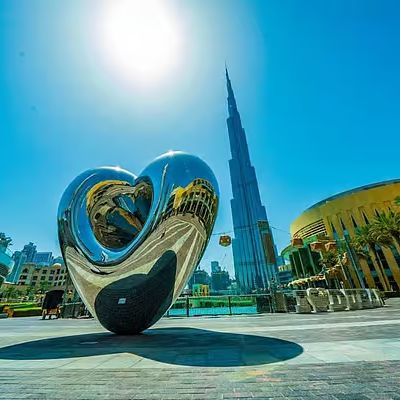
A monumental heart in mirror-polished stainless steel by British sculptor Richard Hudson, standing on the mall's Waterfront Promenade. It's no ordinary heart: the form is organic and asymmetric — swelling and voluptuous on one face, scooped and hollowed on the other — and finished to a flawless liquid-mirror sheen. At five metres tall, roughly as wide, 3.8 metres deep and weighing over 7,000 kilograms, it holds the plaza at real architectural scale rather than as a photo prop.
Its placement is the whole point. LOVE ME sits directly on the axis of the Burj Khalifa, at the opposite end of the promenade from the tower, and its curved mirror surface catches the world's tallest building, the sky and the crowd all at once — so the viewer, the fountain and the skyline fold into the sculpture in a single reflection, a quality critics have compared to Anish Kapoor's Cloud Gate in Chicago. Hudson, a Yorkshire-born, Madrid-based sculptor whose abstract forms are often inspired by the female body, describes the heart as an all-encompassing symbol of love and peace, "an icon image that crosses all boundaries"; it was the first of his public works commissioned in the region. Best at golden hour and after dark, when the Burj Khalifa's LED shows slide across the steel — stand close and off-centre to wrap the whole of Downtown onto the curve.
Wings of Mexico by Jorge Marín
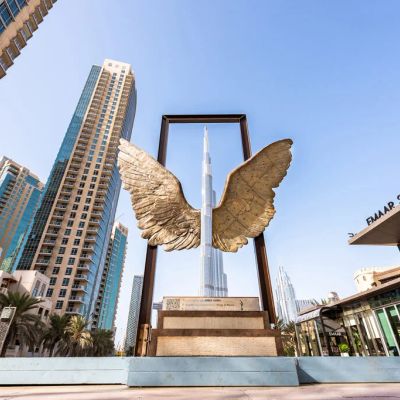
Just outside the mall in Burj Plaza, this bronze pair of angel wings by Mexican sculptor Jorge Marín is one of Dubai's most photographed artworks. Mounted at human height on a stepped platform, it's designed to be stepped into rather than only observed: climb the steps, stand between the wings, and appear "winged" yourself with the Burj Khalifa rising behind you. Up close it rewards a second look for the fine detailing of the feathers in the cast bronze.
It isn't unique to Dubai. The wings belong to Marín's Wings of the City project, launched in 2010, in which he places identical human-scale bronze wings as permanent gifts in public squares worldwide — the first went to Tel Aviv in 2012, followed by Mexico City, Berlin, Los Angeles, Québec and Singapore — the idea being a network of shared symbols linking cities through one gesture. Across Marín's wider work the wing is a signature motif for the human dream of flight and the wish to move beyond physical limits. Expect a queue; come early morning or late evening for the light and the shortest wait.
Camel Family by Donald Greig
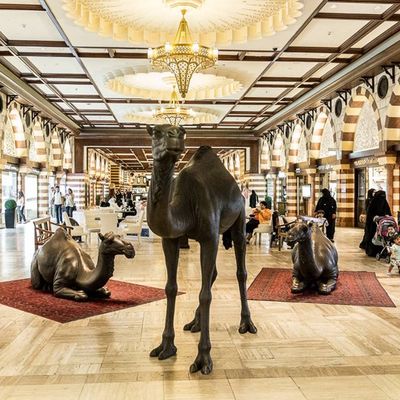
At the north entrance of the Gold Souk, three bronze camels rest beneath a ceiling painted like a starry night sky. Sculpted by Donald Greig — a bronze sculptor known for finely detailed, research-led animal work — the group was built the slow, traditional way: modelled in clay over a polystyrene armature, moulded in silicone, cast in wax, dipped in ceramic and filled with molten bronze by the lost-wax method, over roughly eight months. It's precisely observed: the adult stands about 3 metres tall, the calf around 1.9 metres, and a resting camel about 1.3 metres, together some 800 kilograms of bronze. The camel is the enduring symbol of Gulf heritage — endurance, patience, survival in the desert — and here the group sets the theme for the souk beyond: the journey of the caravan traders who once crossed the desert to trade gold. Easy to walk past on the way to the shops, which is exactly why it rewards a proper look at the three different postures and the modelling.
Arabian Stallion
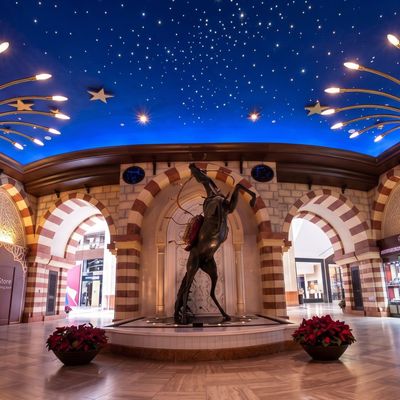
The counterpart to the camels: a bronze Arabian horse guarding the Gold Souk's south entrance. The two sculptures deliberately bookend the souk's "journey of the caravan traders" — patient camels at one end, a proud, spirited stallion at the other. The Arabian horse is one of the region's most storied symbols, prized for centuries for its stamina, spirit and beauty and woven deep into Gulf identity. Cast in bronze among the souk's gold and marble detailing, it's best appreciated as one half of a pair: walk the souk from the camels at the north entrance, through the Treasury Dome, to the stallion at the south, and the heritage narrative the designers built reads in full.
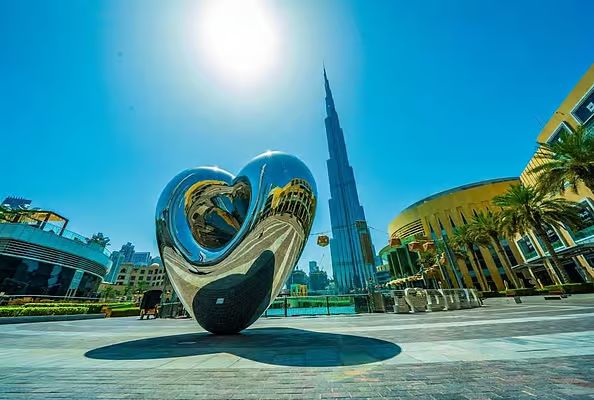
LOVE ME
Richard Hudson's five-metre mirror-polished heart, aligned so the Burj Khalifa lands on its surface.
Come at the two ends of the day: at golden hour the polished steel takes on the warmth of the light, and after dark, when the Burj Khalifa runs its LED shows, the tower's colours slide across the heart's surface. Stand close and off-centre and you'll find the whole of Downtown wrapped onto the curve — Burj Khalifa, fountain, sky, and you — in one frame. It's free, outdoors, and on the promenade side of the mall, an easy pairing with the Dubai Fountain show and Wings of Mexico nearby.
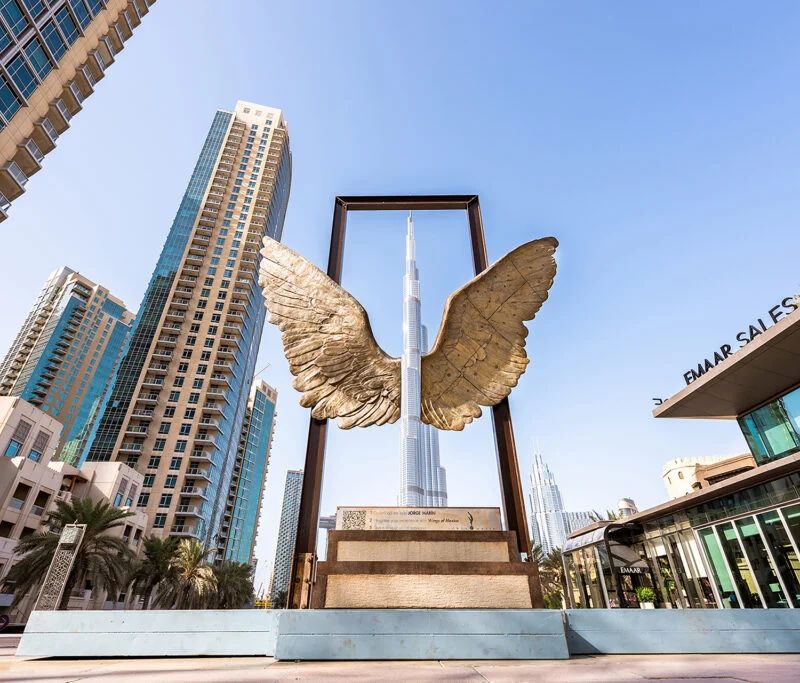
Wings of Mexico (Alas de México), Dubai
Jorge Marín's monumental bronze angel wings — stand between them and the Burj Khalifa frames the shot.
There's almost always a queue, so come early morning or late at night and bring some patience — regulars reckon on arriving around 45 minutes before sunset if that's the light you want. The classic frame is head-on, standing between the wings with the Burj Khalifa centred behind you. But don't stop there: take a few steps toward the tower and shoot from the side, and the composition changes completely — wings to one edge, the Burj filling the sky. Sunrise gives the softest light and the shortest wait; after dark, the tower lights up behind the bronze and the whole thing reads differently again. It's free and open around the clock, and it sits within a few minutes' walk of the Dubai Fountain, Burj Park and Dubai Opera if you're building an evening around it.
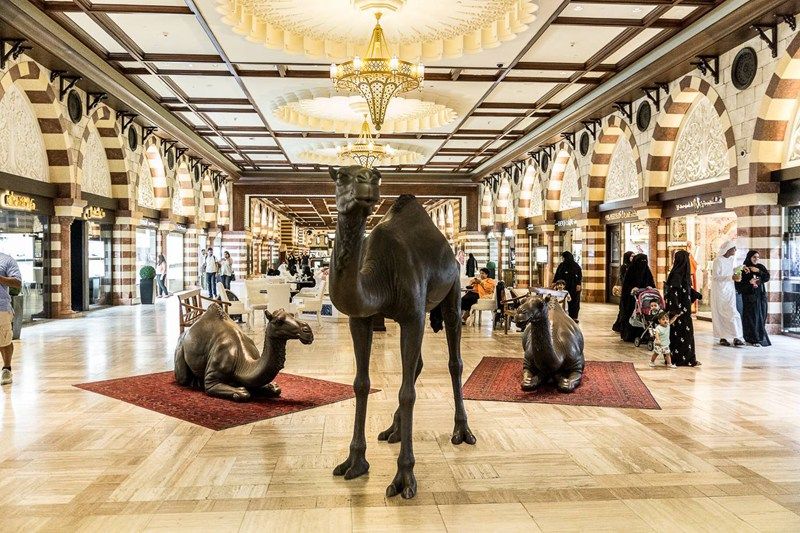
Camel Family
Three life-size bronze camels resting under a starry dome — Donald Greig's welcome to the mall's Gold Souk.
It's easy to walk straight past these on the way to the shops — which is exactly why they reward a proper look. Note the difference in the three animals' postures and the detail in the modelling; this is serious figurative bronze, not mall dressing. Part of a themed sequence in the Gold Souk that also includes an Arabian stallion at the south entrance and other heritage motifs — a falcon, a gold palm tree — worth tracing as a small trail through the souk.
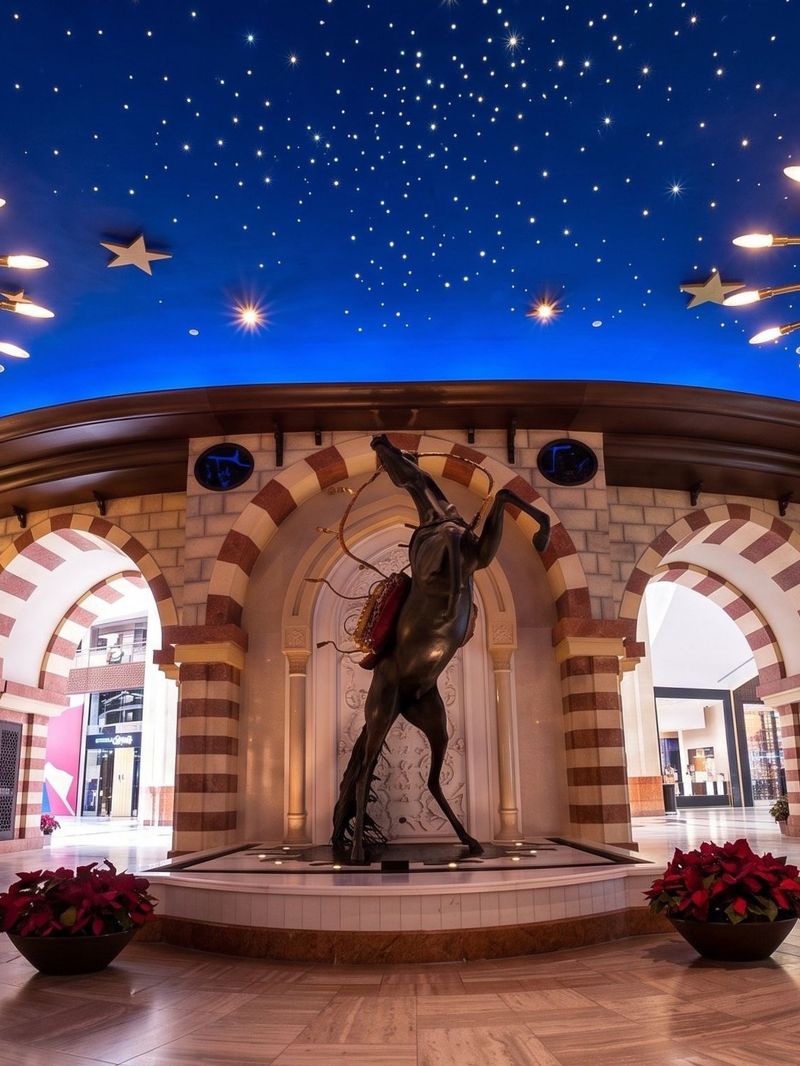
Arabian Stallion, Gold Souk
A bronze Arabian horse guarding the south entrance of the Gold Souk — heritage counterpart to the camels up north.
Best appreciated as one half of a pair: walk the Gold Souk from the camels at the north entrance through the Treasury Dome to the stallion at the south, and the heritage narrative the designers built — desert caravan to treasury — reads in full. A quick but rewarding trail through the souk.
Kinetic and light installations
Apple Solar Wings by Foster + Partners
The Apple store's terrace, facing the Dubai Fountain, is screened by what Foster + Partners calls one of the world's largest kinetic art installations: the Solar Wings, a contemporary reinterpretation of the traditional Arabic mashrabiya lattice screen. Built entirely from carbon fibre — a net of 340 slender rods — there are 18 wings in total, each around 11 metres tall and weighing roughly a tonne, and they move: closing to shade the terrace by day and opening in the evening, taking about a minute each way. The motion was modelled on a falcon spreading its wings. As the sun shifts, the lattice casts crosshatched shadows deep into the store. Come around dusk to catch the wings opening.
The Fashion Catwalk by Square Peg Design
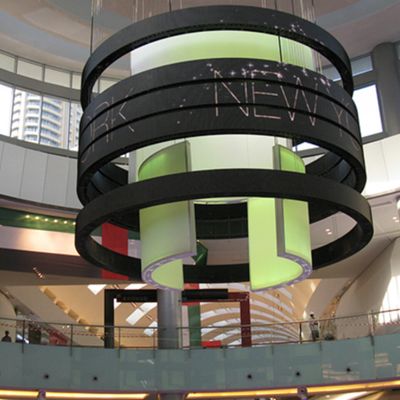
Above the Fashion Avenue atrium hangs a kinetic media installation of five illuminated rings, designed by Square Peg Design. They can be choreographed with music and video — playing as one unbroken cylindrical screen or as five separate displays at different levels — functioning at once as a chandelier, a landmark and an animated billboard, backed by eight curved LED screens around the atrium. A fashion runway literally rises from the atrium floor for shows. Best seen when a sequence is running rather than idling.
Neon City light installation by Jason Bruges Studio
At the heart of the mall's Chinatown, the three-storey skylit Neon City atrium is animated by a multidimensional light installation from London's Jason Bruges Studio, known for work at the meeting point of art, technology and architecture. It runs across LED screens depicting the twelve animals of the Chinese zodiac, choreographed into a timed light show that turns the atrium into a performance. Come after dark and give it a few minutes to run its full cycle; view it from the lower level looking up.
Treasury Dome, Gold Souk by Northpoint architects
The Gold Souk — billed as the world's largest indoor gold souk — is designed as a journey that culminates at the Treasury Dome, a roughly 25-by-13-metre atrium crowned by a projection ceiling running ever-changing multimedia shows that shift with the time of day. Designed by Northpoint architects, it's the climactic space of the souk's themed route. Look up rather than walking straight under it.
Apple Store Solar Wings
A Foster + Partners kinetic mashrabiya of 340 carbon-fibre rods that open at dusk toward the Burj Khalifa.
Time a visit for the transition around dusk, when the wings shift from closed to open — that's the piece actually performing, rather than sitting still. From the terrace you get one of the best free vantage points on the Dubai Fountain and the Burj Khalifa, framed through the carbon-fibre lattice. Inside, notice how the crosshatched shadows move across the stone through the day: the mashrabiya idea, doing its original job in a new material.
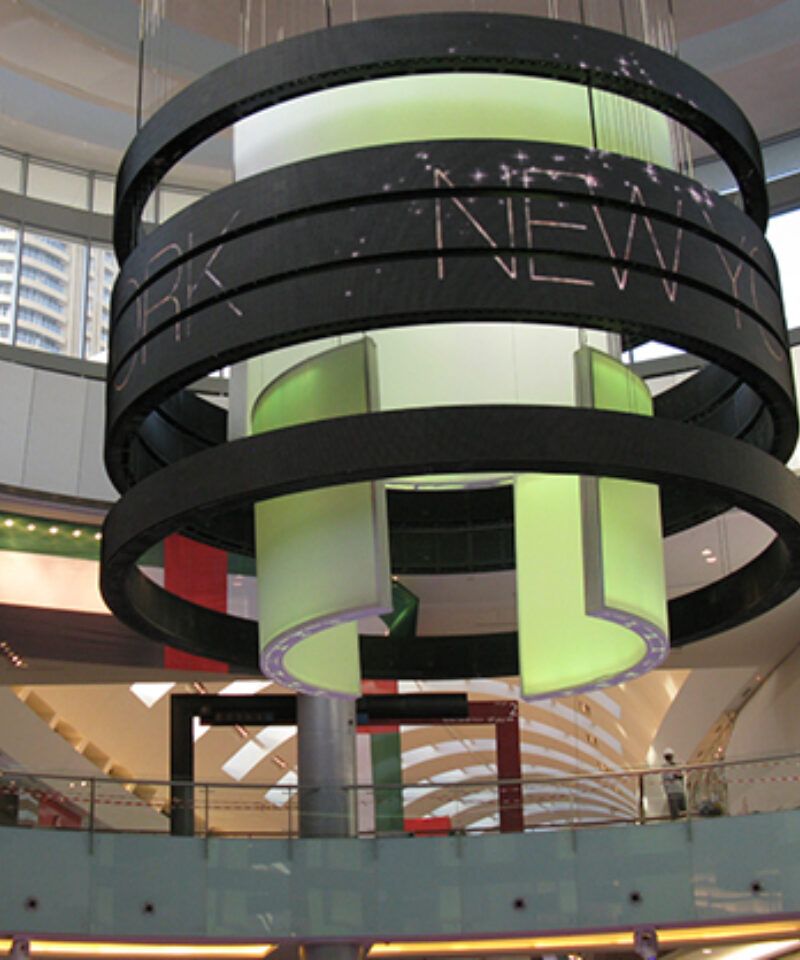
The Fashion Catwalk
A kinetic LED "chandelier" of five choreographed rings above the Fashion Avenue atrium — with a runway that rises from the floor.
Catch it when the rings are running a sequence rather than idling — they choreograph to music and video, and the effect shifts constantly. Best read from the atrium floor looking up through the stacked rings, or from a balcony across for the full cylinder. If there's an event or fashion show on, the runway rising from the floor is the piece at full theatre.
Neon City Light Installation
A three-storey kinetic light show of the Chinese zodiac by Jason Bruges Studio, at the heart of Chinatown.
Come in the evening and give it a few minutes rather than a single photo — it's a timed light sequence, so what you see shifts. Stand on the lower level and look up through the three-storey atrium for the full effect of the zodiac screens against the skylight. It sits along the Neon City stretch of Chinatown, on the first floor of the mall.
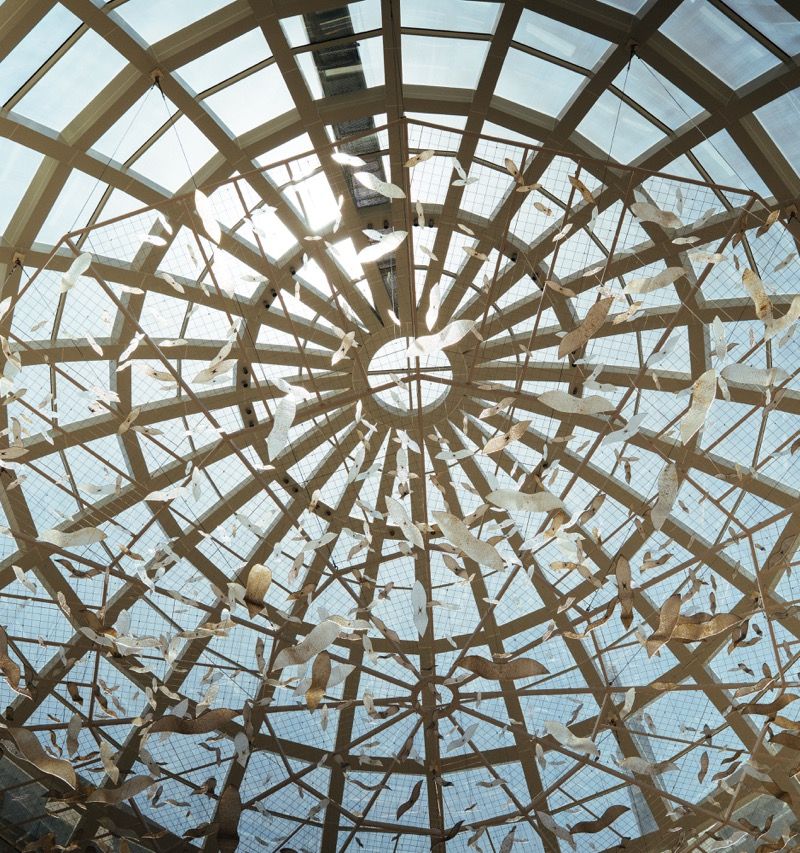
Treasury Dome, Gold Souk
A 25-metre projection dome that crowns the world's largest indoor gold souk with ever-changing multimedia.
Easy to walk under without looking up — which is the mistake. Pause beneath the dome and watch the projection cycle; the imagery changes through the day. It's the payoff at the heart of the Gold Souk's "journey" design, and pairs naturally with the bronze Camel Family at the north entrance and the Arabian stallion at the south, if you walk the souk end to end.
Immersive design districts
Chinatown by Kokaistudios
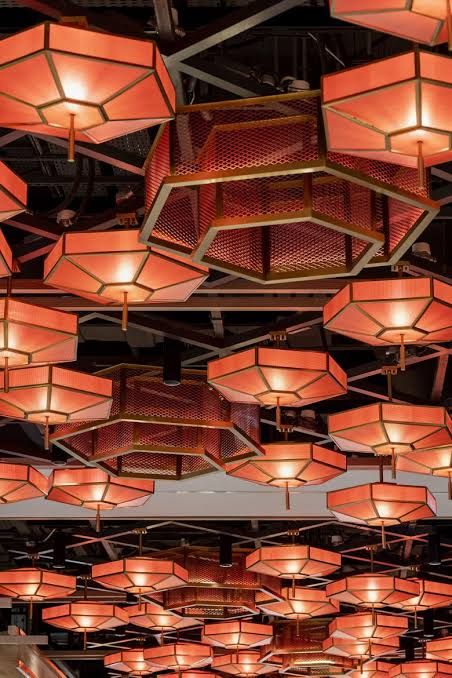
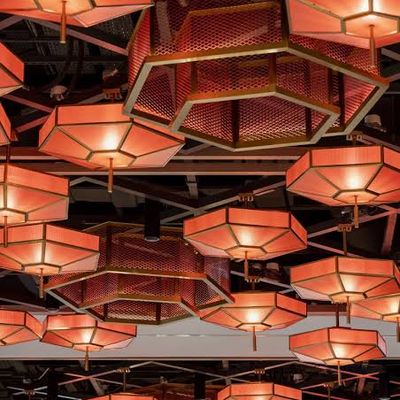
Billed as the UAE's first Chinatown, this is less a shop than a fully designed immersive environment — a 15,000-square-metre district by Kokaistudios (founded in Venice, headquartered in Shanghai). You enter through a circular moon gate; Lantern Street is canopied by thousands of hexagonal red lanterns; the Bird Market food court hangs birdcage-shaped lighting; and the Tea Room Garden offers a calmer retreat under oversized floating red fans. A large panda and a golden dragon bookend the space. Treat it as a walk-through installation. It's on the first floor, opposite the Dubai Ice Rink, and is liveliest in the evening.
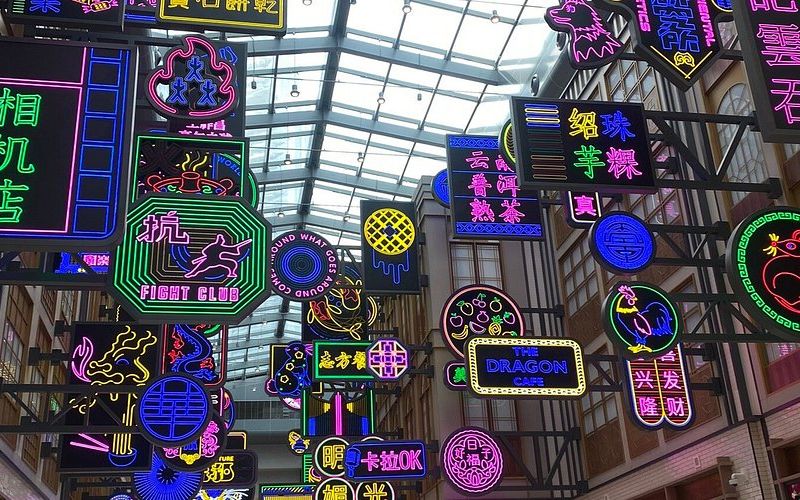
Chinatown, The Dubai Mall
The UAE's first Chinatown — a designed immersive district of moon gates, lantern streets and neon, by Kokaistudios.
Treat it as a walk-through installation, not a food court with decoration. The design rewards attention: notice the moon-gate entry, the shift in ceiling treatment from Lantern Street to the birdcage lighting of the Bird Market, the traditional joinery. Liveliest in the evening, when the neon and lanterns carry the space. It's on the first floor, opposite the Dubai Ice Rink.
Temporary and seasonal installations
Alongside its permanent collection, The Dubai Mall regularly hosts temporary and seasonal art — so if you've seen a piece in photos that isn't in this guide, it may have come and gone. A few notable examples give a sense of what rotates through:
- 1.78 by American artist Janet Echelman — a vast, billowing aerial net sculpture in her Earthtime series, suspended over the Dubai Fountain for four months in 2018 as one of the first commissions of Emaar's public-art initiative. Its title refers to the 1.78 microseconds by which a single earthquake shortened the length of a day.
- Skyward by Florida artist Jason Hackenwerth — a sculpture of some 20,000 balloons, shown at the Souk entrance for the mall's 10th anniversary in 2018.
- Wave-Field — a travelling musical installation of illuminated see-saws by Canada's Lateral Office and CS Design.
- Air Castles by Dimitri Shabalin — a large-scale sculpture built entirely from recycled children's toys, hand-painted and finished with crystal, shown at Fashion Avenue as part of the mall's festive-season programming.
During the winter holidays the mall also dresses its atriums and walkways with large-scale seasonal displays — in recent years, hundreds of suspended chandeliers strung with over 100 kilometres of lights, and crystal-dressed trees and columns in Fashion Avenue. These change year to year, so treat anything festive as temporary.
Practical tips for an art walk through The Dubai Mall
- It's mostly free. Every installation above is free to view except ticketed attractions. Budget nothing but time.
- Cluster your route. The Waterfall, DubaiDino and Chinatown all sit near the ice rink. The Gold Souk (camels, stallion, Treasury Dome) is one connected route. LOVE ME, Wings of Mexico and the Apple Solar Wings are all on the fountain/promenade side.
- Go at the right time. Kinetic and light pieces — Neon City, the Fashion Catwalk, Apple Solar Wings — are best in the evening. Outdoor mirror and bronze works (LOVE ME, Wings of Mexico) shine at golden hour and after dark during the Burj Khalifa light shows.
- Avoid peak crowds. Weekday mornings and later evenings are quietest for photos, especially at Wings of Mexico and the Waterfall.
Frequently asked questions
What is the famous waterfall in The Dubai Mall?
It's called The Waterfall, or the Human Waterfall — a four-storey indoor cascade set with life-size fibreglass sculptures of pearl divers, designed by DP Architects and opened in 2009.
Is there a real dinosaur in The Dubai Mall?
Yes. DubaiDino is a genuine 155-million-year-old Diplodocus skeleton, about 24 metres long and roughly 90 per cent original bone, on free display in the mall.
Who made the angel wings sculpture at The Dubai Mall?
The Wings of Mexico bronze angel wings in Burj Plaza, just outside the mall, were created by Mexican sculptor Jorge Marín as part of his global Wings of the City project.
What is the mirror heart sculpture outside The Dubai Mall?
That's LOVE ME, a five-metre mirror-polished steel heart by British sculptor Richard Hudson, angled to reflect the Burj Khalifa.
Are the art installations in The Dubai Mall free?
Yes — the sculptures, the Waterfall, DubaiDino, the Gold Souk features, Chinatown and the kinetic light installations are all free to view. Only separate ticketed attractions charge entry.
Where is Chinatown in The Dubai Mall?
On the first floor, opposite the Dubai Ice Rink. It's an immersive design district by Kokaistudios, the UAE's first Chinatown, built around a moon gate, a lantern-hung main street and a golden dragon.
What are the diving figures in the Dubai Mall waterfall?
They're sculptures of pearl divers, cast in fibreglass, referencing the pearl-diving industry that was the economic foundation of Dubai and Abu Dhabi before oil.
How long does it take to see all the art in The Dubai Mall?
If you cluster your route around the three zones — the ice-rink area, the Gold Souk and the fountain/promenade side — you can see almost all the permanent installations in one to two hours of walking, longer if you stop for photos or a meal.
Who designed the Apple store wings at The Dubai Mall?
The Solar Wings were designed by architecture firm Foster + Partners: 18 carbon-fibre kinetic wings that reinterpret the traditional Arabic mashrabiya screen and open and close with the time of day.
Is the Wings of Mexico sculpture inside or outside The Dubai Mall?
Outside, in Burj Plaza on Sheikh Mohammed bin Rashid Boulevard, a short walk from the mall — positioned so you can frame the Burj Khalifa between the wings.
Galleries mentioned
Museums mentioned
Places mentioned
Exhibitions mentioned
Artworks mentioned
Related reading
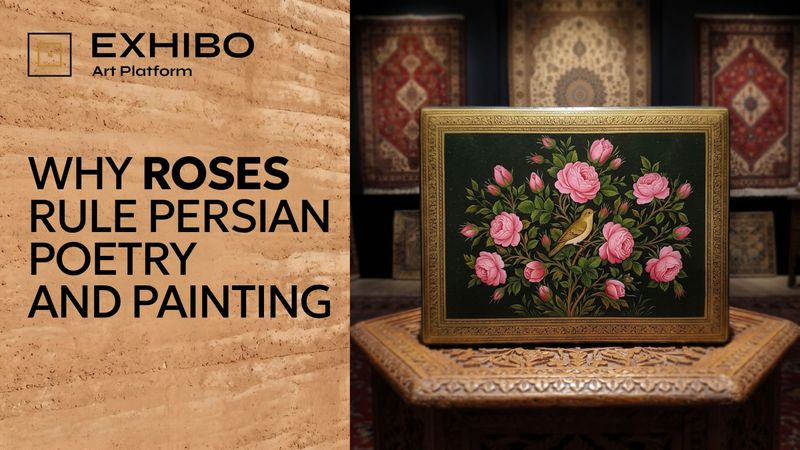
The Flower That Was Never Only Beautiful
The rose rules Persian poetry and painting — but under the sweetness sits a thorn, a bleeding bird, and a national emblem quietly assembled out of Chinese, European and Persian parts. A history of gol o bolbol, from a medieval still to a Dubai gallery.
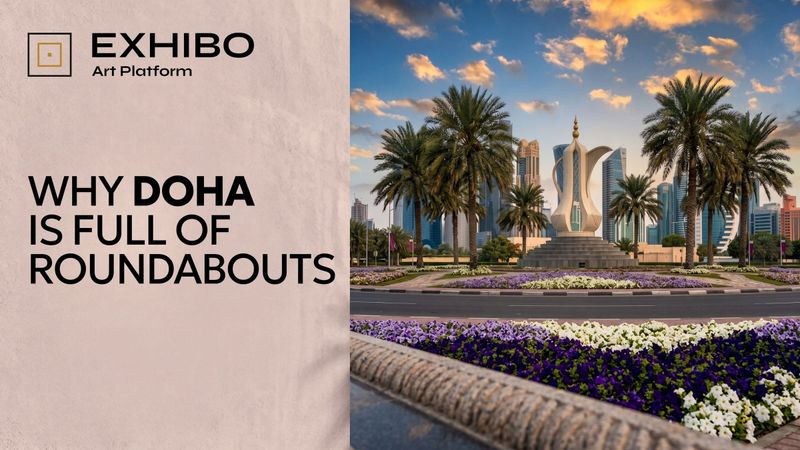
Why Doha Is Full of Roundabouts
An old circle at a crossroads, sharpened by British road engineering, became the way an Arabian city found its way and remembered itself — and it took the bulldozers to reveal it.
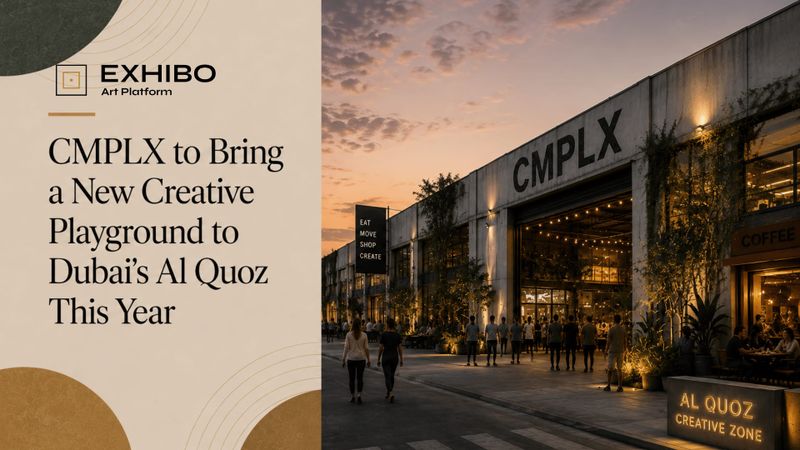
CMPLX to Bring a New Creative Playground to Dubai's Al Quoz This Year
A seven-warehouse lifestyle hub combining food, wellness, retail and creative studios is set to open in Al Quoz Creative Zone by the end of 2026, adding a new anchor to the neighbourhood built around Alserkal Avenue.