
Dubai · United Arab Emirates
Six Landmark Cultural Projects Set to Reshape the UAE's Museum and Performing Arts Scene
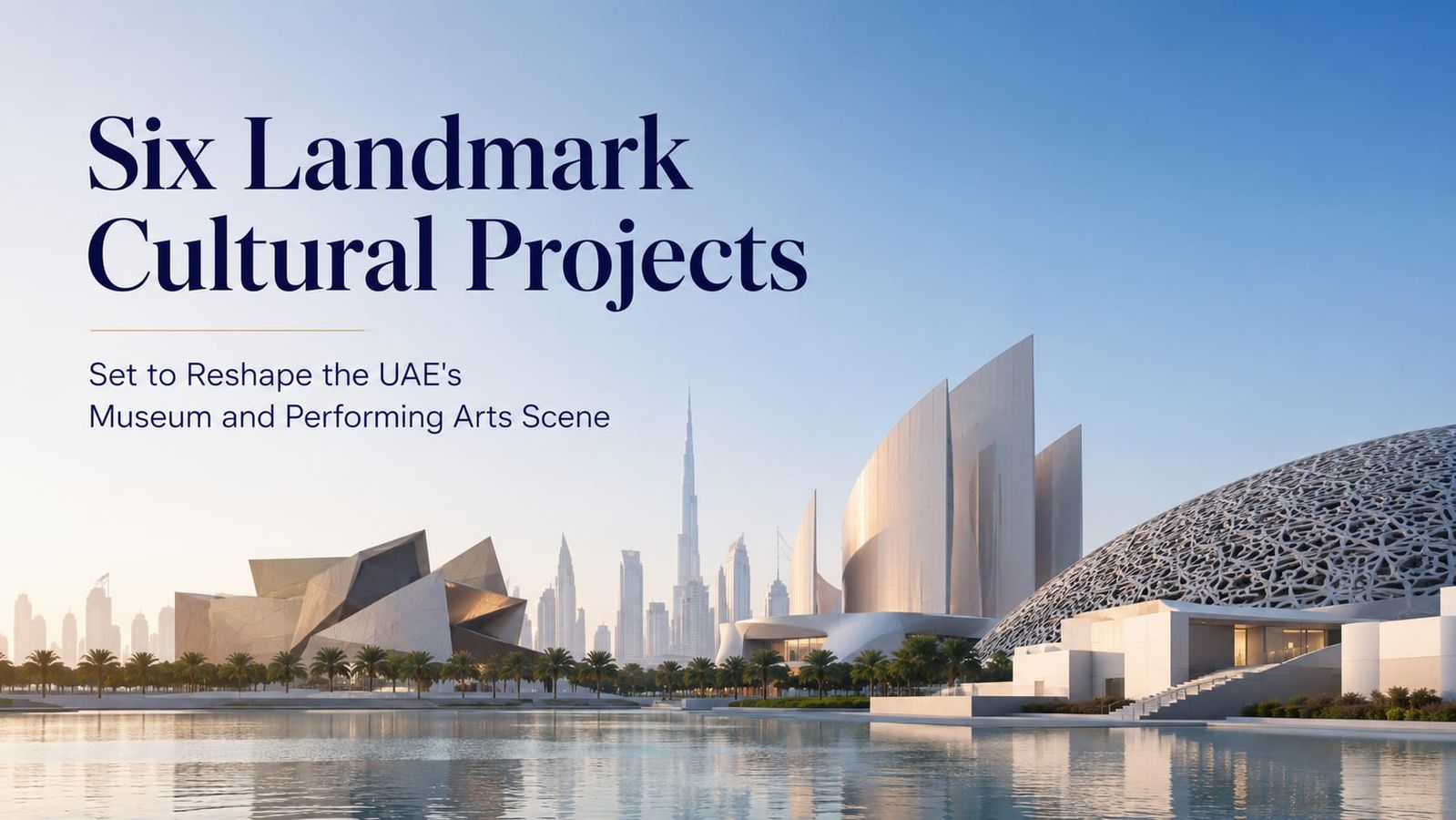
From a Frank Gehry-designed Guggenheim on Saadiyat Island to a floating art museum on Dubai Creek, six major institutions are set to redraw the country's cultural map over the coming years.
The United Arab Emirates is in the midst of one of the most concentrated periods of cultural infrastructure investment in its history, with six major institutions — spanning museums, performing arts centres and immersive exhibition spaces — currently at various stages of development across Abu Dhabi, Dubai and Sharjah.
Taken together, the projects illustrate a shift in how each emirate is positioning itself culturally. Abu Dhabi continues to build out the museum-dense Saadiyat Cultural District as an internationally legible art destination. Dubai, having built its reputation primarily through Art Dubai and the commercial gallery scene rather than major state museums, is now moving to close that gap with two ambitious projects of its own — one analogue, one digital. Sharjah, meanwhile, continues its long-running strategy of distributing cultural infrastructure across its wider territory, including its eastern coastal towns.
PROJECT OVERVIEW
Project | City | Type | Status / Expected Opening |
|---|---|---|---|
Guggenheim Abu Dhabi | Abu Dhabi (Saadiyat Island) | Art museum | Nearing completion — expected late 2026 |
Dar Al Funoon | Abu Dhabi | Performing arts centre (6,000 seats) | Expected 2030 |
Dubai Museum of Art (DUMA) | Dubai (Dubai Creek) | Art museum | No confirmed date |
Museum of Digital Art (MODA) | Dubai (DIFC Zabeel District) | Digital art museum | No confirmed date |
Al Fahidi Fort | Dubai | Heritage restoration / Dubai Museum | Ongoing |
Al Mahara Theatre | Sharjah (Kalba) | Performing arts venue (1,000 seats) | No confirmed date |
Guggenheim Abu Dhabi — Saadiyat Island
The most closely watched of the six is Guggenheim Abu Dhabi, designed by the late Pritzker Prize-winning architect Frank Gehry and now understood to be entering its final stages of construction. The museum will be the largest in the Guggenheim network, with a gross floor area of roughly 80,000 square metres spread across 28 galleries, plus extensive outdoor exhibition space in surrounding plazas and terraces.
The building's exterior draws on traditional Emirati wind-tower forms, reimagined as asymmetric cones that double as entrances to the museum and its outdoor spaces. In addition to galleries, the complex will house an art and technology centre, an education facility, an auditorium, archives, a library and a conservation laboratory.
While no fixed public opening date had been confirmed at the time of writing, officials speaking earlier this year described the project as nearing completion, with a debut anticipated by the end of 2026. The museum will complete Saadiyat Island's cultural district alongside the Louvre Abu Dhabi, the Zayed National Museum and the Natural History Museum Abu Dhabi — positioning the island as one of the most concentrated clusters of major museums anywhere in the world.
Dar Al Funoon — Abu Dhabi
Abu Dhabi is also developing Dar Al Funoon, a performing arts centre with a planned capacity of around six thousand seats. The venue is intended to host opera, ballet, theatre, concerts and other live performance formats, positioning it as a significant addition to the emirate's cultural infrastructure beyond the visual arts institutions concentrated on Saadiyat Island. The project is expected to open by 2030.
Dubai Museum of Art (DUMA) — Dubai Creek
Perhaps the most visually striking of the six projects, the Dubai Museum of Art (DUMA) was unveiled in October 2025 by Sheikh Mohammed bin Rashid Al Maktoum, and is designed by Pritzker Prize-winning Japanese architect Tadao Ando. The museum will appear to float above the waters of Dubai Creek, its curved shell structure — inspired by the sea and the pearl, two enduring symbols of the emirate's heritage — enclosing a circular exhibition hall built around a central cylindrical light well.
Developed by Al-Futtaim Group, the five-storey building will combine modern and contemporary exhibition galleries on its first and second floors with a restaurant and VIP lounge above, and a library, study rooms and educational facilities below. The museum is intended to function as a working cultural venue rather than a purely contemplative space, with a programme of artist talks, panel discussions, art fairs and residencies planned alongside its exhibitions. No firm opening date has yet been announced, though DUMA has been positioned as a cornerstone of Dubai's Creative Economy Strategy 2030 — and, notably, as the emirate's first dedicated art museum, following decades in which Dubai's art profile rested primarily on its commercial gallery scene and Art Dubai rather than state-run institutions.
Museum of Digital Art (MODA) — DIFC Zabeel District
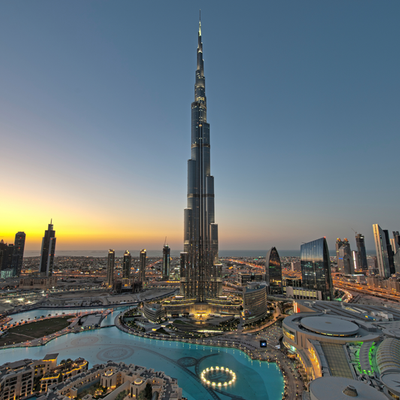
Launched in May 2026 by Sheikha Latifa bint Mohammed bin Rashid Al Maktoum, Chairperson of Dubai Culture and Arts Authority, the Museum of Digital Art (MODA) is billed as the first institution in the Middle East dedicated entirely to digital art and emerging technologies. It will be built within the DIFC Zabeel District expansion and designed by Adrian Smith + Gordon Gill Architecture, the Chicago-based firm behind the Burj Khalifa.
Spanning five floors, MODA will combine permanent and temporary exhibitions with immersive installations, interactive platforms and dedicated educational spaces, with a particular focus on generative art, AI-driven work and other technology-led practices. A notable feature of the concept is a planned "digital twin" model intended to allow global audiences to access exhibitions remotely. DIFC will oversee the museum's physical development, while Dubai Culture will manage its operations and curatorial direction.
Industry observers have noted that MODA's digital focus allows Dubai to establish a distinct cultural identity relative to Abu Dhabi's museum-led model, built around blue-chip institutional names such as the Louvre and Guggenheim, without competing head-on for the same category of flagship art institution.
Al Fahidi Fort — Dubai's Historic Core
Alongside its two new museum projects, Dubai continues the restoration of Al Fahidi Fort, home to the Dubai Museum and among the emirate's oldest surviving buildings. The renovation is designed to preserve the fort's historic character while upgrading its infrastructure and expanding its exhibition capacity — an approach that sits deliberately apart from the scale and spectacle of DUMA and MODA, anchoring Dubai's museum landscape in its own pre-oil history even as the emirate builds toward a more futuristic cultural identity.
Al Mahara Theatre — Kalba, Sharjah
In Sharjah, plans continue for Al Mahara Theatre — also known as the Shell Theatre — a performing arts venue on the corniche of Kalba, on the emirate's east coast. First announced in 2022 and championed personally by Sheikh Dr Sultan bin Muhammad Al Qasimi, Ruler of Sharjah, the theatre takes the form of a giant seashell surrounded by water basins, with visitors entering the venue via an underwater corridor — one of the more unusual architectural approaches among any of the six projects. The theatre is designed to seat around 1,000 people and forms part of a wider development corridor along Kalba's coastline that includes new lakes, parks and heritage attractions.
Galleries mentioned
Museums mentioned

Places mentioned
Exhibitions mentioned
Related reading
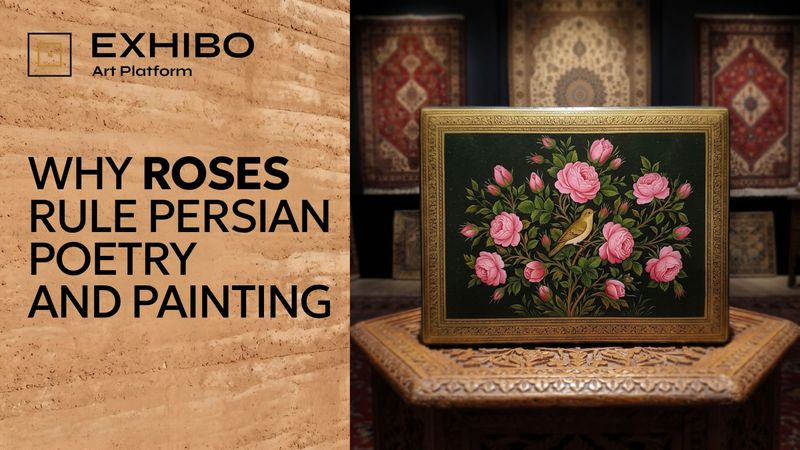
The Flower That Was Never Only Beautiful
The rose rules Persian poetry and painting — but under the sweetness sits a thorn, a bleeding bird, and a national emblem quietly assembled out of Chinese, European and Persian parts. A history of gol o bolbol, from a medieval still to a Dubai gallery.
Gol o bolbol — the rose and the nightingale — is among the most beautiful images in a thousand years of Persian art, and in modern Persian it also means sweet, empty talk. Under the tile, the picture is darker: a bird singing in blood for a flower that will not answer and will not last.
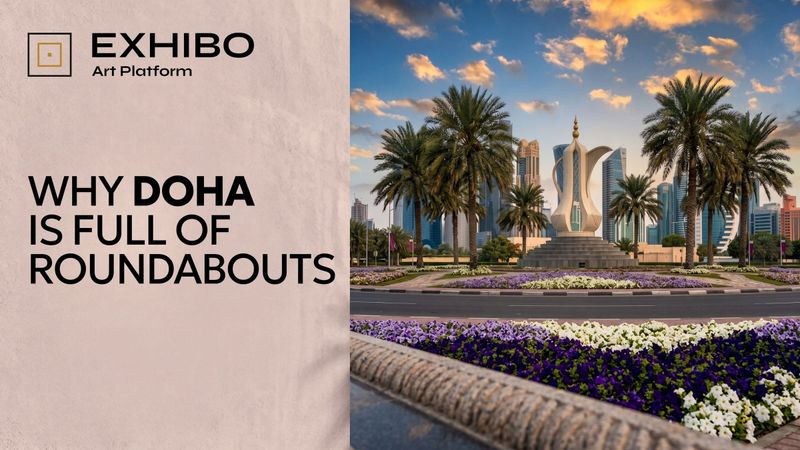
Why Doha Is Full of Roundabouts
An old circle at a crossroads, sharpened by British road engineering, became the way an Arabian city found its way and remembered itself — and it took the bulldozers to reveal it.
In a city where a landmark was more useful than an address, Doha's roundabouts became its navigation, its landscaping and its national image all at once. Now they're being torn out for signalled junctions — and the affection for them arrived, as one scholar put it, only posthumously.
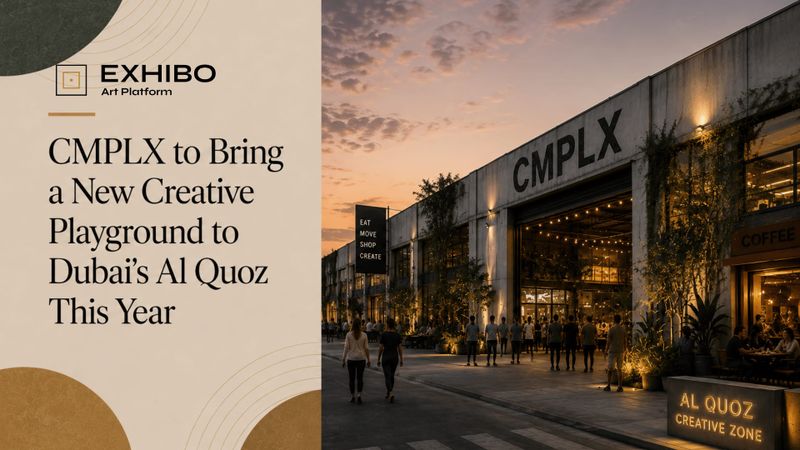
CMPLX to Bring a New Creative Playground to Dubai's Al Quoz This Year
A seven-warehouse lifestyle hub combining food, wellness, retail and creative studios is set to open in Al Quoz Creative Zone by the end of 2026, adding a new anchor to the neighbourhood built around Alserkal Avenue.
CMPLX, a new warehouse-style lifestyle destination combining food, wellness, retail and creative studios, is set to open in Dubai's Al Quoz Creative Zone by the end of 2026 — adding a fresh anchor to a neighbourhood already defined by Alserkal Avenue's galleries and cultural spaces.