
Exhibo Editorial
What Is Encaustic Painting?
Hot beeswax, damar resin and pigment on rigid panels: Fayum portraits, Jasper Johns, and how artists fuse, layer and conserve wax paint today
Encaustic painting is a method in which an artist mixes dry pigment into molten beeswax (and, in most modern practice, damar tree resin), applies the warm mixture to a rigid, absorbent support, and bonds successive layers with heat. The Greek word enkaustikos means "burn in," and Pliny the Elder used related terms for wax pictures fixed with a heated tool. Encaustic is not oil, acrylic or fresco. It sets by cooling, not by oxidation or lime carbonation, and it can be reworked decades later if you reheat the surface.
That combination of permanence and reversibility explains why Roman Egyptian workshops painted elite faces in wax on thin wood panels, why Byzantine monks at Mount Sinai kept an early encaustic icon tradition alive, and why Jasper Johns chose pigmented wax for Flag (1954–55) when Abstract Expressionist brushwork dominated New York studios. The cluster hub is Art Techniques and Materials. Buon fresco on lime plaster, which fixes colour by mineral bond, is treated in the sibling guide What Is Fresco Painting?. Named collections below appear in the museums directory.
What encaustic painting means in art
In museum labels and studio speech, "encaustic" names a binder system (beeswax, often with resin), a temperature regime (molten application, fused layers), and a family of supports (wood panel, prepared board, fabric mounted on plywood). Tate and the Getty Art and Architecture Thesaurus treat encaustic as pigment carried in wax. Workshop suppliers such as R&F Handmade Paints sell the term as a product line: encaustic medium plus encaustic colour. All three uses point at the same physical fact: the picture is a stratified wax film that an artist can scrape, embed, polish or remelt.
Encaustic is sometimes called hot wax painting. That English phrase is accurate but vague. Cold wax mediums mixed with oil exist; they share wax but not the encaustic workflow of a heated palette and fusing pass. Egg tempera and encaustic both appear on Fayum mummy portraits, sometimes on the same corpus, but tempera binds with protein on a prepared surface while encaustic builds a wax body that can be modelled warm. Do not collapse the two because both are "ancient panel methods."
The technique also differs from wax used as a final varnish on oil paintings. Beeswax resists moisture and can sit on top of an oil film as a protective coat. Encaustic is the primary paint film itself. When you read "encaustic on limewood" on a Metropolitan Museum label, the wax is not a topcoat. It is the image.
Beeswax, damar resin and the encaustic medium
Ancient and modern encaustic share beeswax as the core binder. Roman Egyptian painters melted wax with powdered pigments and worked with brushes and heated metal tools; resin and oil appear in some Fayum panels analysed by conservators, but recipes varied by workshop and price. Twentieth-century revivalists standardised a mix of refined beeswax and damar resin because the resin raises melting temperature, adds hardness, and reduces the "bloom" (surface haze) that pure wax can develop as it cures.
Understanding the medium means separating wax, resin and pigment, then seeing how each changes the film's behaviour on a panel. The subsections below follow that order. Pigment choice matters for lightfastness and for how much colour you can load before the wax turns brittle.
Beeswax as binder and vehicle
Beeswax is a complex mixture of esters, fatty acids and hydrocarbons exuded by honeybees. As a paint binder it melts between roughly 62 °C and 65 °C (about 144–149 °F), flows while hot, and solidifies within seconds on a cool panel. Pure beeswax film is water-resistant and remains thermoplastic: heat softens it again. That property lets artists fuse layers and, if they choose, scrape back to an earlier stratum.
Refined beeswax for art use is filtered and bleached to reduce pollen and propolis, which can cause spotting or uneven melting. Some painters add a small proportion of carnauba wax for hardness; others rely on damar alone. Conservation science treats beeswax as stable in dark, moderate conditions but vulnerable to thermo-oxidative ageing under UV and nitrogen oxides in polluted air. A 2020 materials study in Thermochimica Acta found that NOx exposure and UV both shorten beeswax's oxidation induction period and increase free fatty acids in the film. Museum storage, not just studio practice, belongs in any honest account of encaustic durability.
Damar resin and modern medium recipes
Damar is a natural resin collected from Southeast Asian trees in the genus Shorea. Melted into beeswax it raises the softening point, toughens the cooled film, and helps optical saturation when the surface is buffed. R&F and other manufacturers sell encaustic medium as a pre-mixed wax–resin block; many studios mix their own at ratios between roughly 4:1 and 8:1 wax to resin by weight, tuning hardness for climate and technique.
Too much resin can make the film brittle in cold storage. Too little leaves a tacky or bloom-prone surface. Artists test a recipe on sample boards before committing to a large panel. Damar is not the only historical resin: ancient writers mention various tree saps, and Fayum analyses sometimes find pinaceous resins or oils in specific panels. For the English-language studio today, "encaustic medium" almost always means beeswax plus damar unless a label states otherwise.
Pigments, opacity and load
Encaustic colour can be built from dry pigments stirred into molten medium, or bought as ready-made encaustic cakes. Earth colours, umbers, ochres and carbon blacks behave predictably. Modern synthetics (phthalocyanines, quinacridones) extend the palette but must be tested for heat stability and lightfastness. Heavy pigment load makes the wax opaque and sculptural; thin glazes stay translucent and stack like atmospheric layers.
Fayum painters used Egyptian blue, red lead, gold leaf and imported pigments that signal trade across the Roman Empire. Met object records for portraits such as Portrait of a young woman in red (09.181.6, dated c. AD 90–120) list encaustic on limewood with gold leaf. The materials line is short; the labour behind it was not. Gilded backgrounds and wreaths required size and burnishing on a wax ground prepared to take metal leaf without flaking in the tomb.
Heat, ventilation and studio safety
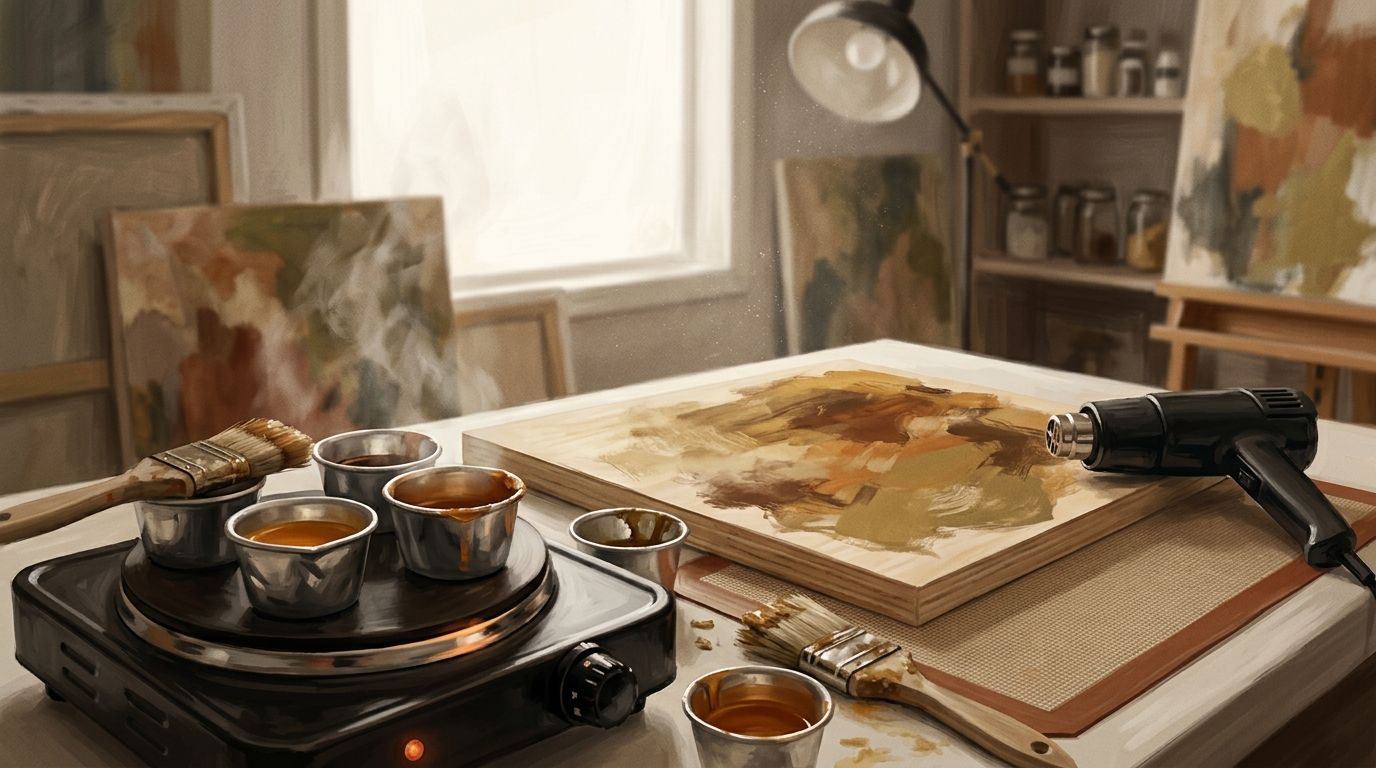
Encaustic painting is a hot process. Electric griddles, pancake griddles with thermostats, and specialised palettes hold medium and colour cups at working temperatures, typically between 90 °C and 110 °C (about 200–230 °F) for molten paint, according to common manufacturer guidance from R&F and Jackson's Art. Heat guns, embossing guns, propane torches and encaustic irons rewarm the panel to fuse layers. Each tool can scorch wax, ignite paper collage, or burn skin if you treat it like a hair dryer.
Safety is not an appendix to the technique. It is part of why encaustic stayed a specialist trade after tempera and oil dominated European easel painting. The paragraphs below cover temperature control, air quality, and fire habits that serious studios adopt as default practice.
Working temperatures and burn risks
Commercial encaustic medium has a melting point near 72 °C (about 160 °F). Paint on the palette is kept hotter so it flows; Jackson's Art notes that R&F cakes melt around that point and recommends a thermostatted hot plate rather than an uncontrolled burner. On the panel, wax solidifies almost on contact. You extend working time by fusing: passing heated air or an iron across the surface until the film glosses and merges with the layer below.
Skin burns happen at palette temperature, not only from torches. Dedicated silicone gloves, tool rests, and a clear bench edge reduce accidents. Johns dipped strips in hot wax over a burner; contemporary studios use labelled cups and colour-coded brushes so a cerulean brush never returns to the white cup. Overheated wax smokes before it chars. If the medium darkens or smells acrid, discard the cup and lower the thermostat.
Ventilation, fumes and fire prevention
Beeswax and damar release vapours when overheated. Studios need active ventilation: an extractor fan, open window cross-draft, or ducted hood when torches are in regular use. Wax vapour is not "toxic" in the alarmist blog sense, but repeated exposure to smoke from scorched resin belongs in the same category as any poorly ventilated solvent practice. Do not eat or store food on the encaustic table. Keep a fire extinguisher rated for Class B (flammable liquids) within reach. Clear loose paper, spirit-soaked rags and polyester fabric scraps before you fuse collage.
Torches demand a non-flammable rest, a metal shield under the panel, and a habit of shutting the gas off before you set the tool down. Heat guns draw less fuel risk but can still ignite newsprint embedded in wax, which matters when you teach Johns's collage method. Sprinklered classrooms sometimes ban open flame entirely; heat guns and irons become the only legal fusing tools. Check institutional rules before you demo encaustic in a school or museum studio.
How encaustic painting works: layering, fusing and surface work
An encaustic painting grows in layers: medium ground, coloured passes, optional collage or line, fuse, repeat. Because each stratum is thermoplastic, the stack behaves like a laminated solid rather than a chemically cross-linked oil film. You can embed paper, fabric or photograph fragments while the wax is warm, press a stamp, or scrape with a potter's loop to reveal earlier colour. The surface can finish matte, satin or high gloss depending on buffing and top layers.
The workflow rewards planning but punishes timidity. Cool wax accepts only short brushstrokes; fusing reopens the film. The subsections below walk ground preparation, layer sequence, and the scraping and collage moves that distinguish encaustic from flat acrylic or gouache.
Grounds and rigid supports
Encaustic needs a rigid, absorbent support. Softwood panels, birch plywood, MDF sealed and braced, and commercial encaustic boards (gesso-coated panels with tooth) are standard. Stretched canvas flexes; wax cracks when the fabric moves. The painting supports types guide in this series treats panel preparation in full; here the rule is enough absorbency for the first wax bite and enough stiffness to survive transport.
Many artists lay a clear or lightly pigmented encaustic ground with a hake brush, fuse it, then begin colour. Fabric works when mounted on plywood: Johns's Flag uses fabric on three plywood panels, not loose canvas. Imprimatura in oil is a different system; do not prime for encaustic with flexible acrylic gesso alone on a heavy canvas stretcher and expect archival results.
Layering and fusing
A typical pass runs: apply warm colour with a natural bristle brush, fuse with heat until the surface sheens and merges, cool, assess. Early layers often stay thin and smooth; later passes can be impasto-thick if the support and fuse discipline carry the weight. Impasto in oil is a related but distinct technique of loaded brush and wet-on-wet relief; see what is impasto for that fence.
Fusing is not optional decoration. Without it, layers sit like stacked flakes and can delaminate in warm storage. With it, the wax film becomes continuous. Artists adjust fuse distance and speed: too close scorches; too shy leaves cold seams. On a large panel, fuse in zones so the heat gun does not warp plywood.
Scraping, incising and collage
Encaustic invites subtraction. Scrapers, loop tools, razor edges and dental picks remove wax to expose lower tints or the ground. Line can be incised warm or drawn into a fused skin that is briefly re-softened. Collage elements (newsprint, tissue, photographs) are pressed into warm wax or dipped in molten medium and laid down, then fused. Johns's Flag at MoMA embeds newsprint strips in encaustic and oil on fabric; headlines were chosen to avoid overt political slogans, letting the process show through the symbol.
Transfer paper, stencils and photocopy transfers appear in contemporary encaustic practice. Each addition changes fuse time and odour (inkjet prints may release coatings when heated). Test on scraps. Mixed media on a wax ground overlaps the territory of what is mixed media art; this page stops at wax-primary works where the encaustic film carries the image.
Buffing, sheen and surface finish
Cooled encaustic can be matte, satin or glossy depending on resin content, top layers and handling. Many painters finish a session by buffing with a soft cotton cloth or nylon stocking when the panel is cool to the touch. Buffing compacts the outer skin and restores colour saturation after bloom. Over-buffing on a warm day can polish too aggressively and flatten intended texture; under-buffing leaves a hazy veil that may clear as the wax cures over months.
Some artists leave tool marks proud as part of the image; others fuse until the surface reads flat as enamel. Neither choice is chemically wrong. Document your finish preference if you sell work, because collectors may assume matte encaustic is unfinished when it is intentional. Varnish is unnecessary: wax is its own moisture barrier, unlike an oil film that often wants a separate coat for gloss and dust protection.
Historical development from ancient Greece to the Fayum portraits
Pliny the Elder, writing in the first century AD, could not name a single inventor of encaustic. He listed earlier painters in wax, then credited Pamphilus with teaching the method to Pausias of Sicyon, whom he called the first to win fame in the style (Natural History 35.40). Pausias painted miniatures, panelled ceilings, and a portrait of Glycera titled Stephanoplocos ("Girl making wreaths"). Pliny also described a third encaustic method developed for warship decoration: wax colours melted and applied with a brush while hot, a process he claimed resisted sun, wind and salt (35.41). Whether "burning in" always required flame is disputed; Met curators note that Fayum panels show varied methods, hot and cold, with tools heated or not.
Greek and Roman literary sources tie encaustic to ivory, panels, and ship hulls more often than to mummy boards. The Fayum corpus is the largest surviving body of ancient encaustic portraiture, but it is a provincial Roman-Egyptian funeral custom, not the whole history of wax painting.
Pliny's account of Pausias is useful even without surviving works. He records that Pausias competed with Polygnotus on a wall restoration at Thespiae and lost, then retreated to miniatures and ceiling panels where wax handling could show off speed and touch. The Hemeresios ("One-day Boy") was painted to answer critics who mocked his slow finish. The Stephanoplocos portrait of Glycera, a wreath-maker, became famous enough for Lucius Lucullus to buy a copy in Athens for two talents. Those anecdotes tell you how encaustic functioned in elite Roman taste: portable luxury, proof of skill, subject matter that suited small scale and melted precision.
Roman Egypt and the Fayum mummy portraits
Between roughly the first and third centuries AD, workshops in the Fayum and neighbouring nomes painted lifelike heads on thin wooden panels, often limewood imported from Europe. Many panels were made during the sitter's life, then bound into mummy wrappings over the face after death. The Met's 1988 film The Fayum Portraits (Richard Brilliant, commentary) dates the practice broadly to AD 100–300 and stresses that psychological directness, not only mummy ritual, made these objects extraordinary.
Encaustic portraits were the expensive option. Less wealthy clients commissioned tempera on the same supports. Met exhibition copy for Ancient Faces: Mummy Portraits from Roman Egypt (2000) explains that "encaustic" in scholarship now covers any pigment mixed with beeswax, with great variety in application: hot or cold wax, underpainting, soft or hard tools, heated or not. Gold leaf backgrounds and jewellery details appear on elite examples such as Met 09.181.6 (Portrait of a young woman in red, c. AD 90–120, encaustic on limewood with gold leaf). British Museum holdings from Hawara, excavated by Flinders Petrie from 1888, spread the corpus across European collections.
Technical studies continue to refine dating. Radiocarbon and multi-analytical work on individual panels sometimes pushes proposed date ranges, a reminder that stylistic dating and scientific dating can disagree. Write date ranges on labels, not false precision.
In the gallery, encaustic Fayum heads reward raking light. Turn slightly and watch the cheek modelled in warm wax layers rather than oil glaze. Compare an encaustic panel with a tempera neighbour in the same room: tempera often reads chalkier and more matte; encaustic carries a thicker skin and sharper highlights on jewellery and eyes. Many panels are small (often 30–40 cm high) because they had to sit over a wrapped face. Scale is part of the technique's meaning. You are not looking at salon portraiture meant to fill a wall. You are looking at a face made to travel into a tomb and still meet the living at the funeral.
Byzantium, Sinai and the medieval gap
Very few encaustic panel paintings survive from the centuries between late antiquity and the modern revival. An exceptional cluster lives at the Monastery of Saint Catherine, Mount Sinai: sixth- and seventh-century encaustic icons preserved in desert dryness outside Constantinople's iconoclastic destruction. Early Sinai icons use wax on wood; later Orthodox practice shifted to egg tempera on gesso. Encaustic did not vanish entirely, but tempera and oil dominated European easel painting for a millennium.
Pliny's ship-painting method and Pausias's miniatures are known through text, not extant objects. The Fayum panels and Sinai icons anchor what you can still see in a gallery. Everything else is inference, fragment, or later reintroduction.
Encaustic in modern art: Jasper Johns and the wax revival
Encaustic returned to serious American studio use in the mid-twentieth century when artists wanted durability, matte depth, and a process visible on the surface. Jasper Johns (b. 1930) is the name most linked to encaustic in museum surveys, though he did not revive the technique alone. What Johns did was bind encaustic to everyday symbols and to collage facture at a moment when Abstract Expressionism treated gesture as confession.
Jasper Johns: Flag, targets and material fact
Johns reported that he dreamed of painting an American flag, then bought materials and made Flag (1954–55, MoMA, gift of Philip Johnson). The object is encaustic, oil, and collage on fabric mounted on plywood in three panels, about 107 × 154 cm. He dipped strips of cloth and newsprint into pigmented wax and laid them on a cut bedsheet traced with a pencil outline. MoMA's collection entry states the result registers its making on the surface: wax ridges, embedded type, a flag that is both a thing and a picture of a thing. Alfred H. Barr wanted to acquire it from Johns's 1958 Leo Castelli debut; trustees initially worried the work might read as unpatriotic. Barr secured it through Philip Johnson.
Johns reused encaustic for targets, numbers, maps and later variations on flags, including White Flag (1955, Metropolitan Museum). The technique gave him a slow, layered skin unlike dripping house paint. For students reading technique through one work, Flag teaches that encaustic in 1954 was not archaeological pastiche. It was a contemporary choice about fact, symbol and newsprint under wax.
Twentieth-century workshops and today's supply chain
Artists such as Karl Zerbe, who taught at Boston, and later manufacturers including R&F (founded 1988 in New York State) rebuilt studio encaustic as a teachable system: medium blocks, pigment cakes, thermostatted palettes, health handouts. The International Encaustic Artists network and the Museum of Encaustic Art in New Mexico (founded by Douglas and Adrienne Mehrens) collect and exhibit wax-primary work. Royal Academy of Arts and other schools publish short process films; search traffic still skews to supplier demos and Instagram reels rather than museum catalogue essays.
Contemporary painters use encaustic for abstraction, landscape, photography transfers and sculpture casts. The common thread is heat discipline and rigid support, not a single style. If you visit encaustic in a museum, expect twentieth-century and twenty-first-century work on panel; do not expect a full Fayum room in every encyclopaedic collection. Fayum panels live in Egyptian or classical departments; Johns in modern art.
How encaustic paintings fail, degrade and are conserved
Encaustic's reputation for archival stability rests on Fayum panels that survived tombs and on wax's moisture resistance. Stability is conditional. Heat, cold, light, pollution and poor framing still damage wax films. Conservators treat bloom, scratches, gouges, and collage lift without assuming the medium is indestructible.
Degradation modes split into reversible surface changes and structural loss. The table below maps common causes to what you see in the room. Preventive care overlaps with studio safety: the same 65 °C softening point that lets you fuse in the studio can destroy a painting in a closed car or a hot attic.
| Condition / stress | Typical cause | What you see | Preventive or treatment notes |
|---|---|---|---|
| Softening or surface tack | Ambient heat above ~65 °C; sun on glass; hot vehicle storage | Gloss increases; fingerprints hold; collage shifts | Keep 15–25 °C in display; avoid direct sun; transport in climate-controlled cases |
| Flow or slide of thick wax | Extreme heat, improper vertical storage of heavy impasto | Ridges slump; wet look | Mount flat or with secure cradled panel; insure shipping |
| Bloom (surface haze) | Wax curing; humidity cycles; pure wax without enough resin | Whitish veil, matte fog | Gentle buff with soft lint-free cloth when cool; stable medium recipe reduces recurrence |
| Cracking or cleavage | Flexing support; freezing then warming; excessive resin brittleness | Hairlines across panel; edge flaking | Rigid support; avoid sub-zero transport; tune wax–resin ratio |
| Pigment fade | UV on fugitive colours; daylight on works with inks or dyes | Local colour loss, especially collage | UV-filter glazing or low-light display; pigment tests before embedding |
| Collage lift | Incomplete fuse; incompatible ink or paper | Paper edge rises; air pocket | Refuse with heated tool under conservator; test fusing on scrap |
| Thermo-oxidative ageing | Long UV exposure; polluted air (NOx) on beeswax | Embrittlement; yellowing; increased acidity in film | Museum dark storage; HEPA and pollutant filters in urban galleries |
| Scratch or gouge | Handling without edges protected; abrasive cleaning | White or light line in wax | Local fill with matched encaustic; fuse and buff under magnification |
What collectors and curators should ask
Request condition reports that mention support type (panel cradling, fabric mount), fuse quality near edges, and any bloom treated in the past. Encaustic does not require glass for chemical reasons; many dealers float panels in open frames so viewers see wax relief. Glass protects against touch and dust but can trap heat in sun. UV-filter acrylic is a compromise.
Do not store paintings face-to-face without interleaving. Soft wax can impress another surface. Use acid-free paper or silicone release film for long storage, not wax paper for years of stacking. Attics in summer can exceed 65 °C even when outdoor temperature is lower; conservators cite 150 °F (65.5 °C) as the softening threshold in care guides.
Conservation treatment for historical Fayum panels belongs to specialists; public collections do not encourage studio-style refusion on Roman-Egyptian objects. Modern encaustic can sometimes be locally reheated and reworked by the artist who made it. That is a feature for living artists and a liability if an owner tries it without training.
When you stand in front of Johns's Flag at MoMA, look for wax build-up along stripe edges and the grey newsprint ghosting through red fields. Those material facts are the technique argument. When you stand before a Fayum youth in the Met's Egyptian galleries, look for tool direction in the wax and the gilded ground where the original background survives. Two centuries and two continents apart, both objects ask you to read heat and layer, not only likeness or symbol.
What encaustic painting costs today
Ancient encaustic was labour and material luxury: imported wood, gold leaf, sitting time for a portrait that might outlive the sitter in a tomb. Modern studio encaustic is cheaper than bronze casting or monumental fresco, but more gear-dependent than gouache on paper.
A starter setup in the UK or US commonly includes: a thermostatted hot plate or griddle (£40–£120 / $50–$150); encaustic medium and three or four colour cakes (£30–£80 / $40–$100 per starter set); natural bristle brushes; a heat gun (£25–£60 / $30–$80); and rigid panels (£8–£25 / $10–$30 each at modest sizes). Budget £200–£450 ($250–$550) to test the process safely with ventilation already in the room. Open-flame torches add fuel cost and insurance questions; many beginners stay on heat guns.
Professional painters scaling up buy bulk refined beeswax and damar, dedicated ventilation, multiple panel sizes, and branded colour at £15–£35 ($18–$40) per 104 ml cake. A finished small work (30 × 40 cm) at gallery price reflects hours of fuse and scrape, not only material: studio pieces often list £400–£2,000 in regional markets; established names run higher. Commissions on large cradled panels (90 cm+) can reach five figures when framing and shipping are included.
Workshop tuition runs £120–£350 ($150–$400) for a weekend intro; university electives bundle materials in fees. Compared with oil vs acrylic paint (sibling guide), encaustic trades tube convenience for palette heat and rigid support. Compared with fresco, it avoids masonry crews but still resists casual canvas practice.
Frequently asked questions
What is encaustic painting in simple terms?
Encaustic painting is making pictures with pigment mixed into hot beeswax (usually with damar resin), brushed or poured onto a rigid panel, with each layer bonded by reheating the surface. The wax cools hard within seconds and can be scraped, polished or remelted later.
What wax is used for encaustic painting?
Filtered beeswax is the standard binder. Modern studio recipes add damar resin to harden the film and raise the melting point. Ancient Fayum painters used beeswax with pigments; some panels also contain other resins or oils identified by conservation analysis.
What is the binder in encaustic paint?
The binder is beeswax, often combined with damar resin in contemporary practice. Dry pigment is dispersed in that molten binder. Encaustic does not use linseed oil or acrylic polymer as its primary film former.
How does fusing work in encaustic?
After you apply a wax layer, you pass a heat gun, torch or encaustic iron across the surface until the wax glosses and merges with the layer below. Fusing creates a continuous film and reduces the risk of flaking in warm conditions.
Is encaustic painting difficult to learn?
The basics (melting medium, brushing, fusing) can be learned in a weekend class. Mastery of layering, collage, and surface control takes longer, chiefly because wax timing is physical: cool wax stops moving, overheated wax runs or smokes. Ventilation and burn awareness are part of the learning curve, not optional extras.
How long do encaustic paintings last?
Fayum mummy portraits survive from two millennia ago in tomb conditions. Modern encaustic is considered archival when artists use sound medium ratios, rigid supports, and stable pigments, and when owners avoid sustained heat, freezing flex, and direct UV. Wax can bloom or scratch; it does not "dry out" like oil.
Can encaustic melt on a wall?
In normal room temperatures (about 18–24 °C), encaustic stays solid. Softening begins near 65 °C (150 °F). Works left in closed cars, unventilated attics, or direct sun behind glass can soften, tack or slump. Climate-controlled display is standard in museums.
Where can I see encaustic paintings in museums?
Fayum portraits are held by the Metropolitan Museum of Art, the British Museum, and other collections with Roman-Egyptian holdings. Jasper Johns's Flag is at MoMA in New York; White Flag is at the Metropolitan Museum. Early Byzantine encaustic icons survive at Saint Catherine's Monastery, Mount Sinai. Use the museums directory to locate collections by city.
Related reading
Curating Tomorrow's Archive: Hamburger Kunsthalle Seeks Contemporary Collections Lead
A new permanent appointment will steer the museum's post-1960 holdings across paper, photography, and media formats.
The Hamburger Kunsthalle is inviting applications for a senior curatorial position focused on contemporary acquisitions, exhibition strategy, and digital collection management. Applications close October 2026 for a January 2027 start.
Whilst We Are Savages: Colonial Constructs and Atlantic Dialogues
A critical survey at TEA Tenerife exploring how colonial frameworks shaped identity, territory, and knowledge across Europe, Africa, and Latin America.
William Morris Gallery Reopens With Intimate Restoration and New Focus
A comprehensive overhaul at the Walthamstow venue explores the designer's contradictions through newly displayed archives and a domestic curatorial approach.