
Saint Catherine's Monastery
The sixth-century fortress-monastery at the foot of Mount Sinai — the Burning Bush, Byzantine mosaics and one of the world's great libraries.
At the foot of the holy mountain
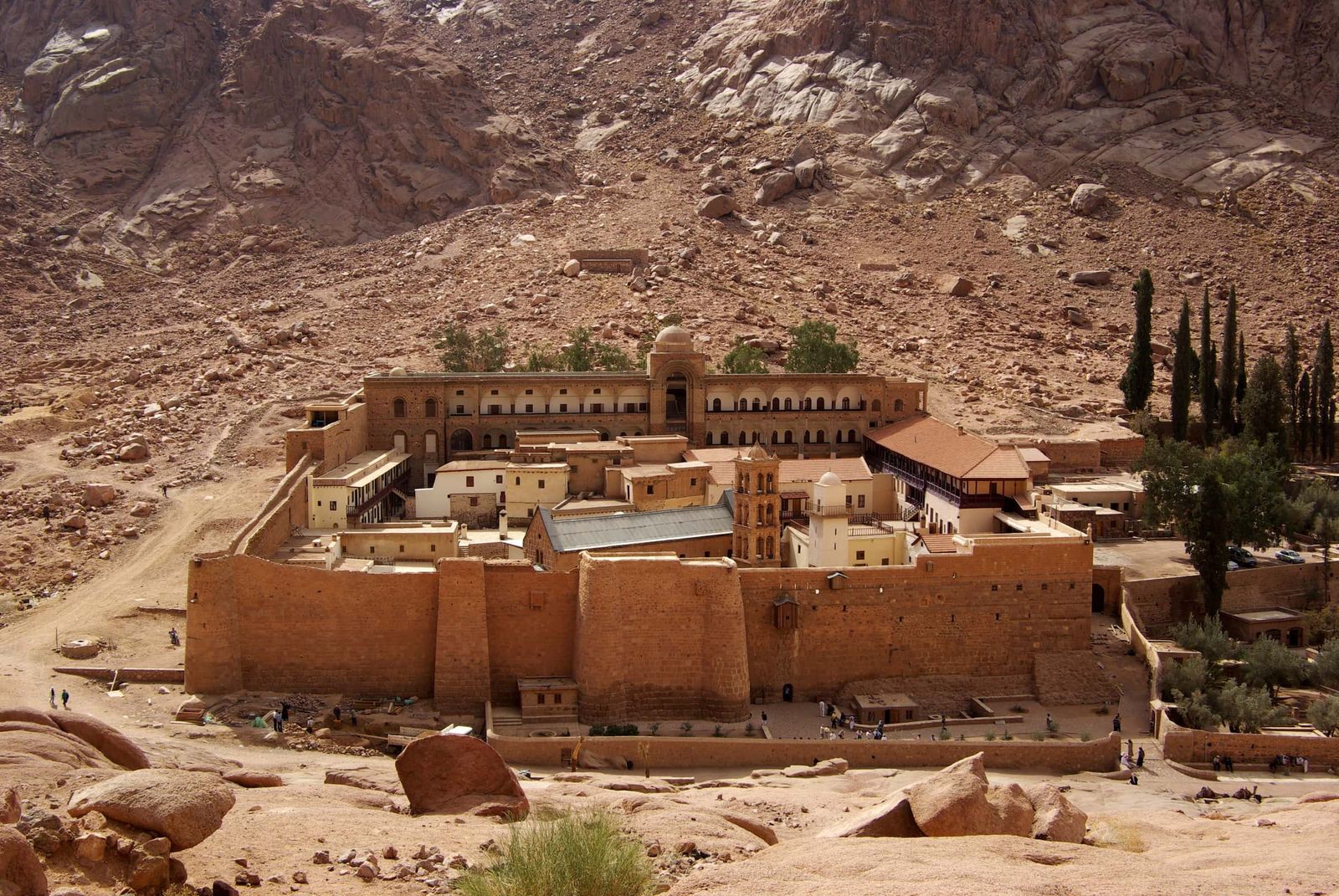
Saint Catherine's Monastery stands in a high valley of the southern Sinai, at about 1,570 metres, at the foot of Mount Sinai (Gebel Musa), where tradition places the giving of the Law to Moses. It is one of the oldest continuously inhabited Christian monasteries in the world. Monks and hermits lived here from the fourth century around the site identified as the Burning Bush, and in the mid-sixth century the Byzantine emperor Justinian built the fortified monastery whose massive granite walls still enclose it. It belongs to the Greek Orthodox Church and is dedicated to St Catherine of Alexandria, whose relics, according to tradition, were found on a nearby mountain. Together with the surrounding mountains, it forms the UNESCO World Heritage Site of the Saint Catherine Area.
Inside the walls
The heart of the monastery is the Basilica of the Transfiguration, built under Justinian, whose apse holds a celebrated sixth-century mosaic of the Transfiguration of Christ, one of the finest early Byzantine mosaics in existence. Behind it, the Chapel of the Burning Bush is built over the place where God is believed to have spoken to Moses, and a bramble growing outside its wall is venerated as a descendant of the bush itself. Within the walls also stand a Fatimid-era mosque, built in the early twelfth century and testimony to centuries of coexistence, and the Well of Moses.
Icons and manuscripts
Because of its remoteness and its protection by successive rulers, the monastery preserved treasures lost elsewhere: a collection of icons that includes some of the oldest in the world, from the sixth and seventh centuries, painted in encaustic and survived the Byzantine Iconoclasm, and a library considered one of the most important collections of early manuscripts in the world, second only to the Vatican's. The Codex Sinaiticus, one of the oldest complete manuscripts of the Bible, was kept here until the nineteenth century; most of it is now in the British Library. Some of these treasures are displayed in the monastery's museum, the Sacred Sacristy.
Exhibo editorial
You come over the last pass in the desert and there it is, at the bottom of a valley of red granite: a fortress of honey-coloured stone with a bell tower rising inside, exactly as it has stood for fourteen centuries. Inside, the monks in black move quietly among pilgrims and visitors, and in the dim basilica, Christ shines in gold mosaic above the altar.
The opening hours are short and crowds gather early, so plan to arrive soon after the gates open, ideally after descending from Mount Sinai at dawn. Look at the bush, the mosque, the icons — and remember that this small walled world has outlasted empires.
How to find it
The monastery lies about 3 km from the town of Saint Catherine in South Sinai, about 2.5 hours by road from Sharm el-Sheikh or Dahab, and longer from Cairo. From the car park, walk up to the walls and enter through the small gate on the north side; the Basilica and the Burning Bush are inside, close together.
Similar places
All places
News by Exhibo
Editorial coverage on Exhibo
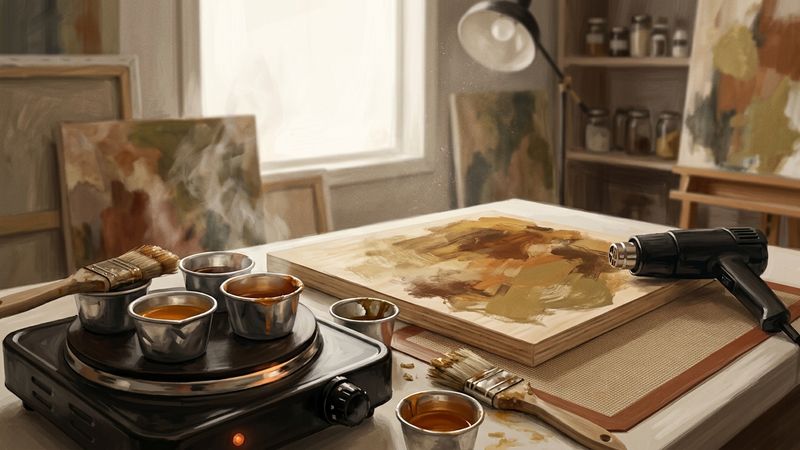
What Is Encaustic Painting?
Hot beeswax, damar resin and pigment on rigid panels: Fayum portraits, Jasper Johns, and how artists fuse, layer and conserve wax paint today
Encaustic painting binds dry pigment in heated beeswax (often with damar resin), applies it to a rigid support, and fuses each layer with a heat gun or iron. This guide walks materials, studio safety, layering and fusing, Roman Fayum portraits, Jasper Johns's Flag, and what makes wax film fail in heat or UV.
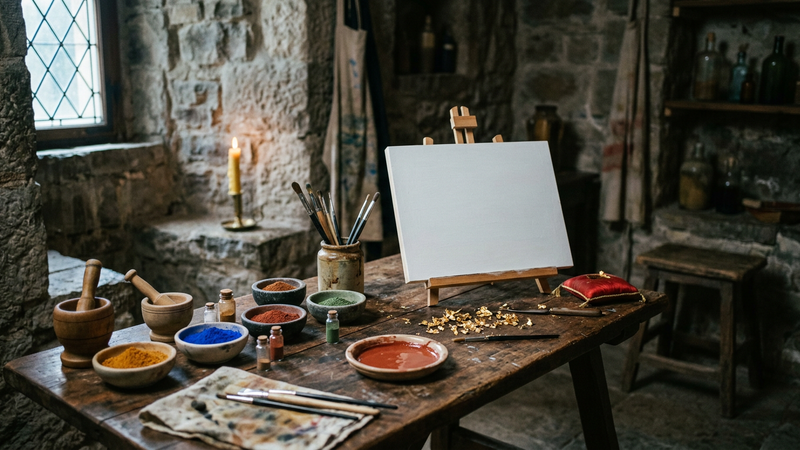
Icons and Icon Painting
How Byzantine sacred panels were made, used in liturgy, and argued over from Sinai workshops to the later Orthodox world.
A museum-led guide to Byzantine icons as practice and image theology: how panels and gold grounds work, what Iconoclasm changed after 843, four works to study at close range, and how the type travelled into Rus, the Balkans and Western painting without turning the piece into confessional debate.