
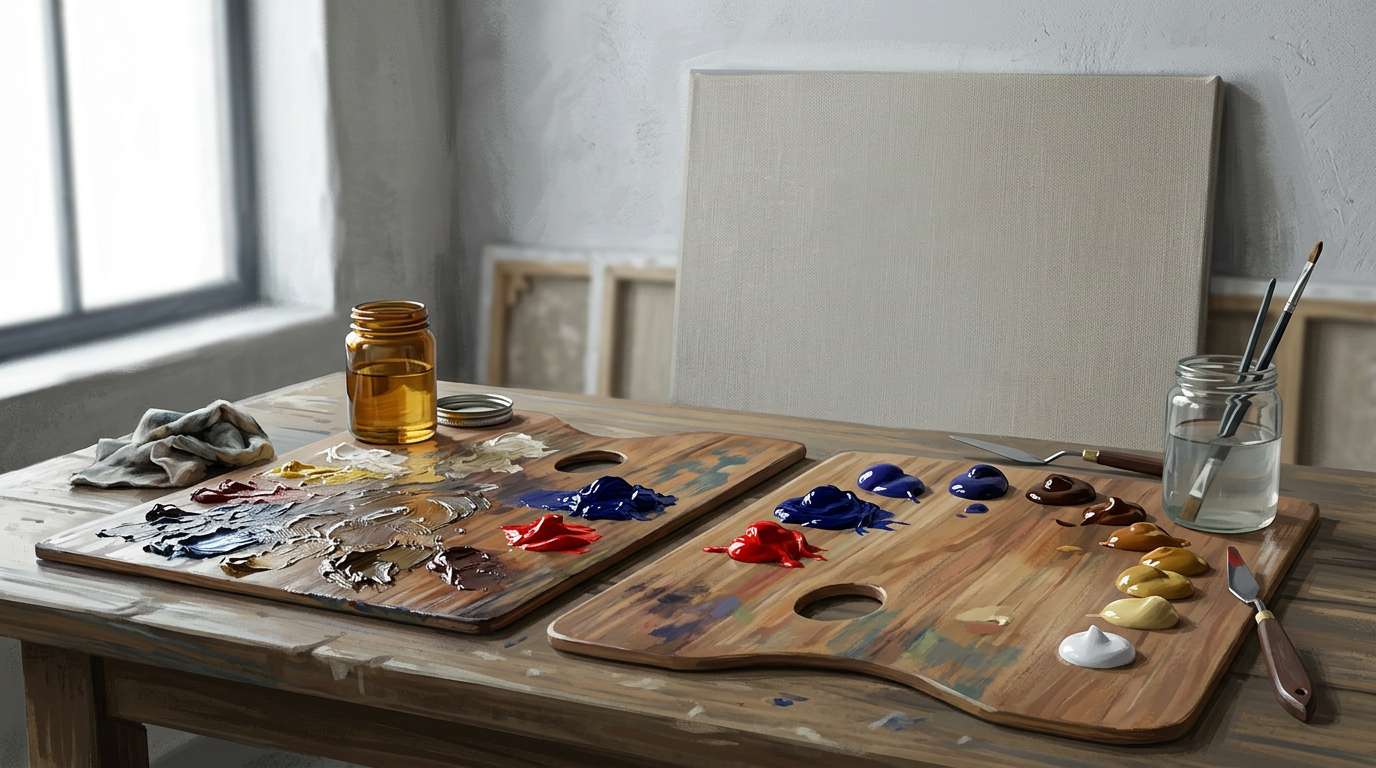
Exhibo Editorial
Oil vs Acrylic Paint
Binders, drying chemistry, glazing and conservation through museum examples, from van Eyck’s oil films to post-war acrylic on canvas
Oil paint and acrylic paint both carry pigment in a binder, but the binders obey different chemistry. Oil paint suspends pigment in a drying oil, usually linseed, walnut or poppy. The film hardens slowly as the oil takes up oxygen and cross-links. Acrylic paint suspends pigment in an acrylic polymer emulsion carried by water. The film forms as water evaporates and the polymer particles coalesce. You can layer both on primed canvas or panel. You cannot swap their rules. Oil stays wet long enough to blend on the palette and on the canvas; acrylic locks within minutes unless you add retarder or keep the palette misted. Oil rewards fat-over-lean sequencing and thin glazes; acrylic favours direct handling, fast revisions, and additives when you want oil-like open time.
This page belongs to the Art Techniques & Materials series. It compares two Western easel-painting systems that share a label line on museum walls ("oil on canvas," "acrylic on canvas") but diverge in workshop practice and in how conservators treat ageing films. Gouache, a water-based opaque cousin of watercolour, sits beside them in the same cluster. When you want to see how either medium behaves on a real object, the museums directory lists collection pages for the institutions cited below. Impasto, the thick-bodied brushmark technique often associated with oil, has its own entry at what is impasto.
Binders, vehicles and what each paint actually is
Both paints are pigment plus binder plus vehicle, but the words point at different substances. In oil paint the binder is the drying oil itself. Linseed oil dominates artist ranges because it dries at a practical rate and forms a durable film. Walnut and poppy dry more slowly and yellow less, which suits pale passages. The vehicle is the same oil, thinned with turpentine or odourless mineral spirits when the painter wants a lean layer. In acrylic paint the binder is an acrylic polymer (polymethyl methacrylate and related copolymers appear in tube ranges). Water is the vehicle for standard emulsion acrylics. The manufacturer adds surfactants, defoamers and thickeners so the emulsion stays stable in the tube and flows from the brush.
Pigment load varies by brand and colour index, not by the oil-versus-acrylic split. Both media can carry cadmium, phthalocyanine, iron oxide and modern quinacridone. Student ranges in either family use more filler and less pigment. The binder choice changes how that pigment reads after drying, how fast you must work, and what solvents touch the film later. That is the comparison worth making. A list of "pros and cons" without chemistry repeats what the tube label already states.
How oil films dry
Oil paint does not dry by evaporation alone. The drying oil polymerises: it reacts with oxygen at the surface and the reaction propagates through the film over days, weeks and months. Touch-dry can arrive in a day or two depending on thickness, pigment, temperature and medium additives. Full cure takes far longer. Old master paintings in the National Gallery and the Rijksmuseum still carry microscopically mobile fractions in deep fat passages centuries on, which is one reason conservators speak of "young" varnish on "old" paint.
Because drying is oxidative, fat layers (more oil relative to solvent) should sit over lean layers. The studio rule "fat over lean" prevents a fast-drying lean stratum from cracking when a slower, fatter layer above it moves. Lead-based driers, historically common, accelerated the process. Modern health regulations removed lead from most artist oils, and conservators now track new instability in some twentieth-century oil films where driers and semi-drying oils interact badly. The Getty Conservation Institute's Modern Oils Research Consortium documents water sensitivity and soft surface skins on modern oil paintings, a problem distinct from the craquelure you expect on nineteenth-century oils.
How acrylic films dry
Acrylic emulsion paint dries in two visible stages. Water evaporates first; the paint feels touch-dry within minutes to an hour for thin films. Then the polymer particles deform and fuse into a continuous plastic film, a process called coalescence. Retarders, open acrylic mediums and humid air extend stage one. They do not turn acrylic into oil. Once coalescence completes, standard acrylic is insoluble in water even though you thinned it with water while wet.
The Getty's Conservation of Acrylic Painted Surfaces (CAPS) teaching materials note that artist acrylics have been available since the 1940s: first solvent-borne solution acrylics, then water-borne emulsions that artists adopted widely from the 1950s onward. Surfactants in the emulsion can migrate toward the surface as the film ages, which affects gloss and makes dirt adhere tenaciously. Cleaning an acrylic painting with the wrong aqueous solution can disturb that surface. Conservators treat acrylic as its own class, not as "fast oil."
Drying time, open windows and what you can do in one session
Drying governs every other difference. If you need to soften an edge, scrape back, or merge two wet passages, oil gives you hours or days on a standard studio session. Acrylic gives you minutes unless you intervene. Oil painters speak of the "open window." Acrylic painters speak of "work wet" or accept that the next pass will be on a dry, slightly grabby film.
Alla prima painting, the direct wet-into-wet method used from Frans Hals to contemporary portrait painters, exists in both media but feels different. In oil, alla prima can mean a single long sitting with the whole canvas alive. In acrylic, alla prima often means large brushes, retarder, and a willingness to let earlier passages set while you attack later ones. Neither approach is superior. Each matches a temperament and a subject. Landscape painters chasing changing light often prefer oil or open acrylic. Illustrators shipping tight deadlines often prefer standard acrylic.
Touch-dry misleads beginners in both families. An acrylic that feels dry to the finger may still be vulnerable to soluble film disruption at the surface. An oil that feels dry on top may still be mobile underneath. Varnishing too early traps solvent or moisture. Manufacturer literature for both media typically advises waiting weeks to months before final varnish, longer for thick oil.
Layering, underpainting and the fat-over-lean rule
Layering is where the two paints diverge most sharply in practice. Traditional oil technique builds from lean underpainting toward fatter, more resinous or oily upper layers. A common historical sequence runs: toned ground, charcoal or thin imprimatura, dead colouring in lean paint, working up in body colour, glazing in translucent oil-rich layers, then varnish after sufficient cure. Jan van Eyck and his Netherlandish peers pushed that system toward microscopic detail in oil on oak panel. Rembrandt's late portraits at the Rijksmuseum show dark grounds, scumbled lights, and glazed shadows accumulated over sittings separated by drying time.
Acrylic accepts layering, but the physics differ. Each new layer sits on a plastic film that is already largely fixed. You can paint over dry acrylic within hours. Adhesion is generally good if the surface is clean and not overly glossy. Acrylic does not use fat-over-lean because there is no oxidative drying gradient between layers. Instead you watch for "locking in" mistakes: a dry underlayer that reads too dark once a semi-transparent overpass goes down, or a surface that turns rubbery if you add too much retarder in multiple strata without cure time.
Underpainting in oil
Oil underpainting can be monochrome grisaille, earth-tone dead colour, or a full value map in lean paint. Titian's workshop and later Venetian painters were famous for building hue in glazes over a prepared underpainting. The National Gallery's technical bulletins on sixteenth-century Italian panels describe preparatory layers of gesso and toned ground before oil application. Underpainting in oil buys planning time: you can leave a grisaille to dry thoroughly before colour passes.
Acrylic underpainting serves the same compositional purpose with less waiting. Painters often execute a fast acrylic sketch on gesso, then switch to oil for upper layers only if the ground is compatible and properly sealed. That hybrid route appears in contemporary atelier teaching. Pure oil over unsealed acrylic can fail adhesion if the oil cannot key into a stable substrate. Product literature from major paint makers specifies which acrylic grounds accept oil overlays.
Layering in acrylic
Acrylic layering favours direct accumulation: opaque passages, scumbles while the film is still open, then detail with smaller brushes. Transparent acrylic glazes exist (fluid mediums, high-flow paints), but they dry quickly and can look streaked if you revisit them wet. Open mediums extend working time; glazing liquid increases transparency without the same body as oil glaze.
Because acrylic films remain flexible, they tolerate canvas movement better than aged oil in some cases. Thick acrylic built in one session without medium can crack if the top dries before the bottom coalesces. Manufacturers recommend thin layers first, then body. The failure mode differs from oil's top-down craquelure but still rewards patience.
Glazing, transparency and colour shift
Glazing is the application of a transparent or semi-transparent colour over a dry or semi-dry layer so the underlayer shows through and modifies hue. Oil glazing is the historical default for luminous shadow and skin tone. Vermeer's small oeuvre at the Mauritshuis depends on thin oil films over light grounds: the pearl in Girl with a Pearl Earring (c. 1665) reads from a grey underpass plus scumbled highlight, not from a single opaque stroke.
Oil glazes use pigment in a medium-rich, low-pigment-load mix. They dry slowly, which lets the painter even the passage with a soft brush. Multiple glazes deepen colour without mud if each layer is thin and lean enough relative to what sits below. The cost is time and the risk of sinking (a matte patch where oil is absorbed into an underlayer).
Acrylic glazes dry fast and tend toward a more even, plastic-looking surface unless you add matting agents or work on a toothy ground. They are excellent for graphic transitions and flat colour fields. Roy Lichtenstein's Whaam! (1963, Tate T00897) uses Magna, an early solvent-borne acrylic, on canvas: crisp Ben-Day dots and hard edges depend on sharp, dry overlays rather than wet-into-wet oil blending. When you stand in front of the painting at Tate Modern, the medium supports mechanical clarity.
Colour shift on drying differs by medium. Oil often darkens slightly as linseed-rich films clarify. Acrylic emulsion frequently dries darker than its wet appearance because the refractive index changes when water leaves. Manufacturers sell "wet" viewing aids and retouching varnishes so painters can judge value on an open acrylic session. Neither medium lies about value forever; each shifts on cure, and photographers of art know to wait before documentation.
If you copy a master glaze recipe from a book, check which medium it assumes. A terre verte dead layer over vermilion, common in portrait manuals after the eighteenth century, expects days between passes. An acrylic version of the same hue sequence can be done in an afternoon, but the optical depth comes from transparency and ground colour, not from waiting. Johannes Vermeer's limited output at the Mauritshuis is almost entirely oil on canvas over light grounds; the grey behind the pearl in Girl with a Pearl Earring (c. 1665) is part of the glaze logic. You cannot reproduce that schedule with student acrylic and a hair dryer without accepting a different surface character.
Surface body, tooth and impasto
Surface body describes how thickly paint sits on the support and how much brush or knife mark remains visible. Oil paint straight from the tube can hold stiff peaks. Cold wax medium, alkyd gel and traditional impasto techniques let painters stack paint without slumping for longer than acrylic straight from the tube, because oil stays movable. Rembrandt's The Conspiracy of Claudius Civilis (1661–62, National Gallery of Sweden, fragment of a larger commission) shows wet-into-wet handling in the beard and cloak where loaded brushwork stayed open.
Acrylic can be built up with heavy gel mediums, molding paste and thick body gels. The peaks hold because the polymer sets fast. The look differs: acrylic impasto often reads sharper at the ridge, less buttery in transition. For a full treatment of knife work, ridge shadow, and historical examples from Van Gogh onward, see the impasto article in this series (what is impasto).
Neither medium owns texture. David Alfaro Siqueiros, Jackson Pollock and other mid-century painters used commercial enamels and house paints that behave unlike tube oils. Pollock's Number 31, 1950 (1950, MoMA) is enamel on unprimed canvas: dripped, not brushed impasto in the Rembrandt sense. The lesson for comparison is that "oil versus acrylic" on a label collapses industrial alkyd, artist oil, and artist acrylic into three families with overlapping visual outcomes.
Supports, priming and studio safety
Supports overlap: cotton or linen canvas, wood panel, paper, board. Oil on raw linen risks oil seeping into fibres and rotting fabric over decades. Traditional practice sizes with rabbit-skin glue or modern PVA size, then primes with oil ground or acrylic gesso. Acrylic adheres to acrylic gesso readily; many contemporary painters use acrylic gesso under both media. Oil on acrylic gesso is standard in art schools if the gesso is labelled compatible and fully cured.
Rigid supports suit both media. Oil on panel was the norm before stretched canvas dominated easel painting. Acrylic on panel is common for small works and illustration. Paper works for acrylic and for oil if sized and primed; oil on lightweight paper without prep is a conservation liability.
Studio safety splits the media. Acrylic cleanup uses soap and water while wet. Dry acrylic resists water but avoids the chronic solvent exposure of a classical oil studio. Oil painting traditionally requires turpentine or mineral spirits for thinning and brush cleaning, plus ventilation for solvent vapour. Some painters use water-mixable oils to reduce solvent load; those are modified oils, not acrylics, and they follow oil drying rules. Rags soaked in drying oil can combust if piled; acrylic rags are messy but not oxidising fire hazards in the same way.
The mid-twentieth-century shift from oil dominance to acrylic adoption
For five centuries of European easel painting, oil was the default fine-art binder for portable pictures. Fresco, tempera and distemper persisted in niches, but oil on panel and canvas carried portrait, history and landscape markets from the sixteenth century through the nineteenth. The twentieth century added industrial coatings, house paints, and synthetic polymers that artists borrowed for speed, flatness and scale.
Solvent-borne acrylic solution paints appeared in the 1940s. Leonard Bocour and Sam Golden marketed Magna and, by the mid-1950s, water-borne Liquitex ranges that artists could dilute with water instead of spirits. Getty teaching materials date widespread artist use of acrylic emulsions from that post-war decade. Acrylic matched new interests: hard-edge abstraction, colour-field stain, commercial illustration, mural scale with less solvent.
Oil did not vanish. Lucian Freud worked in oil until his death in 2011. Gerhard Richter moves between oil and other media depending on series. The shift was plural: acrylic joined the studio as a primary option, not a universal replacement.
From commercial paint to gallery wall
Before artist tubes caught up, painters tested industrial products. Pollock's enamel pours, Siqueiros's Duco experiments, and Picasso's household enamels (documented in Getty publications on modern paints) show artists choosing binders for behaviour, not for academy categories. Conservators now analyse those works with pyrolysis-GC-MS and FTIR because the binder may be nitrocellulose, alkyd or acrylic, not traditional linseed.
By the 1960s, Pop and Colour Field painters had artist-grade acrylics with reliable pigments. Magna let Lichtenstein mask and spray. Water-borne heavy body acrylic let Helen Frankenthaler adapt stain techniques she had pioneered in thinned oil on unprimed canvas in Mountains and Sea (1952, National Gallery of Art, Washington). That earlier picture is still oil and charcoal on canvas: thinned paint soaked into sized cotton duck, leaving a halo at the edge of each pour. When Frankenthaler moved toward acrylic emulsions for similar soak behaviour, she gained repeatability and faster tack without abandoning the idea that canvas could be a field rather than a screen for illusion.
Hockney adopted fast-drying acrylic in California for swimming-pool pictures such as A Bigger Splash (1967, Tate T03254), where crisp white lines and flat blue read as graphic fact, not atmospheric glaze. British-born, Los Angeles-based, he valued acrylic for photographs translated to paint: hard sun, flat planes, telephone poles. His later return to oil in some portrait series does not undo the 1960s argument; it shows a painter choosing binders per project rather than per loyalty oath.
Who stayed with oil, who pushed acrylic
The split is instructive. Freud's Benefits Supervisor Sleeping (1995, private collection, frequently exhibited) depends on oil's slow rework: flesh built over months, scraped and repainted. Hockney's acrylic pools depend on fast lock and masked edges. Both are figurative. The medium choice serves different optical goals.
Abstract painters divided similarly. Morris Louis and Frankenthaler pushed thin liquid colour into raw canvas fibres (oil and acrylic phases of the same idea). Bridget Riley's early Op Art is largely acrylic emulsion on canvas for flat, stable colour. Older masters in museum collections remained oil for market and habit: Andrew Wyeth worked egg tempera and watercolour as well as oil, but not acrylic as a primary.
Four museum works read through the medium
Definitions settle when you test them on named objects with catalogue numbers.
Jan van Eyck, The Arnolfini Portrait, 1434, National Gallery London (NG186). Oil on oak panel. The medium allows thin, translucent browns in the mirror frame and glowing greens in the dress. Panel size (~82 × 60 cm) suits oil's slow build without the sag of a huge wet canvas. This is pre-acrylic history, but it sets the optical standard many acrylic painters still chase with glazes and mediums.
Rembrandt van Rijn, The Night Watch, 1642, Rijksmuseum, Amsterdam. Oil on canvas. A large commission built with scumble, glaze and impasto in passages such as the golden girl's dress. The canvas has been trimmed and varnished repeatedly; conservation records document varnish removal campaigns. The work shows oil's capacity for scale when the workshop plans drying stages across the surface.
*Roy Lichtenstein, Whaam!, 1963, Tate (T00897).* Magna (acrylic) on canvas, two panels. Hard edges, primary colours, and Ben-Day dots depend on a medium that dries quickly without yellowing seams between masked areas. Compare to oil comic pastiches from the same decade: the acrylic surface stays matte-mechanical.
David Hockney, A Bigger Splash, 1967, Tate (T03254). Acrylic on canvas. Flat sky and pool, white splash built with quick strokes over blue underpass. The Tate label lists acrylic explicitly. The picture argues for California light as graphic design; oil might have merged edges overnight.
Standing in those galleries (or paging through official collection photography on museum sites linked from the museums directory) trains the eye better than any table.
Conservation, ageing and what changes over decades
Conservators treat oil and acrylic as different ageing problems. Traditional oil paintings accrue yellowed varnish, dirt in craquelure, and bloom on varnished surfaces. Structural issues include canvas slack, tear, and flaking where ground and paint lose adhesion. Cleaning often means solvent gels that dissolve varnish without attacking pigment, a skill honed on Old Masters.
Acrylic paintings from the 1960s onward present surface dirt that bonds to migrated surfactants, making aqueous cleaning risky. CAPS research at the Getty developed tailored systems because plain water or aggressive solvents both fail on some acrylic films. Acrylic is flexible, which reduces some canvas tensions, but heat and cold during transport can still stress thick gel builds.
Modern oil paints (twentieth and twenty-first century) add new faults: water-sensitive passages, sticky exudates on the surface, and soft skins on impasto, documented in the Getty newsletter on cleaning modern oil paints. Removing lead driers from commerce changed curing behaviour. Conservators cannot assume a 2010 oil painting will age like a 1710 oil painting.
Varnish philosophy differs. Many contemporary acrylic painters choose not to varnish, or use removable conservation varnishes in thin coats. Oil traditions often assume a final varnish layer for even gloss. Retouching follows the same split: oil retouching uses stable pigments in a medium matched to the original; acrylic retouching must respect the plastic film's sensitivity.
Light exposure affects both families. Organic pigments in oil and acrylic can fade if hung in direct sun, though museum glazing filters UV. Oil films yellow in dark storage if varnish is absent or if medium-rich passages exude. Acrylic films can pick up airborne grime in urban flats, which is why Tate and other institutions document cleaning tests on donated studio samples, not only on masterpieces. If you own work in either medium, stable relative humidity and avoidance of rear heating pipes matter more than the binder name on the receipt.
For deep conservation protocols (humidity set points, lining ethics, flood response), the S23 conservation cluster will go further. Here the practical reader note is simple: medium choice commits the work to a maintenance profile. Collectors storing work in attic heat treat acrylic and oil differently, but both hate rapid swings.
Oil vs acrylic: comparison table
| Property | Oil paint | Acrylic paint |
|---|---|---|
| Binder | Drying oil (linseed, walnut, poppy typical) | Acrylic polymer emulsion (PMMA and copolymers) |
| Vehicle / thinner | Oil; thinned with turpentine or odourless mineral spirits | Water while wet; specialty mediums when dry |
| Drying mechanism | Oxidative polymerisation of the oil | Water evaporation, then polymer coalescence |
| Touch-dry (thin film, room conditions) | Often 6–48 hours; pigment and medium dependent | Often 5–30 minutes |
| Full cure before varnish (manufacturer guidance) | Weeks to months; longer for fat impasto | Days to weeks; longer if heavy gel build |
| Classic layering rule | Fat over lean; slow glazes over fast underlayers | Thin layers first; no fat-over-lean; mind fast lock-in |
| Typical dry surface | Satin to glossy; yellowing of linseed over decades | Matte to satin; plastic clarity; less yellowing |
| Glazing character | Slow, even, historically central to Old Master depth | Fast, can streak; strong for graphic and flat fields |
| Flexibility of cured film | Becomes brittle with age; craquelure common on canvas | Remains flexible; less craquelure, more dirt adhesion issues |
| Support prep for long life | Sized and primed; oil on raw fabric risky | Acrylic gesso common; bonds well to cotton/linen |
| Studio solvent exposure | Higher if using spirits for wash and thin | Low; soap and water while wet |
| Artist adoption timeline | Dominant easel medium c. 1400s–mid-1900s | Artist emulsions widely used from 1950s onward |
| Typical conservation focus | Varnish removal, craquelure, yellowed medium | Surfactant migration, water-sensitive cleaning, surface dirt |
| Entry-level tube set (typical UK retail, 2024–25, indicative) | Often £40–£80 for 8–12 tubes student range | Often £25–£60 for 8–12 tubes student range |
Figures in the last row shift by brand and sale; they mark order of magnitude, not a buying guide.
Typical costs today without turning into a shopping guide
Material cost favours acrylic at student level because the binder system is cheaper to manufacture and cleanup needs no spirits. Professional ranges converge: high-pigment oil and high-pigment acrylic both price by series (cadmiums cost more than earths). Supports cost the same whether you paint them in oil or acrylic: stretched canvas, linen, and cradled panels dominate spend for serious work.
Hidden costs differ. Oil painters buy mediums, solvents, varnishes, and ventilation or solvent-safe waste disposal. Acrylic painters buy retarders, gels, and occasionally isolation coats. Time has a price: oil portraits that need drying between sittings tie up studio space. Acrylic illustration that ships next day rewards fast cure.
Commission pricing in the market reflects labour, reputation and size more than binder. A Freud oil and a Hockney acrylic have sold at comparable auction magnitudes for unrelated reasons. This article stops at the studio ledger: expect to spend slightly more maintaining an oil practice in solvents and waiting time; expect to spend slightly less on entry tubes for acrylic if you already paint on shared gessoed boards.
FAQ
Can you mix oil and acrylic paint in the same layer?
Not in one wet mix: oil and water-borne acrylic repel like salad dressing. Standard practice is acrylic under oil, never oil under acrylic, if you combine them at all. Seal a fully cured acrylic underpainting and ensure the ground is compatible before oil passes. Even then, manufacturers warn that flexibility mismatch can cause adhesion failure as films age. Purists stick to one binder per object.
Which dries faster, oil or acrylic?
Acrylic dries faster to the touch in almost all normal studio conditions. Oil continues to polymerise for months. "Fast-drying" alkyd oils and mediums shrink the gap but do not match acrylic minutes.
Did Bob Ross use oil or acrylic?
Bob Ross taught wet-on-wet oil painting on television, using a modified oil technique with liquid white and other proprietary mediums. His on-air method is oil-based, not acrylic emulsion.
How can you tell an oil painting from an acrylic on a gallery wall?
Labels are the first source: museums state the medium. Visually, undated work is harder. Rake light shows craquelure patterns more typical of aged oil. UV examination (conservators, not visitors) can distinguish some modern films. Acrylic on unvarnished canvas often feels uniformly matte-plastic; varnished oil can read deeper gloss. When unsure, ask the gallery for the catalogue entry rather than guessing from a JPEG.
Is oil or acrylic better for beginners?
Art schools disagree. Acrylic lowers solvent exposure and speeds feedback loops. Oil teaches blending and value control in a forgiving wet window. Beginners choose based on ventilation, budget, and whether they mind waiting for layers. Neither is morally superior; both produce durable work when supports are prepared and fat-over-lean or acrylic thin-layer rules are respected.
Why do some artists refuse acrylic?
Reasons vary: preference for oil's blend time and depth, dislike of fast lock-in, distrust of plastic appearance, or habit from training. Some artists reject acrylic for environmental reasons tied to microplastics discourse; others choose acrylic for lower solvent use. The refusal is aesthetic and procedural, not a law of materials.
Do professional artists use acrylic?
Yes. Museum collections include acrylic on canvas from Lichtenstein, Hockney, Riley, and contemporary painters worldwide. Illustration, mural, and design trades use acrylic heavily. "Professional" describes practice and output, not binder snobbery.
What about water-mixable oil paint?
Water-mixable oils are modified drying oils that accept water in the wash cup through emulsifiers. They dry by oxidation like traditional oil. They are a third category, useful for solvent reduction, not a substitute for acrylic chemistry.
Related reading
Curating Tomorrow's Archive: Hamburger Kunsthalle Seeks Contemporary Collections Lead
A new permanent appointment will steer the museum's post-1960 holdings across paper, photography, and media formats.
The Hamburger Kunsthalle is inviting applications for a senior curatorial position focused on contemporary acquisitions, exhibition strategy, and digital collection management. Applications close October 2026 for a January 2027 start.
Whilst We Are Savages: Colonial Constructs and Atlantic Dialogues
A critical survey at TEA Tenerife exploring how colonial frameworks shaped identity, territory, and knowledge across Europe, Africa, and Latin America.
William Morris Gallery Reopens With Intimate Restoration and New Focus
A comprehensive overhaul at the Walthamstow venue explores the designer's contradictions through newly displayed archives and a domestic curatorial approach.