
Exhibo Editorial
What Is Impasto?
Thick paint, knife and brush: binders, drying chemistry, Van Gogh to de Kooning, cracking modes, and studio costs today
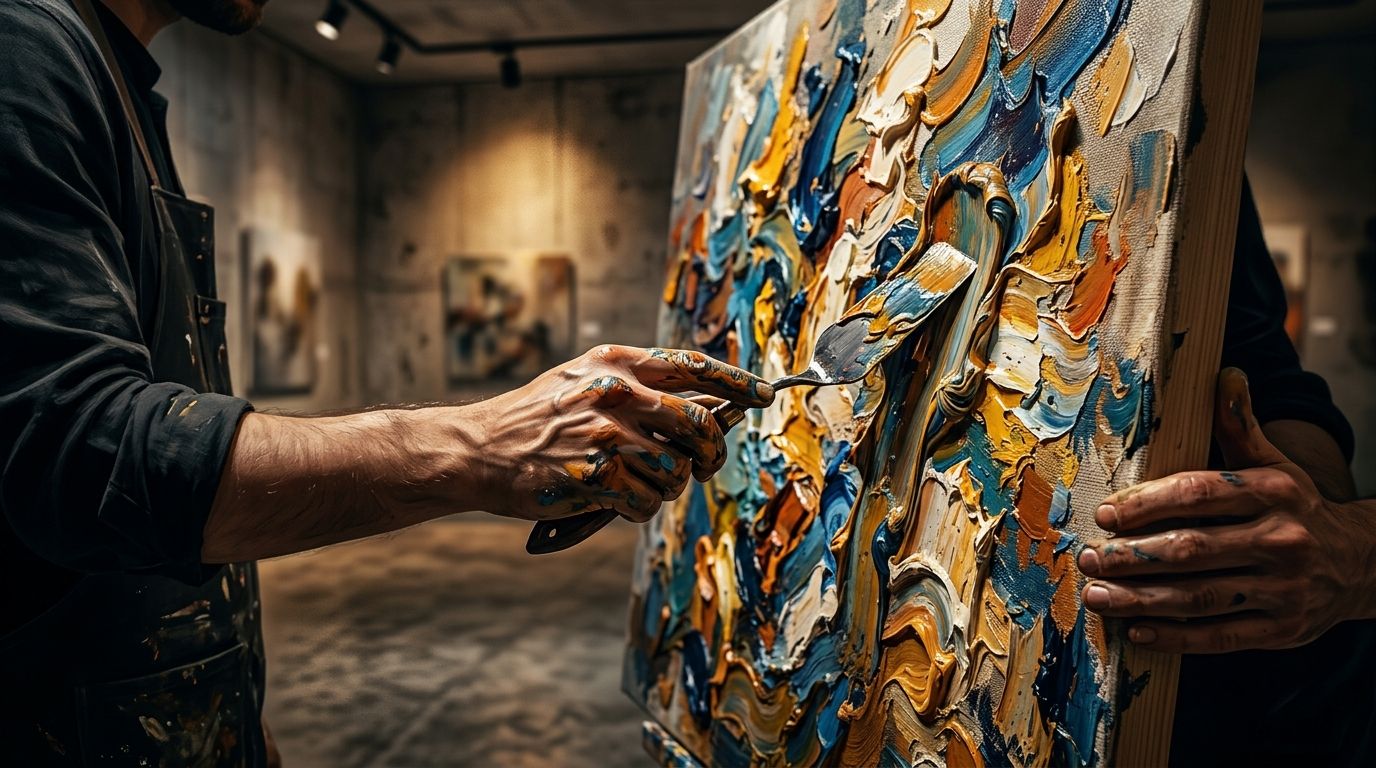
Impasto is a painting technique in which the artist applies pigment so thickly that the dried film stands above the support and keeps the trace of the tool that put it there. The Italian word impasto means paste or dough. In studio speech it names a physical fact about the paint layer, not a mood or a subject. You can see impasto under raking light as ridges, facets and cast shadows on the paint itself. You can photograph it as a landscape of peaks. Museum labels attach the term to Van Gogh's sunflower seed heads, Rembrandt's late lead-white face, Courbet's knife-worked waves and Willem de Kooning's encrusted Woman I at MoMA.
The method depends on binder chemistry. Oil paint dries by slow oxidation and can hold body for days. Acrylic coalesces within hours unless you add retarder or gel. Either medium can carry impasto if you load it heavily or mix it with a thickening medium. The sibling guide Oil vs Acrylic Paint compares those binders across glazing, fat-over-lean sequencing and conservation. This page stays with relief application: materials, process, history, failure modes and cost. The cluster hub is Art Techniques and Materials. Named works below sit in collections you can locate through the museums directory.
What impasto means in painting
In catalogues and wall text, "impasto" usually describes paint applied thick enough that the surface topography becomes part of how you read the work. Tate's art-term entry treats impasto as an area of thick paint or texture that becomes increasingly notable from the nineteenth century onward, when painters began to insist that the canvas surface should have its own reality rather than act as a smooth window into an illusion beyond it. MoMA's glossary defines impasto as paint thickly laid on a surface so that brushstrokes or palette-knife marks remain visible. Both definitions centre on process and material presence.
Impasto differs from adjacent words that students often merge. Painterly describes loose, visible handling that may or may not build high relief. Gestural emphasises the movement of the arm. Scumble is a thin, broken layer dragged over dry paint. Impasto is the measurable thickness of the film. A thin but energetic brushmark is gestural, not impasto. A ridge of tube colour left proud of the weave is impasto even if the stroke was slow and deliberate.
The technique also differs from the design element "texture" taught in foundation classes. Texture in that vocabulary covers actual surface relief and implied texture made with marks on a flat field. The elements guide What Is Texture in Art? (S1-06) sends readers here for the studio recipe: how to mix, load, dry and preserve thick paint. This article does not re-teach actual versus implied texture as an element. It assumes you already know that Van Gogh's Sunflowers (1888, National Gallery, London, NG3863) combines a depicted flower with a crust you could feel if touching were allowed.
Impasto can serve several jobs at once. Thick light paint catches real gallery illumination and throws micro-shadows, so highlights on jewellery, snow or flesh can glow without smooth blending. Directional knife facets can stand in for ripples, masonry or wind. In modern painting, raised paint became proof that the artist's hand and the medium itself mattered: truth to materials, in Tate's phrase, rather than concealment of the stuff behind a polished finish.
Search intent around what is impasto often arrives from a reproduction that looks sculptural on screen. Screens flatten relief. Standing in front of NG3863 or NG221, you see peaks pick up light from a different angle than the wall label photograph. That viewing lesson belongs here because impasto is partly a lighting effect. Museums angle spots to respect fragile surfaces without heating the paint. Copying impasto from a JPEG misses the raking highlight that makes a Rembrandt fold read as flesh.
Materials, binders and why thick paint behaves differently
Every impasto passage is pigment plus binder plus whatever medium the painter added. The binder governs open time, final gloss, flexibility and how the film shrinks as it cures. Thick layers magnify any mistake in that chemistry because the outer skin can dry while the interior remains mobile, and because shrinkage stress concentrates at peaks and at the edges of ridges.
Nineteenth-century tube paints made impasto easier at scale. Before portable metal tubes spread through Europe in the 1840s, painters ground colour in the studio and carried it in bladders or pots. Van Gogh's Arles letters praise the stiff consistency of new tube oils that hold a standing mark. Industrial grinding also standardised pigment particle size, which changes how much oil a given colour needs. Some pigments naturally lean short and buttery; others run long and slick. An impasto painter learns colour by colour behaviour, not only by brand marketing.
Oils, alkyds and drying chemistry
Traditional impasto is oil paint: pigment suspended in a drying oil, most often linseed. The film hardens when the oil absorbs oxygen and cross-links. That reaction needs air. In a thin wash, oxygen reaches the whole layer quickly. In a ridge several millimetres tall, the surface skins over while the core cures more slowly. Conservators and manufacturers both warn that fast-drying pigments layered over slow-drying ones can crack as the upper stratum shrinks over a still-soft lower one. The European Artists' Colours Association (EuACA) publishes best-practice guidance for thick oil work: build toward increasing flexibility in upper layers, place slow-drying colours over fast-drying ones, and allow adequate drying time before varnish.
Lead white historically anchored much Baroque and Dutch impasto. Rembrandt's Self Portrait at the Age of 63 (1669, National Gallery, London, NG221) carries very heavy applications of lead white on the face, turban and collar, with smoother handling elsewhere. National Gallery catalogue and conservation literature describe the face as modelled in three dimensions with swirled, heavily loaded brushwork and coagulated dabs for skin blemishes. Cross-section analysis shows thick white impasto over brown undermodelling and a quartz-based ground. Lead white dries relatively quickly and forms a stiff film, which suits ridges but carries toxicity concerns that keep it out of most student ranges today.
Modern oil painters extend body with impasto mediums: stand oil, wax pastes, alkyd resins, marble dust or silica in paste form. Alkyds polymerise more uniformly than raw linseed alone and can reduce the inner-core drying lag that causes wrinkling. Wax and cold-wax mixtures trade some flexibility for matte, paste-like drag on the knife. Each additive changes the refractive index of the film and therefore how saturated the colour looks when thick. Testing on scraps matters. A medium that feels perfect on day one can yellow, sink or crack on month six.
Acrylics, gels and modelling pastes
Acrylic impasto follows different timing. Standard emulsion paint dries by water evaporation and polymer coalescence. Heavy-body acrylic straight from the tube can hold short peaks. For taller relief, painters mix in acrylic gel medium, molding paste or granular pastes. Retarders extend open time; they do not convert acrylic into oil. Once coalesced, the film is a flexible plastic. Peaks survive well on rigid panels; on flexible canvas they can crack if the support moves or if the paste was too brittle.
Manufacturers caution about applying oils over glossy acrylic films without proper tooth and preparation. Golden Artist Colors' recent testing notes potential for cracking when certain oil colours sit over glossy acrylic grounds in heavy layers. If you combine media, follow current manufacturer guidance on ground type, matte versus gloss, and drying intervals. The oil vs acrylic sibling treats that crossover in more detail. For pure acrylic impasto, the practical rule is simpler: gel structure carries the weight; pigment supplies the colour; retarder buys minutes, not days.
Tools: brush, knife and surface preparation
Impasto is not tied to a single implement. Van Gogh used stiff bristle brushes and loaded dots for seed heads. Courbet switched between knife and brush within one passage, then smoothed with rag or sponge according to Art UK accounts of his technique. De Kooning scraped, sanded and repainted with house-painter's brushes and commercial oils. What the tools share is the capacity to deposit a wet mass that keeps its shape until the binder sets.
Choosing a tool changes the mark's geometry and the amount of air mixed into the paint. Brushes tend to produce directed strokes with slightly feathered edges where bristles thin out. Knives deposit planar facets with crisp shoulders. Squeegees and combs drag ribs. Fingers and rags push paint into unpredictable wedges useful for clouds or flesh transitions. None is more "correct." Each leaves a signature that conservators later read under magnification.
Palette knives and stiff brushes
Palette knives range from flexible trowels to rigid spatulas with cranked handles that keep knuckles clear of wet paint. A knife loads more colour per pass than a brush and compresses the stroke into a lamina with a clean break at the edge. Courbet's wave paintings, discussed in Art UK essays on his realism, use knife work to give breaking water a stone-like solidity. Critics in the 1850s called that handling materialist and crude because visible knife tracks broke academic smoothness. The insult named a technique preference that Realist painters turned into a virtue.
Stiff hog or synthetic bristle brushes in flat and bright shapes push thick colour without collapsing the stroke. Soft sables suit thin glaze, not standing impasto. Some painters leave brushmarks as short dabs, alla prima, working wet into wet. Others let a ridge set partially, then drag a dry brush across the top to break the highlight. Knife and brush often alternate in one session: knife for mass, brush for a softened transition or a drawn line at the ridge edge.
Grounds and supports that carry weight
Thick paint needs a ground that will not buckle. Stretched canvas on sturdy bars can hold moderate impasto if the primer is robust. Very heavy relief on flexible canvas risks cracking when the fabric breathes with humidity. Rigid panels (gessoed MDF, aluminium composite, traditional chalk ground on wood) give conservators' favourite support for extreme build-up. EuACA recommends high-pigment, strong primers for heavy oil impasto and notes texture pastes designed to establish a stable foundation before colour layers.
Sizing and ground absorbency matter. A thirsty ground steals oil from the first ridge and can leave a halo of sunken colour around peaks. A non-absorbent oil or acrylic ground lets strokes sit on the surface with full body but may need light sanding for adhesion of later fat layers. Commercial "impasto gesso" products add tooth and mineral filler. Whatever you use, label your stack: impasto weight on a weak ground is a common studio failure that shows up as cleavage rings around peaks within a few seasons.
How to build an impasto painting, step by step
Impasto rewards planning even when the final surface looks spontaneous. You are managing wet mass, drying order and the optical interaction of peaks under gallery lights. The sequence below is a workshop norm for oil; acrylic follows the same logic with shorter waits.
Start with a toned ground on a rigid or well-stretched support. Many painters use a mid-value imprimatura so gaps between ridges do not flash white. Draw or thinly indicate major masses in lean paint or charcoal sealed with fixative or a thin wash. Keep this layer lean: little extra oil, fast-drying earth colours if possible. The fat passages will sit above.
Block in big shapes with a knife or large brush, establishing where relief will live. Sky, flesh, flowers and water each get different peak heights in historical examples. Van Gogh pushed seed heads higher than background yellow in Sunflowers; Rembrandt reserved the thickest white for facial features and left the robe comparatively thin. Decide early which areas stay flat to avoid fighting the whole canvas for attention.
Work wet into wet while the binder allows merging at edges. Oil gives you hours to days depending on thickness, medium and climate. Acrylic gives you minutes unless retarded. If a ridge slumps, the load was too wet or the medium too fluid. Scrape back with a knife, adjust the mix, try again. De Kooning's Woman I (1950-52, Museum of Modern Art, New York) is the extreme case of that cycle: MoMA's collection entry and curator audio describe months of painting, scraping, sanding and repainting until the surface kept a battlefield topography of orange, blue, yellow and green strokes piled and revealed again.
Layer sequence and drying order
Fat-over-lean remains the oil painter's guardrail. Each successive layer should contain equal or more binder relative to solvent than the layer below. In impasto that rule collides with the desire for height in one sitting. Common compromises include: building height in two or three sessions rather than one monumentally wet tower; using quick-drying earths and umbers underneath slow-drying whites and reds; adding alkyd medium to upper ridges to harmonise cure through the thickness.
Colour drying order matters as much as fat-over-lean. Umbers and earths oxidise faster than many lakes and whites. EuACA lists manufacturer drying-time charts as essential reading. A fast umber ridge under a slow titanium white cap can crack as the top skin contracts. If you must invert the order for pictorial reasons, keep the upper layer thin or accept hairline traction cracks as part of the object's history, as conservators do on many nineteenth-century landscapes.
Allow partial set between major build-ups. A ridge that feels touch-dry may still be mobile underneath. Oil on canvas can take months to years to fully cure in thick passages. Acrylic peaks touch-dry in hours but continue to harden. Rushing varnish traps solvent, softens ridges or pulls yellow from medium. Manufacturer guidance for both families typically advises weeks to months before final varnish on heavy work.
Finishing, drying and varnish timing
Finish by stepping back under the light you expect the work to live under. Gallery spots raking across impasto reveal strokes you miss under flat ceiling fluorescents. Adjust peak heights sparingly; every new wet lump resets drying clocks. Some painters dry-brush a broken colour over set ridges to unify temperature without adding bulk.
Store drying impasto flat if possible, away from dust that embeds in tacky peaks. Dust on wet impasto is nearly impossible to remove without solvent and local flattening. Control humidity during cure: high humidity slows oil oxidation and can promote soft surfaces on acrylic. Varnish only when the film is fully cured. Spraying varnish from an angle avoids pooling in crevices. Brush varnishing across heavy relief needs a soft wide brush and light touch so peaks do not pick up and smear.
Historical development: from Venetian light to modern relief
Thick paint is old. Titian and Tintoretto in sixteenth-century Venice built passages of raised colour that catch light like jewellery on flesh and fabric. Tate's impasto entry begins there, then follows the technique through Baroque Rubens, nineteenth-century Constable and Romantic landscape, and into modern insistence on surface truth. Impasto did not appear full-born with Van Gogh. It intensified as tube paint, portable easel practice and changing ideas about finish converged.
Before tubes, impasto was selective. Rembrandt and Velázquez could load a highlight or fold while keeping the rest of the canvas comparatively smooth. That economy saved expensive pigment and reduced drying risk. Viewers experienced impasto as accent, not uniform carpet. The National Gallery's Rembrandt catalogue contrasts heavy lead white on face and collar with smoother hands and background in NG221, a split still visible in the gallery.
The National Gallery's Sunflowers audio description, written for blind and partially sighted visitors, names impasto explicitly and invites you to imagine stiff tube oil applied in dabs thick enough to imitate bristling seed heads. That institutional wording matters: impasto is not slang invented by bloggers. It is standard curatorial vocabulary tied to a dated support (1888, oil on canvas, 92.1 x 73 cm) and a named acquisition (Courtauld Fund, 1924). When the picture travels on loan, as scheduled in 2026, the peaks travel under climate-controlled crate rules because the crust is part of the object, not optional decoration.
Baroque and Dutch selective thickness
Dutch seventeenth-century painters used impasto tactically. Lead white and light ochres modelled linen, metal and skin. Dark passages often stay thin and transparent over brown ground. The Rijksmuseum's Dutch portraits, including Verspronck's crisp Portrait of a Girl Dressed in Blue (1641, SK-A-3064), rely more on smooth finish than on standing paste, which reminds you that impasto was never universal even within one school. When Rembrandt pushes volume in late self-portraits, the thickness reads as deliberate demonstration of skill and material knowledge as much as emotional confession.
Rubens and later Baroque painters used raised paint for flickering light on silk and armour. The stroke visible at arm's length merges into shimmer at viewing distance. That scale dependency still governs museum hang height. Impasto planned for a palace wall may overpower a domestic corridor.
Nineteenth-century landscape and tube paint
Constable's sketches, represented at Tate, carry open-air impasto that records cloud and leaf movement quickly. Courbet's Realism made knife texture ideological: visible paste insisted that paint is matter depicting matter. The Painter's Studio (1855, Musée d'Orsay, Paris) puts Courbet himself at the centre of an allegory of seven years of artistic life, with friends and critics on one side and "everyday life" on the other. The canvas scale matches history painting, but the handling rejects academic polish. When the jury rejected the work for the 1855 Exposition Universelle, Courbet built his own Pavilion of Realism to show it anyway.
Impressionists used broken impasto for optical mixing at a distance. Post-Impressionists pushed height again. Van Gogh's Provence period (1888-89) combines directional strokes and standing dabs. The Metropolitan Museum of Art's Wheat Field with Cypresses (1889, acc. 1993.132) is described in collection copy as distinguished by rich impasto in on-the-spot studies of cypresses. Van Gogh regarded it among his best summer landscapes and made studio versions afterward, including one in the National Gallery, London.
Artists who mastered impasto and what they wanted from it
Naming masters risks turning technique into hero worship. The point here is narrower: each painter used thickness to solve a specific visual or rhetorical problem. You can test that claim in front of the objects in major collections linked through museums.
| Artist | Key work (date) | Collection | Tool emphasis | What the thickness does |
|---|---|---|---|---|
| Titian / Tintoretto | Portraits and mythologies (c.1550-1590s) | Accademia, Venice; National Gallery, London; Prado, Madrid | Brush | Raised lights on flesh, velvet and metal catch candle and daylight |
| Rembrandt van Rijn | Self Portrait at the Age of 63 (1669) | National Gallery, London (NG221) | Brush, lead white | Models ageing skin and turban in relief; smooth elsewhere |
| Gustave Courbet | The Painter's Studio (1855) | Musée d'Orsay, Paris | Knife and brush | Asserts material presence; Realist manifesto scale |
| Vincent van Gogh | Sunflowers (1888) | National Gallery, London (NG3863) | Stiff brush, tube oil | Seed-head dabs as highest relief; directional petals |
| Vincent van Gogh | Wheat Field with Cypresses (1889) | The Met, New York (1993.132) | Brush en plein air | Cypress and field strokes read as wind and heat |
| Willem de Kooning | Woman I (1950-52) | MoMA, New York | Brush, scrape, sand | Figure rebuilt through layered, scraped impasto |
| Frank Auerbach | Head of E.O.W. I (1960) | Tate, London (T06682) | Heavy rebuild | Portrait carved by repeated scraping and repainting |
Rembrandt wanted selective truth of flesh under light. National Gallery education copy notes he may have studied his own ageing skin to perfect how he would paint clients' faces. Courbet wanted ideological friction with academic finish. Van Gogh wanted immediacy and a symphony of yellow in Arles interiors. De Kooning wanted to rescue the figure with Abstract Expressionist energy after years of abstract work; MoMA quotes him: "Flesh is the reason oil paint was invented."
Twentieth-century painters took impasto toward sculpture. Frank Auerbach and Leon Kossoff, cited in Tate's impasto essay, build portraits over months until the surface resembles geological strata. Jean Dubuffet's matter painting mixed sand and cement into paste. Jackson Pollock's drips are impasto of a different order: filaments and skins of enamel and house paint. The through-line is refusal to hide the medium.
How impasto fails, cracks and is treated in conservation
Thick paint fails differently from thin film. Peaks dry faster on the outside, stress concentrates at shoulders, and raised passages catch sleeves, dust and cleaning cloths. Conservators distinguish age craquelure (fine networks developed over decades) from drying cracks and traction cracks that appear when a upper layer shrinks over a slower layer below. Heritage conservation glossaries class severe traction cracking as alligatoring. Impasto can show both early and late.
The EuACA impasto guidance states plainly that outer layers can dry while inner layers remain partially fluid, leading to cracking, wrinkling and paint seepage (liquefaction) with conservation consequences. Research on drying oil paints published in Heritage Science (2022) measured shrinkage and brittleness increasing over decades; some films become stiffer than traditional glue grounds and can crack even without humidity cycling if shrinkage exceeds strain capacity. Thick ridges on rigid panels feel that stress at the peak first.
Mechanical damage is common. Impasto flakes when knocked. Lining a canvas (adding a second fabric support) presses on relief unless conservators use protective facing and hollow spacers. Handling rules in storage forbid stacking face-down. Cleaning must avoid abrading tops of ridges. Varnish removal on textured surfaces uses gels that limit mechanical action; a swab dragged across a peak can remove pigment as well as dirt.
National Gallery technical studies of Rembrandt NG221 include X-radiographs that reveal pentimenti in the turban and hands beneath the visible impasto. Cross-sections show white ridges partially covered by later background paint when Rembrandt reduced the turban height. Conservators treat those buried strokes as historical fact, not errors to excavate. The lesson for painters is that impasto records revision: scraping and repainting leave a geology conservators read decades later. De Kooning made that geology the subject.
MoMA's conservation studio videos on de Kooning emphasise how uneven thickness complicates treatment planning. Not every crack is treated. Stable craquelure integral to a work's history is often documented and left. Active flaking gets consolidation under magnification. Inpainting respects ridge topography rather than flattening it for retouching convenience.
For living painters, prevention beats repair: respect fat-over-lean and drying order, use appropriate grounds, avoid varnishing early, document mediums for future conservators. MITRA (Materials Information and Technical Resources for Artists, University of Delaware) and manufacturer technical sheets belong in the studio folder next to colour charts.
What impasto costs today: materials, labour and the market
Impasto spends paint faster than smooth painting. A single large knife load may equal several brushfuls of a thin passage. Titanium white and cadmium ranges cost more per millilitre than earths. Specialty impasto mediums, alkyd gels and archival moulding pastes add roughly £8 to £25 per 250 ml tube at typical UK retail (2025-2026 art-supply listings; treat as order-of-magnitude, not a quote). A modest 60 × 80 cm oil study with moderate relief can consume two to three times the tube volume of the same composition handled flat.
Time is the hidden cost. alla prima impasto finishes in one long session but still ties up drying space. Auerbach-style rebuilds measure sittings in months. De Kooning's Woman I absorbed roughly eighteen months of labour before MoMA acquired it in 1953. Commission pricing for heavy impasto portraiture in London and New York studio markets often starts in the low four figures GBP/USD for small works and rises steeply with scale and sitting count, though public price lists are rare and auction results mix fame with technique. This page does not offer investment advice. It notes that material intensity and studio hours precede market value.
Acrylic impasto can reduce waiting cost between sessions but not pigment volume. Gels add bulk cheaper than pure pigment paste. Shipping framed heavy impasto needs crating with face clearance; couriers charge on volumetric weight. Insurance valuations should note fragile peaks.
For learners, starter setups need not mirror museum masters: one rigid panel, a hog flat, a medium palette knife, a heavy-body white and three earths, plus a small jar of alkyd gel, teach the behaviour before you scale up. The oil vs acrylic guide helps choose binder first. Then visit a collection in the museums directory and compare peak height under raking light to reproductions online. The difference teaches more than any shopping list.
FAQ
What kind of paint do you use for impasto?
Oil paint is the historical default because it stays workable long enough to model ridges and oxidises into a durable film. Heavy-body acrylic with gel or molding paste suits faster work. In either case you need enough body to hold a peak; thin wash will not qualify as impasto no matter how visible the brushmark.
How do you make impasto?
Load stiff paint with a brush or palette knife onto a strong ground. Build height in stages if using oil, respecting fat-over-lean and faster-drying colours beneath slower ones. For acrylic, mix gel medium into pigment until the stroke stands. Allow proper curing before varnish. EuACA and manufacturer guides give drying-order charts for oils.
Is impasto the same as modeling paste?
No. Modeling paste (or molding paste) is usually an acrylic filler you shape before or under paint. Impasto is the thick paint layer itself, though artists may embed paste beneath pigment to establish relief. Paste alone is support engineering; impasto is coloured film.
Who is a famous artist who uses impasto?
Vincent van Gogh is the name most linked to the word in textbooks, especially in Sunflowers and cypress landscapes. Rembrandt, Courbet, Constable, Willem de Kooning and Frank Auerbach are standard museum examples with works in London, Paris, New York and Amsterdam collections.
Can you do impasto with acrylic paint?
Yes. Heavy-body acrylic straight from the tube holds short texture; gels and pastes extend height. Open time is shorter than oil unless you add retarder. Once dry, acrylic peaks are flexible plastic. Follow guidance if you plan oil layers on top.
Why does impasto crack?
Cracks form when layers dry at different rates or shrink unequally. A skinned-over ridge with a soft core stresses the film as it cures. Fast colour over slow colour, excessive medium imbalance, weak grounds and early varnishing all contribute. Some historical cracking is stable and accepted; active flaking needs conservator assessment.
Does impasto take longer to dry?
Thicker oil films take longer to through-dry than thin washes, sometimes months to years for deep ridges. Surface touch-dry can mislead you. Acrylic peaks skin quickly but benefit from days before stacking or varnishing. Humidity, pigment choice and medium affect both.
Is impasto only for oil painting?
Oil dominates art-historical examples, but acrylic, encaustic and even water-miscible oils support raised application. Each binder has its own drying chart and failure modes. The technique is defined by thickness and tool mark, not by a single medium brand.
Related reading
Kiasma Outlines a Robust 2027 Season Featuring Major Surveys and Prize Showcase
Helsinki's Museum of Contemporary Art Kiasma unveils a comprehensive schedule balancing institutional retrospectives, immersive solo projects, and regional award programmes.
The 2027 calendar at Kiasma positions spatial experimentation and critical historiography at the forefront of Nordic contemporary practice.
Ukrainian Museum Celebrates Half-Century With Community-Led Lobby Project
Molly Gochman transforms archive fragments into a projected collage marking five decades of cultural preservation
As the institution turns fifty, an immersive lobby installation invites locals to contribute personal artefacts, weaving private histories into a broader narrative of Ukrainian heritage and resilience.
When Defending Heritage Becomes a Crime: The Arrest of Iraqi Archaeologists
Whistleblowers targeted over corruption claims and controversial investment legislation
Detentions of leading experts raise alarms over censorship, rapid site clearance, and the future of Iraq's archaeological record.