
Exhibo Editorial
What Is Gouache?
Opaque watercolour on gum arabic and chalk, from Turner highlights to Matisse cut-outs, plus designer versus artist ranges
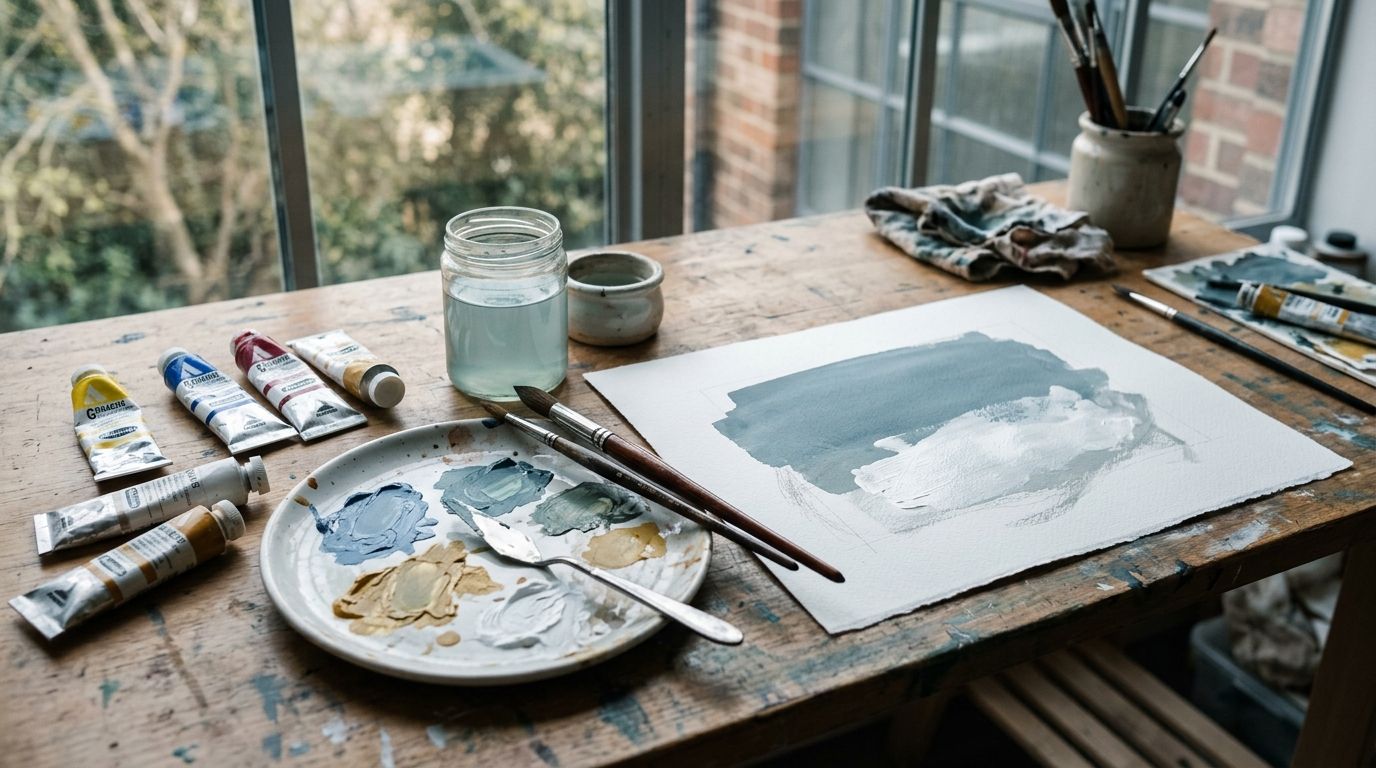
Gouache is an opaque water-based paint. Pigment sits in gum arabic, the same plant gum that binds watercolour, but the mix carries enough extra pigment and enough inert white filler (traditionally chalk or zinc oxide) that a single brushstroke hides the paper beneath. It dries to a flat, matte surface. Unlike acrylic, it stays water-soluble after drying, so you can lift, blend, or revive dried colour with a wet brush. Museums call many Indian and Persian miniatures gouache or bodycolour; European painters from Turner to Matisse used it for highlights, sketches, and, in Matisse's last decade, entire cut-out compositions.
This page belongs to the Art Techniques and Materials series. Oil versus acrylic covers polymer emulsion paints and their drying chemistry; this article stays with gum-bound water media. Transparent watercolour technique has its own materials logic; here the job is opacity, rewetting, and the split between designer and artist ranges. Collection pages for the museums named below sit in the museums directory.
Gouache defined: opaque watercolour
Tate's glossary states that the term gouache entered French usage in the eighteenth century for a paint made like watercolour (pigments in water-soluble gum) but with added white pigment to force opacity. Larger percentages of binder are used than in transparent watercolour, and inert fillers such as chalk may be added to increase covering power. The result is a thicker paint film that does not let the support show through.
English-language museum labels still use "bodycolour" for the same family of media. Bodycolour is any opaque water-soluble paint applied to paper or vellum, whether you call the wet paste gouache or not. A National Gallery label might read "watercolour and bodycolour" for a Victorian interior where the artist lifted room details in opaque white. A Tate Turner label might swap in "gouache" for the same material on a later sheet. Neither label is wrong. They reflect cataloguing habit and period vocabulary more than a chemical difference.
Bodycolour is the older, broader English term for any opaque water-soluble pigment. Artists have used bodycolour since at least the late fifteenth century, often with lead white until zinc oxide ("Chinese white") became standard in the nineteenth century. Today "gouache" and "bodycolour" overlap in museum labels. A Tate entry for J. M. W. Turner may read "watercolour and bodycolour on paper"; another Turner sheet reads "gouache and watercolour on blue wove paper." Both name an opaque gum-bound layer beside transparent wash.
The pronunciation follows French: roughly "gwash," rhyming with "squash." Etymology runs from Italian guazzo (puddle, wet mud) through French studio slang. That muddy root fits the paste you squeeze from a tube: denser than watercolour, softer than acrylic.
Gouache is not acrylic gouache. Brands such as Holbein Acryla Gouache and Turner Acrylig Gouache use an acrylic polymer binder. They dry waterproof and cannot be rewet like true gouache. They behave like matte acrylic. This article applies only to gum-bound gouache unless a label says otherwise.
Commercial ranges also sell "watercolour gouache" or "gouache watercolour" hybrids. Read the binder line on the tube. If gum arabic is the sole binder and the paint rewets, you are in the tradition this page describes.
Materials and chemistry
A tube of artist gouache is a suspension: fine pigment particles, gum arabic, water, and often a small amount of humectant (glycerine or honey in some recipes) to slow skinning in the palette. Opacity comes from two mechanisms working together: high pigment load, and a white or inert extender that scatters light in the dried film.
Paint chemists and conservators describe gouache as a water-medium system, not a separate pigment family. The same cadmium yellow or ultramarine you find in watercolour may appear in gouache from the same manufacturer, reformulated with more solids and less gum relative to watercolour in that colour line. Ralph Mayer's handbook classifies gouache under water-based opaque media alongside tempera and casein. The Getty Art and Architecture Thesaurus treats bodycolour as a technique/material flag for cataloguers. When you read a technical bulletin, look for binder percentage, pigment identification, and filler presence; those three fields explain most handling differences you will feel at the easel.
Gum arabic as binder
Gum arabic is the hardened sap of acacia species, soluble in water, insoluble in oil. It has bound watercolour since at least the medieval period and remains the standard binder for both transparent and opaque water media. When the water evaporates, the gum forms a continuous film that locks pigment on the paper fibres. Because that film redissolves in water, gouache remains reworkable. Acrylic polymer, by contrast, cross-links as it dries and will not release with plain water.
Conservators treat gum-bound paint as sensitive to humidity. The paper support expands and contracts with atmospheric moisture; a stiff, high-pigment gouache layer on top can crack, cup, or flake when the paper moves. That physical mismatch is one reason works on paper need stable storage, not just careful handling.
Chalk, zinc oxide, and the white that makes opacity
Traditional gouache owes its body to inert white fillers. Chalk (calcium carbonate) and blanc fixe (barium sulphate) increase volume without adding strong colour. Zinc oxide white, marketed from the nineteenth century as Chinese white, replaced lead white in many commercial ranges because lead carbonate darkens over time through reaction with sulphur compounds in the air.
Holbein, a major Japanese manufacturer, notes that its Designers Gouache selects naturally matte pigments rather than loading every colour with a universal whitening agent. Winsor & Newton's Designers Gouache range lists each colour's opacity rating (opaque, semi-opaque, transparent) in its permanence table. Transparent pigments used in gouache (some phthalocyanines, for example) stay semi-opaque at best; manufacturers compensate with filler or higher pigment load.
White gouache is its own studio tool. Turner scraped and stippled white bodycolour for spray and foam. Burne-Jones heightened watercolour with white gouache on The Garden Court (1870–75, Cleveland Museum of Art). The white is not a separate "highlighting fluid"; it is the same medium at full opacity.
Pigments and lightfastness
Artist gouache ranges (Schmincke Horadam, M. Graham, Holbein Artist Gouache, some Winsor & Newton lines) prioritise single-pigment colours and ASTM or manufacturer lightfastness ratings where published. Designer gouache (Winsor & Newton Designers Gouache is the textbook example) offers a wider, flatter, pre-mixed gamut aimed at illustrators and reproduction work. Some designer colours use fugitive lakes or dyes that fade faster under display light. Joyce H. Townsend's 2023 technical study of Vincent van Gogh's gouache The Oise at Auvers (1890, Tate) identified geranium lakes based on Eosin Y in the pink passages, pigments known to fade. Van Gogh's choice was typical of nineteenth-century commercial water media, not a special fault of gouache as a category.
Read the permanence code on the tube. For work you expect to hang on a wall, artist-grade single-pigment colours with documented lightfastness beat convenience sets.
Designer gouache versus artist gouache
The trade split is twentieth-century but the habits behind it are older: illustration and reproduction wanted flat, predictable colour; easel painters wanted pigment integrity and reworkability.
Before tubes, both camps mixed dry pigment with gum and water in the studio. The twentieth-century factory line codified two markets. Print shops and advertising studios needed colours that matched from batch to batch when photographed for halftone reproduction. Easel painters and serious illustrators doing limited-edition prints wanted pigments that survived daylight. Manufacturers responded with parallel SKUs rather than one universal formula. Today the shelf labels do the sorting for you, but the underlying chemistry remains gum arabic plus pigment plus, in most opaque colours, filler.
Designer gouache
Winsor & Newton launched its Designers Gouache line for the graphic-reproduction trade: posters, layout, camera-ready art. Colours are mixed for consistency across batches, opacity on the page, and a matte finish that scans without glare. The range is large (nearly one hundred colours in the current catalogue). Permanence varies by pigment; the manufacturer's chart marks each colour.
Designers gouache suits comps, storyboards, and quick colour keys. It is also what many beginners buy first because set prices run lower per tube than artist lines. The trade-off is fading in some hues and less pigment information on the label.
Artist gouache
Artist ranges emphasise pigment load, lightfastness, and fewer convenience mixtures. Schmincke Horadam Gouache and M. Graham gouache (with honey in the binder) target painters who work on paper or panel and care about archival colour. Holbein Artist Gouache is widely stocked in illustration studios that outgrew student sets.
Winsor & Newton also sells Professional Gouache (artist tier) beside Designers Gouache. The names are easy to confuse at the shelf. Read the line name, not just the word gouache on the tube.
Choosing between them
If the work goes under museum glass or stays in a portfolio for decades, artist gouache with documented lightfast pigments is the rational buy. If the work is a book spread photographed once and filed, designer gouache's flat, predictable mixes save time. You can mix both on one sheet; gum arabic binds them the same way. The risk is fugitive designer colours pulling down the whole image under light.
How gouache behaves on the paper
Three behaviours define gouache in the studio: opacity, rewetting, and matte drying. Each has a failure mode on the wall. Search traffic often asks whether gouache sits "between watercolour and acrylic." That description is useful only if you remember what each pole does. Watercolour stays transparent and stakes everything on the white paper. Acrylic locks into a plastic film you cannot rewet with water. Gouache shares watercolour's gum binder and rewetting habit but rejects transparency as a default. It is closer to watercolour than to acrylic in cleanup and paper handling; closer to acrylic than to watercolour if you need a flat opaque plane in one stroke.
Opacity and coverage
Opacity means you can lay light over dark without the underlayer shining through, provided the top layer is sufficiently concentrated. Thin gouache with too much water and it becomes a milky wash, semi-transparent like watercolour. Thick gouache straight from the tube covers in one pass. Turner alternated transparent wash with opaque gouache on blue paper so the tinted sheet acted as a mid-tone; see Tintagel Castle from the Sea (c. 1825, Turner Bequest, Tate), where pink gouache picks out castle ruins on a blue ground.
Manufacturers sometimes label colours "semi-opaque." Test on toned paper if you need true cover. A semi-opaque phthalo green may still read as a stain on black paper.
Rewetting and rework
Rewetting is gouache's signature property among opaque paints. Dried gum-bound gouache dissolves again when you add water. That makes travel palettes workable: paint dries in the pan, you spritz and stir, you paint. It also means a wet brush dragged across dry passage can lift or muddy what you thought finished. Acrylic and oil do not do this; once dry, they stay put unless you solvent-scrape or sand.
Studio advice for travel palettes: use deep half-pans rather than wide shallow wells so cracked dried paint stays contained; pre-mist pans the night before; carry the palette face-up in a bag. Acryla Gouache and similar acrylic-bound lines cannot be rewet; treat them as a separate medium even when the label says gouache.
Matte film and surface finish
Matte finish comes from the pigment and filler surface scattering light. Varnishing gouache is controversial. Winsor & Newton advises against varnishing Designers Gouache because varnish can alter the matte character and, on gum paint, may cause cracking. Display under glass instead.
Drying is fast relative to oil, slower than some acrylic skins in thick impasto. Gouache on unsized paper cockles as water hits the fibres. Heavy paper (300 gsm and above), stretching, or taping the sheet to a board reduces buckling. Indian miniature painters historically sized paper with gesso and burnished it smooth before applying gum-bound colour; that preparation limited warp when using thin washes and fine squirrel-hair brushes. A full account of Rajasthani or Mughal workshop practice belongs with world-traditions essays; for gouache readers, the pointer is enough: the same gum-and-pigment system supports hairline detail when the support is prepared.
Working with gouache: a studio sequence
You can treat the following as a first-session workflow on cold-pressed or hot-pressed watercolour paper. Adjust for illustration board or toned paper if you copy Turner's blue sheets. The sequence assumes gum-bound gouache, not acrylic gouache.
Support and preparation
Prepare the support. Tape or stretch paper if the sheet is lighter than 300 gsm. If you work on toned paper, choose one whose colour serves as a mid-value (Turner's blue wove is the classic example). Illustration board removes cockling but accepts fewer washes before the surface seals. For Matisse-style flat fields, some painters prefer hot-pressed paper because the smooth face shows even colour.
Mixing, pans, and rewetting
Squeeze or activate paint. Tube colour goes onto a ceramic plate or into shallow pans. To rewet dried pans, mist with clean water and wait several minutes; overnight soaking works better than a last-second spray. Distilled water avoids hard-water scum in pale mixes. Some painters transfer tube colour into empty pans once, let it dry, and work from a rewettable travel set thereafter. That workflow trades the lush wet squeeze for portability.
Mix with a palette knife or brush. Add water gradually. Test opacity on a scrap: if the ground shows, add pigment or a touch of white gouache. For large flat fields (poster-style illustration), mix more paint than you think you need; gouache dries lighter in some pigments and rewetted second passes can streak. Winsor & Newton notes that designers gouache is intended for flat application rather than wet-into-wet glazing, though many painters glaze anyway with a light touch.
Layering and finishing
Lay from general to specific. Many painters block shapes in flat colour, then add line and smaller accents. Because gouache rewets, you can soften edges while the layer is damp or glaze a second colour once the first is dry. Lifting with a damp brush or tissue removes colour back to white paper if the stain has not sunk in.
Protect the surface. Sign and date, let the sheet dry flat, store or frame under mount and glazing. Do not roll a finished gouache; creases crack the brittle paint skin. If you ship work, use rigid flat packaging; sandwich the sheet between acid-free boards.
Historical development
Opaque gum-bound colour predates the word gouache. Medieval illuminators used bodycolour on vellum. Renaissance artists applied white heightening on tinted paper for study sheets; Albrecht Altdorfer's Salome with the Head of St John the Baptist (1517, Alte Pinakothek, Munich) is a drawing heightened with bodycolour on prepared paper, a type of object museums still file under drawing rather than painting.
Winslow Homer's late nineteenth-century watercolours sometimes carry white gouache surf on waves (Flamborough Head, 1882, referenced in conservation literature). Edward Burne-Jones built architectural fantasy in transparent wash, then punched window light with opaque bodycolour. In every case the opaque passages sit on top of or beside transparent layers, not instead of them. That hierarchy (wash first, bodycolour second) remained standard until modernists treated gouache as a full-surface medium.
Persian and Mughal court artists built opaque watercolour into manuscript illustration from the sixteenth century onward. Pigments ground from minerals (lapis lazuli, vermilion, malachite) mixed with gum arabic on sized paper support the flat colour fields and fine line you see in albums such as the Shah Jahan album (British Library, various folios). European catalogues often label these "gouache on paper" or "opaque watercolour." The materials parallel European gouache; the workshop conventions (sizing, burnishing, squirrel brushes, gold leaf application) do not. This page names that parallel so you can read a label; it does not retell the full history of Indian miniature painting.
In eighteenth-century France, gouache named a distinct trade product. Hyacinthe Rigaud, Jean-Baptiste Isabey, and others worked in opaque water media for portraits and miniatures. By the nineteenth century, English watercolourists kept gouache for highlights inside transparent pictures. Turner's bequest to the nation (1856, now mostly at Tate Britain) includes thousands of sheets where bodycolour carries sky, foam, and architectural light. John Ruskin's praise of Turner's watercolours is inseparable from those opaque passages; without bodycolour, many late Turner skies would read as thin wash rather than weather.
Twentieth-century modernists pushed gouache from accessory to primary medium. Henri de Toulouse-Lautrec's posters and sketches, Vasily Kandinsky's compositions on paper, and Henri Matisse's late gouaches découpées (paper cut-outs) all depend on matte, saturated colour. Matisse switched to cut painted paper when arthritis made easel painting difficult. The Snail (L'Escargot, 1953, gouache on paper, cut and pasted, mounted on canvas, Tate, T00540) measures roughly 287 × 288 cm: coloured rectangles arranged in a spiral on white ground, also titled La Composition Chromatique. MoMA's cut-outs audio tour notes that Matisse tore as well as cut some sheets. The object is collage and gouache at once; the paint film lives on paper before scissors touch it.
Poster designers and animation background painters in the mid-twentieth century kept designer gouache in production while easel painters moved toward acrylic. Today social media revivals of gouache sketching drive search volume on "what is gouache" without changing the chemistry: still gum, still rewettable, still matte when the filler load is right.
Four works that show what gouache does
These four objects span highlight, landscape, illustration scale, and late modernist collage. Dates and accession numbers follow the holding museums. Read them as material arguments, not a ranking of fame. Each answers a different question: when gouache highlights a drawing, when it builds a sketch on toned paper, when it carries a finished study in fugitive colour, and when it becomes coloured paper before scissors or paste touch the sheet.
Turner: opaque weather on blue paper
Joseph Mallord William Turner's Genoa from Inland (c. 1828–37, Turner Bequest, Tate) combines watercolour and gouache on blue wove paper (140 × 192 mm). Tate's materials study notes dense application, heavy white gouache impasto in the sky, and fluid blue wash elsewhere. The blue paper acts as sea and mid-tone; opaque white builds clouds and buildings. The sheet is a travel memory, not an exhibition watercolour. That division (sell the finished public watercolour, keep the gouache sketch) shaped what survives in the bequest.
Turner's Tintagel Castle from the Sea (c. 1825, Turner Bequest, Tate) pushes the same logic further into weather. Eric Shanes reads the sheet as testing a composition later developed on white paper. Pink gouache picks out castle masonry on a blue ground; teal and white describe sea and spray with brush marks that would be impossible in transparent wash alone. You are watching gouache do texture work, not just cover.
Van Gogh: a late riverscape in fugitive pink
Vincent van Gogh's The Oise at Auvers (1890, gouache on paper, Tate) belongs to the artist's Auvers period. Townsend and Freemantle's 2023 study confirmed geranium lake pigments vulnerable to light fading, typical of commercial pinks in his era. The work is gouache as easel study on paper, not a cut-out or an illustration comp. It reminds you that opacity does not mean permanence; pigment choice matters as much as binder.
The same study examined two van Gogh drawings in Tate with related display history: mount windows that protected edges while centres faded. Gouache shares that vulnerability with coloured ink and transparent wash when lakes are involved. Museum policy, not studio technique, now governs how often such sheets rotate on view.
Matisse: colour before scissors
Matisse's The Snail (1953, Tate, T00540) is the cut-out example most visitors know. Assistants painted sheets with gouache; Matisse directed colour and cut shapes. The final object is not a wet-brush painting but pigmented paper on canvas. Gouache's matte, flat fields suit reproduction in pochoir prints too: Jazz (1947, published by Tériade) translated cut-out designs into stencil-printed books. MoMA holds impressions from the edition (for example Icarus, plate VIII, object 291.1948.8).
Earlier cut-outs such as Blue Nude II (1952, gouache on cut-and-pasted paper, Centre Pompidou, Paris) show the same pipeline: paint paper, cut figure, pin and repin until the gap between shapes carries the body. Gouache here is a coloured sheet stock, not a wet medium in the easel sense. See what is collage in art for paste and support; this page stops at the paint that colours the paper.
An Indian album folio (pointer)
A folio from Mughal or Deccan album painting (for example British Library collections from the Shah Jahan or Davis albums) shows opaque gum-bound colour at manuscript scale. Mineral pigments in gum on sized paper produce the even fields and fine contour line European viewers often call "miniature gouache." Gold and silver hilkari powder, applied with gum and burnished with agate, sits beside matte colour in many court workshops. The technique link to European gouache is real (gum arabic, opaque body, paper support). The cultural frame is not interchangeable with French eighteenth-century gouache portraiture. World-traditions pages carry the rest.
| Feature | Transparent watercolour | Gouache (gum-bound) | Acrylic paint | Designer gouache | Artist gouache |
|---|---|---|---|---|---|
| Binder | Gum arabic | Gum arabic + fillers | Acrylic polymer | Gum arabic, illustration formulae | Gum arabic, high-grade pigments |
| Opacity | Transparent to semi-transparent | Opaque when thick | Opaque | Matched for flat cover | Opaque; pigment-dependent |
| Rewet after dry | Yes | Yes | No (except with special mediums) | Yes | Yes |
| Typical finish | Stained, luminous | Flat matte | Satin to gloss | Flat matte for scan | Flat matte |
| Primary historic use | Landscape, wash drawing | Highlights, illustration, cut-outs | Mid-twentieth century onward | Graphic reproduction, layout | Easel works on paper, archival illustration |
| Main failure mode | Fading, paper foxing | Cracking/flaking on paper; fugitive pigments | Flexible film; less rewetable | Fading in some hues | Same as gouache; cost of better pigments |
| Example in text | Turner wash passages | Turner white sky; Matisse cut papers | See oil vs acrylic | W&N Designers range | Schmincke Horadam, Holbein Artist |
The table is a studio crib, not a shopping mandate. Individual tubes vary.
Gouache beside watercolour and acrylic
Watercolour and gouache share gum arabic and water cleanup. The practical difference is coverage and workflow. Watercolour builds value through transparent layers; the white of the paper is the lightest light. Gouache can hit white with zinc-based paint and cover dark underlayers. You may use both on one sheet (Turner's standard). Winsor & Newton states they are compatible in the same painting.
Acrylic differs in binder chemistry. Acrylic dries to a waterproof plastic film, can flex on canvas, and suits impasto without rewetting surprises. Gouache stays on paper or board for most archival work. Oil versus acrylic covers polymer and oil drying times; this page only notes that "acrylic gouache" is acrylic, not gum gouache.
Casein and egg tempera also offer matte opacity, but with different binders and cleanup. Tempera is its own technique page elsewhere in the cluster.
Degradation, conservation, and display
Gouache's enemies are mechanical and photochemical. Mechanical: paper moves, paint cracks. Photochemical: pigments fade, especially organic lakes and some dyes in designer mixes.
As a heavier layer than transparent watercolour, gouache sits on top of the paper fibres rather than sinking into them. When humidity shifts, the paper expands and contracts. The more rigid paint skin moves with it until something gives: cupping, cracking, or flaking at stress points. Fine Art Restoration Company's treatment notes describe saving loose flakes for re-adhesion under magnification, a job for a paper conservator, not a studio fix with PVA.
Consolidation and flattening
Paper conservators consolidate flaking gouache by introducing adhesive under the paint film, often with the sheet on a suction table and under magnification. The Getty's Paper Conservation Group and practitioners publishing in Journal of the Institute of Conservation document gelatin and methyl cellulose consolidants tested for penetration without dissolving the paint. Humidification before consolidation can slow adhesive uptake; each sheet needs testing on a surrogate or edge sample where ethics allow.
Flattening treatments follow creases or rolling damage. Never roll gouache for storage. If a work arrived folded, conservators may use controlled humidity and weighting to relax the paper without rewetting the image surface more than the pigments tolerate.
Light, framing, and environment
Display policy for works on paper usually limits lux hours and UV exposure. Tate's study of van Gogh's gouache fed into broader lighting review for fugitive modern materials. Museum glazing with UV filtration is standard for framed gouache. Do not hang unglazed gouache in direct sun.
Past framing often used acidic mount board; you may see a window mat line where protected paper stayed lighter while the centre faded. That pattern is evidence of display history, not a separate medium problem.
Storage at roughly 50% relative humidity and flat orientation reduces cockling and flake loss. Foxing and mould need prompt treatment; organic binders can support biological growth if humidity spikes. Lead white bodycolour in older works may darken through chemical reaction; zinc white is more stable but not immune to all pollutants.
Full conservation treatment reports belong to the conservation series. Here the takeaway for readers is label-level: gouache on paper is fragile, rewettable, and light-sensitive in proportion to its pigments.
What gouache costs today
Prices shift by region and retailer; the bands below are UK-oriented snapshots for comparison, not a buyer's guide. Check current shop listings before you budget.
Entry sets (10–12 × 14–15 ml tubes, designer or student grade) often run £25–£45. Winsor & Newton Designers Gouache sets sit in that band. Individual designer tubes (14 ml) are commonly £4–£7.
Artist tubes (15–20 ml) run roughly £6–£12 each for single-pigment colours from Schmincke, Holbein, or M. Graham. A basic palette of six artist tubes can exceed £50 before paper and brushes.
Pans and half-pan sets suit travel; expect £30–£80 for a filled box of artist or designer pans. Empty pans plus tube fills save money if you already own tubes.
Paper at 300 gsm cotton watercolour stock costs about £1–£3 per A4 sheet at retail; illustration board costs more but cockles less. Squirrel or synthetic pointed brushes for detail add £10–£40 depending on size.
Professional illustration billed by the client is outside this series. The material fact is that designer gouache keeps per-image cost low; artist gouache raises pigment cost but lowers fading risk for kept work.
FAQ
What is gouache in simple terms?
It is opaque watercolour: pigment in gum arabic with enough white filler or pigment load to cover what is underneath, drying matte and rewettable with water.
How is gouache different from watercolour?
Watercolour is usually transparent and builds light through the white paper. Gouache covers in opaque layers and can hide dark colours beneath. Both use gum arabic and water.
Is gouache the same as acrylic?
No. True gouache uses gum arabic and stays water-soluble when dry. Acrylic uses polymer binder and dries waterproof. "Acrylic gouache" is acrylic with a matte finish.
What is designer gouache?
A range formulated for illustrators and reproduction: flat, opaque, wide pre-mixed gamut. Winsor & Newton Designers Gouache is the standard example. Permanence varies by colour.
Can you rewet dried gouache?
Yes. Gum-bound gouache dissolves again with water. Use deep pans, pre-mist dried paint, and expect that wet brushwork can lift earlier layers if you scrub.
Did Matisse paint with gouache?
He painted paper with gouache, then cut and pasted the sheets. The Snail (1953, Tate) is gouache on cut paper on canvas, among the late gouaches découpées.
Is gouache good for beginners?
It forgives opacity mistakes and cleans up with water. Designer sets are affordable. Fugitive colours and rewetting surprises catch beginners who expect acrylic behaviour.
Where can I see gouache in museums?
Turner Bequest works at Tate Britain; Matisse cut-outs at Tate Modern and in travelling exhibitions; van Gogh works on paper at Tate and the Van Gogh Museum, Amsterdam. Start from the museums directory, then confirm loans on each museum's site.
Related reading
Curating Tomorrow's Archive: Hamburger Kunsthalle Seeks Contemporary Collections Lead
A new permanent appointment will steer the museum's post-1960 holdings across paper, photography, and media formats.
The Hamburger Kunsthalle is inviting applications for a senior curatorial position focused on contemporary acquisitions, exhibition strategy, and digital collection management. Applications close October 2026 for a January 2027 start.
Whilst We Are Savages: Colonial Constructs and Atlantic Dialogues
A critical survey at TEA Tenerife exploring how colonial frameworks shaped identity, territory, and knowledge across Europe, Africa, and Latin America.
William Morris Gallery Reopens With Intimate Restoration and New Focus
A comprehensive overhaul at the Walthamstow venue explores the designer's contradictions through newly displayed archives and a domestic curatorial approach.