
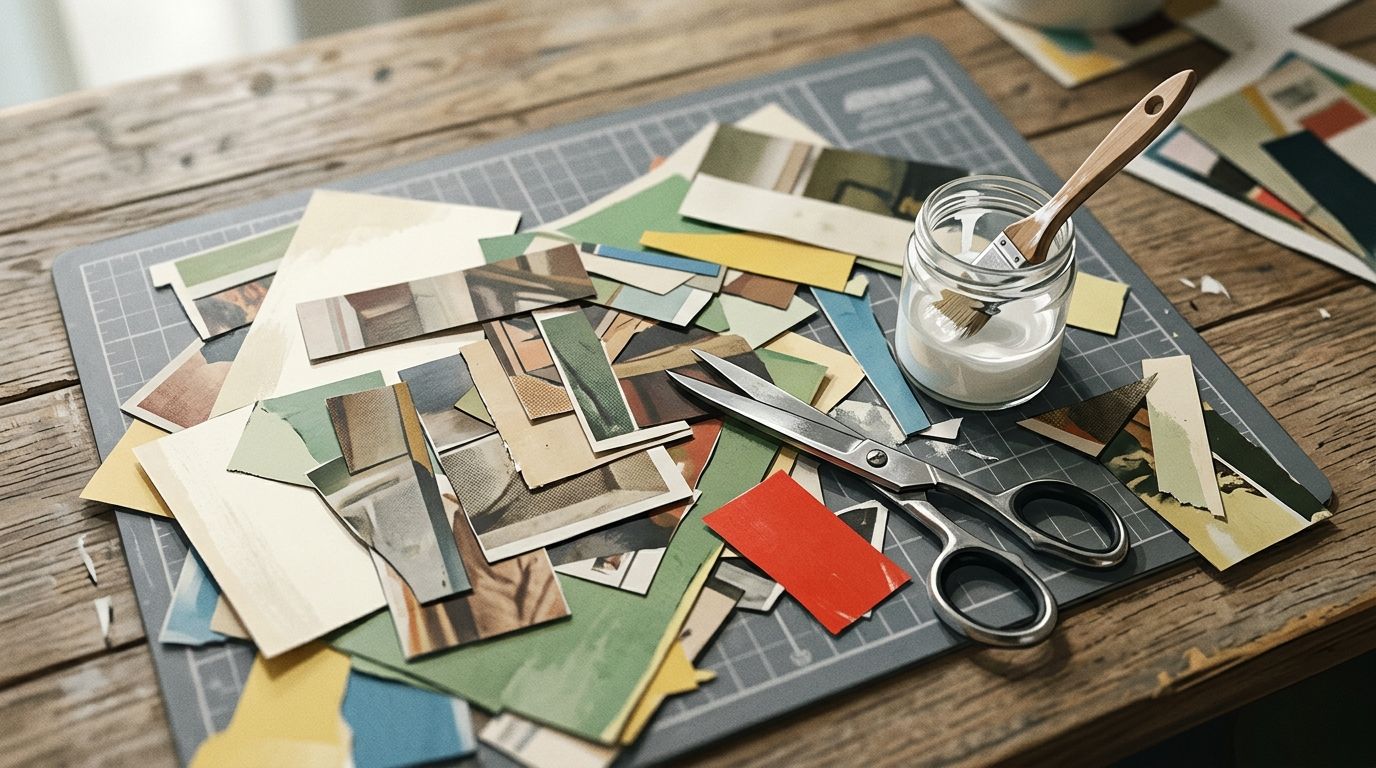
Exhibo Editorial
What Is Collage?
Cut paper, glue and found print on a support: how collage works as technique and object, from Cubist papiers collés to digital layers
Collage is the technique of arranging and fixing fragments of paper, photograph, fabric or other flat material onto a support so that the joins remain visible and the source of each piece stays partly readable. The French verb coller means to glue. Tate and MoMA both use the word for the method and for the finished work: a collage is what you make when you collage. That double sense matters in the gallery. A label that reads "collage on paper" names a process (cutting, layering, adhering) and an object you can walk around.
You are looking at time compressed. Newsprint from Tuesday sits beside a scrap of wallpaper from last year and a photograph cut from a magazine that thousands of other hands have already handled. Cubist painters in Paris turned that habit into a fine-art argument around 1912. Dada and Surrealist artists in Berlin and Hanover pushed it toward politics and dream logic. Romare Bearden rebuilt Harlem street life from clippings in the 1960s. Digital artists now stack image layers in software, but the grammar (fragment, overlap, re-context) stays recognisable. This page sits in the Art Techniques and Materials series. For the wider rule that any material can share one surface, see the sibling what is mixed media art. Collection pages for the museums named below are listed in the museums directory.
What the word names in a museum label
MoMA's collection term defines collage as work in which fragments of paper and other materials "are arranged and glued down onto a supporting surface." Tate adds fabric and ephemera and notes that collage can include painting and drawing and even slight relief. Neither institution treats collage as a subject category like landscape or portrait. It is a making method. A collage can depict a still life, a city crowd or an abstract field of colour. The method does not dictate the motif.
Three confusions arrive early in search results and in first-year essays. Collage is not the same as mixed media, though most collages are mixed media in the materials sense. Mixed media names any combination of substances in one work; collage names the specific act of cutting and sticking flat pieces. Collage is not identical to photomontage, though many photomontages are collages. Photomontage builds an image from photographs (often rephotographed after cutting). Collage is the wider family. Collage is not assemblage. Assemblage constructs in the round from found objects; collage stays chiefly pictorial and flat, even when a cord frame or a lump of paste raises the surface slightly.
The SERP for "what is a collage in art" is dominated by glossaries, school pages and hobby tutorials. Those pages define the word and list materials. They rarely follow a work through support choice, adhesive chemistry, or what happens to newsprint in a frame after thirty years. That gap is what this article fills.
Collage, papier collé, photomontage and assemblage
Modern English usage follows French studio vocabulary from the 1910s. Picasso and Georges Braque did not always separate their terms cleanly in letters, but art historians and museums now distinguish papier collé (pasted paper, often mimicking wood grain or wallpaper) from collage (which may add charcoal, oil, rope, sand or other substances). Braque's pasted faux-bois sheets and Picasso's printed oilcloth in Still Life with Chair Caning are papier collé in a strict sense, but both sit inside the larger collage story because the pasted element carries meaning as manufactured stuff, not only as colour and pattern.
Photomontage entered Dada in Berlin when Hannah Höch and Raoul Hausmann lifted images from illustrated weeklies and rearranged them into satirical fields. Höch called some works photomontage; catalogues today often say collage on cardboard. The distinction is material and rhetorical: photographs bring indexical truth claims (this face, this machine, this politician) that coloured paper does not. When you crop a face from Die Dame and float it beside a turbine, you are arguing with the magazine's editorial world. Kurt Schwitters' Merz works refuse the neat boundary. Tickets, lace, wire and bank letterhead share a surface with oil paint. Tate treats Merz as Schwitters' invented category for collage and assemblage together.
Assemblage extends into space. Joseph Cornell's boxes, Robert Rauschenberg's combines and many Neo-Dada works hang on the wall but build outward. If the object reads as a shallow picture with pasted papers, call it collage first. If you would describe it as a constructed relief or an environment, assemblage or installation is the better type-word. The museums directory lists institutions where all three strains appear side by side in twentieth-century rooms.
Papier collé and Cubist paste
Papier collé names the moment when pasted paper replaces painted simulation. Braque pasted printed wood-grain paper onto drawings in 1912 so that a table could be "wood" without brushstrokes pretending to be grain. Picasso pasted a piece of oilcloth printed with chair caning into an oval on canvas and framed the oval with rope. The Musée national Picasso-Paris records Nature morte à la chaise cannée (spring 1912, MP36) as huile et toile cirée sur toile encadrée de corde: oil and waxed oilcloth on canvas, rope frame, 29 × 37 cm. The letters JOU (from journal) sit in the field. You are not looking at a painted chair seat. You are looking at a fragment of mass-produced seating pattern admitted into a painting's contract.
Photomontage and the printed page
Photomontage uses the photograph as raw material. Höch's Cut with the Kitchen Knife Dada through the Last Weimar Beer-Belly Cultural Epoch of Germany (1919–20, Staatliche Museen zu Berlin, Nationalgalerie, NG 57/61) is a wall-scale photomontage on cardboard, about 114 × 90 cm. Inventory records list cardboard and collage technique. The title is a blade. Kitchen knife stands for domestic labour and for cutting; Dada stands for ridicule aimed at militarist and bourgeois culture. Reproductions flatten the field. In the room you track dozens of faces and machines at different scales. Photomontage depends on cheap halftone printing. Without illustrated press culture, the technique has little fuel.
Digital collage
Digital collage replaces scissors and glue with selection tools and layers. The artist stacks raster images in Photoshop, Procreate or similar software, adjusts opacity, masks edges and exports a file. The output may stay digital on a screen, or become a pigment print on paper. Museums then face a familiar labelling problem: the materials line may read "inkjet print" or "archival pigment print" while the making was collage in software. The technique cluster's mixed media page treats combination methods further. Here the point is narrow. Digital collage is collage by arrangement of fragments. It is not photography in the single-exposure sense, though it often includes photographic sources.
Materials, supports and adhesives
Collage looks like a low-threshold technique because the ingredients are familiar: scissors, glue, paper. Permanent work is a small chemical system. Paper fibres, sizing, printing inks, adhesive polymers and the support board all react to light, humidity and heat. Conservators at institutions such as Tate and the Getty treat twentieth-century collage as composite structure: each layer can damage its neighbour.
Supports carry the load. Illustration board, mat board, canvas and heavy watercolour paper are common. Picasso used canvas for MP36. Höch used cardboard. Romare Bearden mounted many 1960s collages on board or Masonite-scale panels. A too-flexible support cockles when glue dries unevenly. A board that is acidic transfers that acidity to pasted papers over decades.
Adhesives define longevity. Studio collages historically used starch paste, animal glue, casein, rubber cement and polyvinyl acetate (PVA). Rubber cement and many pressure-sensitive tapes cross-link as they age. They yellow, embrittle and fail. Conservation literature documents staining from rubber-based tape on Robert Rauschenberg works and rubber cement in commercial illustration collages. Museums prefer reversible adhesives (wheat starch paste, methyl cellulose, selected acrylic dispersions) when they must reattach lifting edges. Artists in the twentieth century often chose speed over reversibility. That choice is now part of the object's history.
Paper types carry their own risks. Newsprint is lignin-rich and darkens. Magazines use clay-coated stock that does not take glue the same way as fibrous drawing paper. Photographic emulsions curl when humidity swings. Metallic foils and plastic tapes react differently from watercolour washes. When you read a long materials line on a label, the conservator is warning you that the work is a stack of incompatible neighbours.
Supports and ground preparation
Heavyweight paper (300 gsm and above) or rigid board reduces warp. Many artists seal the ground first with acrylic medium or size so that glue does not sink into fibres and stain outward. Canvas supports for collage often receive gesso so pasted edges lie flat. Bearden's The Dove (1964, MoMA, 377.1971) is cut-and-pasted printed paper, gouache, pencil and coloured pencil on board, about 33.8 × 47.5 cm. The board gives a stable plane for a busy street scene built from dozens of clippings. Without that rigidity, a dense field of small pieces would twist at the corners within a few exhibition seasons.
Adhesives artists actually use
Wheat starch paste and PVA white glue dominate hand-cut collage studios today. Paste rewets with water and suits thin paper. PVA dries fast and grabs coated stock. Acrylic gel medium doubles as adhesive and as a sealing coat. Bearden pressed collages with a roller through resin emulsion so pieces lay flat; that unified surface reads almost like varnish in the room. The method stabilises edges for handling but complicates later treatment if the resin yellows. Archival PVA marketed to artists is a practical default for new work. Historic works on museum walls were not always built with archival intent.
| Material / stage | Typical use in collage | Main failure mode over time | Common studio or museum response |
|---|---|---|---|
| Newsprint clippings | Tone, text, cheap mass-media reference | Darkening, brittleness, acid migration | Limit light; interleave buffered storage; accept patina or replace only in facsimile works |
| Magazine/coated paper | Colour fields, bodies, machines in photomontage | Edge lift, curl, glue failure on slick surface | Mechanical edge support; acrylic adhesive chosen for coat; local reattachment |
| Wheat starch paste | Thin paper, reversible fine-art collage | Moisture sensitivity, mould if damp stored | Stable RH; paste reactivation for treatment |
| PVA / acrylic medium | General studio adhesion, sealing | Less reversible; can stain porous paper if overapplied | Document formula; avoid water baths in treatment |
| Rubber cement / masking tape | Fast layout, grid lines (1960s–70s studio habit) | Yellow stain, adhesive failure, tape carrier shrink | Tape removal; solvent or heat protocols; replace with archival tissue hinges |
| Photographic prints in montage | Faces, documentary truth | Silver or dye fade; curl | Cold storage for valuable works; UV-filtered glazing |
| Board support (cardboard, mat board) | Dada scale, illustration | Acid decay, corner crush | Mount on archival back; store flat; frame with rag board |
| Digital pigment print output | Editioned collage prints | Ink fade if cheap inks; file obsolescence | Archival inks and paper; preserve layered source files separately |
Building a paper collage step by step
The sequence below is the backbone taught in museum education studios and foundation courses. Individual artists compress or repeat steps. Hannah Höch rearranged masses of clippings before any glue touched the board. Schwitters picked up tram tickets on walks and let the find dictate the composition. The order still helps you read a finished work and plan one that survives.
When you stand in front of a Cubist papier collé or a Bearden street scene, you can often reverse the steps. Visible paper edges tell you where scissors passed. Slightly proud layers suggest press order. Matte zones around a scrap may mean resin or heavy gel. Gouache applied after paste sits on top of cut fibres rather than soaking through them. None of this replaces the label, but it turns looking into a kind of forensic pleasure that painting alone rarely offers.
Cutting and selecting sources
Artists harvest from newspapers, their own monotypes, marbled papers, packaging and photographs. Scale matters early. Bearden often enlarged and reduced fragments on a photocopier before cutting, shifting emphasis on hands and faces. Cubists kept fragments of sheet music and newspaper headlines at readable scale so the viewer saw both abstract shape and literal reference. Curved cuts soften; hard straight cuts read as architecture. A hoard of uncut sources is normal in a collage studio. Glue enters only when the layout holds.
Dry layout and transfer
Most collages are composed dry first. Pieces move on the support until the rhythm works. Photographs of the layout guard against memory errors once glue is wet. Some artists trace positions lightly in pencil. Others number the back of each scrap. Large works use a grid transfer from a study sheet. Speed collages skip documentation and accept loss. Museum conservators wish they had more of those maps when edges lift decades later.
Adhesion, pressing and drying
Glue spreads thin on the reverse of each piece or on the ground, depending on paper weight. Over-wetting buckles thin stock. Under-gluing lifts corners. Weights or a roller press the sandwich flat while the adhesive sets. Bearden's roller through resin emulsion is an extreme version of this step. Drying under flat glass or between boards reduces warp. Humidity control in the room prevents curl while water-based adhesives cure.
Finishing: paint, seal and frame
Many collages receive gouache, ink or charcoal after paste dries. Picasso added oil around the oilcloth oval in MP36. Höch left sharp photomontage edges exposed. Sealing with acrylic medium or spray fixative reduces chalk shed and minor scuffing but changes surface gloss and may yellow. Framing for exhibition uses UV-filtering glazing and rag board mounts. Works on poor board may be hinged rather than fully adhered to a back mat so the support can be replaced later without cutting the art.
How collage entered modern painting
Paper collage in European fine art is a twentieth-century claim, even though people have pasted paper for centuries in folk practice, scrapbooks, decoupage furniture and Japanese chigiri-e (torn-paper pictures). Tate notes that the term derives from French papiers collés and that artists' collage began in the early twentieth century. The Cubist turn is the usual hinge.
Picasso and Braque, working closely in Paris, pasted papers into drawings and paintings from 1912 onward. Braque's wood-grain papers and Picasso's chair caning shifted debate from "can painting represent depth?" to "what counts as a painting's surface?" The pasted scrap is both image and thing. World War I scattered the network. Dada in Zurich and Berlin weaponised cut-up media against nationalist rhetoric. Schwitters coined Merz in Hanover around 1919 and treated city waste as art raw material. Surrealists used collage for uncanny juxtapositions. Suprematist and Constructivist books used cut elements in layout, overlapping graphic design and gallery art.
After 1945, collage fed Pop and Neo-Dada. Richard Hamilton's Just what was it that made yesterday's homes so different, so appealing? (1956) is a small domestic interior built from American magazine clippings, a hinge work for British Pop. Eduardo Paolozzi's early scrapbooks and collages (Tate holds Meet the People, 1948) mined American advertising. Bearden's 1960s street collages translated jazz rhythm into visual jump-cut. Contemporary artists work analogue, digital and hybrid without asking permission from any single movement.
Do not claim a single inventor. Victorian scrapbooks and Japanese paper traditions precede Cubism. Picasso's 1912 works are teaching hinges, not a global first. Scholarship sometimes cites earlier pasted oddities. The defensible statement is narrower: Cubist papier collé changed what European fine art expected from a painted surface.
Six collages to read in the room
Definitions stay abstract until you test them on dated objects with inventory numbers. The six below span Cubist paste, Dada photomontage, Merz debris and American city collage. Visit them in the museums directory when travel allows. Reproductions hide edge lift, tape sheen and paper yellowing that the body notices at arm's length.
| Work | Artist | Date | Materials (label sense) | Collection | Inventory |
|---|---|---|---|---|---|
| Nature morte à la chaise cannée | Pablo Picasso | spring 1912 | Oil and waxed oilcloth on canvas, rope frame | Musée national Picasso-Paris | MP36 |
| Still Life with Tenora | Georges Braque | 1913 | Cut-and-pasted printed and painted paper, charcoal, chalk, pencil on gessoed canvas | Museum of Modern Art, New York | 947.1979 |
| Cut with the Kitchen Knife… | Hannah Höch | 1919–20 | Photomontage / collage on cardboard | Nationalgalerie, Berlin | NG 57/61 |
| Mz 129 rot oben | Kurt Schwitters | 1920 | Collage on paper | Scottish National Gallery of Modern Art, Edinburgh | GMA 4764 |
| The Dove | Romare Bearden | 1964 | Cut-and-pasted paper, gouache, pencil, coloured pencil on board | Museum of Modern Art, New York | 377.1971 |
| Just what was it that made yesterday's homes so different, so appealing? | Richard Hamilton | 1956 | Collage of printed papers | Kunsthalle Tübingen (version often reproduced); Tate holds later upgrade variants |
Read MP36 for manufactured pattern admitted as fact, not illusion. Read Braque's Tenora for wood-grain and newspaper fragments interlaced with charcoal on gessoed canvas. Read Höch for political photomontage at architectural scale. Schwitters' Mz 129, about 10.6 × 8.3 cm, is modest in size but typical in material range: tickets and printed scraps, a red triangle noted in the title. Bearden's The Dove compresses Harlem into a syncopated grid; the dove reads as symbol only if you slow down amid the bustle. Hamilton's interior satirises postwar consumer promise through bodybuilders and appliances clipped from American magazines.
Artists who stretched what glue could argue
Pablo Picasso and Georges Braque used paste to fracture the Renaissance window. When chair caning enters as oilcloth, the still life stops pretending to be a window onto meat and glass. It becomes a flat contract between studio, factory print and gallery wall. Braque pushed the same logic with faux-bois and newspaper fragments. Their collages stayed small enough to hand to dealers and friends. Scale kept the experiment private before it became history.
Hannah Höch cut Weimar culture apart with kitchen tools as metaphor. As the only woman in Berlin Dada circles often pictured in textbooks, she also cut gendered imagery apart: athletes, dancers, politicians and domestic scenes collide in NG 57/61. Her craft training at the Ullstein press gave her scissors fluency and access to mass imagery. Photomontage was labour as much as manifesto.
Kurt Schwitters treated Hanover streets as a supply store. Merz (from a fragment of Commerzbank letterhead) named an practice that swallowed tickets, lace, wire and paint. MoMA's collection term notes thousands of collages and the architectural Merzbau environments that grew out of them. The first Merzbau in Hanover was destroyed in the Second World War; fragments and related works survive in Tate, Edinburgh and elsewhere. Schwitters proves collage can be miniature and still hold civic noise.
Romare Bearden turned to full-time collage in the 1960s after graphic design and social work. The Dove belongs to the Spiral group moment around civil-rights activism. Cut photographs and coloured papers rebuild street life with jazz timing: repeats, breaks, sudden close-ups. MoMA's materials line is explicit about gouache and pencil on board. Bearden sometimes made photostat enlargements of smaller collages for later series; the primary pasted works remain the material anchor.
Later artists extend the line without closing it. John Stezaker's sliced postcards, Mark Bradford's concentric paper abstractions built from merchant posters, and contemporary digital artists on Instagram all inherit the same cut-and-layer grammar. The masters above matter because they changed what counted as source material and what counted as authorship when the hand only selects and places.
Failure modes: acidity, light and detachment
Collage fails in layers. Paper darkens when lignin and optical brighteners break down. Adhesives fail when polymers embrittle. Supports warp when humidity cycles. Each failure shows differently at the edge: a lifted corner, a brown halo, a crack along a tape line.
Light hits printed colour first. Magazines and cheap books fade unevenly. Gouache and coloured pencil in Bearden's work are light-sensitive compared with stable mineral pigments in oil. UV-filtered glazing and limited lux-hours in exhibition are standard for works on paper. Collage doubly suffers because dozens of pieces may fade at different rates, shifting the colour balance the artist set.
Acid migration moves through contact. Newsprint against board stains both. Rubber cement leaves orange halos that conservators document but cannot always remove without losing artist intent. Pressure-sensitive tapes on 1960s works fail predictably; treatments at institutions such as NYU's Conservation Center have preserved tape carriers when the artist wanted them visible, replacing adhesive systems underneath.
Physical handling threatens raised edges. Frame vibration in transit can snag a lifted scrap. Insects and mould target organic adhesives and starch in damp storage. Museums store flat when possible, with interleaving tissue and stable relative humidity (often near 50%, within institution bands). Composite-structure guidelines recommend photographing each layer during treatment because overlap order is evidence.
Private owners can slow damage without treating the work: stable interior climate, no attic storage, UV-filtered frame, handling with clean dry hands at supported edges. Full conservation belongs to paper conservators. DIY iron-and-tape repairs usually make future treatment harder.
What collage costs today
Costs split into studio making, education market, original art market and print editions. Figures below are broad 2024–2026 bands in GBP and USD for general readers, not investment advice. Auction prices for historic masterpieces swing with provenance and are omitted here except as context.
Student and hobby making sits low. Scissors, a cutting mat, a pad of mixed paper, a bottle of archival PVA and a board support often total roughly £25–£80 or $30–$100 at retail. Found paper is free. Time dominates.
Foundation and evening-class courses in UK cities often run £150–£400 for a ten-week term; US community studio equivalents run roughly $200–$500. Museum member workshops cost less per day but sell out fast.
Contemporary collage originals on paper by mid-career artists in regional UK and US galleries commonly list from about £400–£4,000 / $500–$5,000 for modest sizes (A4 to medium board). Established gallery names and dense material fields push higher. Large Bearden-era scale works by recognised artists can reach five figures without entering museum collection tiers.
Editioned pigment prints of digital or scanned analogue collages often sell £80–£800 / $100–$1,000 depending on edition size and paper. Open-edition online prints sit lower. The artist's reputation moves the band more than the technique label.
Commissioning a portrait or event collage from a working illustrator runs roughly £300–£2,000 / $400–$2,500 for private clients, with licensing for commercial use priced separately.
Insurance and framing add ongoing cost. A custom frame with museum glass for a 40 × 50 cm collage often runs £150–£400 / $200–$500 in urban shops. Specialist paper conservators charge hourly rates comparable to other object conservation when treatment is needed.
FAQ
What is a collage in art in one sentence?
Collage is an art technique and the artwork made by cutting or tearing pieces of paper, photographs, fabric or similar flat materials and gluing them to a support so the fragments stay visible as fragments.
Did Picasso invent collage?
No. Picasso and Braque pioneered papier collé in Cubist painting around 1912, but pasted paper existed earlier in folk and decorative arts. MP36 is a hinge work in modern art history, not proof of a single global invention.
What is the difference between collage and photomontage?
Collage is the general method of sticking down pieces. Photomontage builds the image chiefly from cut or rearranged photographs, often from the press, as in Höch's Berlin Dada works.
What is the difference between collage and mixed media?
Mixed media names any combination of materials in one work. Collage names a specific process of cutting and adhering flat pieces. Most collages are mixed media; not all mixed media works are collages.
What materials do you need to make a collage?
A support (board or heavy paper), sources to cut, adhesive (paste or PVA), scissors or a knife, and optionally paint or pencil for finishing. Archival choices matter if you want the work to age cleanly.
Why do old collages turn yellow or peel?
Newsprint and poor board are acidic. Rubber cement, old tape and some PVAs yellow and fail. Light fades printed inks. Humidity warps supports and weakens glue bonds.
Is digital art collage?
When the artist composes by layering cut-out or selected image fragments in software, the making is collage even if the exhibited object is a pigment print. The materials line on the label should name the output medium.
Where can I see famous collages in museums?
Cubist and Dada works hang in Tate, MoMA, the Musée Picasso-Paris, Berlin's Nationalgalerie and many regional modern collections listed under museums. Check lender and rotation notes before travel; works on paper rotate frequently.
Related reading
Curating Tomorrow's Archive: Hamburger Kunsthalle Seeks Contemporary Collections Lead
A new permanent appointment will steer the museum's post-1960 holdings across paper, photography, and media formats.
The Hamburger Kunsthalle is inviting applications for a senior curatorial position focused on contemporary acquisitions, exhibition strategy, and digital collection management. Applications close October 2026 for a January 2027 start.
Whilst We Are Savages: Colonial Constructs and Atlantic Dialogues
A critical survey at TEA Tenerife exploring how colonial frameworks shaped identity, territory, and knowledge across Europe, Africa, and Latin America.
William Morris Gallery Reopens With Intimate Restoration and New Focus
A comprehensive overhaul at the Walthamstow venue explores the designer's contradictions through newly displayed archives and a domestic curatorial approach.