
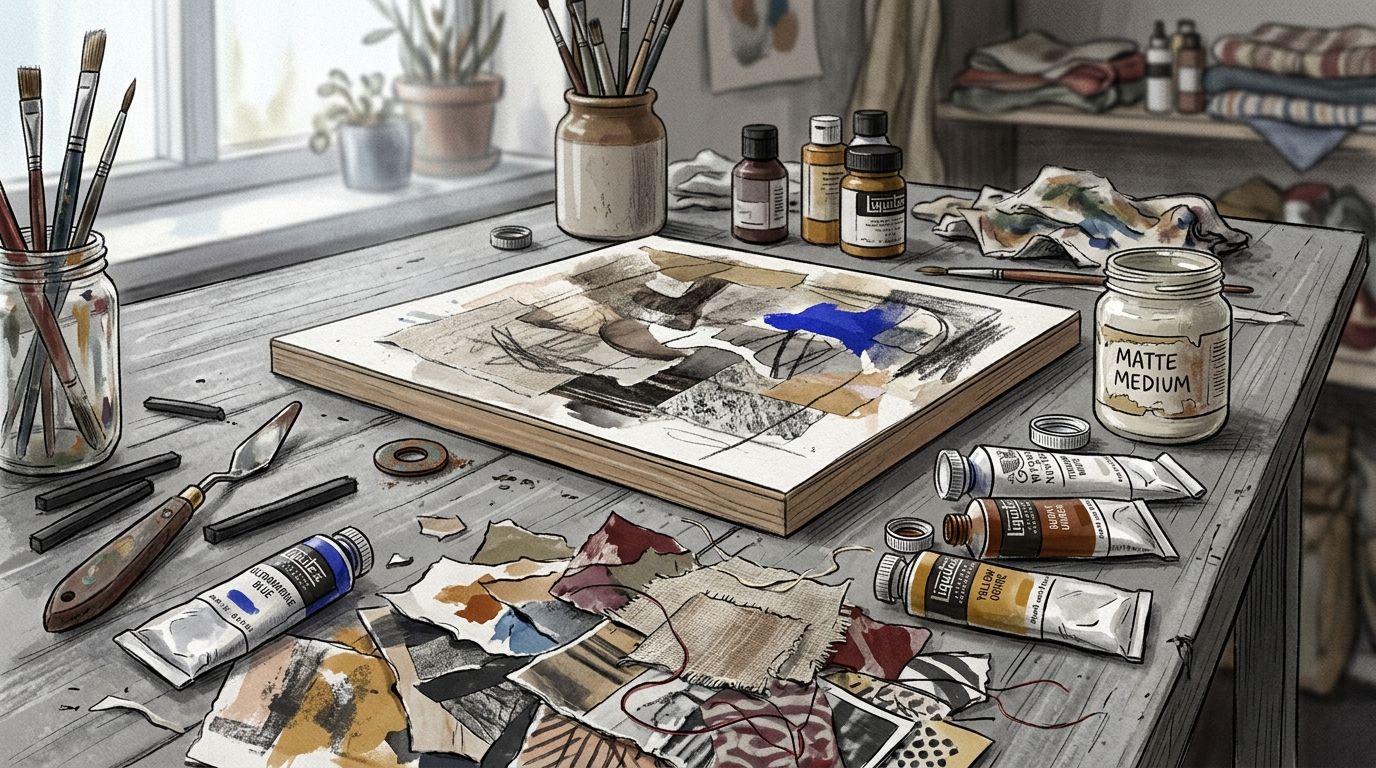
Exhibo Editorial
What Is Mixed Media?
When paint, paste, print and found objects share one surface: how mixed media works as technique and label, from Cubist paste to Neo-Dada combines and contemporary assemblage
Mixed media art is any artwork in which an artist combines two or more materials or techniques in one object so the materials line on the label names more than one substance or process. Oil beside pasted newsprint, charcoal over acrylic, a taxidermied goat with a tyre and a painted field: each counts. Tate’s art term calls mixed media “artworks composed from a combination of different media or materials” and notes that Picasso and Braque’s Cubist collages from around 1912 opened the habit in modern European fine art. The phrase is broad by design. It describes what is on the wall, not a single school or a fixed recipe.
You read mixed media when the work is a small chemical and mechanical system. Paper, fabric, metal, animal glue, synthetic polymer, living dust and factory print all age at different speeds. Conservators treat these objects as composite structures: each layer can damage its neighbour. That material honesty is why searchers ask what mixed media art is. They want a definition they can use in a gallery, then enough process detail to understand why the edges lift or the colour shifts. This page sits in the Art Techniques and Materials series. For cut-and-pasted flat work, see the sibling what is collage in art. Collection pages for the museums named below are listed in the museums directory.
What the word names on a museum label
Getty’s teacher materials and MoMA’s collection terms both treat mixed media as a materials description rather than a subject category like landscape or portrait. A work can be a portrait, an abstract field or an environment and still be mixed media if the making combined substances. The label’s job is to list what is physically there: “acrylic, oil, charcoal and collage on canvas,” “wood, fabric, metal and oil paint,” “pigment, resin, printed paper and elephant dung on canvas.” Read those lines as a stack, bottom to top or inside to out, even when the wall text does not spell out the order.
Three confusions arrive early in search results and in first-year essays. Mixed media is not the same as multimedia. Tate distinguishes them cleanly: multimedia usually includes electronic media such as video, film, audio or computers in one work, while mixed media stays within visual art materials even when the list is long. Mixed media is not identical to collage, though most collages are mixed media in the materials sense. Collage names the specific act of cutting and adhering flat fragments; mixed media is the wider umbrella. Mixed media overlaps with assemblage when the artist builds in relief from found objects, but assemblage stresses construction from disparate things scavenged or bought, often with strong three-dimensional presence. A shallow Cubist still life with pasted paper is mixed media first; a wall relief of chairs and cigarettes is assemblage first. Both labels can apply to the same object.
The SERP for “what is mixed media art” is dominated by AI summaries, school pages, hobby blogs and short Tate or Wikipedia entries. Those pages define the word and list example materials. They rarely follow one work through support choice, adhesive compatibility, or what happens when rubber cement meets newsprint in a frame after forty years. They seldom name inventory numbers. That gap is what this article fills.
Mixed media, collage, assemblage and installation
English usage follows French studio vocabulary from the 1910s and American Neo-Dada language from the 1950s. Picasso and Braque pasted papers into drawings and paintings from 1912 onward. Kurt Schwitters coined Merz around 1919 for collage and construction that swallowed tickets, lace, wire and paint. Robert Rauschenberg called his wall works with pillows, goats and radios “Combines” in the mid-1950s. Museums now file all of that under mixed media when the materials line is plural, while more specific words remain useful for art history.
Collage stays chiefly pictorial and flat, even when paste raises the surface slightly. The sibling article on collage treats papier collé, photomontage and digital layers in full. Assemblage extends into space. Tate defines it as art made by assembling disparate elements, often everyday objects scavenged by the artist or bought specially. Picasso’s cubist construction Still Life (1914, scraps of wood and tablecloth fringing, glued and painted) is an early hinge between flat paste and built relief. Schwitters’ Merz pictures and architectural Merzbau environments refuse the boundary. Rauschenberg’s Combines hang on the wall but project outward: a quilt, a goat, a tyre.
Installation art names room-scale mixed-media construction, often planned for a specific place. Tate’s installation term describes “large-scale, mixed-media constructions.” That scale raises logistics this technique page does not treat as collecting advice. Questions about buying, insuring, storing or commissioning room-scale mixed media belong with the editorial guide on collecting mixed-media and installation (E13, pending). Here the focus stays on how combined materials behave as technique and object. When a biennial fills a hall with timber, video and sand, you still read each junction where tape, screw or weld meets surface, even if the whole exceeds any single frame.
Wet and dry combinations
Many classroom mixed media pieces combine wet and dry media on one sheet: acrylic ground, then gouache, then ink, then soft pastel fixed with spray. The order matters because each layer needs a stable surface for the next. Watercolour over untreated oil is a known failure. Acrylic over oil without isolation can crack. Pastel over smooth acrylic may not grip unless the ground is toothy. Artists often seal stages with acrylic medium or fixative so later marks do not pick up earlier ones. The materials line may still read simply as “mixed media on paper” even when the studio sequence had six steps.
Relief, object attachment and the wall plane
When the artist screws, ties or embeds objects, the work crosses into relief or assemblage. Rauschenberg bolted furniture and animals to painted panels. Sarah Lucas builds from cigarettes, furniture and casts. Phyllida Barlow stacks timber, cement and fabric into sprawling sculptures that Tate has shown as commission-scale mixed media. The wall label still lists substances; your eye reads mass and shadow. Installation pieces may leave the wall entirely. The technique vocabulary (layer, adhere, seal) still applies to each junction, even when the whole fills a room.
Materials, supports and adhesives
Mixed media looks like a low-threshold technique because the ingredients are familiar: paint, glue, paper, things from a drawer. Permanent work is a set of interactions. Paper fibres, sizing, printing inks, adhesive polymers, metal corrosion, fabric dyes and animal products all respond differently to light, humidity and handling. Conservators at institutions such as Tate, MoMA and the Getty treat twentieth-century mixed media as composite structure: incompatible neighbours are the norm, not the exception.
Supports carry the load. Canvas, panel, heavy paper, board and found surfaces (doors, blankets, tyres) each impose limits. A flexible canvas with heavy rigid attachments can ripple at the corners. A acidic board stains pasted papers within decades. Metal against acidic paper can leave foxing-like marks. When you read a long materials line, the conservator is often warning you that the stack was built for expression first and for chemical peace second.
Adhesives define longevity. Studio mixed media historically used starch paste, animal glue, casein, rubber cement, epoxy and polyvinyl acetate (PVA). Rubber cement and many pressure-sensitive tapes cross-link as they age. They yellow, embrittle and fail. Conservation literature documents staining from rubber-based products on Neo-Dada works and commercial illustration pieces. Museums prefer reversible adhesives when they must reattach lifting edges. Artists in the twentieth century often chose speed and grab over reversibility. That choice is now part of the object’s history.
Found objects introduce their own chemistry. Taxidermy, food, cigarettes, organic fabrics and some plastics off-gas or attract pests. Chris Ofili’s use of elephant dung in works such as No Woman, No Cry (1998, Tate) required institutional protocols for display and storage, not only aesthetic debate. El Anatsui’s bottle-top hangings combine aluminium and copper wire in flexible fields that shift every time they are draped. The materials line is short; the behaviour is complex.
| Material / stage | Typical use in mixed media | Main failure mode over time | Common studio or museum response |
|---|---|---|---|
| Acrylic / oil paint ground | Sealing support, building colour, isolating layers | Cracking if fat-over-lean rules break; yellowing in some oil films | Gesso or acrylic ground; documented layer order; avoid water on oil without test |
| PVA / acrylic gel medium | General adhesion, collage paste, sealing | Less reversible; can stain porous paper if overapplied | Archival PVA for new work; local reattachment in treatment |
| Wheat starch paste | Thin paper collage, reversible fine-art work | Moisture sensitivity, mould if damp stored | Stable RH; paste reactivation under conservator control |
| Rubber cement / masking tape | Fast layout, 1960s studio habit | Yellow halo, adhesive failure, carrier shrink | Document as artist intent; specialist removal if endangers object |
| Newsprint / cheap board | Mass-media reference, Dada scale | Darkening, acid migration, corner crush | Buffered storage, UV-filtered glaze, accept patina where irreversible |
| Found metal / wire | Assemblage armatures, Merz debris | Corrosion, stress at join points | Coating or isolation where artist allowed; climate control |
| Fabric / quilt / clothing | Rauschenberg Combines, soft sculpture | Dust, pest attraction, dye fade | HEPA vacuum protocols; low light; support under folds in storage |
| Taxidermy / organic matter | Neo-Dada shock, ritual materials | Pest, odour, structural collapse | Integrated pest management; sealed cases; limited loan |
| Digital pigment print in physical piece | Layer in hybrid work | Ink fade if cheap; file obsolescence | Name output medium on label; preserve source files separately |
| Epoxy / hot glue (contemporary studio) | Quick object fix | Brittle failure; non-reversible | Prefer mechanical fixings or archival epoxies for permanence |
Supports and ground preparation
Heavyweight paper (300 gsm and above), rigid panel or stretched canvas reduces warp when wet media and dry collage share a plane. Many artists seal the ground with acrylic gesso or medium so glue and oil do not sink unevenly into fibres. Canvas with heavy attachments may need internal bracing or a panel insert. Bearden mounted dense collages on board for stability; the same logic applies when paint and paste crowd one surface. Found supports (quilts, doors) carry prior wear that becomes part of the aesthetic but also a weak point at torn edges.
Adhesives artists actually use
Wheat starch paste and PVA dominate hand-built mixed media studios. Paste suits thin paper and reversibility. PVA grabs coated stock and dries fast. Acrylic gel medium doubles as adhesive and sealing coat. Epoxy and hot glue appear in contemporary assemblage for speed; conservators note them as future treatment problems. Rauschenberg and Jasper Johns worked with house paint and commercial adhesives alongside oil. Their surfaces encode that pragmatism.
Building a mixed media work step by step
The sequence below is the backbone taught in foundation courses and museum education studios. Individual artists compress or repeat steps. Schwitters picked up tram tickets on walks and let the find dictate the composition. Rauschenberg woke up with the idea to paint on his bed. The order still helps you read a finished work and plan one that survives.
When you stand in front of a Cubist papier collé or a Combine, you can often reverse the steps. Visible paper edges tell you where scissors passed. Matte zones may mean gel medium or heavy fixative. Oil applied after paste sits on cut fibres differently from oil on gesso alone. Screw heads and wire ties mark object attachment after the painted field. None of this replaces the label, but it turns looking into a material reading.
Choosing support and layer order
Artists decide early whether the work stays flat or builds outward. Flat work can follow a paper logic: ground, then collage, then drawing, then seal. Relief work needs armature thinking: where weight hangs, how the wall bears load, whether the object is cantilevered. Order of wet media still follows fat-over-lean in oil traditions, or acrylic’s fast drying schedule in contemporary studios. Mixing oil and acrylic without isolation is a deliberate risk some artists accept.
Dry layout, adhesion and pressing
Collage elements are usually composed dry before glue. Photographs of the layout guard against memory errors. Heavy objects need mechanical fixing as well as adhesive. Rauschenberg’s Combines often combine paint with bolts and straps. Pressing flat layers under weight while adhesive cures reduces warp. Humidity control in the room prevents curl while water-based products dry.
Finishing, seal and presentation
Many mixed media pieces receive varnish, fixative or wax after the last mark. Sealing reduces chalk shed and scuffing but changes gloss and may yellow. Found textiles may stay unsealed so they keep nap. Framing for flat work uses UV-filtering glazing and rag board. Deep reliefs may need custom vitrines. Works with protruding objects trade standard frame depth for open display cases in museums.
How mixed media entered modern art
European fine art treated single-medium purity as a norm for centuries even when workshop practice was messier. Tempera panels received gilding. Oil painters added resin or sand. Mixed media as a conscious modern claim accelerates when Picasso and Braque paste factory print into drawings and paintings around 1912. Tate dates widespread mixed media from that Cubist moment: “Essentially art can be made of anything or any combination of things.”
World War I scattered networks. Kurt Schwitters in Hanover treated city waste as raw material from about 1919, calling the practice Merz. Dada in Berlin and Zurich cut up press imagery. Surrealists combined unlikely objects in relief. After 1945, Neo-Dada in New York and arte povera in Italy pushed scavenged and humble materials into gallery contexts. Pop artists mixed advertising print with paint. Contemporary artists work analogue, digital and hybrid without asking permission from any single movement.
Do not claim a single inventor. Victorian scrapbooks, Japanese paper traditions and folk altars combined materials long before Cubism. Picasso’s 1912 works are teaching hinges in European fine art, not proof of a global first. Scholarship sometimes cites earlier pasted oddities. The defensible statement is narrower: Cubist papier collé changed what European painting expected from a surface, and Rauschenberg’s Combines changed what American galleries expected from a painting’s depth.
Artists who stretched what the label could hold
Kurt Schwitters treated Hanover streets as a supply store. Merz (from a fragment of Commerzbank letterhead) named a practice that swallowed tickets, lace, wire, wood and paint. Tate’s Merz term notes collage and assemblage together. The first Merzbau in Hanover was destroyed in the Second World War; fragments and related works survive in Edinburgh, London and elsewhere. Schwitters proves mixed media can be miniature and still hold civic noise. His small collages such as Mz 129 rot oben (1920, Scottish National Gallery of Modern Art, GMA 4764) pack printed scraps and painted passages into a postcard-scale field.
Robert Rauschenberg renamed the wall plane for American art. Between 1954 and 1964 he made Combines: works that hang like paintings but include furniture, animals, clothing and radios. Bed (1955, Museum of Modern Art, New York) mounts pillow, quilt and sheet on wood supports with paint and pencil. You are not looking at a painting of a bed. You are looking at bedding that became the support and subject. Monogram (1955 to 1959, Moderna Museet, Stockholm) places a taxidermied Angora goat with a tyre around its middle on a painted platform with collaged elements. The inventory list runs oil, paper, fabric, metal, wood, rubber shoe heel, tennis ball and taxidermied goat. MoMA’s collection history treats Combines as mixed media that forced curators to invent new categories between painting and sculpture.
Jasper Johns paired encaustic with collage and found objects in flags and targets from the 1950s onward. His sketchbook note, quoted on Tate’s assemblage page, is a studio recipe: “Take an object / Do something to it / Do something else to it. [Repeat.]” That sentence fits mixed media pedagogy without reducing it to Dada shock alone.
Chris Ofili layered acrylic, oil, resin, glitter, map pins, printed paper and elephant dung on canvas in No Woman, No Cry (1998, Tate). The work memorialises Stephen Lawrence. The materials are symbolic and physical at once. Institutions had to plan display, light and storage around organic matter inside a painting convention.
Phyllida Barlow, whose Tate Britain Commission 2014 filled the Duveen Galleries with timber, cement, fabric and paint, shows that mixed media at architectural scale still obeys gravity and join logic even when the label reads like a builder’s merchant list. Sarah Lucas, Mario Merz and many YBA sculptors extend assemblage into mixed media that trades on familiarity of cigarettes, furniture and neon.
Six mixed media works to read in the room
Definitions stay abstract until you test them on dated objects with inventory numbers. The six below span Cubist paste, Merz debris, Neo-Dada Combines and contemporary canvas. Visit them in the museums directory when travel allows. Reproductions hide edge lift, tape sheen, textile nap and protruding objects that the body notices at arm’s length.
| Work | Artist | Date | Materials (label sense) | Collection | Inventory |
|---|---|---|---|---|---|
| Nature morte à la chaise cannée | Pablo Picasso | spring 1912 | Oil and waxed oilcloth on canvas, rope frame | Musée national Picasso-Paris | MP36 |
| Still Life with Tenora | Georges Braque | 1913 | Cut-and-pasted printed and painted paper, charcoal, chalk, pencil on gessoed canvas | Museum of Modern Art, New York | 947.1979 |
| Mz 129 rot oben | Kurt Schwitters | 1920 | Collage and paint on paper | Scottish National Gallery of Modern Art, Edinburgh | GMA 4764 |
| Bed | Robert Rauschenberg | 1955 | Oil and pencil on pillow, quilt and sheet on wood supports | Museum of Modern Art, New York | 79.1989 |
| Monogram | Robert Rauschenberg | 1955 to 1959 | Oil, paper, fabric, metal, wood, rubber, tennis ball, taxidermied goat | Moderna Museet, Stockholm | NM 0212-027 |
| No Woman, No Cry | Chris Ofili | 1998 | Acrylic, oil, polyester resin, printed paper, glitter, map pins, elephant dung on canvas | Tate, London | T07502 |
Read MP36 for manufactured pattern admitted as fact, not illusion: oilcloth printed with chair caning inside an oval, rope frame, letters JOU from journal visible in the field. Read Braque’s Tenora for wood-grain and newspaper fragments interlaced with charcoal on gessoed canvas. Schwitters’ Mz 129, about 10.6 × 8.3 cm, is modest in size but typical in material range: tickets and printed scraps beside a red triangle noted in the title. The Edinburgh inventory lists collage on paper; in the room you may see pencil, oil or printed ink on individual scraps depending on light angle.
Bed compresses sleep, paint and domestic textile into one vertical panel; the quilt’s geometry reads as abstract painting until you recognise bedding. MoMA’s catalogue entry stresses that Rauschenberg hung the work like a painting after waking from a dream that suggested using his bed as a surface. Monogram forces you to negotiate humour, pathos and the literal goat in the room; the tyre turns the animal into a monogram letter. Ofili’s No Woman, No Cry holds portrait and tears built from resin droplets; dung balls support the canvas structure and carry cultural charge that the materials line states plainly.
Contemporary assemblage and hybrid practice
Mixed media did not close with Neo-Dada. Artists today combine 3D-printed parts with hand carving, embed screens in panels, cast resin over found shells, or stitch industrial felt onto steel. Tomoko Takahashi, Mike Nelson and Christina Mackie build room-scale installations from scavenged furniture and debris; Tate’s assemblage entry names them among artists working at installation scale from assembled materials. Mark Bradford layers merchant posters and string in dense abstract reliefs. El Anatsui’s metal cloths behave like textile and sculpture at once.
Digital tools add another layer without replacing physical mixed media. An artist may compose in software, print a pigment layer, then collage and paint atop the print. The exhibited object is mixed media even when part of the labour was screen-based. The label should name the output medium (archival pigment print, inkjet, etc.) alongside hand media. NFTs and crypto markets belong elsewhere in the Exhibo programme; this page stops at objects you can stand in front of in a gallery.
Regional craft traditions worldwide have long combined materials on one support. This article follows the European and American museum canon because that is what the English search query and major collection databases emphasise. Islamic geometric craft, hurufiyya and fibre-art collecting sit in editorial series with their own fences. Technique here means reading a plural materials line, not ranking cultures.
Conservation of composite works
Mixed media fails in layers. Paper darkens when lignin breaks down. Adhesives fail when polymers embrittle. Supports warp when humidity cycles. Each failure shows differently at the edge: a lifted corner, a brown halo, a crack along a tape line, a drooping textile fold. The American Institute for Conservation’s Book and Paper Group wiki treats many works on paper as composite structures where delamination, acid migration and incompatible linings complicate treatment.
Light hits fugitive materials first. Magazines and cheap inks fade unevenly. Gouache and coloured pencil fade faster than stable mineral pigments in oil. UV-filtered glazing and limited lux-hours in exhibition are standard for sensitive stacks. Mixed media doubly suffers because dozens of components may fade at different rates, shifting the colour balance the artist set.
Physical handling threatens raised edges and weak joins. Frame vibration in transit can snag a lifted scrap or snag wire. Insects and mould target organic adhesives, fabric and some found matter. Museums store flat when possible, with interleaving tissue and stable relative humidity, often near fifty percent within institution bands. Composite-structure guidelines recommend photographing each layer during treatment because overlap order is evidence.
Found objects and living materials need integrated pest management and sealed cases. Ofili’s dung supports required institutional agreement on display protocols. Rauschenberg’s textiles and taxidermy attract conservator attention for dust, pest and structural settlement. Metal wire in Anatsui-style works can abrade adjacent surfaces if packing is careless.
Treatment ethics for composite works often favour stabilisation over full restoration. When an artist chose rubber cement knowing it might yellow, removing it can erase history. Conservators document before and after, test solvents on scraps, and sometimes accept visible ageing if the alternative is loss of collage layers. The AIC Book and Paper Group wiki notes that chine collé and cloth linings can delaminate in water baths; mixed media with dozens of types rarely gets a single safe bath. Local humidification and suction tables replace total immersion. Photographs of overlap order during treatment become part of the object file because reassembly is evidence, not housekeeping.
Private owners can slow damage without treating the work: stable interior climate, no attic storage, UV-filtered frame or vitrine, handling at supported edges. Full conservation belongs to object and paper conservators trained in composite analysis. DIY iron-and-tape repairs usually make future treatment harder. Buying, insuring and commissioning large mixed media or installation pieces raises contractual questions this page does not answer; see collecting mixed-media and installation (E13, pending).
What mixed media costs today
Costs split into studio making, education market, original art market and hybrid production. Figures below are broad 2024 to 2026 bands in GBP and USD for general readers, not investment advice. Auction prices for historic masterpieces swing with provenance and are omitted here except as context.
Student and hobby making sits low. A basic mixed media kit (acrylic set, glue, matte medium, heavy paper or small panel, charcoal, a bottle of fixative) often totals roughly £40 to £100 or $50 to $120 at retail. Found objects cost nothing. Time and experimentation dominate.
Foundation and evening-class courses in UK cities often run £150 to £400 for a ten-week term; US community studio equivalents run roughly $200 to $500. Museum member workshops cost less per day but sell out quickly.
Contemporary mixed media originals on panel or canvas by mid-career artists in regional UK and US galleries commonly list from about £500 to £5,000 or $600 to $6,000 for modest sizes. Dense material fields, large scale or recognised names push higher. Neo-Dada-scale assemblage with found furniture or taxidermy enters five figures without reaching museum collection tiers.
Editioned pigment prints with hand-finished collage or paint on top often sell £150 to £1,200 or $200 to $1,500 depending on edition size and paper. Open-edition online prints sit lower. The artist’s reputation moves the band more than the mixed media label.
Custom framing for shallow mixed media on paper often runs £150 to £400 or $200 to $500 in urban shops. Deep reliefs need vitrines or build-outs that can double that cost. Specialist conservators charge hourly rates comparable to other object conservation when treatment is needed.
FAQ
What is mixed media art in one sentence?
Mixed media art is an artwork made with two or more materials or techniques combined in one object so the materials line names more than one substance or process.
What is the difference between mixed media and collage?
Mixed media names any combination of materials in one work. Collage names a specific process of cutting and adhering flat pieces. Most collages are mixed media; not all mixed media works are collages.
What is the difference between mixed media and assemblage?
Assemblage builds from disparate found or bought objects, often in relief or in the round. Mixed media is the broader materials description. A Rauschenberg Combine is both.
What is the difference between mixed media and multimedia art?
Mixed media combines visual art materials such as paint, paper, fabric and objects. Multimedia usually includes electronic media such as video, film, audio or computers in one work, as Tate’s glossary notes.
Which artists are famous for mixed media?
Pablo Picasso, Georges Braque, Kurt Schwitters, Robert Rauschenberg, Jasper Johns and Chris Ofili are common museum examples. Contemporary artists including Phyllida Barlow, Sarah Lucas and El Anatsui extend the practice.
Did Picasso invent mixed media?
Picasso and Braque pioneered papier collé in Cubist painting around 1912, a hinge moment in modern European art. People combined materials long before that in folk, craft and non-European traditions.
What materials do you need to start mixed media?
A stable support, at least two media (for example acrylic and collage paper), adhesive or medium, and optional sealant. Archival choices matter if you want the work to age cleanly.
Why do old mixed media works peel or stain?
Incompatible adhesives, acidic board, rubber cement, old tape and humidity cycles fail at different rates. Light fades some inks faster than others. Composite works need climate control and professional care when damage appears.
Is digital art mixed media?
When a physical work combines hand media with printed or screen-based layers, it is mixed media in the materials sense. Pure screen-based work without a physical object is a different discussion, treated in the programme’s digital art pages.
Where can I see famous mixed media works in museums?
Cubist, Dada, Neo-Dada and contemporary examples hang in Tate, MoMA, the Musée Picasso-Paris, Moderna Museet, Edinburgh’s National Galleries and many regional modern collections listed under museums. Check rotation notes before travel; works on paper and textile-heavy pieces rotate frequently.
Related reading
Curating Tomorrow's Archive: Hamburger Kunsthalle Seeks Contemporary Collections Lead
A new permanent appointment will steer the museum's post-1960 holdings across paper, photography, and media formats.
The Hamburger Kunsthalle is inviting applications for a senior curatorial position focused on contemporary acquisitions, exhibition strategy, and digital collection management. Applications close October 2026 for a January 2027 start.
Whilst We Are Savages: Colonial Constructs and Atlantic Dialogues
A critical survey at TEA Tenerife exploring how colonial frameworks shaped identity, territory, and knowledge across Europe, Africa, and Latin America.
William Morris Gallery Reopens With Intimate Restoration and New Focus
A comprehensive overhaul at the Walthamstow venue explores the designer's contradictions through newly displayed archives and a domestic curatorial approach.