
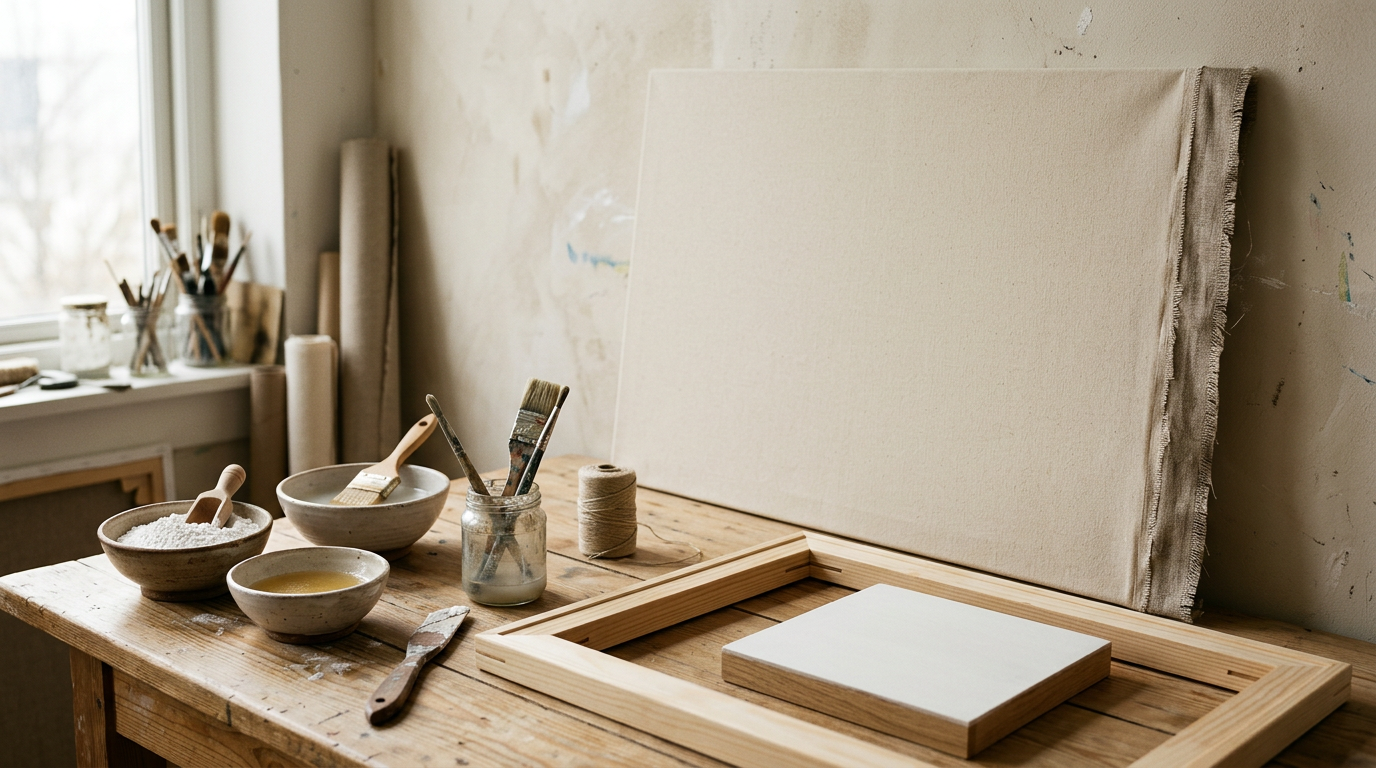
Exhibo Editorial
What Artists Paint On
Canvas, panel, linen, paper, metal and wall: how painting supports are built, prepared, and why the wrong substrate fails decades later
A painting support is the material that carries the image: the oak panel under Jan van Eyck’s oil, the linen weave under a Rembrandt portrait, the heavy paper under a Degas pastel, the lime plaster in a Padua chapel. Paint is the medium. The support is what the medium sticks to. Conservators call it the primary support. Stretcher bars, sizing, gesso, and cradling are not decorative extras. They are the engineering between a coloured film and a world of humidity swings.
Western easel painting today runs on a short list: cotton or linen canvas on stretchers or board, wood or composite panels, archival paper, prepared metal, and, for murals, prepared wall surfaces. Each type accepts paint differently, fails differently, and costs differently. This page maps those types for painters and for readers who want to decode a museum label that says “oil on canvas” versus “tempera on panel.” It sits in the Art Techniques & Materials series. How oil and acrylic behave once applied belongs with the medium comparison; full restoration protocols belong with the art conservation and science cluster. Collection pages for the museums named below are in the museums directory.
Support versus medium: what the label is telling you
Getty’s Art and Architecture Thesaurus separates support from medium cleanly. The support is “materials to which media are applied to create an image.” Oil, acrylic, egg tempera, and watercolour are media. Canvas, oak, paper, copper, and plaster are supports. A label that reads “oil on canvas” compresses both into one line. “Oil on canvas, lined” adds a conservator’s note: the original fabric may now have a secondary fabric glued to the back.
The support governs absorbency, texture, rigidity, and weight. A thin oil glaze on a smooth chalk ground on poplar reads differently from the same pigment on coarse linen left partly visible. A wall fresco (pigment in wet lime plaster) locks the image into the building; you cannot roll it for shipping. Paper accepts watercolour and pastel but buckles if you flood it with unmodified acrylic. Metal needs abrasion and a compatible primer or the film peels in a temperature cycle.
Students often treat “canvas” as synonymous with painting. Historically it is a latecomer. Panel painting dominated portable European work for centuries. Canvas rose with large formats and cheaper transport. Paper always served study and print. Walls held the biggest programmes. Modern shops sell polyester canvas and aluminium composite panels; museums still file most new acquisitions under the same few nouns. Learn the nouns first. The brand names change every decade.
Canvas and woven fabric supports
Canvas, in everyday studio speech, means a woven fabric prepared for paint. Cotton duck and linen are the two fibres you meet in art suppliers. Both arrive as roll goods, get stretched over a wooden frame or glued to a rigid board, then sized and primed. The weave shows through thin paint. Thick impasto hides it. Conservators record thread count, fibre type, and whether the tacking edges were trimmed when the painting was restretched.
Fabric supports move. Humidity swells cellulose and protein fibres. A stretched canvas breathes across its face and back. That flexibility suits oil and acrylic films that also move slightly in the first decades of life. It punishes brittle or poorly prepared stacks: stiff rabbit-skin glue size on linen, oil soaked into raw cotton, acrylic gesso too thin for oil. The National Gallery’s technical bulletins on seventeenth-century Dutch canvas repeatedly note double weave linings and later strip linings added when the original support slackened or tore. The painting you see is often a sandwich.
Roll labels quote weight in ounces per square yard (oz) or grams per square metre. Heavier cloth resists denting; lighter cloth suits small works and tight detail. Plain weave is standard; duck denotes a tighter weave used for cotton. When you stand in front of Vermeer’s The Milkmaid (c. 1657–58, Rijksmuseum) or Girl with a Pearl Earring (c. 1665, Mauritshuis), the label says oil on canvas. The weave you cannot always see under paint still shaped how the paint loaded on the brush: slightly absorbent gesso, cloth tooth, and a ground tone chosen in the Amsterdam or Delft workshop. Photographs flatten that difference. In the room, compare a panel portrait and a canvas portrait in the same gallery wing if the hang allows it.
Stretcher bars and how canvas is held in tension
Stretcher bars are the wooden frame behind a stretched canvas. Standard profiles have a bevelled inner edge so the fabric only touches the ridge, not the flat, which would leave a ghost line in the paint. Keys (small triangular wedges in the corner joints) let you tap the frame wider after stretching, retensioning slack fabric. Museum stretchers are frequently replaced; the original tacking holes along the edges tell that story to conservators even when you cannot see them from the front.
Stretching is its own craft. The painter pulls wet or dry canvas over the bars, staples or tacks along the reverse, and may use canvas pliers to even out tension. Wet stretching (damping the cloth before pulling) was common when shops sold unsized yardage; the fabric shrinks as it dries and can drum tight. Many artists now buy pre-primed rolls and stretch dry. Uneven pull produces ripples that read as hills in raking light. Very large contemporary works sometimes use heavy-duty aluminium stretchers or cross-braced timber to resist bowing. Cross-braces are horizontal members that stop long bars from bowing inward under fabric tension.
When a dealer ships a painting, corner protectors and face-out rolling (only for short periods, and never for thick impasto) trade off against the safer flat crate. Museums prefer crates where the painting travels vertical, face to face with a padded separator, stretcher keys taped so they cannot fall out. If you inherit a family canvas with slack fabric, a local framer can restretch without repainting. If the paint is flaking, restretching waits for a conservator.
Canvas board (canvas glued to cardboard or MDF) gives a firm face without keys. It suits studies and small works. Long-term, the glue line and the board’s acidity can threaten the fabric. Many artists use canvas board for sketches and reserve linen on stretchers for work they expect to enter collections. Labels should say “oil on canvas board” if that is what you used, not “oil on canvas.”
Linen versus cotton canvas
Linen is woven from flax fibres. It is stronger, stiffer, and more expensive than cotton. Its irregular slubs give a visible tooth prized for oil sketching and for surfaces where the weave is part of the look. Cotton duck is woven from cotton; it is cheaper, more uniform, and slightly more hygroscopic. For acrylic and student oil practice, cotton dominates shop stock. For professional oil on large formats, linen still appears on many painters’ order forms.
Thread count and weight matter more than the fibre name on the roll label. A heavy Belgian linen prepared with oil-compatible gesso takes scrubbing. A lightweight cotton with thin acrylic gesso may dent if you lean with a palette knife. Golden Artist Colors notes that stiffening agents like GAC 400 stiffen cotton more effectively than linen; linen’s own stiffness often makes extra stiffening unnecessary.
Neither fibre rots overnight if sized and primed correctly for the paint system. Raw linen or cotton with oil soaked through untested student gesso is a different object: the acid in drying oil attacks cellulose over decades. That is a preparation failure, not a moral verdict on cotton. When you copy a museum materials line, copy “oil on linen” or “oil on canvas” as written. Do not “upgrade” cotton to linen in an essay to sound serious.
Wood panels, boards and engineered surfaces
Before canvas became default for portable size, European painters worked on wood. Oak in the north, poplar and walnut in Italy, Baltic pine in later centuries. Panels were joined from planks, planed smooth, coated with size, then given chalk or gypsum gesso grounds. The face is rigid. Brush pressure does not bounce. Detail sits sharp, which is why Netherlandish oil on oak could chase reflections in metal and glass.
Jan van Eyck’s The Arnolfini Portrait (1434, National Gallery, London, NG186) is oil on oak, about 82 × 60 cm. The Gallery’s object entry states those materials. The oak support is part of why the picture survived travel and why micro-cracking follows the wood grain in some passages. Leonardo’s Mona Lisa (Louvre) is oil on poplar panel; poplar is lightweight and fine-grained, suited to smooth sfumato. Hans Holbein the Younger’s The Ambassadors (1533, National Gallery, NG1314) is oil on oak at monumental scale (207 × 209.5 cm). Joined planks and a prepared ground let Holbein lay anamorphic skull logic across a stable plane.
Modern panels include plywood, MDF, hardboard (masonite), and cradled composites. Each trades wood movement for factory flatness. Hardboard is dense, smooth, and cheap; seal the reverse or humidity will cup it. Plywood can delaminate if the edges take water. Artists who want panel rigidity without joining planks buy prepared cradled boards from art suppliers or build their own.
Solid wood versus engineered boards
Solid wood panels move with the grain when relative humidity shifts. Historic workshops dried planks for years, joined them with care, and painted the reverse to slow moisture exchange. Cracks along joints and splits across the grain appear in museum X-rays when movement outran the paint film. Engineered boards reduce some movement but introduce others: MDF swells catastrophically if water hits unsealed edges; hardboard can release formaldehyde in poorly ventilated studios if you cut it without extraction.
For oil and acrylic on panel, the face still needs sizing (on absorbent wood) and gesso or commercial primer. Ampersand and similar makers sell oil-primed linen glued to panel, combining fabric tooth with panel stability. The label may read “oil on linen, mounted on panel.” That is a hybrid support, not cheating.
Panel cradling and why the back matters
Cradling means gluing a lattice of strips to the reverse of a panel to keep it flat. Historic panels sometimes received cradle treatments during nineteenth-century restorations; conservators today debate when cradling helps and when it locks in new tension that splits the paint face. Modern “cradled panels” from art shops ship with a finished lattice already bonded to MDF or hardboard: the cradle resists warping and gives screw points for hanging without flexing the painted face.
If you build your own, seal both faces. Painters who gesso only the front often see the bare reverse absorb moisture and cup the board within a season. Gilders and panel painters in tempera traditions sized the reverse as a matter of course. Contemporary acrylic painters on MDF should at least coat the back with a barrier medium. The preventive conservation guide in the conservation cluster explains why flat storage and stable RH matter once the object leaves the easel.
Sizing, gesso and preparing a support
Raw fabric or wood is rarely paint-ready. Preparation bridges support and paint system. Three words recur in studio manuals: size, primer, ground. In conservation English, “size” is a thin sealing coat; “primer” (often acrylic gesso in modern shops) builds tooth and opacity; “ground” is the toned or white surface you actually paint on. Shop assistants say “gesso” when they mean acrylic primer. Old master texts say “gesso” when they mean chalk in hide glue on panel. Context disambiguates.
Golden Artist Colors’ support preparation sheet lists minimum steps by paint type. Opaque acrylic on cotton can go straight onto acrylic gesso. Transparent acrylic glazes need a size that blocks Support Induced Discoloration (SID): water-soluble impurities in the fabric migrate into clear films and yellow them. Oil on flexible canvas traditionally needed size to limit oil penetration into fibres; modern acrylic gesso stacks, sometimes with a stiffening medium, replace rabbit-skin glue in many studios.
Sizing for oil and for clear acrylic films
Rabbit-skin glue size was the European standard for centuries. It stiffens fabric and blocks oil. It is also hygroscopic: it swells in high humidity and can stress brittle oil films on canvas. Conservators document craquelure patterns tied to glue size movement. Acrylic size alternatives (GAC 100, gloss medium layers) block SID without the same swell cycle if applied correctly.
For oil on linen, Golden’s published minimum is stiffening where needed, then three or more coats of acrylic gesso, with several days’ dry time before painting in oil. Skipping gesso and painting oil on raw fabric remains a common student mistake; the National Gallery’s conservation essays on flaking often start with poor ground adhesion. For staining acrylic on raw canvas, the manufacturer recommends sealing after the stain dries if you want archival isolation between fabric and paint.
Acrylic gesso, traditional gesso and oil-primed surfaces
Modern acrylic gesso is an acrylic polymer loaded with calcium carbonate or similar solids. It is flexible, white, and sandable on panel. “Student” gessoes with low polymer content crack when flexed. Professional ranges balance pigment load and flexibility. Oil-primed linen (linseed oil bound lead white or titanium on fabric) still appears for painters who want a slick, oil-native ground from the tube roll.
Traditional gesso on panel is not the same product. It is slaked plaster or chalk bound in animal glue, built in many thin layers, and often sanded to ivory smoothness for tempera and early oil. Egg tempera on true gesso panel (Botticelli-era practice) demands that absorbent mineral ground. Pouring acrylic gesso thickly and calling it “the same” misstates the physics: acrylic gesso stays slightly plastic; true gesso is brittle and thirsty.
Coloured grounds (red earth imprimatura, grey middle tones) are grounds in the historical sense. You can buy tinted gesso or tone the final coat with pigment. Rembrandt’s dark grounds show through in scraped passages on canvas in the Rijksmuseum’s Night Watch (1642). The support preparation is part of the lighting logic, not just a white rectangle.
Paper, card and lightweight supports
Works on paper are paintings when pigment binds on the sheet as the primary image, not only when the sheet is a preparatory drawing. Degas’s late pastels on paper (examples in the Musée d’Orsay and elsewhere) build colour on joined sheets with fixative between layers. Watercolour on heavy cotton paper is a distinct system (sizing inside the paper mill controls absorbency), but gouache and acrylic on paper cross into mixed practice.
Paper weight is measured in gsm (grams per square metre). Watercolour papers at 300 gsm (140 lb) and above resist buckling for moderate washes. Thin sketch paper cockles under acrylic unless you tape it to a board. Pastel papers have tooth from cork or pumice. Illustration board combines paper face with cardboard back; it is convenient and not always archival if the core is acidic.
Paper supports fail by foxing, acid burn from mats, and light strike on fugitive pigments. Museums hinge works at the top edge with archival tape or photo corners; they do not dry-mount a collectible pastel. If you paint for reproduction only, paper economics beat canvas. If you paint for a collection, match the paper to the medium’s water demand and frame behind UV-filtering glazing.
Metal and other rigid modern supports
Copper, brass, aluminium, and steel have all carried paint. Small Dutch seventeenth-century cabinet pieces on copper exploit the metal’s smoothness and reflectivity. The Rijksmuseum and other Dutch collections hold examples where the warm metal tone shines through thin glazes. Aluminium composite panel (dibond-type sheets) appears in contemporary studios for lightweight rigidity; the face is factory-coated or abraded and primed.
Metal must be degreased and often abraded before primer. Non-porous faces reject water-borne gesso unless the profile is scratched or a dedicated metal primer intervenes. Outdoor murals on sheet metal add thermal expansion to the stress list: a dark metal panel in sun moves more than the paint film expects. Golden’s mural guidance stresses cleaning, profiling, and compatible primer stacks.
Historic copper supports are often small: portrait miniatures and cabinet pictures where the metal’s warm tone acts like a coloured ground. Dutch and Flemish collections preserve oil on copper with enamel-smooth faces; the Rijksmuseum and Mauritshuis hold examples alongside larger canvas works from the same period. Contemporary painters use anodised aluminium or dibond when they want a light panel for large formats without canvas bounce. The label should name the metal if it is structurally part of the work, not only a hidden armature.
Other modern faces include polyester canvas (uniform weave, less hygroscopic than cotton), 3D-printed substrates, and found objects. Found supports belong to assemblage when the object stays visible; this page stops at supports painters prepare for paint films. The conservation cluster treats delamination on experimental substrates under how paintings are restored.
Walls, plaster and immovable supports
Buon fresco binds pigment into fresh lime plaster; the wall is simultaneously support and binder. Giotto’s Scrovegni Chapel in Padua (c. 1303–05) is the textbook case: images are the plaster skin of the architecture. A secco passages on dry plaster sit on the surface and are more vulnerable. Fresco belongs to its own process essay in this series; here the point is categorical. A wall support cannot be reframed. Climate control must treat the whole room.
Modern murals on drywall, concrete, or brick need barrier coats against alkali and moisture. Exterior work adds UV, pollution, and freeze-thaw cycles. Muralists specify mineral silicate paints, elastomeric primers, or approved acrylic systems per substrate test patches. The support is the building envelope. Failure is structural and expensive.
How support choice shaped painting history
Support economics steered aesthetics. Oak panels were costly and heavy; altarpieces were joined and cradled, then polychromed. When Venetian painters pushed monumental narrative in the sixteenth century, canvas let them stitch large linings and roll compositions through workshops. Titian’s late works in the Prado and elsewhere are oil on canvas at scales panel could not serve without heroic joinery.
The Dutch Golden Age standardised modest canvas formats for the open market. Rembrandt, Vermeer, and Frans Hals worked predominantly on canvas prepared in urban workshops. Detail painters still chose panel when smoothness won. The shift is visible in any museum that hangs fifteenth-century panels beside seventeenth-century canvases: the panel glows from behind oil in thin layers on chalk; the canvas drinks slightly differently and shows weave in skies.
In Venice, Titian and his workshop pushed oil on canvas for large commissions that would have been impractical in joined oak at sea-level humidity. Canvas could be seamed, rolled for transport between palace and studio, and replaced if the ground failed on one section. The Prado’s Charles V at Mühlberg (1548) and other Titians on canvas show how scale followed the support. Spanish Habsburg collections inherited Venetian habits. By the eighteenth century, French and British academies taught canvas as default for easel painting, reserving panel for miniatures, enamels, and special smoothness. The Louvre’s walls still mix both: panel early Italians, canvas Caravaggisti and north Europeans.
Nineteenth-century plein-air painting liked portable canvas rolls and lightweight stretchers. Impressionist labels overwhelmingly say canvas. Twentieth-century American abstraction scaled up: Jackson Pollock’s Number 1A, 1948 (MoMA) is oil and enamel on canvas, unstretched on the floor during execution then mounted. The slack or tight canvas debate becomes part of the object. Lucio Fontana’s slashed canvases treat the support as wounded skin. Support is not neutral background; it is a decision recorded in the conservation file.
Failure modes and what conservators watch for
Supports fail before paint in some cases, with paint in others. Canvas tears at stress points (corners, keyholes, prior fold lines). Stretchers warp; keys fall out; sagging fabric rubs the stretcher bar and leaves cracks. Panel splits along grain; cradle members glue themselves to the wrong plane and lock in cupping. Paper embrittles. Metal corrodes under a permeable primer. Walls effloresce salts through fresco skins.
Flaking paint often tracks ground failure: gesso too thin, size reactivated by water during a later restoration, oil on unprimed fabric. Tenting (paint lifting in cups) appears where movement differs between layers. Craquelure maps drying stress; support movement steers the pattern. On panel, split wood can telegraph cracks through the ground in a straight line along the grain. On canvas, diagonal cracks at corners often mean transport stress or a too-tight stretch. On paper, foxing spots signal mould or metallic impurities in cheap pulp, not a problem fixable by retouching alone.
Lining (gluing a second fabric to the back of a weak canvas) and strip-lining (partial lining along edges) are conservation interventions, not studio techniques. Wax-resin linings, common in the mid-twentieth century, are now judged case by case because wax changes handling and can darken grounds. Pentimenti and ground imaging belong with infrared and X-ray articles in the conservation cluster. What is craquelure explains crack patterns; this page only ties them to support movement where relevant.
This page names failures so you know why museums control humidity and why you should not store a canvas in a damp garage. Step-by-step restoration, lining ethics, and flood response live in how paintings are restored and sibling S23 guides. Owner-level cleaning belongs elsewhere. Call a conservator when flaking starts; retensioning a National Gallery treasure is not a weekend DIY.
Painting support types: comparison table
| Support type | Typical fibres / material | Rigidity | Common media | Preparation minimum | Main failure modes | Relative cost (studio, UK indicative) |
|---|---|---|---|---|---|---|
| Cotton canvas (stretched) | Cotton duck on timber stretcher | Flexible face | Oil, acrylic, alkyd | Acrylic gesso; size stack for oil or clear acrylic | Sag, tear, corner cracks, ground flaking | £15–£80 per small/medium stretcher ready-primed |
| Linen canvas (stretched) | Flax on stretcher or panel mount | Flexible to semi-rigid | Oil (primary), acrylic | Oil or acrylic primer system per manufacturer | Same as cotton; costlier to reline | £40–£150+ per medium stretcher prepared |
| Wood panel (solid) | Oak, poplar, walnut | Rigid | Oil, tempera, acrylic | Size + gesso or traditional chalk gesso | Splitting, warp, joint opening | £20–£100+ DIY; bespoke joinery higher |
| Hardboard / MDF panel | Engineered wood, often cradled | Rigid | Acrylic, oil with prep | Seal reverse; gesso face | Cupping if unsealed, edge swell | £8–£40 retail cradled boards |
| Paper / board | Cotton cellulose, pastel tooth | Flexible to semi-rigid | Watercolour, gouache, pastel, thin acrylic | Internal paper sizing; optional stretch | Buckle, foxing, acid mat burn | £3–£15 per sheet archival |
| Copper / aluminium | Metal sheet or composite | Rigid | Oil, acrylic with metal primer | Degrease, abrade, compatible primer | Delamination, corrosion, thermal stress | £15–£60+ sheet stock plus primer |
| Wall / plaster | Lime plaster, masonry, drywall | Fixed architecture | Fresco, mural systems | Barrier coats, patch tests | Salt efflorescence, moisture ingress | Project quote; not comparable to easel |
Costs are order-of-magnitude for 2024–25 UK retail and change by size, brand, and preparation labour. They exclude the painter’s time to size and gesso properly.
What supports cost in the studio today
Money splits three ways: the blank support, the preparation materials, and the labour of correct preparation. A shop-bought cotton stretcher with factory gesso is the fast route for acrylic sketches. Professional oil on linen often means buying roll linen, building or buying bars, applying size and multiple gesso coats, and waiting dry days before the first paint touch. That labour is invisible on the receipt but visible in the object at year fifty.
Panel painters pay for cradled boards or shop time on a table saw. Paper painters pay per sheet and per archival mat when framing. Muralists pay surface prep contractors. None of this is the paint itself; oil versus acrylic compares binders once the ground exists. Across supports, false economy repeats: thin student gesso under heavy oil, unstretched canvas stored rolled face-in on impasto, MDF unsealed on the back, metal wiped with kitchen cleaner then gessoed.
If you sell work, record the support accurately on the stretcher bar or panel reverse: fibre, primer type, date. Collectors and conservators read that later. If you study in a museum, compare the label’s materials line to the edge you can see in the gallery. Weave, panel join, or paper deckle confirms or complicates the entry.
FAQ
What is the thing called that artists paint on?
Conservators and cataloguers call it the support (primary support). Everyday studio speech says canvas, panel, or paper. Easels and palettes are equipment, not supports.
What do painters use to support canvas?
Stretched canvas is held on stretcher bars with staples or tacks along the reverse, tension adjusted with keys at the corners. Canvas can also be glued to rigid board (canvas board) or mounted on panel for extra stability.
Is linen or cotton canvas better for oil painting?
Linen is stronger and stiffer, handles large formats well, and costs more. Cotton is cheaper and uniform, fine for practice and many finished works if sized and gessoed for oil. Preparation quality matters more than fibre snobbery.
What is gesso and do you need it?
Gesso is a primer ground that seals the support and gives paint tooth. Acrylic gesso suits acrylic and, when applied in enough coats with proper dry time, oil. Traditional chalk gesso in glue is for rigid panel and tempera systems. Painting oil on raw canvas without an adequate ground risks flaking.
What is sizing for canvas?
Size is a thin seal applied before gesso. It limits oil penetration into fabric and, for acrylic workflows, can block discolouration migrating from the fibres into clear films. Rabbit-skin glue is historic; modern acrylic sizes and mediums replace it in many studios.
What is a cradled panel?
A cradled panel is a rigid board (often MDF or hardboard) with a wooden lattice glued to the reverse to resist warping. Shop cradled panels are factory products; conservators also use “cradle” for historic interventions on old wood panels, a different context.
Can you paint oil on paper?
Yes, on heavyweight prepared paper or oil paper designed for the medium, with sizing to limit oil strike-through. Thin sketch paper is unsuitable. Works on paper are often framed behind glass; the support is fragile compared to canvas or panel.
When should a painting support go to a conservator?
When you see flaking, new cracks tied to a warp, tears, mould, or water staining. Retensioning a valuable canvas and lining weak fabric are conservation tasks. The S23 conservation guides describe what happens in the lab; they do not replace professional assessment.
Related reading
Curating Tomorrow's Archive: Hamburger Kunsthalle Seeks Contemporary Collections Lead
A new permanent appointment will steer the museum's post-1960 holdings across paper, photography, and media formats.
The Hamburger Kunsthalle is inviting applications for a senior curatorial position focused on contemporary acquisitions, exhibition strategy, and digital collection management. Applications close October 2026 for a January 2027 start.
Whilst We Are Savages: Colonial Constructs and Atlantic Dialogues
A critical survey at TEA Tenerife exploring how colonial frameworks shaped identity, territory, and knowledge across Europe, Africa, and Latin America.
William Morris Gallery Reopens With Intimate Restoration and New Focus
A comprehensive overhaul at the Walthamstow venue explores the designer's contradictions through newly displayed archives and a domestic curatorial approach.