
Exhibo Editorial
What Is Craquelure?
Age cracks, drying cracks and impact webs: how craquelure forms in oil, tempera and ground, and how to tell it from craft crackle
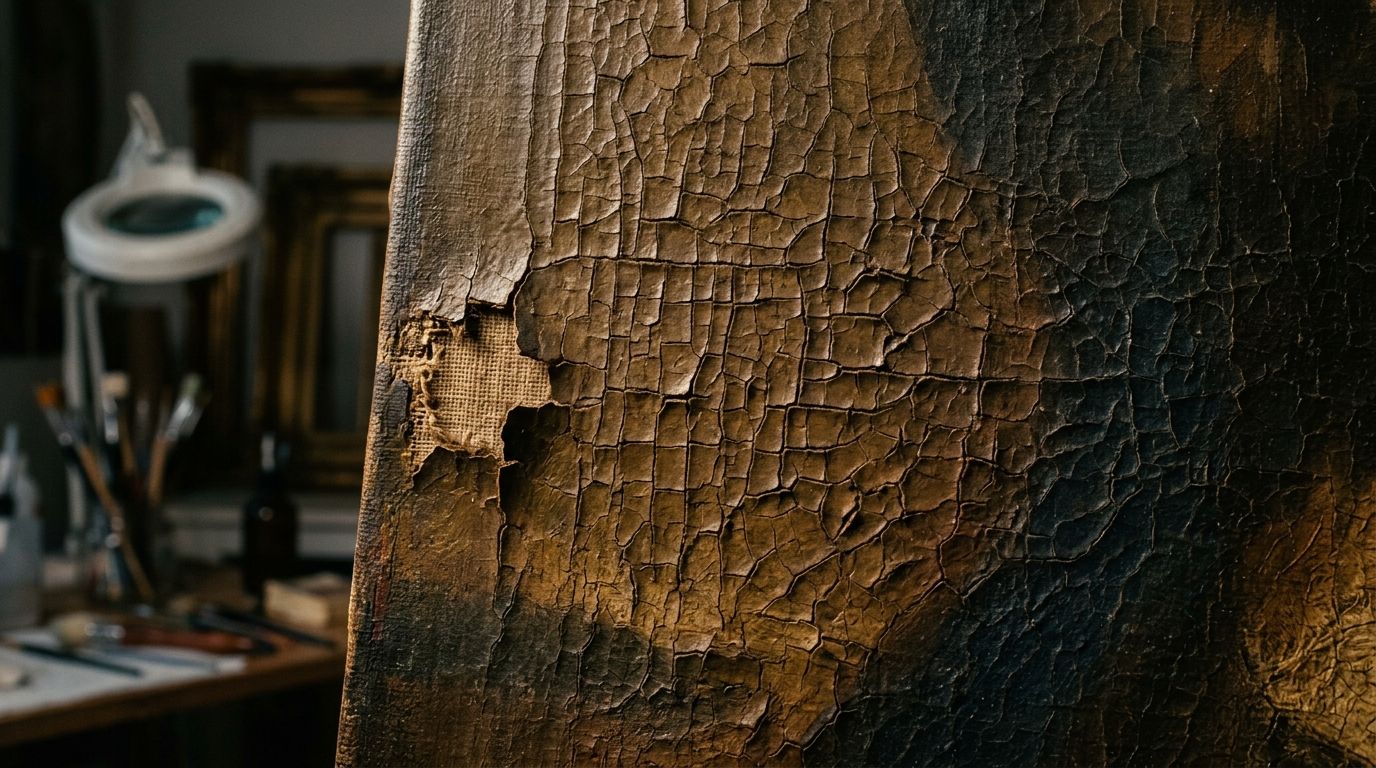
Craquelure is the network of fine cracks that forms in the varnish, paint or ground of a picture as those layers shrink, stiffen or take stress from the support beneath. The National Gallery, London, defines it as the pattern that appears across the surface as paint ages and shrinks. The Museum of Fine Arts, Boston, CAMEO materials database calls the same French word a network of fine cracks on a painting or a ceramic, and notes that the direction, regularity, size and shape of the islands between cracks have been tied to workshop materials and methods. The Australian Institute for the Conservation of Cultural Material (AICCM) adds the mechanisms: different drying rates between two layers, or one layer growing brittle while its neighbour still flexes.
You meet the word in wall labels, condition reports and auction notes. Conservators treat a stable network as part of the object. Dirt that settles in the openings can darken a pale sky or a flesh tone, which is why the National Gallery calls some craquelure disfiguring even when the paint still adheres. Types (age, drying, mechanical), oil and tempera mechanics, six named pictures, and the gap between historic networks and craft crackle glaze occupy the rest of this page. The full restoration sequence belongs with how paintings are restored (pending). Forgery tricks that imitate cracks belong with how forgeries are detected (pending). The cluster sits in Art Conservation & Science.
The word, the sound and the surface
English speakers borrow the French craquelure (from craqueler, to crackle). Cambridge Dictionary’s UK transcription is /ˈkræk.əl.jʊər/ (CRACK-əl-yoor); gallery educators often say something closer to krak-LOOR (/krækˈlʊər/). Canadian and French condition reports keep craquelure as the umbrella, then split it: craquelure prématurée for drying cracks, craquelure de tension for mechanical cracks, craquelure circulaire for a cobweb from a blow. English conservation prose keeps the French noun for the network and uses plainer English for the subtypes.
CAMEO lists synonyms that leak into other crafts: crackle, reticulation, and, on ceramics, crazing. On an easel painting the network can sit in varnish, paint, ground, or through the whole sandwich down to canvas or wood. Egg tempera and oil both crack. The National Gallery notes that most pictures of any age show craquelure everywhere at the surface, and that the varnish cracks with them. A new acrylic on a rigid board may show none. A fourteenth-century Sienese panel will show a lot.
Spike Bucklow, writing from the Hamilton Kerr Institute at the Fitzwilliam Museum, Cambridge, put the research point in one sentence: a crack pattern is not an intentional part of Old Master pictures. It forms as the object answers its environment, above all changes in relative humidity. Materials and construction give a painting a predisposition to crack in a certain map. The weather history of the room may decide how far that map develops.
How a painting is built, and why it cracks
A European easel painting is a stack of materials that swell, shrink and stiffen on different clocks. Canvas or wood sits at the bottom. Animal-glue size seals many canvases. A preparatory ground (chalk and glue, or oil and filler) makes a paintable plane. Paint follows, in one session or many, sometimes with glazes. Varnish, if the workshop or a later restorer added it, sits on top. Each layer has its own stiffness, its own appetite for water, and its own drying chemistry. Stress moves from the support into the uncracked film. If the stress in the middle of an uncracked island exceeds the strength of the material, a new crack opens. Łukasz Bratasz and colleagues call the end state fracture saturation: once islands are small enough, extra load no longer starts new fractures.
Two engines drive most of that map. Drying shrinkage happens inside the pictorial layers. Glue-based grounds and tempera lose water. Oil binders lose low-molecular-weight components over years and even centuries; a 2022 Heritage Science study of historic oil paint, cited in a 2024 canvas-modelling paper in npj Heritage Science, reported drying shrinkage on the order of 9 per cent after about 400 years, with crack systems confined to the paint. Ageing cracks come from the support: wood or glue-sized canvas swelling and shrinking as humidity cycles. Marion Mecklenburg, Charles Tumosa and David Erhardt, in the Getty Conservation Institute volume Painted Wood: History and Conservation (1998), measured how gesso and wood part company once relative humidity leaves a mid-range band around 40 to 60 per cent. In the tangential direction of the wood, a rise from 50 to 80 per cent RH can crack gesso; severe drying can buckle it in compression.
Canvas adds a geometry of its own. Finite-element models of a glue-sized canvas on a wooden stretcher, published in 2024 in npj Heritage Science, show high tensile stress at the corners when humidity falls and the sized fabric shrinks. The stretcher bars bend inward in their middles; the corner joints do not. Cracks there run perpendicular to the diagonal. Central networks on old canvas pictures, the authors argue, come from the slow, isotropic shrinkage of oil paint and oil grounds. Thicker ground damps the canvas response. That is a materials fact, not a recipe for owners.
Mechanical insults sit beside those two engines. A blow from behind, a scrape on the reverse, keys driven too hard in a stretcher corner, a drop onto an angle: each leaves a local pattern with sharp edges. The Canadian Conservation Institute (CCI) Notes 10/11 (2016) glossary is the working vocabulary for those shapes. Conservators read the map to infer cause. The problem starts when a crack is joined by cleavage, cupping or flaking: the film has lost adhesion, and fragments can leave the picture.
Age cracks, drying cracks and mechanical webs
Condition reports sort craquelure by cause because cause predicts behaviour. Age cracks that have reached a saturated network may sit quiet for decades in a stable room. Drying cracks that opened while the paint was still curing are, in CCI’s words, stable in most cases and do not spread, even when they look harsh. Mechanical cracks mark an event. They may be old and inactive, or they may sit next to a dent that still flexes. A phone photograph of yellowed varnish will not sort them. Raking light and a sense of the support will.
The three-way split is a field habit, not a law of physics. One picture carries all three. Vermeer’s Girl with a Pearl Earring (c.1665, Mauritshuis, The Hague) is the mix Jørgen Wadum diagrammed in 1994: a strong age network, a spider-web from impact, corner cracks from keys tapped too hard, and fine cracks in the ground that formed soon after the ground went on. The 2018 Girl in the Spotlight campaign scanned the same surface so later conservators can see whether the map has moved.
Age cracks
Age cracks (CCI: checks in varnish, paint or ground from long-term movement of the support) run in straight or gentle curves. On canvas they follow the warp and weft, so the islands look rectangular. On panel they run with the wood grain, because wood moves across the grain and the brittle gesso cannot follow. Edges are sharp. The crack can travel through paint and ground to the support. The Mauritshuis blog on the Girl states the sequence: paint and ground lose flexibility; an unstable room lets the canvas shrink and relax; stress finds relief in cracks; if the canvas shrinks a great deal, the edges of each flake lift (cupping); if a flake detaches, you have a loss.
Conservators respect a stable age network. Citaliarestauro’s conservation training pages call it a new equilibrium of the materials and part of the patina. Dirt in the openings is a separate problem: it changes the reading of light passages. Cleaning and filling belong to treatment ethics, not to “fixing” age. The pending restoration guide in this series covers when a studio consolidates cupping and when it leaves the map alone.
Drying cracks
Drying cracks (CCI: craquelure prématurée) open while the film is still forming. They can be wide. They expose the layer below. Edges are rounded or sloping, and CCI notes that they show no cleavage. Traction cracks and alligatoring (peau de crocodile) belong here: a faster-drying upper layer shrinks over a slower, fatter underlayer and tears into polygonal islands. The “fat over lean” rule in oil painting exists to reduce that mismatch. Excess medium, too much drier, a lean scumble over a greasy passage, or a varnish put on before the paint has set, all feed premature networks.
These cracks can appear within months or a few years of the sitting. They are a record of studio practice. A nineteenth-century sketch with a greedy glaze can alligator in the artist’s lifetime. A 2024 canvas study treats drying shrinkage of oil as a cumulative, isotropic process that keeps adding stress in the centre of a canvas long after the studio is closed. The slow chemistry and the fast traction tear share a family. One is a curing fault you can see in the first years. The other is the oil film still losing volume after centuries.
Mechanical cracks
Mechanical cracks (CCI: craquelure de tension) have sharp edges and a local story. Concentric or cobweb cracks mark a blow or pressure. Diagonal cracks at corners mark a drop or keys driven too far. Feather or herringbone cracks mark a scrape on the reverse or a glancing hammer blow while keying out. Spiral cracks mark a release of stress in the paint. Bucklow’s 1998 stylometric paper illustrated impact cracks on François Boucher’s Venus Asking Vulcan for the Arms of Aeneas (Louvre) and on Abraham de Verwer’s The Battle of the Zuiderzee (Rijksmuseum): the same insult, two workshop constructions, two different looks around the impact.
Raking light shows the dent or bulge that travels with many mechanical cracks. Age networks lack that local dish. Forgers have rolled canvases over cylinders and pressed from the reverse to force a web. Those induced maps are a problem for authentication, not a lesson in how to fake. The science of that distinction sits in the sibling article on how forgeries are detected (pending).
Oil, tempera and the ground beneath
Medium and ground decide how a crack looks as much as the support does. Egg tempera dries by water loss into a lean, brittle film. Oil dries by oxidation and cross-linking into a film that stays a little more plastic for longer, then embrittles. Chalk-glue gesso is stiff, with a low moisture expansion compared with wood across the grain. Oil grounds behave more like old oil paint. You read the picture as a composite, not as “paint on a board.”
Cennino Cennini’s workshop recipe for gesso, still cited in laboratories that cast test bars, is a reminder that the ground is a designed material: glue strength and chalk-to-glue ratio set the modulus. The 2024 npj Heritage Science canvas paper measured chalk-glue ground at a pigment volume concentration of 92 per cent and watched it pass from stiff to gel-like as humidity rose. Historic oil grounds keep evolving for years, so researchers use stiff glue grounds as a declared stand-in for old, brittle pictorial layers.
Oil films
Oil paint on canvas is the public image of craquelure: a rectangular web over a portrait, darker in the varnish, catching raking light on the forehead. The film shrinks as the binder’s molecular mix changes. Pigment volume concentration changes the stiffness by orders of magnitude; a review in the Journal of Cultural Heritage (Pauchard and Giorgiutti-Dauphiné, 2020) notes that elastic modulus can vary by a factor of a thousand from a lean, crowded pigment load to a fat, binder-rich glaze.
A thick impasto and a thin scumble on the same picture will not crack on the same schedule. Van Gogh’s piled yellows, treated below, are one end of that range. A lean Dutch glaze is the other.
The “fat over lean” rule is the studio attempt to keep those layers in step. A lean scumble over a greasy passage is how traction cracks and alligatoring start. The slow, isotropic shrinkage that still runs in the centre of an old canvas after centuries is the same chemistry on a longer clock.
Egg tempera and gesso on panel
Egg tempera on a gessoed panel is brittle once dry. CCI’s guidelines on caring for paintings note that a non-rigid support would have cracked such a film, which is one reason the medium stayed on wood. Wood swells across the grain. Gesso cannot match that move. Fine craquelure aligned with the grain is the expected map on a panel.
Italian poplar and Flemish oak do not move the same way, and the grounds differ, which is why Bucklow could sort fourteenth- and fifteenth-century Italian panels from fifteenth- and sixteenth-century Flemish ones by crack photographs alone. Glue-chalk gesso on oak, with the grain running the length of a Baltic plank, produces the smooth, parallel Flemish map. Gesso on poplar, with different sawing habits, produces the jagged Italian map with a secondary web.
Duccio’s The Transfiguration in London, treated at length below, shows that writing in public: a knot in the panel cracks the field beside Christ. The paint records the wood.
Canvas weave, stretchers and keys
On canvas, the textile is both a support and a template. Glue size shrinks hard when the air dries; Mecklenburg’s laminar model, refined by later canvas-glue composite work, puts large forces in the sized fabric at low RH. Cracks in Dutch seventeenth-century pictures follow warp and weft and meet at square junctions, which is Bucklow’s Dutch type. Eighteenth-century French canvases in his survey showed smoother, curved, non-directional cracks. He attributed that to stiffer sublayers that delocalised tension so the weave no longer dictated the map.
Keys in a stretcher corner are a local mechanical story. Tap them too hard and you get the corner cracks Wadum numbered on the Girl. Keying out a slack canvas is a historic studio and restorer habit. It is also a way to print feather cracks from the reverse if a hammer glances the fabric.
A backing board, a stable RH, and fewer moves do more for a cracked canvas than any owner “tightening.” The 2024 canvas models put humidity-driven new cracks at the corners, not in the middle. If the centre of an old canvas is a dense rectangle of islands, you are looking at oil shrinkage and weave, not last winter’s heating.
Four workshop maps
Bucklow photographed more than five hundred passages of sky or flesh, each about 20 to 30 cm², chosen to avoid impact cracks, panel splits and obvious brushwork. The pictures came from four traditions that differ in materials and construction: fourteenth- and fifteenth-century Italian panels, fifteenth- and sixteenth-century Flemish panels, seventeenth-century Dutch canvases, and eighteenth-century French canvases. Thirty observers, from Old Master specialists to sixth-form students, sorted a subset. Statistical analysis found a correlation of about 75 per cent between pattern and art-historical category, and pair-wise discrimination above 90 per cent, with 97 per cent success separating Italian from Flemish panels. A neural net on digitised lines did worse than the humans; discriminant analysis did better.
Bucklow’s own limit still stands: painters do not in every case use the same materials in the same way, so a crack pattern alone is a poor signature of a named artist. It can confirm or challenge a school and a construction. It cannot replace documents, pigment analysis or a catalogue raisonné. The Hamilton Kerr project page states that environmental history may decide the extent of cracking without changing the predisposition. A Flemish oak panel that spent three centuries in a damp church and a cousin that sat in a dry château can share a family likeness in the map even if one web is thicker.
| Tradition in Bucklow’s survey | Support | Crack direction | Line quality | Islands and junctions |
|---|---|---|---|---|
| Italian panels, 1300 to 1500 | Wood (poplar in many central Italian shops) | Perpendicular to the wood grain | Jagged, with a distinct secondary web of thinner cracks | Irregular islands; secondary network visible in flesh and sky |
| Flemish panels, 1400 to 1600 | Oak, chalk-glue grounds | Parallel to the wood grain | Smooth, straight segments of even thickness | Small, square islands |
| Dutch canvases, 1600s | Glue-sized canvas | Perpendicular to the major axis; follows warp and weft | Jagged | Square junctions; rectangular islands |
| French canvases, 1700s | Canvas with stiffer sublayers in the sample set | Non-directional | Smooth, curved | Random distribution; weave no longer dictates the map |
| Drying / traction (any school) | Paint or ground over a slower layer | Isotropic or local to a passage | Wide, rounded or sloping edges | Polygonal or “alligator” islands; may spare the support |
| Mechanical impact (any school) | Local insult to canvas or panel | Radiating from a point or corner | Sharp edges | Cobweb, feather, diagonal or spiral, in many cases with a dent |
CAMEO cites this 1997 Studies in Conservation paper as the reference for relating island shape to period materials. In a gallery, look at direction relative to grain or weave, at whether lines are jagged or smooth, and at whether a second, finer web sits inside the first.
Six pictures and the cracks they carry
Named works keep the vocabulary from floating. The six below are public, attributed, and documented in museum or conservation literature. Each is a different mechanical object.
1. Duccio, The Transfiguration, c.1308 to 1311. National Gallery, London. Egg tempera on wood.
A Sienese predella panel from the Maestà. Horizontal grain, a knot that cracks the field to the left of Christ, gesso and canvas extending over original frame mouldings. This is Italian panel construction of the kind Bucklow sampled: brittle tempera on gesso on poplar-type wood, with the support’s faults written as paint cracks. Stand close and the gold and the flesh both show the web. The cracks to the left of Christ are a carpentry event, not a later restorer’s craquelure medium.
2. Leonardo da Vinci, Mona Lisa (Portrait of Lisa Gherardini), begun 1503. Musée du Louvre, Paris. Oil on poplar.
The Louvre’s collection entry describes a thin poplar board, about 79.4 × 53.4 cm, now a little convex, with an 11 cm split that starts at the top, crosses the hair, and stops at the forehead. Two butterflies and canvas patches on the reverse stabilised that split long ago. The same entry states that movement of the panel, constrained by a frame, produced the networks of craquelure now so visible. Since 2005 the picture has sat in a climate-controlled vitrine, in part because poplar keeps moving with humidity. The famous web is age and support, plus later varnish: a poplar panel in a frame, not a coating Leonardo brushed on for effect.
3. Jan van Eyck, The Arnolfini Portrait, 1434. National Gallery, London. Oil on oak.
Bucklow’s Flemish cell is a school, not this one panel, but the Arnolfini is the oak-and-oil object most visitors can use to remember the type: a Baltic oak board, a chalk-glue ground, a thin oil film. CCI describes the grain-aligned craquelure of panel paintings as the result of wood moving more than gesso across the grain. Look for smooth, straight segments and small islands, the Flemish grain map rather than the jagged Italian secondary web. The portrait is a construction you can walk up to, not a published crack atlas of this one oak board.
4. Johannes Vermeer, Girl with a Pearl Earring, c.1665. Mauritshuis, The Hague. Oil on canvas.
A Dutch canvas with a fine, rectangular age network that a 2018 TU Delft topography scanner recorded at micrometre scale. Wadum’s 1994 diagram still organises a visit: (1) strong age cracks; (2) spider web from pressure or impact; (3) corner cracks from keys; (4) fine ground cracks from the first days of the ground. The 1881 starch (water-based) lining (Heritage Science; Mauritshuis public blog says 1882) shrank the original canvas and cupped the paint. The 1915 varnish “regeneration” left copaiba balsam, later found in black material inside cracks. The 1994 treatment filled losses; the 2018 campaign documented the present map so the next generation can see change. Age, mechanics and restoration history share one small surface.
5. François Boucher, Venus Asking Vulcan for the Arms of Aeneas, 1732. Musée du Louvre, Paris. Oil on canvas.
Bucklow published this picture as a French-canvas example of impact cracks: a cobweb from a blow, sitting on a construction whose background craquelure, in his eighteenth-century French set, tends to smooth curves rather than Dutch rectangles. Use it to separate a local insult from the field network. The field tells you about workshop build. The cobweb tells you about an event.
6. Vincent van Gogh, Sunflowers, 1889. Van Gogh Museum, Amsterdam. Oil on canvas.
A piled, chrome-yellow still life with zinc white in the background, later varnishes, a twentieth-century wax-resin lining since removed, and a 2019 decision that the picture will not travel. The museum’s conservation note is that ground and paint are stable but sensitive to vibration and climate. That is drying oil, thick application, and a long treatment history. Both this canvas and the Girl are “oil on canvas,” and they crack as different objects.
Decorative crackle, ceramics and artists who want the break
Historic easel craquelure is an accident of materials. Other crafts crack on purpose, and some living painters accept or court a broken surface as part of the work. Mixing those practices with Old Master networks is the main public confusion around the keyword. Search results for “craquelure” already include Polyvine how-to videos and crackle-varnish product listings. Those products answer a transactional query. They do not age a new painting into a seventeenth-century Dutch canvas. The three neighbours below share a look in a thumbnail and part company in the object: kiln glaze, craft coating, and contemporary paint that is allowed to fail.
Ceramic crackle
Chinese Ge ware and related guan-type celadons of the Song period carry a dual crackle in the glaze: a coarser dark network (tie xian, “iron wire”) and a finer pale web. The cracks form as glaze and body contract at different rates on cooling. Later staining can darken the primary lines. That is a ceramic glaze under thermal stress, closer to what AICCM and CAMEO call crackle or crazing on pottery than to oil-paint age cracks.
Korean and later European factories copied the look. Contemporary potters still fire for it. The word craquelure appears in ceramic glossaries; the physics is kiln and glaze, not a glue-sized canvas. Dirt in those glaze fissures can stain the body where the glaze no longer seals it, which is a ceramic conservation problem of its own.
Craft crackle glaze
Furniture and craft suppliers sell two-part crackle varnishes and “crackle glaze” paints that shrink a top coat over a base colour so a contrasting ground shows in the fissures. The pattern is even, shallow, and confined to the coating. It appears in days. Historic age cracks take years to centuries, follow grain or weave, and run into the ground.
A raking-light photograph of a 2020s still life with craft crackle will show a decorative skin. A raking-light photograph of the Girl shows cupping, losses filled in 1994, and a rectangular web that matches a canvas. If the fissures stop in the varnish and ignore the weave, you are looking at a coating.
Artists who want the break
Anselm Kiefer’s paintings and lead-and-clay constructions crack because the materials are heavy, brittle and unstable in chemistry: clay bodies on canvas, industrial glues, lead sheets, electrolysis sediment. A 2018 treatment at the Centro Conservazione e Restauro La Venaria Reale, for a work with clay plaques of about 50 kg, had to re-adhere masses that gravity had pulled from the fabric and to restrain a warped stretcher. Tate and White Cube campaigns on other Kiefers have accepted a measure of change, with the artist’s consent, because the broken crust is part of the work’s argument. Conservators manage loss on that crust. They do not chase an Old Master web.
Some painters buy craquelure medium to quote age as a style, the way a photographer adds grain. The honest label is “induced crackle” or “crackle medium.” Conservators restoring losses on an old picture sometimes continue a crack pattern into a fill so the repair does not sit as a smooth island. Citaliarestauro calls that reconstituted craquelure and separates it from forgery. The intent is visual integration, documented in the treatment report.
How to look
Stand at a normal viewing distance first. Then step in. Raking light (a torch or a window at a low angle) turns cracks into ridges and valleys. The Mauritshuis 2018 photography of the Girl is the demonstration: cupping reads as a low relief; a filled loss disappears in ordinary light and shows on X-ray as a dark gap.
Check whether the network follows the weave or the wood grain. Check island size, and whether a finer secondary web sits inside the first. Look for a cobweb, a feather, or a corner diagonal that points to an insult. Then check whether the paint still sits flat, or whether islands cup and threaten to detach. The first three checks are vocabulary. The fourth is condition. Stable age craquelure is compatible with display. Cupping, cleavage and flaking are why a painting leaves the wall for a studio.
Do not pick at a crack. Do not oil it, varnish it, or run a home steamer at a cupped canvas. CCI and AICCM condition language exists so you can describe what you see to a conservator: alligatoring, concentric cracks, stretcher-corner diagonals, tenting. The treatment decisions (consolidate, fill, retouch, line, or leave) belong in a documented studio process. That process is the subject of how paintings are restored (pending). Preventive care (stable humidity in the mid-range Mecklenburg measured, backing boards, fewer loans for fragile impasto) belongs with the later guide on preventive conservation in this series.
Authentication uses craquelure as one clue. A network that matches the support and the claimed workshop is consistent with the story. A network that sits in a new varnish alone, or that looks rolled, baked or printed, is a warning. Bucklow’s caveat still applies: the map can refute a category more than it can name a hand. Pigments, panels, dendrochronology and provenance do the rest. Browse public museums that publish technical notes (National Gallery, Louvre, Mauritshuis, Van Gogh Museum, Hamilton Kerr) when you want to check a crack claim against a collection page rather than against a dealer’s adjective.
Common confusions
Craquelure and crazing. AICCM keeps both terms. Craquelure is the network in varnish or paint from drying mismatch or embrittlement. Crazing is a fine or microscopic network in a varnish or coating that can make the surface look cloudy because it scatters light. On ceramics, crazing and crackle describe glaze fissures. Writers blur them. A cloudy, blanched varnish may be crazing, bloom, or micro-fissures that have not yet become a readable crack map. A dark, dirt-filled web on an old oil is craquelure.
Crackle glaze and historic age. A craft crackle finish is a coating designed to tear. Historic age craquelure is a composite of support movement, drying chemistry and accidents. The first is even and shallow. The second is anisotropic on panels and many canvases, mixed with mechanical incidents, and continuous into the ground. “Crackle glaze” on social media is the first in almost every post.
Varnish cracks versus paint cracks. Varnish can crack on its own, in a network that does not match the paint. The National Gallery notes that cracking into the varnish is common. A disfiguring varnish web can be reduced in treatment; a paint-and-ground web cannot be “removed.” Dirt in paint cracks is harder than dirt on a varnish.
“Craquelure proves it is old.” Drying cracks can form in a year. Induced crackle can form in a weekend. Age networks of the Bucklow type take the time and the construction of the school, and even then a restorer can continue cracks into fills. Age is a hypothesis the whole object has to support.
“All cracks are damage.” Stable age craquelure is the equilibrium Citaliarestauro describes. Fracture saturation can even make a panel less vulnerable to the next humidity cycle, which is the argument of Bratasz’s saturation papers. Damage, in studio language, is loss of adhesion, active flaking, or a new crack from a new insult.
Leather, pottery and product copy. Search also throws up craquelure leather and pottery. Those are surface crackle in other materials.
FAQ
Search pages and antiques forums keep asking the same short questions: what the word means, whether cracks prove age, how drying cracks differ from impact damage, and whether craft crackle varnish counts. The answers below stay inside the vocabulary fence. They summarise types and looking habits from the sections above. They do not teach restoration or forgery detection; those belong with the sibling guides once they publish.
What does craquelure mean?
Craquelure is the network of fine cracks in the surface of a painting, and by extension in some glazes and varnishes. The National Gallery definition is the working one: a pattern that develops as paint layers age and shrink. Cambridge UK: /ˈkræk.əl.jʊər/; gallery talk often says krak-LOOR.
What causes craquelure?
Paint, ground and varnish shrink as they dry and as oil binders keep changing for decades. Supports swell and shrink with humidity. A blow, a scrape, or keys driven too hard add local mechanical cracks. Getty research on painted wood locates a quieter mid-range of relative humidity; large swings away from that band put gesso into tension or compression it cannot take.
What are the different types of craquelure?
Field practice uses three causes: age cracks from long-term support movement; drying or traction cracks from a film that shrank while curing; mechanical cracks from an insult. CCI names shapes (alligatoring, cobwebs, corner diagonals, feather cracks, spirals). Bucklow adds four workshop maps. One picture can carry several types at once, as the Mauritshuis diagram of the Girl with a Pearl Earring shows.
How do you pronounce craquelure?
Cambridge UK: /ˈkræk.əl.jʊər/. Gallery educators often say krak-LOOR (/krækˈlʊər/). The word is French; English conservation prose keeps the French spelling.
Can craquelure be fixed?
A stable age network is not something modern conservation tries to erase. CCI notes that drying cracks, though disfiguring, are in most cases stable and do not spread. Conservators intervene when cracks are joined by cupping, cleavage or flaking. Call a conservator; do not fill cracks at home.
Is craquelure the same as crazing?
AICCM uses crazing for a fine, cloudy network in a coating, and craquelure for the broader crack network in paint or varnish. Ceramic writers use crazing and crackle for glaze. If the surface looks milky, think crazing or bloom. If you see a readable web of fissures in the paint, think craquelure.
Does craquelure prove a painting is authentic?
A network that matches the claimed support and workshop is consistent with authenticity. Drying cracks and craft crackle can be young. Forgers induce webs. Bucklow showed that school-level patterns are readable and that authorship still needs more than cracks. Use craquelure as one line of evidence beside materials, imaging and documents: how forgeries are detected (pending).
Are stress cracks normal?
Age cracks from support movement are the expected condition of old tempera and oil pictures. The National Gallery states that most pictures of any age show craquelure at the surface. Stress cracks from a blow or from over-keying are common accidents. New cracks, lifting edges, or a sudden change in a known map are reasons to ask a conservator.
Related reading
Diego Rivera's Monumental Stadium Relief Set for Conservation in Mexico City
A multi-institutional campaign targets the artist's unfinished stone facade at UNAM alongside works by Siqueiros and O'Gorman
Local conservators will lead a phased preservation effort for Diego Rivera's volcanic stone relief at Mexico City's Olympic stadium, supported by the World Monuments Fund and US diplomatic grants.
Van Lévé: Sovereign Caribbean Visions Take Shape at Harvard
A transnational survey charts twenty-five years of Creole and Maroon artistic practice across the French Caribbean and Amazonia.
Harvard's Alain Locke Gallery presents a landmark survey tracing contemporary production from Guadeloupe, Martinique, Guyane, and Haiti since two thousand and one.
Gustave Fayet: Collector—Artist Designer
A comprehensive survey at the Fondation Louis Vuitton reuniting collected masterpieces with the designer's own studio practice.
The Paris institution expands its patronage series with a dual-focused examination of Gustave Fayet, bringing together hundreds of acquired works and restored creations to chart his impact on early modernism.