
Exhibo Editorial
What Is Fresco Painting?
Buon fresco, secco and a secco on lime plaster: chemistry, giornate, Giotto and Michelangelo, and what wall painting costs when pigment becomes stone
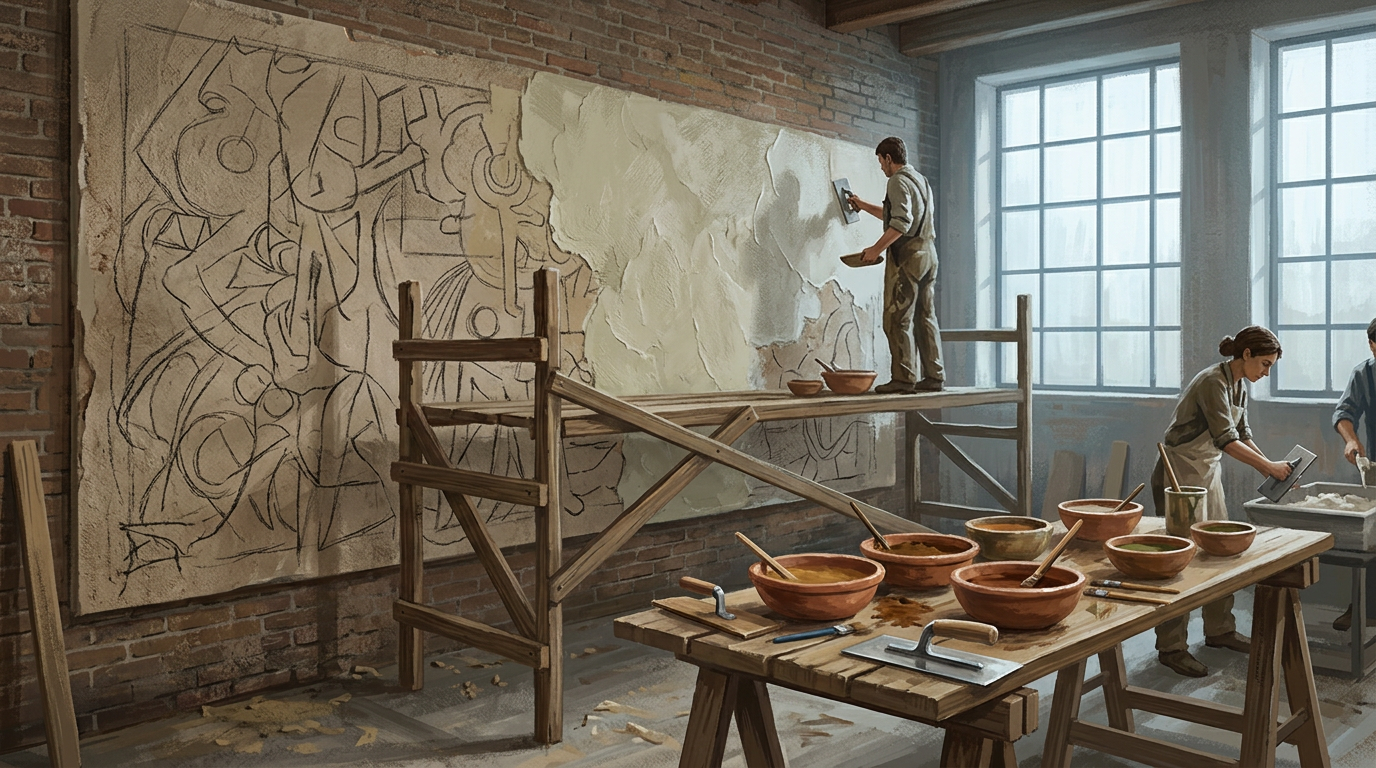
Fresco painting is a mural technique in which an artist applies water-based pigment to freshly laid lime plaster while the surface is still damp. The Italian word fresco means fresh, and in workshop speech it usually points to buon fresco (true fresco): colour carried only in water, brushed into wet intonaco and locked there as calcium hydroxide in the plaster reacts with carbon dioxide in the air. The result is not a skin of paint sitting on a wall. It is colour embedded in a thin mineral layer that has become, in effect, coloured stone.
That bond explains why Roman and Renaissance cycles could survive for centuries when oil on panel darkened or flaked. It also explains the discipline. Buon fresco demands speed, sectional planning and a crew that understands plaster. Touch-up on dry wall belongs to different methods: fresco secco (pigment on dry plaster, often with limewater and a binder) and the broader category a secco (any dry-wall painting with glue, egg or oil). Museums label many walls "fresco" when only part of the surface was painted wet. Reading a chapel or a Pompeian room means asking which passages were buon, which were secco, and what later restorers added. The sibling guide Oil vs Acrylic Paint treats modern binders on canvas and panel; this page stays with lime and wall. The cluster hub is Art Techniques and Materials. Named sites below appear in the museums directory.
What fresco means in art
In exhibition copy and textbooks, "fresco" often collapses three distinct jobs. Buon fresco is the strict form: powdered pigment ground in water, applied to wet intonaco, fixed by carbonation before the plaster sets. Fresco secco is painting on plaster that has already dried, typically after the wall has been dampened with limewater and the pigment mixed with a binder such as casein, egg or animal glue. A secco is the umbrella for any painting executed on a dry lime or gypsum surface with an adhesive medium; it includes secco retouching on top of a buon passage and entire compositions that were never painted wet.
Tate's art-term entry states the durable rule: paint absorbed into wet plaster makes a lasting mural, while a whole composition painted on dry plaster is liable to flake. That flaking is not a moral failure. Secco allowed sharper lines, gold leaf, and corrections after a giornata dried. Giotto's workshop in Padua and Michelangelo's ceiling in Rome both relied on buon fresco for the bulk of the work and accepted secco where the chemistry would not deliver the desired effect.
The word also drifts in casual English. "Al fresco" dining means outside in the fresh air, not painting on plaster. In Italian art schools, affresco remains the technique; al fresco is weather. For search intent around what is fresco in art, the useful answer is the wall method, not the restaurant terrace.
Wall painting in other binders follows different rules. Oil on canvas, discussed in the oil vs acrylic sibling, dries by oxidation and sits on a ground you can move or reline. Fresco commits at the wall. That commitment shaped patronage: popes, guilds, and city councils funded cycles meant to outlast the donor's grandchildren. When a panel altarpiece could travel or sell, a refectory ceiling could not.
Materials, plaster layers and lime chemistry
A fresco wall is an engineered sandwich. Roman and Renaissance builders prepared a masonry support, then built up coarse and fine lime plasters before any figure appeared. Pigments for buon work had to be lime-safe: many organic lakes and some sulphide pigments react with alkali and change colour or vanish. The chemistry at the surface is slow, measurable, and unforgiving. Conservators describe successful fresco as a partnership between mason and painter: if the arriccio moves or the intonaco is scoured with too much sand, no genius of drawing will save the giornata. Art historians sometimes treat wall painting as a subset of "painting" in the abstract; on site it behaves as hydrated lime first and illustration second. The subsections below follow the wall from coarse layer to carbonating surface, then the palette that survives contact with wet alkali.
Arriccio, intonaco and the working surface
The coarse layer is arriccio: lime putty mixed with sand (and sometimes pozzolanic ash or other aggregates) keyed into the wall, often several centimetres thick. It dries slowly and holds the mechanical bond. The fine painting layer is intonaco: lime putty with finer sand, applied in the session's patch only. Cennino Cennini, writing around 1400 in the Libro dell'arte, describes preparing walls, laying arriccio, then transferring a drawing before the final thin coat receives colour. Workshop practice varied by city. In Florence, Ghirlandaio's crews in the 1480s and Michelangelo's team in 1508 both adjusted sand grades and additives when Roman humidity misbehaved.
Intonaco for buon fresco is usually a few millimetres thick. Too thick and the surface skins over while the core stays wet; too thin and it dries before the painter finishes. The plaster must be wet enough to draw pigment inward but firm enough to hold a line. Experienced plasterers speak of the moment the wall "takes" the brush. Miss that window and the day's work is lost.
Carbonation and why colour fixes
Fresh lime plaster is rich in calcium hydroxide, Ca(OH)₂, produced when water is added to quicklime (calcium oxide). As the plaster cures, CO₂ from the air converts hydroxide to calcium carbonate, CaCO₃, the same mineral family as chalk and limestone. Pigment particles trapped in the top layer become embedded in that crystallising matrix. Conservators call the result a "pictorial skin" bonded to the intonaco.
The reaction needs access to air and time. Deep inside a thick coat, carbonation lags. That is one reason painters work on a limited patch: the open surface carbonates while the session runs. Humidity, salt in the masonry, and later water ingress can interrupt the cycle, leaving soft or powdery zones that powder off under a finger (museum staff only; do not test in situ).
Pigments that survive and pigments that fail
Earth colours (ochres, umbers), many mineral greens and blues that resist alkali, and lime-fast blacks such as carbon black served buon fresco well. Orpiment and realgar (arsenic sulphides) appear in some historical palettes but are toxic and unstable in combination with other pigments. Lead white could be used in fresco in some periods but behaves differently from chalk or lime white. Organic reds and purples often shift or fade; workshops learned to put fugitive lakes in secco layers over a buon underpainting, or to substitute mineral alternatives.
Azurite and ultramarine (lapis lazuli) ground fine could enter wet plaster for sky and mantle passages at ruinous cost. The Scrovegni Chapel in Padua and the Sistine ceiling both deploy blues that read as luxury as much as hue. When you compare fresco to tube paints in the oil vs acrylic guide, remember that fresco colour was chosen for chemical compatibility first and for catalogue convenience second.
Lime itself arrives at the wall as putty: quicklime slaked in water, matured for months in a pit so excess water evaporates and the mass becomes workable. Poorly slaked lime causes popping and weak bonds. Sand grade matters as much as pigment choice: sharp, well-graded sand reduces shrinkage cracks. Roman builders added pozzolana, volcanic ash, to speed set and resist moisture; Michelangelo's Roman crew returned to that habit after Florentine mixtures failed on the Sistine vault. Modern conservators matching old repairs analyse aggregate size under microscopy before trowelling new intonaco into a loss.
Buon fresco, fresco secco and a secco compared
The three terms are not interchangeable. Buon fresco is chemically fused. Secco and a secco sit on or in the surface and depend on binders that age, darken, or fail when damp returns.
| Method | Plaster state | Vehicle / binder | Bond type | Typical durability | Common use |
|---|---|---|---|---|---|
| Buon fresco | Wet intonaco, freshly trowelled | Pigment in water only | Carbonation embeds colour in CaCO₃ matrix | High when wall stays dry | Figure fields, skies, large narrative walls |
| Fresco secco | Dry plaster, often dampened with limewater | Pigment plus casein, egg, glue | Adhesive film on surface | Moderate; sensitive to moisture | Fine lines, corrections, blues that misbehave wet |
| A secco (general) | Dry wall (lime, gypsum or other) | Glue, gum, oil, wax, mixed media | Mechanical / adhesive | Variable; often lower than buon | Drapery highlights, gilding, later restorers' overpaint |
| Mezzo fresco | Partially set plaster | Pigment in water, limited binder | Mixed | Uneven; historical term, rare in modern practice | Transitional passages in some Baroque sites |
| Modern lime wash | Dry or damp substrate | Lime slurry with pigment | Weak mineral bond | Depends on preparation | Decorative interiors, not Renaissance substitute |
Exam boards love the buon vs secco binary. On the ground, Roman Fourth-Style rooms at Pompeii combine buon layers with secco detail and architectural illusion in the same wall. Renaissance masters planned the split. Michelangelo's 1980–1994 Sistine restoration removed centuries of secco overpaint by later restorers while leaving buon passages intact, a lesson in how much "fresco" on a postcard is original wet work and how much is later glue paint.
When workshops chose secco
Secco bought time and precision. Gold leaf requires size on a dry surface. Razor-sharp contours and small lettering are easier with a binder on dry plaster. Some pigments, including certain lakes, shift on wet alkali; painters laid a buon base and finished dry. The risk is known: secco passages are often the first to flake in a damp church. Conservators document them separately in condition reports.
A secco also names what happens when a buon giornata goes wrong. Rather than lose a figure, a workshop might cut out failed plaster and replaster, or paint the passage dry. Michelangelo's early ceiling trials in 1508–1509 reportedly suffered plaster failures until his associate Jacopo Torni adjusted the mix toward Roman pozzolana and marble dust in the lunettes. Vasari and later technical studies describe those months as material crisis before the familiar rhythm of the nine Genesis bays settled in.
How a buon fresco is painted, step by step
Fresco is a sequence job: masons, plasterers, painters, and assistants who grind colour and carry water. A single master rarely touched every square metre alone on a large cycle, though Michelangelo on the Sistine vault comes close in legend and in fact. Contracts from Quattrocento Florence specify delivery dates by wall bay, not by "when inspiration strikes." Rain delayed intonaco. Cold slowed set. A patron who wanted a chapel finished for a feast day learned to read the calendar against plaster chemistry. The steps below are idealised; every surviving wall shows shortcuts, repaints, and giornate joints that map real labour against that ideal.
Wall preparation and sinopia
The wall arrives at arriccio, level and cured. The master draws in sinopia: a rough composition in reddish earth pigment on the dry coarse layer, visible through the thin intonaco if the coat is applied thinly enough, or used as a guide for pouncing and cartoon transfer. Cennino describes copying a full-size drawing by pricking holes and dusting charcoal through. In Padua, Giotto's Arena Chapel cycle (c. 1303–05) was planned as a unified narrative on the long walls and vault; sinopia under some scenes survived later overpaint and helps archaeologists reconstruct workshop order.
Scaffolding must place the painter close enough to judge wet colour, which dries lighter and cooler than it appears in the dish. Roman vault painters and Renaissance ceiling crews built timber platforms that moved as giornate advanced. Safety and lighting (north light, reflected lamps) were part of the design.
The giornata: one day's wet patch
A giornata (Italian: day's work) is the area of intonaco laid and painted in one session, before the plaster sets too far to accept brushwork. Size varies with humidity, heat, figure complexity, and crew skill. A large flat sky might be one giornata; a dense group of figures might be split across several. Joints between giornate are visible on close inspection as fine seams or "day lines," prized by conservators mapping production.
The plasterer trowels the day's patch. The painter retraces the sinopia or cartoon lines on the wet surface and applies colour in passes from light to dark, leaving reserves for overlaps where possible. Corrections in buon fresco are limited. Scraping back wet plaster and replastering a zone is possible but costly. That constraint shaped Renaissance composition: clear masses, readable gestures, fewer last-minute changes than oil on panel allows.
Finishing, polishing and secco passes
When the intonaco cures, the buon passage is fixed. The workshop may then go a secco for eyes, embroidery, extreme highlights, or pigments excluded from wet work. Some cycles received a thin lime or wax polish in period; later restorers added varnishes and glues that darkened until removed. The Tate glossary note is worth keeping: small touch-up on dry plaster is normal; an entire mural executed dry is a different object with a different conservation profile.
Assistants ground pigments in water, kept dishes labelled by giornata, and hauled water up scaffold stairs. A poncho of fresh intonaco could not wait while the master finished an argument on the ground. Crew size separated a cathedral nave from a chapelside job. Payment records from fifteenth-century Florence list plasterers, hauliers, and painters separately; the technique was always a building trade as well as an art trade.
Historical development: Pompeii to the Renaissance
Fresco and related wall systems are old. Minoan sites on Crete, Egyptian tomb programmes, and Roman domestic interiors all used lime plasters with painted decoration. The technique the Italian Renaissance perfected was not an invention ex nihilo. It was a refinement of Mediterranean building craft tuned to narrative scale. English-language search traffic clusters on Italy because Roman ruins and Vatican chapels dominate textbooks; the method itself travelled with lime technology wherever builders slaked stone. What changed in the trecento and quattrocento was not the formula alone but the ambition of the programme: whole rooms, whole lives of saints, whole vaults turned into sky.
Roman wall painting and Pompeii
At Pompeii and Herculaneum, buried by the eruption of Vesuvius in AD 79, wall decoration survives in quantity. Archaeologists classify four styles of Roman wall painting. First Style mimics coloured marble panels; Second Style opens architectural vistas; Third Style favours delicate ornamental frames on flat fields; Fourth Style mixes illusionist architecture, mythological panels, and decorative fantasy. Not every passage is buon fresco. Many rooms combine a wet lime ground with secco detail, incised lines, and applied ornament.
The Villa of the Mysteries, outside Pompeii's walls, preserves a famous red-ground cycle whose execution mixed techniques; scholars continue to debate specific passages. What matters for the student is the habit: Roman patrons expected integrated interiors, and workshops treated wall, floor, and stucco as one commission. When those houses were sealed under ash, lime plaster and carbonated colour survived two millennia of stillness, then faced new enemies after excavation: light, air pollution, tourism, and humidity swings in open sites.
The House of the Vettii, reopened to visitors after long conservation, shows Fourth-Style fantasy architecture framing mythological panels: a single room can read as a stage set built from plaster, not stone. Priapus weighing his attribute on a counterweight scale is a tourist favourite; the joke depends on quick reading from the floor, the same viewing distance Roman diners used. None of that narrative convenience required canvas stretchers or frames. Pompeii teaches that "fresco" in archaeology often means "lime-wall programme" rather than a purity test for buon technique in every square centimetre.
Medieval revival and the Italian duecento and trecento
After antiquity, fresco remained the default for church interiors in Italy. Romanesque crypts and Gothic aisles received lime-based programmes. In the late thirteenth century, artists in Rome and Tuscany pushed volume and gesture. Pietro Cavallini's mosaics and frescoes at Santa Cecilia in Trastevere (c. 1290s) and the fresco cycles attributed to the workshop tradition around Assisi show the move toward heavier bodies and clearer space.
Giotto di Bondone (c. 1267–1337) is the name textbooks attach to the shift. Enrico Scrovegni commissioned the Arena Chapel in Padua, dedicated 1305, with a complete New Testament narrative on the walls and a starry vault. The cycle is buon fresco for the main fields, with secco for some details. Giotto's figures occupy believable ground planes; grief in the Lamentation reads across the chapel without a gold background swallowing the scene. The chapel remains in situ; booking and conservation limits apply, but the object is the reference point for "fresco" in fourteenth-century art history.
High Renaissance and the Roman grande decorazione
Fifteenth-century Florence ran on fresco for church and palace interiors: Masaccio in the Brancacci Chapel (1420s), Fra Angelico at San Marco (1430s–1440s), Domenico Ghirlandaio in the Tornabuoni Chapel at Santa Maria Novella (1480s). Each workshop managed giornate, assistant hierarchies, and pigment grinding at scale. Michelangelo apprenticed in Ghirlandaio's bottega in 1488–89, long enough to learn plaster timing even if he left before the contract term ended.
Masaccio's Expulsion from the Garden in the Brancacci Chapel (Santa Maria del Carmine, Florence) shows what buon fresco could do for bare skin and shame in a single giornata's planning: two figures stride in harsh light, no gold relief to separate them from the viewer's space. Loss and later repainting complicate the surface, but the chapel remains the standard school trip for Renaissance depth before perspective manuals circulated in print. Fra Angelico's cells at San Marco invert the scale: small private rooms where Dominican friars met quiet Annunciations at arm's length, proof that fresco served intimacy as well as parade.
Rome under Julius II concentrated ambition in the Sistine Chapel. The walls had been frescoed from 1481–83 by Perugino, Botticelli, Ghirlandaio, and others. Michelangelo painted the ceiling in buon fresco between 1508 and 1512, about 460 square metres of narrative and architectural illusion, organised in nine Genesis scenes, prophets, sibyls, and ignudi. He returned in the 1530s for the Last Judgment on the altar wall, finished 1541, again largely buon fresco on a prepared arriccio. The chapel now receives millions of visitors yearly; Vatican Museums climate control (roughly 22–24 °C, 55–60% relative humidity) is part of the artwork's ongoing material life.
Masters, masterpieces and why fresco suited their aims
Fresco rewarded patrons who wanted permanence and artists who could think in metres, not inches. The masters below are not a ranking. They are case studies in what the technique demands and allows. Monumental lime painting also suited theological politics: a cycle on every wall could instruct a largely illiterate congregation without a shelf of books. Fixed walls prevented a rival faction from moving the imagery after a coup. When you visit the sites in the museums directory, compare how each master sized figures for the room you stand in, not for a reproduction cropped to social feeds.
Giotto and narrative clarity at Padua
Scrovegni's chapel is a box-shaped room, not a basilica apse. Giotto could sequence thirty-eight scenes at eye level and on the vault without competing with aisle traffic. Buon fresco forced him to commit to broad value structure day by day. Blue heavens and architectural frames read from the floor because the planner scaled figures for distance. The cycle's fame rests on psychology and staging as much as on material, but the material made the staging permanent. Without fresco, a private patron's chapel might have received panel altarpieces that could move or sell. Scrovegni wanted fixed instruction and fixed prestige.
Michelangelo, the Sistine vault and the secco debate
Michelangelo's ceiling is the reference image for buon fresco in popular culture. Close study and the 1980–1994 restoration led Gianluigi Colalucci and the Vatican team to conclude that Michelangelo worked predominantly in true fresco on the ceiling, completing each section while plaster was fresh. They identified minimal a secco retouching on some passages. Earlier restorers from the seventeenth to nineteenth centuries had added glue-based overpaint to brighten shadows and redefine contours; the modern campaign removed those layers, revealing high-key colour that shocked viewers accustomed to brown varnish tones.
The dispute among art historians (James Beck and ArtWatch International, among others) centred on whether removal went too far and whether Michelangelo intended darker finishing passes. That argument belongs to conservation ethics. For technique, the takeaway is sharper: the durable original is buon; many perceived "old master brown" tones were later secco and varnish. Separate maintenance in 2024–2026 addressed calcium lactate, a white salt film from visitor breath and humidity on the Last Judgment, cleaned with distilled water and Japanese paper while the chapel stayed open. Science reports detected lactic acid in the chapel atmosphere linked to crowd density. Fresco now fights chemistry in both directions: carbonation once fixed it; human traffic supplies new salts.
Other fresco cultures worth naming once
Byzantine churches used lime and egg-tempera systems distinct from Italian buon fresco. Mexican muralism (Diego Rivera, José Clemente Orozco, David Alfaro Siqueiros, twentieth century) revived monumental lime-wall painting for public buildings, often with cement and modern pigments that behave differently from Quattrocento palettes. Indian and Central Asian cave temples used related mineral-on-plaster traditions. This article stays with the Italian-Roman line that dominates the English query, but "fresco" is not exclusively European.
How fresco fails, degrades and is repaired
No wall painting is immortal. Fresco resists flaking better than oil on canvas when the masonry stays dry, but water, salts, vibration, and human intervention dominate condition. The same carbonation that locked pigment in the Quattrocento can be undone indirectly when salts crystallise in pores or when a roof leak turns a lime matrix to paste. Modern climate control in busy chapels is not luxury; it is part of the artwork's material continuation. The subsections below group failure modes the way a conservator's report would, from water to human overpaint, before any discussion of value on the art market.
Water, salts and structural movement
The primary enemy is water: roof leaks, rising damp, condensation from crowds, capillary rise in ground-level tombs. Water dissolves salts in mortar and plaster, moves them to the surface, and leaves white efflorescence or dark tide lines. Crystals growing in pores push off the pictorial skin in small blisters conservators call "scaling" or "delamination." Michelangelo's ceiling already showed cracks from building movement before he painted; workers filled voids with brick and mortar. Earthquakes, settlement, and truncated arches in remodelled churches repeat the stress.
Saltpetre (nitrates) and calcium carbonate efflorescence appear in Giovio's sixteenth-century account of the Sistine ceiling. Baroque restorers applied oils and animal glue to hide whitening, a cosmetic that later trapped soot. The twentieth-century Vatican team recorded candle wax, amorphous carbon, and multiple glue varnishes before washing.
Mechanical loss, overpaint and light
Scaffolding holes, door cuts, and bomb blast (the Montecassino abbey frescoes, 1944) remove sections outright. Overpaint from later restorers obscures original giornate boundaries until infrared or X-ray maps reveal them. Light fades organic secco passages faster than carbonated buon colour, but even mineral blues can shift with abrasive cleaning.
Conservation today favours minimal intervention: stabilising plaster with compatible lime mortars, poultices for salt reduction, reversible surface treatments, and environmental control. Full-scale removal of overpaint, as on the Sistine ceiling, is controversial and rare. Routine maintenance, as on the Last Judgment in 2026, targets soluble salts without reopening the whole campaign.
What to look for in a gallery or church
You rarely touch the wall, but you can look. Matte, slightly granular surfaces that follow the plaster plane suggest buon work. Glossy or sharply raised lines often mean secco or later oil. Cracks that run through figures regardless of composition follow structure, not design. Hatched repairs in a different grain indicate modern fills. If a "fresco" hangs in a frame like a panel, it is a detached strappo or a transfer on canvas, a rescue object removed from its original wall. Museums label those transfers honestly; the technique story changes when the plaster support is gone.
Emergency salvage sometimes cuts the pictorial skin from the wall. A strappo pulls the upper plaster layer with adhesive fabric; a stacco takes a thicker slab. Transfers mounted on canvas let museums show works that would otherwise be lost to demolition or flood, but the object is no longer a fresco in the strict material sense. The National Archaeological Museum in Naples holds many Pompeian panels removed in nineteenth-century campaigns; they teach iconography well and teach in situ wall craft less. Prefer the house still on its lot when your itinerary allows.
What fresco costs today
Historic fresco was priced like architecture: patron, site, crew, years. Modern commissions revive the method for churches, public buildings, and private villas, but the market is thin compared with canvas or digital print. Costs split between skilled plasterers, pigment specialists, and artists who accept giornata pacing.
Commercial mural pricing in the United States and United Kingdom often runs £15–£50 per square foot for acrylic or latex wall painting by professional muralists, with experienced names higher and project minimums of £800–£4,000 regardless of area (industry surveys such as HomeGuide and ProMatcher, 2024–2025). True lime buon fresco adds lime plaster preparation, multiple coats, pigment testing, and slower daily output. Specialists quote £40–£100+ per square foot for authentic fresco or lime-mural work when plasterers and painters both bill separately; large narrative cycles are quoted as design plus scaffold plus day rate, not a hardware-store per-metre figure.
A small domestic feature wall in buon fresco might start around £5,000–£10,000 in Western Europe once plaster stability, access, and pigment trials are included. A church apse programme can reach six or seven figures over years of scaffolding and conservation monitoring. Public art budgets at £100,000–£500,000+ for major exterior murals (LuxCalculator and municipal commission data, 2025) usually describe acrylic or silicate paint systems, not full Renaissance buon, unless a foundation explicitly funds lime craft.
Students learning the chemistry often work on portable lime panels in art schools (Royal Academy schools, Florence atelier programmes, Mexican legacy workshops). Panel fresco avoids building permits but still requires pigment compatible with lime. Reproduction prints and giclée versions of famous cycles belong to the print market, not to wall technique; see what is a giclée print in the same series for that fence.
Frequently asked questions
What is the difference between buon fresco and fresco secco?
Buon fresco applies pigment in water to wet intonaco and fixes colour through lime carbonation. Fresco secco applies pigment to dry plaster, usually with limewater and a binder such as egg or glue. Buon passages are more durable when the wall stays dry; secco allows finer detail and risky pigments but flakes more readily in damp conditions.
What is a giornata in fresco painting?
A giornata is the patch of fresh intonaco laid and painted in one session before the plaster sets. Joints between giornate appear as fine seams on close viewing. Planning a large cycle meant sizing each day's patch to what the painter could finish while the surface still took the brush.
Is Michelangelo's Sistine Chapel ceiling true fresco?
Conservators who led the 1980–1994 restoration concluded that Michelangelo painted the ceiling predominantly in buon fresco, with only minimal dry retouching. Much darkening seen before that campaign came from candle soot, glue varnishes, and later restorers' secco overpaint rather than from Michelangelo's wet-work palette.
What frescoes survive from Pompeii?
Houses and villas at Pompeii and Herculaneum preserve extensive wall decoration buried in AD 79, including the Villa of the Mysteries and the House of the Vettii. Roman painters combined buon fresco layers with secco detail across four recognised decorative styles; not every coloured surface is true wet fresco.
Why did Giotto matter for fresco?
Giotto's Arena Chapel cycle in Padua (c. 1303–05) demonstrates buon fresco used for coherent narrative on walls and vault, with figures scaled for a small interior and emotional scenes readable from the floor. Art historians treat the chapel as a pivot between medieval icon conventions and Renaissance spatial clarity.
Is fresco still used today?
Yes, but less commonly than acrylic or vinyl mural systems. Contemporary practitioners include church restorers, heritage specialists, and muralists trained in lime plaster in Italy, Mexico, and a few Western art schools. Most new large walls use modern paints unless a patron specifies traditional buon fresco for material authenticity.
How can you tell if a wall painting is fresco?
Look for a matte surface integrated with the plaster plane, day lines between sessions, and labels from the site. Scientific examination (IR, UV, cross-sections) distinguishes buon from secco. A framed "fresco" in a museum may be a detached strappo or transfer, no longer on its original wall.
Is fresco a medium or a technique?
In catalogues, "fresco" usually names a technique (how pigment meets plaster) rather than a single bottled medium. Workshop speech treats it alongside supports: fresco on wall, tempera on panel, oil on canvas. The series hub groups it with other material methods under Art Techniques and Materials.
Related reading
Curating Tomorrow's Archive: Hamburger Kunsthalle Seeks Contemporary Collections Lead
A new permanent appointment will steer the museum's post-1960 holdings across paper, photography, and media formats.
The Hamburger Kunsthalle is inviting applications for a senior curatorial position focused on contemporary acquisitions, exhibition strategy, and digital collection management. Applications close October 2026 for a January 2027 start.
Whilst We Are Savages: Colonial Constructs and Atlantic Dialogues
A critical survey at TEA Tenerife exploring how colonial frameworks shaped identity, territory, and knowledge across Europe, Africa, and Latin America.
William Morris Gallery Reopens With Intimate Restoration and New Focus
A comprehensive overhaul at the Walthamstow venue explores the designer's contradictions through newly displayed archives and a domestic curatorial approach.