
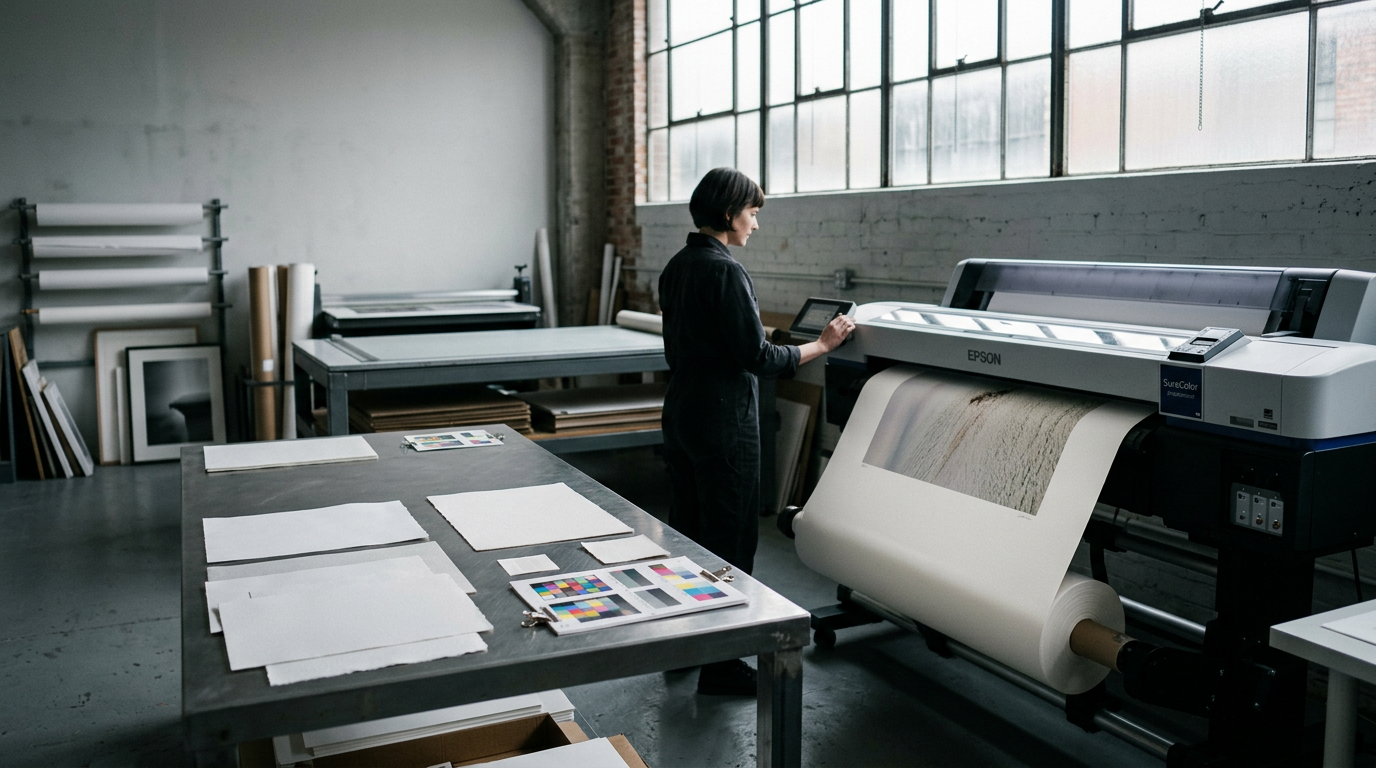
Exhibo Editorial
What Is a Giclée Print?
Archival pigment inkjet on cotton rag or canvas: how fine-art reproduction printing works, where the French trade name came from, and what separates it from a poster
A giclée print is a fine-art inkjet print made with lightfast pigment inks on an archival support, usually cotton rag paper or a prepared canvas, from a high-resolution digital file. The French word giclée (pronounced zhee-clay) entered English around 1991 as a trade name for spray-deposited ink. It does not name a separate printing technology. It describes a quality band inside inkjet: wide colour gamut, controlled colour management, and materials chosen for display life rather than office turnover.
If you stand in a gallery and read “giclée on Hahnemühle Photo Rag,” you are looking at a digitally printed sheet whose stability depends on a matched system of ink, paper coating, and framing. The print may reproduce a painting, extend a photographic edition, or be the original work if the artist composed the file for output. Technique pages for the wider Art Techniques & Materials series treat the chemistry and workflow here. Matrix print methods (etching, lithography, screenprint) belong with types of printmaking. Museum holdings that include inkjet work sit in the museums directory.
Giclée meaning: inkjet at fine-art specification
In professional use, giclée and archival pigment inkjet overlap. Both mean an inkjet print intended for collection or long display, built from a pigment ink set and a support that meets conservation expectations: acid-free, lignin-controlled, often 100% cotton or alpha-cellulose, with a coating that receives ink without bleeding. Dye-based consumer inkjets can produce vivid proofs. They fade faster under light and are seldom sold as giclées.
The technical core is droplet control. Wide-format fine-art printers place thousands of microscopic ink drops per second through fixed or moving heads. A twelve-colour channel (cyan, magenta, yellow, black, light cyan, light magenta, and several greys or spot colours) smooths gradients that a four-colour office printer cannot hold. Resolution is quoted in dots per inch, but perceived sharpness also depends on file size, sharpening, and viewing distance. A 40 × 60 cm reproduction of an oil painting may need a different pixel count than a 40 × 60 cm photograph of the same canvas.
Giclée prints are reproductions more often than they are “original prints” in the printmaking sense. An artist may paint in oils, scan the canvas, and sell numbered inkjet copies. The same artist may also paint only in pixels and never touch brush to panel. Both outputs can carry the giclée label if the materials meet the trade norm. The word does not guarantee that the print is scarce, signed, or valuable. It guarantees a production class: pigment inkjet on archival stock with colour-managed workflow.
Materials: pigment inks, papers, and canvas
Fine-art giclée quality lives in the ink-and-paper pair. Manufacturers test them as a system. Swap paper without retesting and the fade rate changes. Conservators therefore treat “giclée” as a family of combinations, not one recipe. Two decisions dominate every job: which colourant carries the image, and which coated support receives it. Studio staff match those choices to the subject (photograph, watercolour scan, flat graphic) and to the expected hang time. A publisher printing a five-year exhibition poster may accept alpha-cellulose and a lighter ink load. An artist selling a numbered landscape edition will specify cotton rag and a named pigment set. The subsections below split ink chemistry from paper and canvas engineering because failure modes differ: inks fade or shift hue; papers yellow, crack, or lose optical brighteners.
Pigment inks versus dye inks
Pigment inks suspend solid colour particles in a carrier fluid. They sit on or in the paper’s receiver layer. Dye inks dissolve colour molecules that penetrate the coating. Pigments resist ultraviolet light and atmospheric ozone better than dyes. Wilhelm Imaging Research, which publishes display permanence ratings used across the industry, treats yellow pigment stability as the usual limiting factor in gradual colour drift on wall display.
Current Epson UltraChrome PRO, HDX, and related pigment sets, Canon Lucia PRO, and HP Vivera pigment lines dominate studio giclée work. Entry-level “photo” printers may use dye or mixed sets. A label that says “archival pigment” should name the ink family or the printer model. Vague “digital print” without ink type is a warning.
Black-and-white giclées on Epson systems can use a dedicated Advanced Black and White Print Mode that replaces colour channels with multiple carbon-pigment grey inks. Wilhelm’s tests report display ratings above 400 years for some paper pairings in that mode, with tests still running. Colour prints on the same printers more often land between roughly 100 and 250 years to a defined visual endpoint on named cotton papers, always conditional on framing and light level.
Archival papers and canvas supports
Paper choice alters both look and life. Cotton rag papers (often marketed as “museum grade”) have long fibres and no wood-pulp lignin that yellows. Alpha-cellulose papers from purified wood pulp can also meet archival standards when buffered and lignin-free. Common trade names in giclée studios include Hahnemühle Photo Rag, Canson Infinity Platine, Epson Legacy Fibre, and Moab Entrada. Each has a different surface: hot-press smooth, cold-press textured, baryta glossy resembling silver gelatin.
Canvas giclées use a polyester-cotton or pure cotton canvas with an ink-receiving coating, then an optional varnish. The texture reads as “painted” at a distance. Close up you still see a weave. Canvas costs more to ship stretched. Rolled canvas saves freight but needs stretching at destination. Varnish adds UV filtering and uniform sheen. It also complicates future conservation.
Optical brightening agents (OBAs) in some papers make whites look brilliant under gallery light. OBAs can fail over decades, shifting the paper’s apparent colour. Museums weighing long storage sometimes prefer OBA-free stocks. For a ten-year living-room hang, OBA paper is common and acceptable if the buyer knows the trade-off.
How a giclée print is made, step by step
Workflow separates a studio giclée from a print-shop poster. The same Epson or Canon engine that prints a decor canvas may sit in either building; the difference is file hygiene, profiling discipline, and stock grade. A poster shop drops a JPEG into a RIP and walks away. A giclée atelier logs printer serial, ink batch, paper lot, and profile version so a reprint five years later can match the first impression. The steps below describe a typical artist or atelier run from capture to signed sheet. Reproduction jobs start with an object in the room. Born-digital works skip capture but still pass through colour management and proofing.
Capture and file preparation
Reproduction begins with a faithful digital master. Museums and specialists use flatbed scanners or medium-format camera copy stands with cross-polarised lighting to suppress varnish glare. Artists photographing their own work need parallel camera axis, even light, and colour targets. The master file is often 16-bit RGB or Adobe RGB, large enough that the longest edge maps to the intended print width at 300 pixels per inch or the printer’s native input resolution.
Colour correction is its own craft. The operator soft-proofs on a calibrated monitor, adjusts curves, and sometimes builds custom ICC profiles for a printer-paper pair. A file that looks correct on screen can print too magenta on a cold-press paper. Test strips and iterative proofing burn ink and time. That cost sits in the retail price.
Printing, drying, and finishing
The operator loads the paper, selects the profile, and prints. Wide-format machines feed roll or sheet stock. Print heads may pause for alignment checks. Pigment prints feel dry to the touch quickly but manufacturers often recommend twenty-four hours before handling so carriers evaporate fully.
Finishing includes trimming, deckle edges, numbering, and signature. Reproductions may carry a pencil edition fraction (“12/50”) on the front or back. Some artists sign the border; others stamp the reverse. Glass and matting are separate trades. UV-filtering acrylic or museum glass reduces fade rate. Direct sun on any inkjet print, giclée included, accelerates fading beyond test-lab assumptions.
Where the word “giclée” came from
The vocabulary is recent and commercial. Digital fine-art inkjet printing is older than the word, but the word fixed a marketing problem: “inkjet” sounded like office equipment. Collectors who paid hundreds of dollars for a large photograph in 1993 did not want a label that evoked fax machines. Printmakers borrowed from French technical language because Paris still anchored print terminology in the fine-art trade. The history is therefore a chain of hardware (Iris drum proofer), a California studio (Nash Editions), and a naming choice by Jack Duganne, not a medieval craft guild. Understanding that chain explains why the word is optional in museum catalogues yet persistent on Etsy listings.
Iris proofing and Nash Editions
In the late 1980s Iris Graphics of Bedford, Massachusetts, sold the Model 3047, a large drum inkjet proofer for the commercial printing trade. It used water-based dyes on thin proofing paper mounted to a rotating drum. Graham Nash, the musician and photographer, saw an Iris demonstration in March 1989 and recognised that the machine could output exhibition-scale photographs. He purchased an Iris 3047; with tour manager R. Mac Holbert, printer Jack Duganne, and collaborators including colour engineer Dave Coons, he opened Nash Editions in Manhattan Beach, California, on 1 July 1991. Nash Editions describes itself as the first dedicated fine-art digital printmaking studio. The original Iris 3047 Nash bought later entered the collection of the Smithsonian’s National Museum of American History, with an early Nash portrait of David Crosby.
Jack Duganne, then a master printer at Nash Editions, coined giclée around 1991. He drew on the French noun gicleur (nozzle) and verb gicler (to spray). He wanted a term that sounded like existing print names (serigraph, lithograph) and that avoided the industrial connotations of “Iris proof.” Wikipedia and Wilhelm Imaging Research both record Duganne’s coinage in this context. The feminine noun giclée in French slang can also mean a spurt of liquid; some Francophone printers dislike the term for that reason. English-language art trade usage kept it anyway.
From Iris dyes to Epson pigments
Iris giclées were visually rich and chemically fragile. Early water-based dye Iris prints needed careful handling; Wilhelm’s essays on Nash Editions note that permanence anxiety accompanied the medium from the start. By 2003 Nash Editions had moved to Epson wide-format pigment printers. Studios worldwide followed. “Giclée” stayed as the retail word even when no Iris machine touched the work.
The term also broadened until it meant almost any high-quality inkjet. Trade groups such as the Giclée Printers Association (formed 2001) tried to tighten standards with labels like “Tru Giclée.” Competing marketing phrases (Platinum Giclée, vendor-specific names) multiplied. Today a serious buyer asks for pigment, paper brand, and printer model, not the French word alone.
Giclée prints compared with posters, lithographs, and other prints
Confusion starts because all four can show the same image. The difference is how the ink reaches the support and what that implies for texture, edition size, and life on the wall.
Posters and open-edition “art prints” sold online are usually offset lithography or generic digital on lightweight coated paper. Offset litho uses four plates (cyan, magenta, yellow, black) and rubber blankets to transfer ink to paper in a press run of hundreds or thousands. Unit cost drops as quantity rises. Colours are fixed at proof stage. Fine detail and subtle glazing from an oil original may flatten.
Traditional fine-art lithography (Senefelder’s greasy crayon on stone or plate) remains a matrix print method: the artist draws on the matrix, prints an edition, and the matrix may be cancelled. Each sheet passes through a press that transfers ink from a flat surface. Texture and slight variation between impressions belong to the medium. Photolithographic reproduction of paintings is a different industrial path, closer to poster production.
Giclée sits beside those methods as digital inkjet. It excels at smooth continuous tone, wide colour, and short runs (even one copy). It does not emboss a plate mark or leave lithographic crayon grain. Compared with types of printmaking, giclée is not intaglio, relief, or planographic in the historical sense. It is additive ink on a coated surface.
| Print type | Ink or colour system | Typical support | Edition scale | Surface tell | Display life (typical, framed) |
|---|---|---|---|---|---|
| Giclée / archival pigment inkjet | Multi-channel pigment inkjet | Cotton rag, baryta, or coated canvas | Often small, sometimes open | Smooth inkjet dot structure under loupe; no plate mark | Wilhelm-rated pairings often 100 to 250+ years colour; B&W carbon modes higher on named papers |
| Open-edition poster / decor print | Dye inkjet or 4-colour web offset | Lightweight coated or groundwood paper | Open, mass | Dots or screen visible; thin paper | Years to a few decades; fades in bright rooms |
| Offset litho reproduction | CMYK offset ink | Coated or uncoated stock | Hundreds to thousands | Uniform mechanical dot rosette | Decades if fair paper; not conservation-grade unless specified |
| Hand lithograph (artist matrix) | Grease-based litho ink | Arches or similar print paper | Small numbered edition | Plate mark optional; crayon/tusche texture | Long if acid-free paper and fugitive inks avoided; varies by ink |
| Chromogenic (C-type) photograph | Silver-halide + dye couplers | Resin-coated photo paper | Variable | Gloss or pearl photo surface | Wilhelm data: best C-prints rival early inkjets; both beat cheap dye posters |
| Screenprint (serigraph) | Layered opaque inks | Heavy paper or fabric | Small to medium | Raised ink layers, stencil edges | Long with stable pigments; depends on ink formulation |
Use the table as a first sorting tool, not a price guide. A signed screenprint on mould-made paper can outrank a careless giclée in market terms. A well-made giclée on cotton rag can outlast a mass poster by a century of indoor display if framed behind UV glass.
Artists, studios, and works that established the method
Digital inkjet entered museums through photographers and hybrid painters before painters’ reproduction markets adopted it. The masters in this section are not a ranking of “best giclée artists.” They are case studies in how institutions learned to file a spray-deposited sheet next to gelatin silver and lithography.
Graham Nash and Mac Holbert at Nash Editions proved that Iris, then Epson, output could hang beside silver gelatin in collector markets. Early clients included museum photographers and edition publishers. The Smithsonian’s retention of the Iris 3047 anchors the origin story in material culture, not only in marketing copy. When you visit the National Museum of American History, the machine itself is evidence that digital printmaking crossed from prepress utility into art infrastructure in one decade.
Photographer Chuck Close worked with master printers on large-scale inkjet portraits that depend on grid-based files and meticulous RIP settings. His later prints show how inkjet scale rivals painting size while remaining a print medium. Close’s grid logic suits inkjet because the file already reads as a matrix of cells waiting for output.
David Hockney’s iPad drawings, printed as edition inkjets for exhibitions and sales, made born-digital drawing on inkjet a mainstream museum fact. Institutions including the Royal Academy and Tate have shown his printed iPad works. The technique is giclée-class whether or not the label appears on the wall. Buyers receive a sheet that never existed as a unique painting on panel.
Contemporary painters such as Wade Guyton use inkjet failure (banding, misfeed, reused files) as part of the aesthetic on canvas and linen. His work sits in collections including MoMA. That strand treats the printer as a tool with accidents, not only as a neutral reproducer. Guyton’s unprimed linen feeds through the printer until the feed fails; the failure line becomes composition.
Edition houses such as Adamson Editions in Washington and Paragon Press in London built reputations on consistent pigment profiles for artists who do not own printers. Their role mirrors traditional lithography workshops: the artist authorises the file; the workshop guarantees repeatability. Reproduction publishers for museum shops likewise standardise on a handful of cotton papers so Van Gogh or Klimt licensed posters share one material spec even when the painting originals differ in medium.
In the Gulf and wider MENA scene, edition publishers and photography galleries use the same Epson/Canon pigment workflows as London or Los Angeles studios. The technique is global; the word giclée is optional on bilingual labels. Arabic wall text may say “digital print” or “pigment print” while English copy uses giclée for export buyers. Regional photography fairs often sell open-edition pigment prints alongside C-prints; the technique page applies to both trade labels when pigment inkjet is named.
Lightfastness, fading, and what “archival” promises
Archival is a description of intent and tested pairs, not a legal standard. Permanence numbers come from accelerated tests: high light, controlled humidity, measured colour shift to an endpoint.
Wilhelm Imaging Research publishes display permanence ratings in years at specified light levels, often referencing 450 lux for home display versus darker museum storage. A rating of “>100 years” means the test had not reached the visual endpoint when the report was written. Yellow ink stability often governs colour drift. Paper with OBAs can change even when pigments remain stable.
Ozone and humidity matter separately from light. NEDCC’s leaflet on long-lasting inkjet prints notes that pollutant gases and high relative humidity can yellow papers or shift dyes. The Image Permanence Institute recommends cold storage for some inkjet papers whose receiver layers age faster at room temperature. Framed display under UV-filtering glazing and away from south-facing windows is standard advice.
Heat-set dye sublimation and electrophotographic toner prints follow different failure curves; this page stays with inkjet. Within inkjet, dye prints on consumer paper can show noticeable fade in months of south-window display. Pigment giclées on cotton rag fade slowly enough that framing choices dominate the user-visible lifetime.
Wilhelm’s endpoint criteria (Visually-Weighted Endpoint Criteria Set v3.0) describe acceptable colour shift before the print is deemed failed for display rating purposes. That is a lab definition, not what a casual viewer notices on year one. Collectors sometimes see metamerism (colours matching under gallery LED but diverging in daylight) before they see outright fade. Metamerism is a spectroscopic mismatch, not lightfastness failure, but it affects satisfaction.
ISO 18937 and related imaging-materials standards define how to measure indoor light stability; they do not set a single “pass/fail” year count for all prints. Results for one printer, ink, resolution, and paper cannot transfer to another combo. Ask for the specific pair tested if a seller cites a century of life.
For collection care beyond technique, a dedicated editorial guide to buying and living with prints and editions (E07 in the Exhibo programme) will treat certificates, condition reports, and market context. That piece is not live yet. This page stops at what the print is and how it ages.
Editions, signatures, and what the label is not telling you
Giclée reproductions often carry Arabic numerals as fractions: 3/100 means the third print in an edition of one hundred. The artist may also inscribe A/P (artist’s proof) or P/P (printer’s proof) outside the numbered run. None of these notations is regulated by the word giclée. They are customs from printmaking and photography markets.
A certificate of authenticity (COA) may list paper, ink, dimensions, and edition size. It is only as reliable as the issuer. Technique does not replace provenance. Two identical giclées from the same file differ in value if one is signed and one is not, or if one comes from the artist’s studio and one from an unauthorised upload.
Open-edition giclées (unlimited prints from one file) are common in online decor markets. Limited editions raise scarcity but do not change the ink chemistry. Destruction of the digital file after the run is a business promise, not a physical cancellation like scratching a copper plate.
When you need guidance on what to collect, how editions affect price, or how to compare a giclée to a lithograph in a portfolio, follow the future E07 editorial on prints and editions. Here the point is narrow: edition writing describes distribution, not material quality.
What giclée printing costs in studios today
Prices vary by region, printer, and whether capture is included. The figures below are order-of-magnitude studio rates for artists printing their own files in Britain, Western Europe, and North America as of 2024 to 2026 trade surveys and open price lists. Treat them as planning bands, not quotes.
Scanning or photographing a 60 × 80 cm painting with professional copy lighting and colour target: roughly £80 to £250 (or $100 to $300) per image at a specialist, more for crated works or multispectral needs. Custom ICC profiling for one paper on one printer: £50 to £150 per profile.
Single-sheet printing on a 60 cm wide Epson or Canon pigment printer, archival cotton rag at A2 (42 × 59 cm): roughly £25 to £70 per print at a public fine-art lab, higher with rush handling or exotic papers. Canvas giclée at the same size, stretched: often £60 to £150. Artist-owned printers amortise capital (a 44-inch SureColor or imagePROGRAF may cost £2,000 to £6,000+) and ink (£100 to £300 per full cartridge set) over many prints.
Compared with four-colour offset, giclée wins on short runs. Wikipedia’s summary, citing industry sources, notes that a single large-format inkjet can cost more than ten times one offset litho impression in a 1,000-copy job, but inkjet avoids plate setup and bulk storage. Artists selling one print at a time use giclée for cash flow. Publishers printing 5,000 identical posters use offset.
How to read a giclée on a museum or gallery wall
When a venue lists “pigment inkjet print” instead of giclée, the conservator is choosing cataloguing language over retail language. Both may describe the same object. Check four lines on the label or accession record: support (paper or canvas), ink type (pigment preferred), dimensions of the sheet versus the image, and edition if any.
Under magnification, pigment inkjet shows a fine, regular dot or stitch pattern from the head pass. You should not see halftone rosettes of offset litho or the embossed plate mark of an intaglio print. Canvas giclée may show weave through mid-tones.
If the work hangs in a photography department, it may be a photograph printed by inkjet rather than a reproduction of a painting. The technique is the same; the status of the file differs. Born-digital photographs by artists such as Andreas Gursky (who uses large-format inkjet output for exhibition prints) are primary works, not copies after an original in another medium.
Conservation departments file inkjet under “digital prints” or “inkjet prints” in condition surveys. The Getty Conservation Institute’s research on digital print preservation documents water damage patterns, ink bleeding, and cockling distinct from silver prints. Those failure shapes matter when a work travels on loan. A giclée on cotton rag may survive a humidity spike better than a resin-coated C-print, but a flooded basement ruins both.
Major museums that collect contemporary photography and works on paper, including Tate, MoMA, and the Victoria and Albert Museum, hold pigment inkjet prints under climate-controlled conditions. Their presence in those collections supports the material as museum-grade when produced and stored correctly. It does not bless every shop using the word giclée on a product page. Use the museums directory to find institutions whose photography and contemporary departments publish collection searches online.
Common confusions
Giclée versus “art print.” Art print is a retail catch-all. Giclée implies pigment inkjet at fine-art specification. A cheap drop-shipped “art print” may be dye ink on poster paper.
Giclée versus lithograph. Hand lithography pulls ink from a drawn matrix. Giclée sprays ink from heads. Reproduction lithographs of paintings exist; they are still planographic press work, not inkjet.
Giclée versus canvas print. Canvas print names the support. The same canvas may receive dye or pigment. Ask for pigment and coating type.
Original versus reproduction. A giclée can be either. The technique does not decide. The artist’s intent and the existence of a unique painting elsewhere do.
Resolution hype. “1440 dpi” on a box describes the printer engine, not artistic quality. A poor file at maximum dpi still looks soft.
Permanence marketing. “100-year guarantee” cards from paper mills refer to specific Wilhelm or ISO-style tests. Demand the named paper and ink. Generic guarantees without pair data are decoration.
FAQ
What is a giclée print in plain terms?
A high-quality fine-art inkjet print made with long-lasting pigment inks on archival paper or canvas, usually from a digital file of an artwork or a born-digital image. The name comes from the French word for spraying ink.
How do you pronounce giclée?
English speakers usually say zhee-clay (/ʒiːˈkleɪ/). French speakers stress the last syllable differently; either is understood in art trade contexts.
What is the difference between a giclée and a regular print?
A giclée uses pigment-based inkjet on archival stock with colour-managed workflow. A regular decor print often uses dye ink or offset on thin paper built for low unit cost, not long display life.
Are giclée prints worth buying?
Worth depends on the artist, edition, signature, and your purpose. Materially, a well-made giclée on cotton rag framed behind UV glass can hold colour for decades in normal indoor light. Open-edition decor giclées are not investments. Signed limited editions from the artist’s studio follow print-market rules, not magic in the word giclée.
How long do giclée prints last?
Wilhelm Imaging Research ratings for named Epson pigment ink and cotton paper pairings often fall between 100 and 250 years to a defined colour-shift endpoint under prescribed indoor light. Black-and-white carbon modes on some papers exceed 400 years in ongoing tests. Direct sun, high ozone, and damp rooms shorten life. Results apply only to the tested ink-paper pair.
Should you put glass over a giclée print?
Yes for paper works in most homes. Museum glass or UV-filtering acrylic reduces fading and protects the surface from dust and handling. Use spacers so the print does not touch the glazing. Canvas giclées on stretchers are often varnished and hung unglazed like paintings.
Is giclée better on paper or canvas?
Paper suits detailed work, photographs, and works you will frame under glass. Canvas suits brushy reproductions and a painterly wall presence without glass. Archival quality exists in both; match the support to the image and the room.
Can you make giclée prints at home?
Artists do, with calibrated wide-format pigment printers and archival papers. Consumer dye printers produce proofs, not conservation-grade giclées. Professional studios invest in profiling, head maintenance, and paper handling that home setups often skip.
How can you tell if a print is a giclée?
Look for smooth inkjet dot structure under magnification, pigment ink and paper named on a COA or label, and absence of offset rosettes or plate marks. When in doubt, ask the seller for ink type, paper brand, and printer model.
Is a giclée an original or a copy?
It can be either. A file created and editioned only as a print is an original print medium. A scan of an oil painting sold as prints is a reproduction. The technique is the same; the status of the image file differs.
Related reading
Curating Tomorrow's Archive: Hamburger Kunsthalle Seeks Contemporary Collections Lead
A new permanent appointment will steer the museum's post-1960 holdings across paper, photography, and media formats.
The Hamburger Kunsthalle is inviting applications for a senior curatorial position focused on contemporary acquisitions, exhibition strategy, and digital collection management. Applications close October 2026 for a January 2027 start.
Whilst We Are Savages: Colonial Constructs and Atlantic Dialogues
A critical survey at TEA Tenerife exploring how colonial frameworks shaped identity, territory, and knowledge across Europe, Africa, and Latin America.
William Morris Gallery Reopens With Intimate Restoration and New Focus
A comprehensive overhaul at the Walthamstow venue explores the designer's contradictions through newly displayed archives and a domestic curatorial approach.