
Exhibo Editorial
Ottoman Art and the Court Workshop
Court workshops, Iznik tiles, metalwork, textiles and imperial architecture from Bursa to Topkapı, with named museum works
Ottoman art names the visual culture produced under the Ottoman dynasty from the early fourteenth century until the empire's end after the First World War. Sultans, queens mother and high officials commissioned tiles for mosques, silk velvets for kaftans, jewelled daggers for ceremony and calligraphic tughras for every imperial document. Most of what museums label "Ottoman" passed through palace-controlled workshops or followed designs issued from them.
The phrase covers more than Istanbul. Iznik potters fired architectural revetments. Bursa weavers faced cloth with silver thread. Cairo carpet looms supplied prayer rugs. Court painters in the nakkashane drew cartoons that travelled to all three. Search results for "ottoman art" often jump straight to Sinan's domes or a single miniature page. They seldom explain how salaried artisans, quarterly pay registers and pounced paper stencils kept a recognisable imperial look across media. This article follows that workshop system at survey depth. Close reading of Mughal and Persian miniature painting belongs with the pending sibling S5-06. Islamic manuscripts and the art of the book sit in S5-07. A cross-media survey of ceramics, metalwork, glass and textiles is reserved for Islamic decorative arts. Full Islamic architecture treatment is S5-05. Broader framing lives in the Islamic Art & Architecture series hub. Named institutions below are listed in the museums directory.
What Ottoman art names in museums and textbooks
Curators use "Ottoman art" for objects and buildings made while the dynasty ruled from Bursa, Edirne and then Istanbul, and across provinces from the Balkans to Egypt, Iraq and the Hijaz. The label is chronological and dynastic. It is not an ethnic category. Armenian potters signed Iznik jugs. Venetian patterns reappear in Bursa velvets. Persian painters trained the nakkashane after Selim I's Tabriz campaigns. What ties the field together is court taste: repeating floral scrolls, disciplined calligraphy, disciplined geometry on tiles, and the tughra as a graphic seal of authority.
Three habits help you read the material. First, many luxury objects were designed in Istanbul and executed elsewhere under palace contract. Second, architecture carried the same motifs at large scale. Sinan lined mihrab niches with Iznik panels; epigraphic silk bands wrapped cenotaphs. Third, the sixteenth century under Süleyman I (r. 1520–1566) concentrates the masterpieces students meet first, though production continued, shifted and revived in later centuries.
Ottoman art overlaps with wider Islamic art histories. It also has a modern afterlife in Turkish national museums and in export revivals of Iznik blue-and-white. This article stays with historical court production and its immediate geographic spread, not with contemporary calligraphy movements or Gulf cultural districts.
Conditions that shaped imperial workshops
The Ottoman state grew from a frontier principality in northwest Anatolia into a multi-confessional empire. Conquest brought Byzantine masons, Mamluk metalworkers, Safavid-trained painters and Italian velvet patterns into the same supply chains. Each new capital raised the stakes of display. When Mehmed II took Constantinople in 1453, he needed buildings and furnishings that could match the vanished Byzantine spectacle while asserting Sunni Ottoman sovereignty.
Patronage followed the court calendar. Sultans endowed mosques, soup kitchens, schools and hospitals as pious foundations (waqf). Those complexes needed calligraphic inscriptions, tile dados, woven covers and ceremonial objects. Campaign seasons pulled craftsmen onto the road with the army. Ehl-i Hiref registers list painters ordered to accompany Süleyman to Edirne. Victory brought booty and captives with skills. Selim I's eastern campaigns in the 1510s moved artists from Tabriz into Istanbul workshops.
Trade supplied raw materials and models. Chinese blue-and-white porcelain reached the palace collection and pushed Iznik potters toward hard white bodies and cobalt outlines. Italian brocades set patterns that Bursa weavers answered with carnations and hyacinths. Silver from Balkan mines fed treasury goldsmiths. The Bosporus made Istanbul a hub where designs could be standardised and then sent to Iznik, Bursa, Cairo or Damascus for execution.
Religious practice shaped what appeared on walls and cloth. Figural painting stayed largely inside albums and festival books, not on mosque tilework. Calligraphy carried Qur'anic text onto architecture and textiles. The annual kiswa cover for the Ka'ba in Mecca, woven with gold thread, was among the most visible textile commissions any Muslim ruler could sponsor. When you stand before a tile panel or a silk roundel in a museum, you are looking at a chain of quarry, kiln, loom, endowment deed and dynastic claim, not only at surface pattern.
The Ehl-i Hiref and the nakkashane
The palace ran art like a branch of government. The Ehl-i Hiref-i Hassa ("community of talented court artisans") grouped salaried masters and apprentices (şakird) in dozens of specialisms: book arts, jewellery, weaving, woodwork, metal, arms and more. Ottoman salary registers (mevacib defterleri) survive in hundreds of volumes in the Turkish state archives. They record names, trades, quarterly pay and occasional gifts when a craftsman presented work to the sultan. That paperwork is unusually rich for any Islamic court and lets historians reconstruct workshop life beyond guesswork.
The nakkashane was the design heart. Nakkaş ("designer-painter") was an official title, not a casual nickname. Heads such as Şahkulu in the mid-sixteenth century drew scroll compositions, album pages and cartoons for tiles. The workshop sat inside or beside Topkapı Palace, with additional ateliers near the Hippodrome for some teams. Masters and students worked on manuscript illustration, wall painting, stencil preparation and design approval for objects ordered from other branches.
Court artists were Kapıkulu, household troops on the payroll. The status mattered. They received salaries four times a lunar year under named payment seasons. They could be reassigned between branches when a project needed extra hands. A chief painter might answer to the head treasurer (hazinedarbaşı) who controlled appointments and supplies. The system prized repetition with variation: a tughra layout for each new sultan, a tile module that completes only when set with its neighbours, a textile roundel that repeats with staggered rows.
How masters, apprentices and pay worked
Registers from the sixteenth through nineteenth centuries list specialists by corps: Rum painters, calligraphers, goldsmiths, tile painters, velvet weavers. A master (usta) led several students. Pay differed by rank. Extra fees arrived when work was delivered to the sultan. Guild craftsmen in Istanbul's commercial quarters could join specific jobs without full Ehl-i Hiref status. Iznik potters, Uşak carpet weavers and Bursa silk masters appear in documents when a foundation or palace order required their product at scale.
Apprenticeship trained the imperial hand. Boys recruited through devşirme or chosen for talent copied models until they could draw a balanced saz leaf or weave a kemha lampas field. Court painters also documented events. That documentary role links the workshop to history writing, but the painting techniques belong in the miniature guide, not here.
From Istanbul cartoons to Iznik, Bursa and Cairo
Design transmission is the distinctive Ottoman workshop achievement. Court artists drew in black ink on paper, then pricked holes along the lines to make a stencil (nümüne). Powder through the holes left a dotted outline on clay or another support. The same saz scroll could appear on a dish, a mosque lamp and a bedroom revetment. Met educators note that tiles made for Murad III's private quarters in the 1570s were designed in the imperial office and fired in Iznik.
Distance did not break style. A mosque lamp signed by the Iznik painter Musli in 1549, now in the British Museum, carries scroll bands and tulip buds that match panels Sinan installed in Istanbul mosques from the same decade. Bursa velvets repeat carnation ogives that echo tile borders. The court did not manufacture everything in one building. It manufactured a visual language and enforced it through contracts, inspectors and the prestige of palace commission.
Iznik tiles and Ottoman ceramics
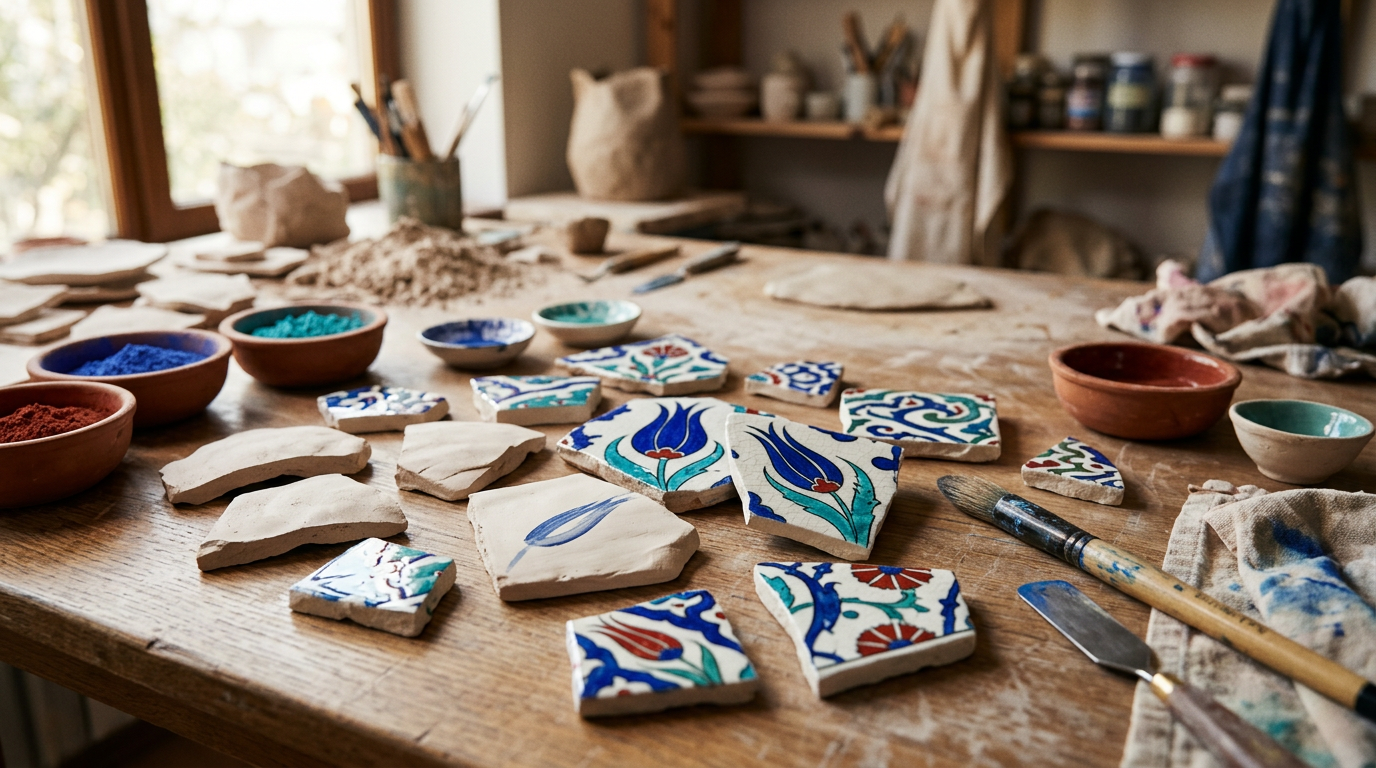
Ceramic production is the medium most visitors associate with Ottoman art. From the 1480s through the seventeenth century, workshops in Iznik and nearby Kutahya made stonepaste bodies, painted them in cobalt, turquoise, green and eventually tomato red, and fired them multiple times for clarity. Dishes, jugs, mosque lamps and millions of square tiles left the kilns for palaces, mosques and export.
Early Ottoman wares looked to Chinese porcelain and to earlier Persian fritware. By the 1520s a court style crystallised. Two motif families dominate museum teaching. The saz style pairs serrated leaves with palmettes and sometimes dragons derived from Far Eastern cloud scrolls; Şahkulu is its best-documented pioneer. Kara Memi and his circle refined a semi-naturalistic floral manner (şukufe): tulips, carnations, hyacinths, roses on white grounds. Older hatayi motifs, stylised Cathayan lotus scrolls, still underpinned both families. All circulated on paper before they hardened in glaze.
Iznik was a factory town for the dynasty. Potters were not anonymous hobbyists. They answered imperial orders timed to construction schedules. When Sinan rebuilt the Süleymaniye complex in the 1550s, tile crews supplied revetments for the mihrab and imperial gallery. The Topkapı Palace Circumcision Room (Sünnet Odası) received panels that scholars link to Şahkulu's draftsmanship. After about 1600 quality fluctuated. Kutahya picked up domestic wares. Nineteenth- and twentieth-century revivals tried to recover lost recipes. Modern Iznik ateliers still cite the sixteenth-century palette.
Saz scrolls, hatayi flowers and the red breakthrough
Met curriculum essays describe saz leaves as featherlike and restless. Hatayi compositions read calmer, with recognisable Istanbul garden flowers. The red slip introduced in the mid-sixteenth century, often called Armenian bole, let potters fill large white fields with bold cloud bands. That palette defines "classic" Iznik in shop windows and museum shops. V&A curators date a Bursa silk with cypress-and-rose roundels to after the 1550s because the same naturalistic buds had entered textiles by then. Motifs crossed media within a single reign.
Potters also signed work. Musli's 1549 lamp states his name and a date in the foot inscription. The Godman ewer in the British Museum carries an Armenian dedicatory inscription dated 1510 from Kutahya, proof that Christian craftsmen participated in the trade. Ottoman court style was a production standard, not a single workshop door.
Tiles in architecture and palace interiors
Tiles were architectural parts. Modules carried half-palmettes cut by the edge so that a full scroll appeared only across a wall. Window lunettes, mihrab hoods and royal bedchambers used different scales. Sinan treated ceramic colour as structure: a blue frame around a niche, a red ground behind white clouds. That integration belongs to the architecture survey, but you need it to understand why Iznik mattered. Tiles were not detachable paintings. They were permanent upholstery for stone.
Topkapı Palace still holds rooms lined with sixteenth-century panels. The Met owns single tiles from Murad III's bedroom renovation, useful when you cannot enter the Harem. British Museum Iznik cases, built around the Godman collection, show how European collectors shaped the field. Arthur Lane's chronology work at the V&A still underpins dating talk in galleries worldwide.
Metalwork, arms and treasury objects
Ottoman metalwork spans soft brass trays, steel armour inlaid with gold, jewelled daggers and enamelled gold cups. Palace goldsmiths (kuyumcular) worked for the treasury (hazine), for state gifts and for religious foundations. Many pieces never left the palace. Topkapı's Imperial Treasury displays the Topkapı Dagger and the Spoonmaker's Diamond alongside enamelled ewers and gem-set hilts that show what Ehl-i Hiref masters could do when cost limits disappeared.
Ceremonial arms carried ideology. A sword of Süleyman with rhinoceros horn hilt and gold inlay, displayed in treasury galleries, functioned at enthronements more than on a battlefield. Mail shirts encrusted with gold plaques turned defence into spectacle. European ambassadors received damascened steel and rock-crystal objects that advertised Ottoman technical reach.
Techniques mixed inheritance and innovation. Repoussé, niello, damascening (koftgari) and stone setting appear across regions the Ottomans ruled. Cairo and Damascus sustained Mamluk traditions. Balkan centres supplied silver. Tughras migrated onto inkwells, pen boxes and snuffboxes in precious metals. Met decorative arts curators treat those small objects as carriers of the same graphic identity as paper firmans.
What the treasury preserves
Topkapı's treasury rooms are not a modern museum conceit. They continue a dynastic store accumulated by gift, conquest and workshop output. Chinese celadons, Iranian jades and European clocks sit beside locally made goldwork. The mix teaches proportion. Ottoman metalwork was one thread in a cosmopolitan hoard. Still, the locally made jewelled pieces demonstrate court control of refinement. Enamel colours, claw settings and fluted vessels from the sixteenth century compare with contemporary Habsburg goldsmithing without copying it.
Workshop output beyond weapons
Brass candlesticks, copper bowls, silver zarfs for coffee cups and tomb fittings filled daily ritual needs. Inscriptions in thuluth or naskh turned basins into gifts. Some shapes followed Mamluk profiles; others answered European table fashion. Because metal is recyclable, survival skews toward treasuries, foundation deposits and foreign collections. British Museum and V&A Islamic galleries preserve Ottoman pieces that left the empire through diplomacy, trade or nineteenth-century collecting. Provenance research continues to adjust which city made which vessel.
Textiles, carpets and woven calligraphy
Ottoman textiles clothed the court and furnished sacred space. Silk velvets (çatma), metal-thread silks (seraser or kemha) and lampas-woven hangings came chiefly from Bursa, with Istanbul workshops focusing on cloth of gold for kaftans and honorific robes (hil'at). A V&A seraser fragment, probably Bursa and dated 1550–1600, faces the warp with silver thread and arranges cypress-and-rose roundels in staggered rows. Ottoman weavers aimed at the same luxury tier as Venice and Florence while shifting motifs toward fan-shaped carnations and tulip sprays.
Dress law made textiles political. High officials wore prescribed silks at court. Sultans layered kaftans with tiger-stripe (çintamani) roundels and triple-dot motifs that appear in painting and on cloth. Topkapı's stored garments let curators match woven patterns to album illustrations. Export mattered too. European nobles prized Ottoman silks. Ecclesiastical vestments remade Turkish brocades into reliquary dress. Met essays on Ottoman silks note that compound weaves travelled into cathedral treasuries as far as Saxony.
Carpets formed a parallel track. Cairo, Uşak, Ladik and other centres supplied prayer rugs and large medallion carpets for mosques and tents. Court orders specified knot density and motif. Domestic floors in paintings show smaller patterns; diplomatic gifts could be room-sized. Carpet production sat partly outside the Ehl-i Hiref, yet palace inspectors still judged quality.
Calligraphy on cloth extended building decoration. Woven Qur'an bands wrapped cenotaphs. Tulip batiks from distant Java, in the Met's Islamic collection, show how far Ottoman tughra forms travelled as talismanic design, even outside the empire. That spread illustrates influence without implying Istanbul controlled Southeast Asian looms.
Bursa velvets and the Italian dialogue
Bursa dominated silk export from the fifteenth century. Weavers studied Italian velvet structures, then "re-Orientalised" ogival carnation layouts. V&A curators describe a red-ground velvet with gold brocade carnations as answering Florentine models with Ottoman flower geometry. Competition was explicit. The dynasty protected weavers because brocade was revenue and propaganda. When you see a sixteenth-century velvet in London, you are often seeing the end of a Mediterranean design argument.
Carpets, kaftans and the kiswa
Carpet commissions inscribed pious foundations. Kaftans rewarded service. The Meccan kiswa, renewed for hajj, displayed Ottoman patronage of the holy cities to the Islamic world. Surviving fragments in museums rarely carry the scale of the original hangings. They still record knot types, dye analysis and motif migration from court albums to loom cartoons, the same pipeline tiles used.
Architecture and imperial patronage
Ottoman architecture is the most public face of the dynasty's art programme. Mehmed II's Fatih complex, Bayezid II's hospitals, Selimiye in Edirne and Süleymaniye in Istanbul turned patronage into skyline. Mimar Sinan, chief imperial architect from 1538 until his death in 1588, designed hundreds of buildings. His mosques combine domes, semi-domes and slender minarets with tile-clad interiors and marble mihrab niches. Met timeline essays call Süleyman's reign the zenith of both architecture and decorative arts.
This section stops at the relationship between building and workshop. Dome geometry, waqf law, provincial mosque types and comparison with Mamluk or Safavid architecture belong in the pending Islamic architecture guide. Here the point is narrower: sultans and their architects specified surfaces that Ehl-i Hiref branches filled. Tile orders, woven cenotaph covers, calligraphic friezes in stone and wood, and bronze doors arrived as parts of a single foundation campaign.
Sinan himself moved between engineering and taste. He chose where Iznik red should shock against white clouds. He aligned window grills with interior tile dados. Later patrons, from the women of the harem to grand viziers, built smaller türbe mausolea and waterside mosques that repeated the same decorative toolkit at reduced scale. Nineteenth-century palaces such as Dolmabahçe shifted to European revival rooms, yet Ottoman workshop traditions persisted in repair ateliers and court carpentry under Abdulhamid II.
If you visit Istanbul, architecture and movable art converge. Topkapı tiles face Sinan's skyline across the Golden Horn. The museums directory lists Topkapı Palace Museum, the V&A and the Met for objects when travel is not an option.
Key figures across media
Ottoman art history names workshop heads more often than anonymous kiln hands. Mimar Sinan (c. 1500–1588) shaped the built environment. Şahkulu, leading court painter from the 1520s until his death in 1556, pushed saz scrolls and dragons into tile and pottery design; archival registers name him head draftsman by 1526; Ashmolean ceramic studies link his office to Topkapı Circumcision Room panels. Kara Memi, active from the 1540s and Şahkulu's leading pupil, refined semi-naturalistic garden florals that still define "Ottoman" pattern in gift shops.
Calligraphers carried equal prestige. Şeyh Hamdullah (d. 1520) reset hüsn-i hat standards for Qur'an copies and imperial documents. Later sultans employed chief calligraphers to draft tughras. Nakkaş Osman, chief painter under Murad III, organised large workshop teams for festival books. His miniatures are vital to Ottoman painting history; technique and album structure are deferred to Mughal and Persian miniature painting.
On the craft side, Musli signed the 1549 mosque lamp for Jerusalem's Dome of the Rock. Armenian Abraham of Kutahya signed a ewer dated 1510. Nigari, Matrakçı Nasuh and Piri Reis crossed into illustration and mapmaking while listed among court artists. The roster proves specialisation and crossover inside one payroll system.
Women patrons appear in foundation inscriptions even when workshop registers list men. Hürrem Sultan and later queen mothers commissioned mosques and soup kitchens that required full decorative programmes. Gender history is still catching up with archival reading of waqf deeds.
Four works to look at closely
Survey labels move fast. Four objects below anchor the workshop story in places you can visit or find online. They span calligraphy, tile, ceramic signature and silk. Dates follow museum catalogues and standard Iznik chronologies. None replaces the depth due to manuscripts or architecture in sibling articles.
Read them as a chain. The tughra shows how calligraphy became dynastic logo. The Murad III tile shows modular palace design. Musli's lamp proves signed craft on a religious commission. The Bursa silk shows the same mid-century florals in metal thread. Together they cover Süleyman's and Murad's reigns without pretending the list is complete.
Tughra of Süleyman the Magnificent (c. 1555–60, Met)
The Metropolitan Museum holds a painted tughra of Süleyman with ink, opaque watercolour and gold on paper. Three vertical shafts and two oval loops on the left form the readable skeleton. Inside the strokes, court calligraphers nested his name, his father's name and the phrase "ever victorious." An illuminator added tight floral scrolls in the interstices. Met educators stress that sultans did not draw these forms daily. A designated court artist maintained the master pattern for firmans, endowments and coins. The object teaches branding before modern logos: one graphic stood for law, tax exemption and building permission across the empire.
Tile from Murad III's bedroom (1570s, Met)
A single Iznik tile in the Met's Islamic collection comes from the renovation of Murad III's private quarters in Topkapı Palace. Lotus palmettes halved by the tile edge, saz leaves and red cloud bands on white ground typify late sixteenth-century production. Set with identical neighbours, the modules complete scrolling stems. Met object notes state that designs were developed in Istanbul and executed in Iznik, with multiple firings for crisp colour. The tile is domestic in scale yet imperial in audience. It shows the workshop pipeline at the point of sleep and ceremony, not only on mosque walls.
Mosque lamp by Musli (1549, British Museum)
The British Museum's stonepaste lamp, made for the Dome of the Rock, carries thuluth inscription bands and a dated foot ring: 956 AH (1549 CE). The potter Musli signed the work and invoked Eşrefzade Rumi, the saint associated with Iznik. Chinoiserie cloud scrolls alternate with arabesque knots in cobalt, grey-green and black outlines. The lamp was architectural equipment for a major foundation, not tableware. It connects Sinan's contemporary tile projects, Jerusalem patronage under Süleyman and the named craftsman history that pottery specialists still cite.
Seraser silk with cypress roundels (c. 1550–1600, V&A)
V&A textile cataloguers describe a woven silk fragment, probably from Bursa, with silver-wrapped weft facing the cloth. Staggered roundels contain cypress trees and rosebuds in red and green on a metal ground. The seraser technique faced the entire surface with precious thread. Cypress-and-rose naturalism helps date the piece after the 1550s, when the same buds appeared on tiles and velvets. The fragment is small. It still records how mid-century floral taste migrated from glaze to loom and how Ottoman weavers competed with Italian luxury exports.
How Ottoman art spread and changed
Ottoman visual culture travelled with foundations, gifts and governors. Tile crews worked in Jerusalem, Mecca and Damascus. Cairo supplied carpets and metal. Balkan towns adopted domed mosques with pencil minarets. Hungarian battle sites still carry Ottoman tombstones with carved turbans. Provincial variation was real. Local stone, older Mamluk motifs and folk embroidery coexisted with imperial orders. Still, a traveller in the sixteenth century could recognise palace work from Belgrade to Baghdad by tughra bands, Iznik palettes and certain carnation rhythms.
Trade spread taste without conquest. European collectors bought Iznik dishes in Venice. Dutch painters placed Uşak carpets on tables. Southeast Asian batiks adopted tughra calligrams as talismans, as a nineteenth-century Jambi batik in the Met demonstrates. Inside the empire, eighteenth-century elites consumed Chinese porcelain and French clocks while Kutahya potters served domestic markets with looser painting. Tanzimat-era reform and palace Europeanisation shifted patronage, yet craft lineages continued in the Ehl-i Hiref registers into the nineteenth century.
Twentieth-century nation-building reclaimed Ottoman form as Turkish heritage. Iznik revival kilns, museum restorations at Topkapı and international exhibitions re-framed court art as national genius. Scholars now stress multi-ethnic workshops and cross-border trade rather than a pure Turkish style. Both readings live in gallery labels.
Critics, museums and what the field left behind
European Orientalist painting and travel writing shaped early impressions of Ottoman art as exotic luxury. Critical history of that gaze sits in the Orientalism in Western art guide. Within art history, Arthur Lane's Iznik studies, Nurhan Atasoy and Julian Raby's catalogue raisonné, and Gülru Necipoğlu's work on Süleyman-era patronage reset standards from the late twentieth century onward. Turkish scholars reading mevacib registers continue to correct older guesses about who served when.
Debates stay active. How much Byzantine practice fed Sinan's engineering? How Persian was the mid-sixteenth-century album? Did Iznik decline from economics, taste change or lost recipe secrecy? Should objects in Western museums return to source countries? Museums update labels as provenance research proceeds. When two catalogues disagree on a date, good galleries say so.
What remains for a visitor is a practical path. Start with one tughra, one Iznik tile, one textile fragment and one Sinan mosque photograph. Use the chronology table below as a spine. Return to the Islamic Art & Architecture hub for muqarnas, aniconism and hub definitions. When album painting becomes the question, open Mughal and Persian miniature painting. For manuscripts and calligraphy as book art, use Islamic manuscripts. For cross-media crafts, see Islamic decorative arts. Topkapı Palace Museum, the V&A, the British Museum and the Met appear in the museums directory.
| Period / focus | Approx. dates | Core media and centres | Where to see key examples |
|---|---|---|---|
| Early Ottoman Bursa and Edirne | 14th–15th c. | Tomb architecture, early calligraphy, textile trade roots | Green Tomb Bursa; Turkish and Islamic Arts Museum, Istanbul |
| Conquest Istanbul and workshop foundation | 1450s–1510s | Mehmed II complexes, nakkashane growth, Kutahya wares | Topkapı Palace; Godman ewer (British Museum, 1510) |
| Classical Iznik and Süleyman-era court | 1520s–1600 | Saz and hatayi tiles, seraser silks, Sinan architecture | Süleymaniye; Met tughra; V&A Bursa silk; Musli lamp (British Museum) |
| Late sixteenth-century palace interiors | 1570s–1620 | Red-ground Iznik, festival books, treasury goldwork | Topkapı Harem tiles; Murad III tile (Met) |
| Provincial spread and Cairo carpets | 16th–18th c. | Uşak carpets, Damascene metal, Arab province tiles | British Museum carpets; provincial mosques |
| Eighteenth-century domestic ceramics | 1700s | Kutahya pottery, continued calligraphy | Kutahya collections; Sadberk Hanım Museum, Istanbul |
| Ottoman revival and modern heritage | 19th c.–present | Iznik revival, museum formation, national canon | Topkapı Treasury; V&A Jameel Gallery; Met Islamic Art galleries |
FAQ
What is Ottoman art?
Ottoman art is the visual and decorative culture produced under Ottoman sultans from the fourteenth century to the early twentieth. It includes tiles, metalwork, textiles, carpets, calligraphy, architecture and court objects made in Istanbul, Iznik, Bursa, Cairo and other centres. Museum labels use the term for anything tied to the dynasty's patronage system, especially the Ehl-i Hiref court workshops.
What are the main types of Ottoman art?
The media most visitors meet are Iznik ceramics and tiles, woven silks and velvets, treasury metalwork, calligraphic tughras, mosque architecture and carpets. Manuscript painting and book arts are equally important but need their own guides. This article treats tiles, metal, textiles and architectural patronage at survey depth.
What was the Ottoman court workshop?
The Ehl-i Hiref-i Hassa was the palace organisation of salaried artisans, including painters in the nakkashane, goldsmiths, weavers and armourers. Masters and apprentices received quarterly pay recorded in Ottoman archives. The workshop drew designs, prepared stencils and commissioned Iznik, Bursa and other makers to execute them.
Why is Iznik pottery famous?
Iznik potters made stonepaste tiles and vessels with cobalt, turquoise, green and later red decoration under court contracts from the late fifteenth to seventeenth centuries. Designs came from Istanbul's nakkashane. The wares clad imperial mosques and Topkapı Palace rooms. Quality peaked in the mid-sixteenth century under Süleyman and his immediate successors.
Who was Mimar Sinan?
Mimar Sinan (c. 1500–1588) served as chief imperial architect from 1538. He designed hundreds of buildings, including the Süleymaniye Mosque in Istanbul and the Selimiye Mosque in Edirne. He integrated Iznik tile programmes into stone architecture. Full architectural analysis belongs in the Islamic architecture guide.
Where can I see Ottoman art in museums?
Topkapı Palace Museum in Istanbul holds treasury objects, tiles and textiles from the court itself. In London, the V&A Jameel Gallery and the British Museum Islamic World gallery hold Iznik ceramics, silks and metalwork. The Metropolitan Museum of Art in New York has Ottoman tughras, tiles and silks in its Islamic Art department. Use the museums directory to locate these institutions.
How is Ottoman miniature painting related?
Miniature painting was a major court output, especially in festival books and histories. Technique, album structure and comparison with Persian and Mughal schools belong in the pending Mughal and Persian miniature painting article so this survey does not repeat them.
Does Ottoman art count as Islamic art?
Yes, in museum and academic classification. Ottoman works form one large chapter within wider Islamic art histories. Shared concerns include calligraphy, aniconic decoration on religious buildings and geometry. The Islamic Art & Architecture series hub places the dynasty in that longer story without treating it as the whole field.
Galleries mentioned
Museums mentioned
Exhibitions mentioned
Artworks mentioned
Related reading
Sharjah Biennial 17 Unveils Curatorial Vision and Opening Schedule
Angela Harutyunyan and Paula Nascimento frame the 2027 edition around archival residue and spatial memory
One Thousand and One Nights as a Visual Network
The book that taught Europe to picture the East arrived with no pictures at all. Three centuries of illustrators — Dutch, Egyptian, Persian, French, German, Iraqi — each gave it a face, and every face was a self-portrait.
Curating Tomorrow's Archive: Hamburger Kunsthalle Seeks Contemporary Collections Lead
A new permanent appointment will steer the museum's post-1960 holdings across paper, photography, and media formats.