
Exhibo Editorial
What Is Islamic Art?
From Umayyad Damascus to Safavid Isfahan: a museum map of calligraphy, tile, carpet and metalwork with named works you can still visit
Islamic art is the visual culture produced across Muslim-ruled lands from the seventh century to the present, spanning architecture, ceramics, metalwork, textiles, manuscripts, glass and portable luxury goods. Searchers who type the phrase often meet wall decor, geometric colouring pages and one-minute motif lists. The historical answer is a set of patronage systems and media whose makers shared techniques more often than they shared a single look. You recognise a fourteenth-century Iranian mihrab by cut-tile mosaic and Qur'anic bands; a sixteenth-century Safavid carpet by dense knotting and a signed date; a Mamluk brass basin by silver inlay and thuluth script.
This page is the hub for the Islamic Art & Architecture series. Vaulting forms such as muqarnas get their own essay. Figurative imagery and religious debate belong in aniconism in Islamic art. Ottoman court workshops, architecture surveys, Persian miniatures, manuscripts and decorative-arts depth sit in sibling articles listed at the end. Living Arab modernism, Hurufiyya and calligraphy as contemporary practice belong on the art movements in the MENA region track, not here. Collection pages for many institutions named below sit in the museums directory, including the Museum of Islamic Art, Doha.
What "Islamic art" names in museum usage
The phrase is a Western museum category. Art historians coined it in the nineteenth century to sort material from lands where Islam was the dominant religion or the faith of ruling elites, even when makers and patrons were Christian, Jewish, Hindu or otherwise. Smarthistory's survey essays state the point plainly: unlike "Christian art," which often signals devotional subject matter, "Islamic art" chiefly describes geography and chronology under Muslim rule. Inside those regions, patrons and craftsmen used more precise labels: thuluth for a calligraphic hand, kashan for a tile centre, maki-e-like kundakari for inlay, or simply "work of the royal workshop."
English-language search still treats "Islamic art" as if one look should answer it: blue tile, gold script, star geometry, the word arabesque. Those motifs exist. They sit inside longer craft histories shaped by court taste, trade routes and local materials. Collectors and textbooks also drag contemporary Arab painting, Gulf cultural districts and Western Orientalist painting into the same search cloud. This article stays with historical visual arts to about the nineteenth century: portable objects, architectural ornament and the workshop habits that link them. Contemporary galleries, Hurufiyya and calligraphy-as-installation belong elsewhere on this site. Western painters' fantasies of "the East" belong in Orientalism in Western art.
The usable definition for a general reader is this: Islamic art is the body of objects, buildings and pictures made in regions under Muslim rule (and by diaspora makers working in those idioms) whose techniques, inscriptions and decorative grammars were shaped by Islam as religion, law and court culture, together with older Roman, Sasanian, Byzantine, Indian and Chinese inheritances. It is plural. The rest of this article maps the conditions that made that plurality, then names works you can check against museum catalogues.
Conditions that produced the traditions
Islam arrived in Arabia in the early seventh century and spread with armies, merchants and missionaries across an arc from Spain to Central Asia within decades. Rulers needed mosques, palaces, mints, textiles and books. They inherited Roman and Sasanian building trades, Syrian mosaic workshops and Coptic weavers. The first great monuments, such as the Dome of the Rock in Jerusalem (completed 691/92 CE under Umayyad patronage), reused late antique marble revetments while commissioning new calligraphic bands in Arabic. That combination, antique spolia plus authoritative script, set a pattern: Islam did not invent every technique; it re-aimed existing skills toward new patrons and new inscriptions.
Trade mattered as much as conquest. Silk roads, Indian Ocean ports and Mediterranean shipping moved lusterware from Iraq, Chinese porcelain into Persian courts, Andalusian ivory into European treasuries and Timurid blue-and-white into Ottoman kitchens. Patronage shifted the centre of gravity. Umayyad and Abbasid caliphs in Damascus and Baghdad funded large-scale architecture and luxury scriptoria. Regional dynasties (Fatimids in Egypt, Seljuqs in Anatolia and Iran, Mamluks in Cairo, Timurids in Herat, Safavids in Isfahan, Ottomans in Istanbul, Mughals in South Asia) each ran workshops that trained specialists in tile, carpet, metal inlay and manuscript painting. Religion and law shaped display: Qur'anic recitation elevated calligraphy; prayer required orientation toward Mecca; some jurists discouraged figural images in religious spaces, a topic this hub only sketches before handing off to the aniconism sibling.
Materials set limits that became tastes. Frit bodies for tile, brass for inlaid vessels, silk and wool for carpets, paper for books, stucco for interior carving: each medium has its own failure modes and prestige. A fourteenth-century Isfahan mihrab demands thousands of hand-cut glazed tiles set into mortar. A sixteenth-century Ardabil carpet demands millions of knots and a designer's cartoon. A Mamluk brass ewer demands silver wire laid into engraved channels. Those chains are social facts. When you stand in a museum gallery organised by dynasty and region, you are looking at the output of courts, shrines, merchant elites and, increasingly, colonial-era collectors who re-sorted the map.
Climate and function trained the eye as well. Courtyard houses in hot cities needed screened light: pierced stucco and coloured glass, like the eighteenth-century Egyptian or Syrian window in the Metropolitan Museum of Art (acc. 93.26.2), turned glare into pattern. Carpets defined prayer space and reception halls. Inscriptions turned bowls and textiles into gifts with spoken blessings. Display formats followed use: a mihrab niche in a madrasa wall, a carpet oriented toward qibla, a manuscript folio read in a scholar's lap. You meet those formats in museums as "works of art." They began as furniture for ritual, study and rank.
A chronology across dynasties and regions
Period boundaries are scholarly conventions with fuzzy edges. Dates below follow the Metropolitan Museum of Art's Heilbrunn Timeline and standard survey chronologies where those sources are explicit. Use the table as a looking map, then check the wall label when you stand in front of an object. Many regions overlapped: Andalusian workshops continued under Christian rulers; Ottoman and Safavid courts exchanged painters and tile recipes.
| Period / dynasty (approx.) | Rough dates | Geographic focus | What makers concentrated on | Named museum anchor |
|---|---|---|---|---|
| Early caliphates (Umayyad, Abbasid) | 661–1258 | Syria, Iraq, Egypt, Spain | Monumental architecture, Qur'anic script, luster ceramics, carved ivory | Dome of the Rock inscriptions; Met al-Jazari folio 57.51.23 (1315 CE) |
| Fatimid | 909–1171 | Egypt, North Africa | Rock-crystal carving, tiraz textiles, mosque carving | Fatimid rock crystals in Cairo and Western collections |
| Seljuq / Anatolian Seljuq | 1038–1307 | Iran, Anatolia | Brick and stucco architecture, star-and-cross tile, bronze incense burners | Anatolian stucco and tile in Konya region museums |
| Mamluk | 1250–1517 | Egypt, Syria | Brass and glass with thuluth inscriptions, mosque lamps, marble pulpits | Mamluk mosque lamps in Cairo and the British Museum |
| Timurid / Turkmen | 1370–1507 | Iran, Central Asia | Manuscript painting, turquoise tile, architectural colour | "Concourse of the Birds," Met 63.210.11 (c. 1600, Safavid copy of Timurid tradition) |
| Safavid | 1501–1722 | Iran | Carpet weaving, court painting, mosaic tile, Chinese porcelain influence | Ardabil Carpet, V&A 272-1893 (dated 946 AH / 1539–40 CE) |
| Ottoman | c. 1299–1922 | Turkey, Balkans, Arab provinces | Iznik ceramics, imperial architecture, inlaid metalwork | Ottoman tankard with tughra of Süleyman, MIA Doha (MW.561.2004) |
| Mughal (South Asia) | 1526–1857 | India | Miniature painting, jali screens, gem inlay architecture | Mughal manuscripts; depth in sibling Persian miniature painting |
| Qajar and nineteenth-century courts | 1789–1925 | Iran, Ottoman reform | Lacquer, photography, revival metalwork | Qajar steel and gold kashkul, MIA (MW.474.2007) |
The table stops before contemporary art on purpose. Artists across the Middle East, North Africa and diaspora communities still work in calligraphy, abstraction and installation. Those decades answer different patrons and global art fairs. Keep them on the art movements in the MENA region pages. Here the job ends when museum departments still label rooms "Islamic" chiefly by dynasty and medium, because that nineteenth-century sorting still shapes how you walk a floor plan.
Between the table's rows, two stretches repay a slower walk. Mamluk Cairo turned brass into a surface for running script and heraldic blazons under slave-soldier patrons who built madrasas and mausolea at street scale. Safavid Isfahan fused Chinese porcelain shapes with Persian blue-and-white and funded carpet ateliers whose signed dates now anchor auction catalogues. Ottoman Istanbul absorbed Balkan silver mines and Timurid decorative vocabularies into a single imperial style you can read on a tankard lid. Hold those three cities in mind when a label says "sixteenth century" without naming a ruler.
Characteristics across media
If you force a single "Islamic style," you flatten the media that carry the tradition. Architecture, tile, metal, glass, textile and book each developed its own criteria of skill. Shared habits still recur: Arabic script as ornament and message; vegetal and geometric pattern that can scale from a pen box to a dome; courtly luxury exchanged as gift and tribute; and regional variation strong enough that a Maghribi Qur'an, a Kashan mihrab and a Deccan bidri bowl should not share one caption template.
Three decorative languages appear so often that museums treat them as shorthand for the whole field. Calligraphy carries Qur'anic text, poetry and patron names. Vegetal scrollwork, often called arabesque in European writing, fills borders on tile, metal and paper. Geometry ties star polygons, strapwork and interlace into surfaces that can wrap a wall or a book binding. None of the three is exclusive to religious buildings. None is forbidden from secular objects. Workshop pattern books (vid albums in later periods) moved motifs between media. A star on a wooden ceiling might reappear on a carpet border and again in a manuscript margin.
Calligraphy and the word on objects
Arabic script is both language and image. Qur'anic verses on a mosque wall orient prayer and claim divine authority. Poetry on a bowl praises wine or the ruler, depending on context. Dynastic titles on metalware record ownership when objects move as gifts. Hands multiply: angular kufic for early stone inscriptions; flowing naskh and thuluth for Mamluk and Ottoman bands; Persian nasta'liq for literary albums in the east. Training was long. A calligrapher copied masters' models, received a certificate (ijaza), and might never paint a figure at all while still ranking among a court's leading artists.
On the Isfahan mihrab in the Met (acc. 39.20), three inscription registers stack around the niche: Qur'anic cursive on the outer rectangle, hadith on the arch frame in kufic, and a facing panel with a saying of the Prophet at the centre. The scripts are not interchangeable decoration. Each choice signals learning and legibility for a literate prayer hall. Contemporary artists who treat calligraphy as pure abstract line have their own histories; this hub stops with workshop tradition and points forward to living practice on art movements in the MENA region.
Metalworkers and potters who could not write still hired scribes or copied pattern books. A single basin might pass through an engraver, an inlay specialist and a calligrapher. That division of labour is why so many objects carry perfect script alongside vegetal fills: different hands, one court brief.
Arabesque and geometric pattern as workshop habits
European writers borrowed the word arabesque to describe rhythmic vegetal scrolls on Islamic objects. Makers rarely used the term. They spoke of islimi (arabesque-like vegetal design in Persian workshop language), rumi (often more geometric or split-palmette motifs), or simply the task of filling a border. The habit is older than Islam: late antique acanthus scrolls fed Umayyad carving and Abbasid stucco. Under Seljuq and Timurid patronage, split palmettes and cloud bands tightened into repeatable modules that draftsmen could scale to a door or shrink to a pen case.
Geometric pattern is a parallel workshop language, not a separate religion. Craftsmen constructed star and polygon fields with compass and straightedge, then translated them into wood, stucco, tile and brick. Interlaced strapwork appears on eleventh-century Egyptian woodwork and on sixteenth-century Safavid carpets alike. Modern mathematicians have shown how periodic tiling underlies many medieval designs; museums now sometimes label galleries with both craft and symmetry explanations. The point for looking is simpler: geometry let anonymous workshop teams produce infinite-looking repeats without figural icons, and vegetal arabesque let the same teams soften corners and frame script.
On the Ardabil Carpet (V&A acc. 272-1893), vegetal scrolls fill the field around a central medallion while guard bands carry smaller repeats. The weavers worked from a cartoon supplied by a court designer; Maqsud Kashani signed and dated the piece in the border. Tile cutters in Isfahan used the same habit of nested repeats when they clad mihrabs. If you want the full medium survey of ceramics, glass and metal, follow the sibling article on Islamic decorative arts. If you want muqarnas vaulting as architectural sculpture, follow muqarnas, explained.
Key figures and workshops
Islamic art history is thick with anonymous makers. When names survive, they often mark calligraphers, master weavers, architects or supervisors of royal workshops rather than solitary "artists" in the Renaissance sense.
Badi' al-Zaman ibn al-Razzaz al-Jazari (1136–1206) wrote The Book of Knowledge of Ingenious Mechanical Devices in Diyarbakır under Artuqid patronage. His treatise describes fountains, clocks and automata with drawings that later copyists coloured. The Metropolitan Museum holds folios from a 1315 CE copy (acc. 57.51.23 and related leaves). Al-Jazari names craftsmen and materials; he is as close as many periods get to a signed engineering mind.
Hasan ibn Ali ibn Ahmad Babavaih, a fourteenth-century tilemaker from Kashan, signed a luster mihrab panel in the Met (acc. 09.87, dated March 1310 CE). Such signatures are rare on architecture but precious: they prove mosaic tile was measured, cut and assembled by named specialists.
Maqsud Kashani signed the Ardabil Carpet in 1539–40 CE as "the slave of the portal," likely a court official overseeing production rather than a loom worker. Safavid carpet ateliers employed teams of weavers, dyers and designers for years on a single commission.
In manuscript painting, Bihzad (late fifteenth century) and later Riza-yi 'Abbasi (d. 1635) anchor Timurid and Safavid schools. Their albums belong in the sibling essay on Persian miniature painting. In the Maghrib, metalworkers signed brass basins with thuluth bands that still read clearly in Cairo's Museum of Islamic Art.
Ottoman court ateliers under Süleyman the Magnificent (r. 1520–66) merged Balkan silver, Persian vegetal motifs and Chinese porcelain shapes. The tankard in Doha bearing his tughra (MIA acc. MW.561.2004) is product and document of that merger. For Ottoman depth beyond this list, see Ottoman art.
Workshop continuity matters as much as biography. A tile master could move from a madrasa facade to a shrine dome. A carpet designer could adapt a manuscript border into knotting instructions. When you credit a court style, ask who cut, wove, cast or illuminated beside the few names history saved.
Four works, read closely
Classroom summaries list dynasties and stop. The search gap is objects with dates, media and rooms, read for decisions you can see. The four below run from fourteenth-century tile to tenth-century metal, with carpet and manuscript between. Each section stays with one work. Together they sample architecture-linked ornament, textile, illustrated book culture and Andalusian bronze.
Stand in front of the object when you can. Reproduction flattens glaze relief, pile height and silver inlay. Museum lighting and case glass add their own distortions. The looking notes below assume you have a catalogue page or a clear photograph to hand.
Mihrab from the Madrasa Imami, Isfahan (Metropolitan Museum of Art)
The Met's prayer niche from the Madrasa Imami in Isfahan is dated 755 AH / 1354–55 CE (acc. 39.20, Harris Brisbane Dick Fund, 1939). It stands over three metres high, assembled from thousands of polychrome glazed tiles cut into stars, crosses and vegetal inserts, then set into a stonepaste body in mortar. Cobalt blue, turquoise, white, yellow and dark green dominate. No figures appear. Instead, Qur'anic verses run in cursive along the outer frame, hadith in kufic lines the pointed arch, and a central panel faces worshippers with a saying of the Prophet about the mosque as the abode of the pious.
What you learn from this niche is how Ilkhanid-era Isfahan married script and surface. The mihrab is not a painting. It is architecture's focus: a hollow that marks qibla in a madrasa where students prayed and studied law. The vegetal arabesque between inscription bands is built from the same cut-tile modules as the stars. A craftsman measured each piece, glazed it, fired it, and fitted it on site. Archnet notes the Madrasa Imami's continuing religious use and restoration campaigns; the Met's panel is the surviving ceremonial heart removed for preservation. Compare a flat manuscript border and you see how three dimensions change the job: light catches glaze ridges; scale lets script read from metres away.
The Ardabil Carpet (Victoria and Albert Museum)
The Ardabil Carpet is dated by inscription to 946 AH / 1539–40 CE, signed by Maqsud Kashani (V&A acc. 272-1893). It is among the largest and earliest dated Persian carpets surviving, woven for the shrine of Shaykh Safi al-Din in Ardabil, ancestor of the Safavid dynasty. The field centres on a yellow medallion with lamps hanging above and below, corner quarters repeat the motif at smaller scale, and multiple borders carry dense floral scrolls in about ten dye colours. The V&A estimates roughly 5,300 knots per ten square centimetres; a team may have worked for years.
William Morris, asked to advise on the purchase in 1893, called the carpet of "singular perfection … logically and consistently beautiful." The museum acquired it for £2,000 after an earthquake damaged the shrine and dealers in Manchester offered the piece. Today it lies flat in a dedicated case in the Jameel Gallery, lit on the hour to limit fading. Two lamps of different sizes have prompted debate: some viewers read them as deliberate perspective; the V&A notes flat drawing and the possibility of intentional imperfection, since only God makes perfect form. Either way, the carpet shows vegetal arabesque at monumental scale, with geometry carried in medallion symmetry rather than star-and-polygon strapwork. If you study only book illustration, you miss how knotting translates line into pile.
"The Elephant Clock," folio from al-Jazari's treatise (Metropolitan Museum of Art)
The folio dated 715 AH / 1315 CE illustrates al-Jazari's elephant clock (Met acc. 57.51.23, bequest of Cora Timken Burnett, 1956). Attributed to Syria or Iraq, copied by the calligrapher Farrukh ibn `Abd al-Latif after al-Jazari's text, it shows a crowned elephant bearing a platform with dragons, phoenixes, a rider and a domed pavilion. Ink, opaque watercolour and gold on paper preserve both mechanical imagination and courtly figural painting. Every half hour, al-Jazari claims, the automaton would whistle, drop a ball and strike the elephant; the drawing is an engineer's pitch as much as a picture.
The page matters because it complicates clichés. Figural imagery exists in Islamic books on science and pleasure. Signed dates and named copyists tie the sheet to Ilkhanid-period Syria, where few illustrated manuscripts survive. The Met holds related leaves (including acc. 55.121.13). Compare the mihrab's aniconic tile and you see context, not a single ban. For manuscript production and illumination technique, follow Islamic manuscripts; here treat the folio as proof that workshop books crossed engineering and entertainment.
The Doha Hind fountainhead (Museum of Islamic Art, Doha)
The hind-shaped fountainhead in the Museum of Islamic Art, known as the Doha Hind, is a tenth-century bronze cast from al-Andalus, associated with the Umayyad caliphal palace city Madinat al-Zahra near Córdoba. Qatar Museums displays it in Gallery 8. The animal's surface carries incised circles with palmettes, a plaited mane and a channel through the mouth for water. Luxury hydraulics joined zoo-like spectacle in courtyard basins; a related stag was excavated at Madinat al-Zahra, and scholars group the hind with Mediterranean metal animals such as the Pisa Griffin and the Mari-Cha Lion.
You cannot walk Madinat al-Zahra's pools today and see water rise from the bronze, but you can read court ambition in the casting. Andalusian workshops served a Muslim elite who also commissioned ivory caskets and silk with Arabic tiraz bands. The hind is Islamic art by patronage and inscription culture, yet its form is animal sculpture without Qur'anic text on the skin. Provenance narratives for Spanish Umayyad metalwork now include colonial-era collecting and Gulf museum formation in the 2000s; the object's public role is to anchor a gallery that spans three continents. Plan a visit through the Museum of Islamic Art, Doha directory page.
How styles spread and mutated
Styles moved with patrons, prisoners of war, gift exchange and paper. Abbasid Baghdad absorbed Chinese Tang ceramics and redraw them as blue-and-white prototypes for later Persian potters. Andalusian ivory carving fed Christian reliquaries while Arabic inscriptions still ran around rims. Crusades and Mongol invasions destroyed cities and relocated craftsmen. Ottoman conquest of the Balkans brought silver mines and Christian silversmiths into imperial ateliers. Safavid Shah 'Abbas I rebuilt Isfahan and exported carpets to Europe and India.
Mutation also happened inside regions. Timurid Herat painters influenced Safavid Isfahan and Mughal Delhi alike; Bihzad's composition turns up decades later on different paper. Mamluk blazons on brass reappear on Ottoman tile. Dutch tulip fashions echo Ottoman hatayi blossoms on Iznik dishes made for export. European Orientalist painters later recycled tile and carpet into easel pictures; that feedback loop belongs to Orientalism in Western art, not to workshop history itself.
Colonial museums re-sorted the map again. French, British and Russian expeditions acquired tiles, carpets and manuscripts that now anchor "Islamic" galleries in London, Paris, St Petersburg and New York. Gulf museums such as Doha's MIA re-centred collections toward the twenty-first century without erasing earlier displacements. Treat the Islamic world as a network of cities rather than a single style waiting in the desert.
Regional taste still diverged when courts exchanged gifts. A Maghribi leather binding and a Deccan bidri box share Islamicate script cultures but not the same patrons or pigments. A survey that flattens them into one brand has stopped doing history.
Critics, then and now
Criticism begins with the category itself. Nineteenth-century European art historians and museum curators grouped centuries of material from Spain to Indonesia under one label partly to organise colonial acquisitions. Banister Fletcher's tree of architecture and world-survey textbooks placed "Muhammedan" or "Saracenic" art on a branch apart from Western modernity. Gulru Necipoğlu and other scholars since the 1970s have traced how that taxonomy froze a diverse field into a decorative, medieval, "non-Western" block and marginalised the nineteenth century until recently.
Inside Muslim societies, pre-modern critics praised calligraphy and poetry more often than they theorised "art" as a separate realm. Biographical dictionaries (tabaqat) of calligraphers and painters record reputation and pupil lines. Jurists debated images in different legal idioms; modern popular summaries flatten that record into a single ban. The sibling article on aniconism carries the scholarly nuance.
Twentieth- and twenty-first-century arguments add layers. National museums in Turkey, Iran and Arab countries reframed objects as heritage rather than as imperial spoils. Restitution debates touch tiles, carpets and manuscripts in Western stores. Contemporary artists challenge the label "Islamic" for work that is secular, feminist or globally networked; those practices belong with art movements in the MENA region, not in this historical hub.
Popular web writing still sells "forbidden images" and "sacred geometry" as if every mosque obeyed one rulebook. Museum education texts, including the Met's curriculum essays, stress plural dynasties, shared motifs and the difference between religious law and court luxury. When catalogues disagree on a date or attribution, name both and wait for the next technical study.
What the historical traditions left behind
The durable residue is a set of techniques and display habits later makers can quote without repeating the social world that produced them. Cut-tile mosaic, kundakari inlay, carpet knotting, nasta'liq composition, muqarnas vaulting, pierced screen light and the division of labour between scribe, painter and craftsman all remain teachable. Museum galleries from New York to Doha keep the objects in public view. Art schools and foundation courses still use compass constructions to explain Islamic geometry.
For viewers outside Muslim-majority countries, the inheritance includes a visual comfort with pattern density, inscription as ornament and craft prestige for textiles and metal. Those habits shaped Art Nouveau bookbindings and modern tile revivals alike. Inside the regions of origin, dynasty labels still organise collections even when living artists refuse them.
If you are building a reading path, move from this hub to muqarnas for architectural ornament, then to Islamic architecture for building types. Add Persian miniature painting and Islamic manuscripts when you need book culture. Finish with Islamic decorative arts for ceramics and metal. The chronology table above is a start. The four close readings are a second pass. The objects will correct both.
FAQ
What is Islamic art, in one paragraph?
Islamic art is the painting, architecture, ceramics, metalwork, glass, textiles, manuscripts and portable luxury objects produced in lands under Muslim rule from the seventh century onward, shaped by Arabic and Persian literacies, Islam as religion and law, and continuous exchange with older Mediterranean and Asian traditions. It is a family of workshops and dynasties, not one decorative style. Period labels help you date objects; medium, patron and city tell you more about how they were made.
Why do museums use the term if makers did not?
Western curators and scholars in the nineteenth century needed a category for objects acquired from Spain to South Asia that shared script habits and patronage structures under Muslim rulers. The label is useful for navigation and contested for what it hides: Christian and Jewish makers, secular courts, living contemporary practice and colonial collecting histories.
What are the main periods of Islamic art history?
Surveys usually begin with Umayyad and Abbasid caliphates, then track regional dynasties such as Fatimid, Seljuq, Mamluk, Timurid, Safavid, Ottoman and Mughal, before nineteenth-century revival and colonial modernity. Exact breaks vary by museum. Use the table above as a working map and confirm dates on the object label.
What is arabesque in Islamic art?
Arabesque is a European term for rhythmic vegetal scrollwork on Islamic surfaces: split palmettes, tendrils and leaves that fill borders around script or geometry. Workshops transferred the same habits between tile, metal, wood and paper. It is a workshop pattern language, not a religious symbol with one fixed meaning.
Does Islamic art forbid images of people?
Religious law and local custom varied by place and century. Many mosques avoid figural tile; illustrated manuscripts and luxury metalwork often include humans and animals. Treat aniconism as a debated field, not a headline. Read the dedicated aniconism in Islamic art article rather than trusting a single social-media post.
What should I look at first in a museum?
If the museum has a dedicated Islamic gallery, start with one calligraphic panel or mihrab fragment so your eye learns script at scale. Add one carpet or textile, one metal object and one book folio. Visit the Museum of Islamic Art, Doha or a local collection via the museums directory when you plan travel.
How is Islamic art different from Arab art?
Arab art can mean art made by Arab speakers or art from the Arab world, including Christian and contemporary secular work. Islamic art is a broader chronological and geographic museum category tied to Muslim rule and Islamicate culture. Modern Arab painting and Hurufiyya belong on art movements in the MENA region, not inside this historical hub.
Why do search results show wall prints and geometry colouring pages?
"Islamic art" is a commercial head term as well as an art-history query. Decor sellers bid on the phrase. Informational results (Wikipedia, museum hubs, short videos) compete with product grids. This article answers the history intent with dated works and leaves shopping results to the marketplace.
Related reading
Sharjah Biennial 17 Unveils Curatorial Vision and Opening Schedule
Angela Harutyunyan and Paula Nascimento frame the 2027 edition around archival residue and spatial memory
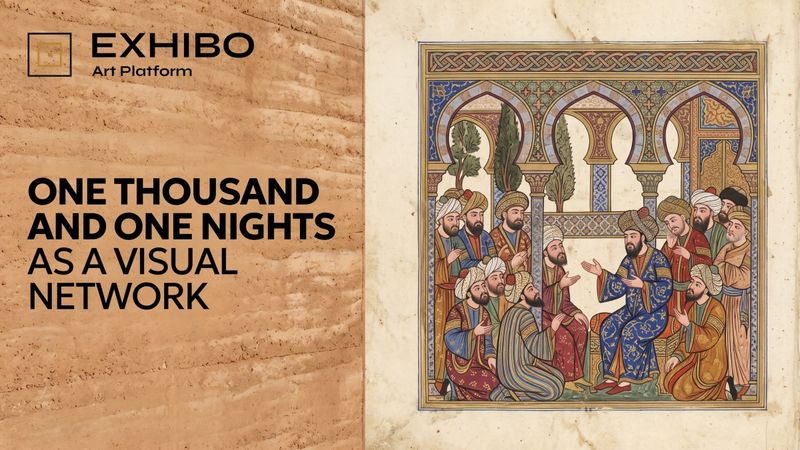
One Thousand and One Nights as a Visual Network
The book that taught Europe to picture the East arrived with no pictures at all. Three centuries of illustrators — Dutch, Egyptian, Persian, French, German, Iraqi — each gave it a face, and every face was a self-portrait.
Curating Tomorrow's Archive: Hamburger Kunsthalle Seeks Contemporary Collections Lead
A new permanent appointment will steer the museum's post-1960 holdings across paper, photography, and media formats.