
Exhibo Editorial
Aniconism: Why Figurative Imagery Is Rare in Islamic Art
Quranic silence, prophetic hadith, legal schools and court workshops: where figural art was avoided, tolerated, or painted at scale.
Aniconism, in art-historical speech, means the avoidance of images of living beings, especially in religious settings. In much writing about Islamic art, the term has become shorthand for a supposed blanket ban on figuration. That shorthand misleads. The Qur'an does not spell out a prohibition on painting or sculpture. Prophetic traditions (hadith) do contain stern warnings against image-makers. Jurists in the four Sunni legal schools disagreed on how far those warnings extend. Meanwhile, Umayyad princes commissioned wall paintings crowded with hunters and dancers, Persian workshops illustrated the Prophet's life from the thirteenth century onward, and Ottoman calligraphers tucked small portraits into devotional sheets. Religious architecture and mosque decoration largely kept to calligraphy, geometry and vegetal pattern. Secular courts and books often did not.
This article stays inside the aniconism fence: scriptural and legal sources, scholarly arguments, regional variation, and named examples of figurative work in palaces and manuscripts. It does not attempt a survey of all Islamic art; that belongs in the series hub on Islamic art (pending). Building types and architectural ornament are treated in the sibling guide to Islamic architecture (pending), not here. Western Christian systems of symbolic figuration, from Byzantine icons to Renaissance altarpieces, have their own vocabulary in Christian iconography in Western art. Broader series context sits in Islamic Art & Architecture. Named works below can often be traced through the museums directory.
What aniconism means, and what it does not
Art historians borrowed the word aniconism from nineteenth-century classical scholarship, where it described early Greek cult objects that signified a god without a human body. Applied to Islam, the term covers a range of practices: total avoidance of sentient figures, restriction to certain media or rooms, or preference for calligraphy and abstract ornament over likeness. None of those practices add up to a uniform "Islamic rule" that all Muslims obeyed at all times.
Oleg Grabar, in The Formation of Islamic Art (1973, rev. 1987), argued that early Muslim attitudes toward images grew from contact with image-rich neighbours: Byzantine Christianity, Buddhism, Zoroastrianism, Hindu traditions in conquered lands. Fear of idolatry (shirk) mattered. So did the theological claim that God alone creates life, reflected in Qur'anic language that calls God al-Musawwir, "the Fashioner" of forms. Grabar's central point, still cited in museum essays, is that abstention from figures in mosques coexisted with abundant figural art in princely settings. Jonathan Bloom and Sheila Blair stress the same split in survey teaching: opposition to human and animal forms "holds true for religious art and architecture," while "in the secular sphere such representations have flourished in nearly all Islamic cultures" (Metropolitan Museum of Art, "Figural Representation in Islamic Art").
You should therefore read aniconism as a tendency with conditions, not as a label that tells you what every object looked like. A glazed bowl with a mounted hunter and a mihrab wall covered only in Qur'anic inscription can both be "Islamic" without sharing the same rules of making.
Conditions that shaped attitudes toward images
The seventh-century Arab-Muslim expansion absorbed territories where figural art was already entrenched. Late Antique Syria and Egypt had Christian fresco programmes and mosaic saints. Sasanian Iran brought royal hunt scenes and banquet imagery. Central Asian routes linked makers to Buddhist wall painting and portable icons. A small conquering elite did not erase those habits overnight. It negotiated them through law, patronage and workshop continuity.
Monotheism set the theological frame. Islam insisted on God's uniqueness. Any art that might redirect prayer toward a crafted object rather than the creator raised jurists' suspicions. That suspicion aligned Islam with Jewish and, at moments, Byzantine Christian anxieties about idols, though the three traditions diverged sharply in practice. Grabar noted that outright destruction of images appears less often in early Islamic sources than in Byzantine iconoclastic episodes.
Patronage split the field early. Caliphs and governors built audience halls, bathhouses and hunting lodges where painters worked in Roman and Sasanian visual idioms. Religious endowments and mosque builders favoured word and pattern, media that carried Qur'anic text without competing with divine creation. Avinoam Shalem's work on historiography reminds us that later European categories such as "Islamic art" were retrofitted onto diverse regional practices; aniconism became one convenient pillar of that modern label, sometimes obscuring the figural material that museums now prize.
Trade, paper and court culture widened the gap between public religious space and private luxury. From the thirteenth century, illustrated histories and epics in Persian and Turkish spread figural conventions across empires. Paper manufacture, arriving in the Abbasid world from China by the eighth century and spreading westward, lowered the cost of books that combined word and image. Ilkhanid administrators such as Rashid al-Din used illustrated chronicles as tools of state memory; Timurid and Safavid princes competed through royal ateliers (kitabkhana) where painters, calligraphers and gilders worked on the same folios.
Print, photography and global media in the twentieth century reopened juridical arguments that medieval scholars had left relatively quiet. Each phase added nuance rather than a straight line toward either permissiveness or prohibition. Bloom and Blair caution that the very phrase "Islamic art" is a modern Western catalogue convenience; aniconism sometimes functions as its moral corollary, a way to distinguish Islam from image-saturated Christianity in textbooks. Shalem pushes further, asking whether figural manuscript painting was sidelined as "decorative" or "Persian" precisely because it complicates the aniconic brand.
Quranic passages and prophetic traditions
Scripture and hadith supply the vocabulary for legal debate. They rarely supply the simple gallery rule many textbooks imply. Art historians and fuqaha (jurists) read them through different methods, which is one reason scholarship and sermons can sound like they describe different religions.
The Qur'an: idolatry, creation and silence on painters
The Qur'an condemns idol worship and the worship of what hands have made, as in the passages on Abraham breaking idols (21:52–68) and on those who take intercessors besides God (10:18). It does not, however, contain a verse that explicitly forbids painting or sculpture as such. Surah 3:49 / 5:110 reports Jesus forming a bird from clay and breathing into it by God's leave. Many exegetes read that miracle as proof that giving life belongs to God alone, a theme later applied to artists who "breathe life" into images. The divine name Musawwir (Fashioner) in 59:24 and related lists of God's names reinforces the idea that shaping living form is a divine attribute.
Because the Qur'an is less specific than later legal literature, jurists turned to hadith and to analogical reasoning (qiyas) to settle workshop questions. Secular historians note the gap: visual culture cannot be reconstructed from scripture alone.
Hadith collections and the image-maker's punishment
The strongest textual attacks on figural art appear in hadith, reports of the Prophet Muhammad's words and deeds compiled from the eighth century onward. Sahih al-Bukhari and Sahih Muslim, among others, include traditions in which image-makers face harsh punishment, angels refuse to enter houses with pictures or dogs, and painters are challenged on Judgment Day to animate their works. One widely cited line threatens "the most grievously tormented" among people who make pictures (musawwirun).
Scholars of hadith debate authenticity, context and scope. Some reports allow images of trees and lifeless things. Others describe the Prophet tolerating figurative cushions in a home until their decoration was cut away. Grabar observed that legal writers eventually treated condemnation of image-makers as majority opinion, while a minority held that beauty pleases God when idolatry is not intended. Modern academic summaries, including peer-reviewed surveys of taswir (image-making), stress variation: strict readings cluster in certain Hanbali and later reformist currents; more conditional readings survive in Hanafi discussions of flat images and necessity.
You cannot translate a hadith clause directly into a museum label. You can use it to explain why a mosque interior favours inscription while a prince's bathhouse might not.
Legal schools, sects and regional habit
Islamic law is not a single code issued by a church-like authority. It is a family of methods built from Qur'an, hadith, consensus and analogy, embodied in schools (madhhab) and local custom (urf). Attitudes toward images follow that plural structure.
Sunni madhhabs: sculpture, flat images and context
Classical summaries, discussed in contemporary academic reviews of artistic practice in Islam, outline recognizable school tendencies without erasing internal disagreement.
The Hanafi school, influential in the Ottoman and Mughal worlds, forbids three-dimensional statues of animate beings and generally treats two-dimensional figures with caution, while allowing flat depictions in cases of necessity if worship is not intended. Vegetal, geometric and architectural ornament is permitted.
The Maliki school, strong in North and West Africa, also rejects statues. Many Maliki jurists express karaha (dislike) toward flat figural images, especially in mosques, with greater tolerance for secular contexts when custom and need apply. Popular summaries that call Maliki law "the permissive school" oversimplify; dislike is not blanket approval.
The Shafi'i and Hanbali schools tend toward stricter readings: prohibition of statues, restrictive rules on animate figures in two dimensions, and clearer permission for non-figural ornament and calligraphy. Ibn Taymiyya (d. 1328), the Hanbali jurist cited by many modern reform movements, argued forcefully against figural art. His views did not erase earlier court painting, but they feed contemporary iconoclastic movements.
Across schools, purpose matters: teaching, satire, erotic display and cultic use receive different judgements. A medical illustration, a war banner and a mosque mural do not share one ruling.
Shi'i, Sufi and modern reform contexts
Twelver Shi'i traditions produced rich figural manuscript cultures, especially in Safavid Iran and Mughal India, including illustrated Mi'raj (Night Journey) cycles and later veiled portraits of the Prophet. Theological emphasis on the Ahl al-Bayt (the Prophet's family) encouraged visual storytelling in some circles while others preferred textual praise.
Sufi poetry and album culture often integrated human figures as symbolic actors rather than objects of worship. Modern Salafi, Wahhabi and Deobandi movements frequently promote aniconic public space and have sponsored the removal or destruction of figurative works in certain regions, from manuscript defacement to attacks on public sculpture. Those episodes belong to present politics as much as to medieval law. They should not be read backward as the "true" Islamic norm that courts secretly violated.
Photography and digital images have reopened ijtihad. Some twentieth-century Arab jurists, such as Muhammad Bakhit al-Muti'i, distinguished camera capture from manual "creation" of form. Others, including many South Asian muftis, extend classical prohibitions to photographs. The split shows that aniconism is still an active legal conversation, not a museum-period curiosity.
Scholars who reframed the debate
Several art historians did the most to stop "no images in Islam" from passing as fact.
Oleg Grabar (1929–2011) tied aniconism to early monotheist anxiety in a multi-religious empire, then documented figural abundance in Umayyad and Abbasid court art. His New Republic essay "Seeing and Believing" (2009) remains a readable entry to Prophet imagery in Persian and Turkish manuscripts, including the shift to veiled faces from the fifteenth century onward.
Jonathan Bloom and Sheila Blair, in surveys such as Islamic Arts (1997) and later catalogue essays, treat figural representation as normal in secular luxury arts while explaining religious avoidance through theology and law. Blair's work on the Islamic book and Bloom's on Fatimid and Mediterranean material ground abstract debate in objects.
Avinoam Shalem interrogates how the category "Islamic art" was assembled in European scholarship and exhibitions. His essays ask whether aniconism functions as a defining myth that sidelines Persian painting, Umayyad murals and illustrated epics as exceptions rather than core evidence.
Terry Allen, in Five Essays on Islamic Art (1988), and Richard Ettinghausen and Oleg Grabar in the classic The Art and Architecture of Islam 650–1250 (1987), supplied object-based corrections early. Museum educators now rely on Met and Smarthistory essays that follow the same line: cite hadith-based caution, then show the palace and the manuscript.
Legal historians and hadith specialists outside art history, from al-Nawawi (d. 1277) to modern academics writing on taswir, provide the juridical spine. Art history without law becomes anecdote; law without objects becomes abstraction. The article keeps both in view.
Figurative art in early palaces and court buildings
The earliest surviving large-scale Islamic figurative programmes appear not in mosques but in Umayyad desert complexes of the eighth century. Smarthistory and UNESCO-related conservation literature describe them as evidence that "aniconic Islam" never described princely taste.
Qusayr 'Amra and the princely cycle
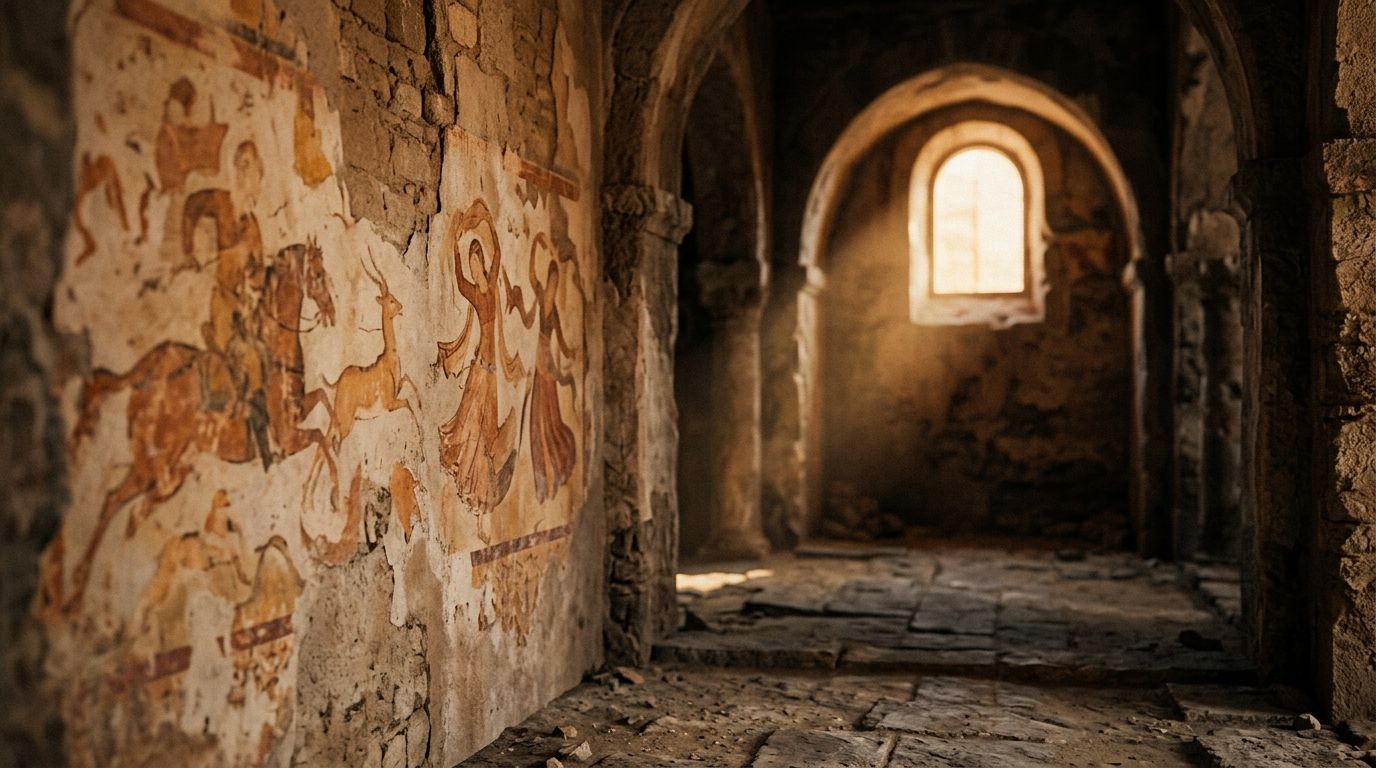
Qusayr 'Amra in Jordan, often dated to the 730s and associated with al-Walid ibn Yazid, preserves the most extensive Umayyad wall-painting programme known today. An audience hall, bath suites and a vaulted caldarium carry scenes of hunting, dancing, musicians, personifications and rulers. A famous fresco strip compares Umayyad and foreign kings, including the Byzantine emperor and possibly the Visigothic ruler, Roderick, in a visual politics of supremacy. A dome in the bath carries a painted star map with Greco-Roman constellations. Recent conservation scholarship treats these images as deliberate royal rhetoric: leisure, cosmic order and diplomacy painted for guests who could read late antique iconography.
Grabar and later archaeologists argued that such cycles drew on late Roman and Sasanian visual languages already local to Syrian and Mesopotamian workshops. Their Islamicate character lies in patronage and setting, not in the absence of figures.
Khirbat al-Mafjar, Samarra and the spread of court painting
Khirbat al-Mafjar, north of Jericho, offers another eighth-century palace with mosaic floors and stucco figures, including a striking "Tree of Life" mosaic with two gazelles and a lion under a tree, now often displayed at the Rockefeller Museum in East Jerusalem. Qasr al-Hayr al-Gharbi in Syria and Samarra's palatial complexes in Iraq add further figural stucco and fresco fragments. Samarra's ninth-century bevelled style is famous for vegetal abstraction, yet figurative panels and carved hunters appear in the same milieu.
These sites show workshop continuity across the Islamic founding centuries. They do not prove that law was ignored. They prove that law and luxury occupied different rooms, and that modern summaries err when they treat mosque decoration as the whole story.
Manuscripts, metalwork and later court arts
From the eleventh century, and especially from the Mongol and Timurid periods onward, illustrated books became the most sophisticated figural archive in many Muslim courts. Persian Shahnama (Book of Kings) manuscripts, Turkish chronicles, scientific treatises and copies of the Mi'rajnameh (Book of the Ascension) integrated human and angelic actors into narrative cycles. The Metropolitan Museum notes that manuscript illustration often escaped the strictest readings because images served texts, not cult.
Ottoman hilye sheets calligraphically describe the Prophet's physical and moral qualities; some include small portrait medallions. Safavid and Mughal workshops produced large-scale court scenes, portraits and allegories on paper. Iznik ceramics sometimes carry ships, plants and stylised faces. Metal basins and brass trays from Fustat and elsewhere show princely feasts, harpies and horsemen. Fatimid lustre pottery in Egypt (tenth to twelfth centuries) carries figural and animal motifs that Grabar linked to Mediterranean luxury trade.
Figures in these media are often stylised: profile faces, repeated types, limited depth. That stylisation reflects workshop convention and aesthetic preference as much as theological caution. From the fifteenth century, many Persian and Turkish images of the Prophet hide his face behind a veil or nimbus, a pictorial piety distinct from legal text but shaped by the same concern for uniqueness. Shi'i manuscript traditions more frequently depict Ali, Husayn and other imams; Sunni Ottoman hilye culture preferred word with occasional portrait.
The Mughal Shahnama tradition under Akbar and Jahangir scaled Persian narrative painting to imperial size. The so-called Shah Tahmasp copy in the 1520s, dispersed across collections including the Metropolitan Museum and the Museum of Fine Arts, Boston, shows hundreds of large figural miniatures with no pretence of aniconic restraint. Court portraits (taswir-i humayun) documented ambassadors, poets and rulers for albums (muraqqa). Those objects circulated as prestige gifts; they were not hidden in private chapels like Christian icons, but they were also not installed in mosque prayer halls.
Metalwork and textiles repeat the pattern. Inlaid brass basins from thirteenth-century Syria show courtiers, musicians and Zodiac medallions. Mamluk and Ottoman silks wove human and animal motifs into clothing reserved for elite ceremony. Such pieces travelled into European church treasuries, where Avinoam Shalem documented them as "Islamic Christianized" luxury goods, evidence that figural Islamicate objects entered Latin collections without theological scandal on the receiving side.
Destruction and censorship punctuate this history. Timurid or Safavid owners sometimes scraped faces from miniatures. Modern fundamentalists have defaced illustrated manuscripts in library collections. Surviving books therefore skew toward what was valued enough to protect.
Four works that repay close looking
Abstract debate gains traction when you attach it to named objects with dates, patrons and current locations. The four below are widely published in museum and academic literature. None stands for "Islamic art" as a whole. Together they show how figural and aniconic choices diverged by setting.
Qusayr 'Amra king fresco (Jordan, in situ)
The ruler fresco in the audience hall places an Umayyad prince on a throne beneath an arch, flanked by attendants and facing the royal comparison panel. Conservation reports document overpainting and loss, but the programme's intent remains readable: earthly power staged through bodily presence. Standing in the hall (visits are regulated; check current UNESCO and Jordanian heritage guidance) makes the aniconism slogan difficult to sustain. This is Islamic patronage using the human figure at scale.
Warqa wa Gulshah manuscript (Topkapı Palace Museum, Istanbul)
Dated to the early thirteenth century and often localised to Anatolia or Azerbaijan, this Persian romance manuscript includes a miniature in which the Prophet Muhammad sits enthroned among the first caliphs, all with haloes comparable to Christian saint imagery. Grabar used such examples to show that thirteenth-century readers could encounter prophetic figures in book art without documented juridical uproar. The manuscript sits at the start of a long Ilkhanid and Timurid illustration tradition.
Rashid al-Din Jami' al-tawarikh folios (Edinburgh University Library / Khalili Collections)
Rashid al-Din Hamadani's early fourteenth-century world history, produced in Tabriz under Ilkhanid patronage, once contained numerous figural miniatures. Survivors in Edinburgh include scenes of Muhammad's birth and the archangel Gabriel revealing prophecy. Figures wear contemporary court dress; only later conventions added veils. These folios demonstrate Mongol-era administrative book production as an engine of Islamic figural narrative, grounded in history writing rather than mosque decoration.
Ottoman hilye calligraphy sheet (various collections, e.g. Metropolitan Museum of Art)
Eighteenth- and nineteenth-century Ottoman hilye-i sharif compositions arrange descriptions of the Prophet's character in concentric calligraphic panels. Some versions insert a small veiled portrait or turbaned bust at the top. The Met and other museums hold examples. They illustrate a Sunni pious genre that used word as primary image and allowed optional likeness at the margin, a compromise between devotion and aniconic habit.
Where figural and aniconic choices diverged
The table is a planning aid for gallery visits and reading. It compresses complex law and patronage; individual objects may contradict their row. Dates follow common museum teaching ranges.
| Context | Typical period | Dominant media | Figural tendency | Notes |
|---|---|---|---|---|
| Mosque prayer hall | 7th c. onward | Calligraphy, geometry, arabesque | Strongly aniconic | Qur'anic inscription preferred; figural tile rare |
| Mihrab and minbar zone | 9th–16th c. | Stucco, tile, wood | Aniconic | Focus on qibla orientation and text |
| Umayyad desert palace | 8th c. | Wall painting, mosaic | Openly figural | Qusayr 'Amra; princely cycles |
| Abbasid Samarra palace | 9th c. | Stucco, fresco, bevelled ornament | Mixed | Abstract vegetal plus some figures |
| Fatimid court (Egypt) | 10th–12th c. | Lustre ceramic, wood, rock crystal | Often figural | Grabar: Mediterranean luxury idiom |
| Ilkhanid/Timurid manuscript | 13th–15th c. | Ink and pigment on paper | Figural narrative | History, epic, science |
| Safavid/Mughal album | 16th–18th c. | Miniature painting | Figural; Prophet often veiled | Court prestige and album culture |
| Ottoman public mosque tile | 16th–18th c. | Iznik tile | Mostly aniconic florals | Secular Iznik wares differ |
| Wahhabi-influenced public space | 20th–21st c. | Architecture, signage | Aniconic enforcement | Statue removal; varies by state |
| Shi'i illustrated Mi'raj | 15th–17th c. | Manuscript | Figural sacred narrative | Gabriel, Buraq, veiled Prophet |
Use the rows to test generalisations. If a speaker says Islam forbids images, ask: in which room, for which patron, under which school?
Iconoclasm, modern controversy and legacy
Selective destruction of images has a history in Islam, but it is neither constant nor universal. Medieval accounts record smashing of idols in pagan contexts and occasional removal of figurative furnishings. The Taliban's 2001 destruction of the Bamiyan Buddhas, Saudi restrictions on public sculpture, and attacks on figurative manuscripts or cartoons belong to modern ideological programmes that cite classical hadith through reformist filters. They cannot be projected onto Umayyad painters or Safavid Shahnama illustrators without anachronism.
The 2005–2006 Danish cartoon crisis and later disputes over depicting the Prophet revived a false binary: that Islam absolutely forbids such images and that any depiction is blasphemy. Grabar's historical survey shows Prophet portraits in Muslim-made manuscripts, especially in Persianate and Turkish contexts, often tied to narrative or mystical texts. Offence in modern polemics mixes legal argument, colonial memory and political mobilisation in ways that museum history alone cannot settle.
For art history, aniconism's legacy is double. It steered religious architecture toward some of the world's most sophisticated non-figural ornament: muqarnas vaults, interlace, and calligraphic band programmes developed partly because walls carried text and pattern instead of narrative scenes. It also misled generations of students into ignoring the figurative half of the archive. Recent exhibitions and digital manuscript projects correct that balance by placing Qusayr 'Amra beside Shah Tahmasp's Shahnama and Ottoman hilye sheets in one timeline.
Comparative religion clarifies without conflating. Western Christian iconography built a theology of images, from early church debate to Nicaea II (787) and beyond, that justified cultic portraits through Incarnation theology. Byzantine iconodules argued that because God took flesh, the painter could honour Christ in pigment and wood. Islamic jurists generally did not transfer that Christological logic to Muhammad or to God. The Second Council of Nicaea's defence of icons belongs to a church council system with no exact counterpart in Sunni or Shi'i institutional structure.
Jewish synagogues in late antiquity sometimes carried mosaic floors with zodiac wheels and biblical scenes, while rabbinic literature debated graven images. Islam inherited part of that Abrahamic unease about idols without copying Jewish or Christian outcomes. Grabar placed Islamic aniconism in this wider monotheist field to stop readers treating figural palace art as "contradictions" rather than as evidence of plural legal and social worlds. Readers moving between traditions should use the dedicated guide to Christian iconography in Western art rather than treating aniconism as Islam's mirror opposite. The two guides are siblings in method (how images work in a religious culture) but not symmetrical in law or visual result.
Contemporary Muslim artists negotiate the same sources anew: calligraphic abstraction, digital collage, figurative self-portraiture and explicit rejection of clerical bans all appear in biennial culture. That living argument sits outside this article's historical focus, which stops where modern art law and activism branch into their own literature.
What to look for in museums and books
When you open a catalogue labelled "Islamic," ask three questions before you infer rules: Is the object religious or secular in original use? Is the figure narrative, decorative or cultic? Which region and century produced it, and which legal school dominated that court? A mihrab panel with only Qur'anic script and a Timurid history manuscript with forty miniatures can be contemporaneous without contradicting each other.
Check whether faces were later scratched or overpainted; conservators sometimes document iconoclastic damage separately from original making. Notice stylisation: profile rulers, identical attendants and flattened space often signal workshop convention rather than theological prohibition. In palace arts, hunt and banquet scenes link rulers to cosmic and imperial order; in manuscripts, the same figures illustrate moral or historical text.
Link outward rather than re-reading the whole field here. The hub essay on Islamic art (pending) maps regions, periods and arabesque logic. Islamic Art & Architecture collects sibling guides on muqarnas, manuscripts, Ottoman workshops and more. Use the museums directory to find institutions with strong Islamic holdings: the Metropolitan Museum of Art's galleries, the British Museum, the Victoria and Albert Museum, the Museum of Islamic Art in Doha, the Khalili Collections, and national museums in Istanbul, Cairo, Tehran and Delhi when travel allows.
Aniconism belongs in your toolkit as a question about setting and law, not as a verdict on every tile, page and fresco signed by Muslim patrons.
FAQ
Search results for aniconism mix dictionary definitions, Wikipedia summaries and polemical blog posts. The questions below stay inside the art-historical fence: meaning, scripture, law, examples and comparison with other traditions.
What does aniconism mean?
In religious and art-historical usage, aniconism is the avoidance or absence of figural images of gods, humans or animals in sacred or public worship contexts. In Islamic art discussions, it describes why many mosques favour calligraphy and geometry, while it does not describe every object made in Muslim-ruled societies.
Does the Qur'an forbid images?
The Qur'an condemns idolatry and affirms God as the sole creator of life, but it does not contain an explicit verse forbidding painting or sculpture. Jurists and preachers derive image rules mainly from hadith and legal reasoning.
Is Islam an aniconic religion?
Islam is diverse in practice. Religious architecture and mosque decoration are largely aniconic. Secular courts, manuscripts and luxury arts often included figures. Modern reform movements may enforce stricter aniconism in public space than many pre-modern elites did.
Why is figurative art rare in mosques?
Mosques function as spaces of prayer oriented toward the qibla, not toward images. Calligraphy carries Qur'anic text without figural competition. Jurists historically discouraged animate decoration in places of worship, and patrons followed that preference while commissioning figural art elsewhere.
Where can I see figurative Islamic art?
Major examples include Umayyad wall paintings at Qusayr 'Amra (Jordan), early palace programmes at Khirbat al-Mafjar and Samarra, and later Persian, Turkish and Mughal manuscripts in the British Library, Topkapı Palace Museum, Metropolitan Museum of Art and Khalili Collections. Check current access and loan status before travel.
Did artists ever depict the Prophet Muhammad?
Yes, in some Persian, Turkish and Mughal manuscript traditions from roughly the thirteenth century onward, often in narrative contexts such as the Mi'raj. Many later images veil the face. Such depictions are contested today; their historical existence is documented in museum collections and scholarship by Grabar and others.
How do the four Sunni schools differ on images?
All four schools restrict three-dimensional statues of animate beings. They diverge on two-dimensional figures: Hanafi texts allow some flat images in necessity; Maliki jurists often express dislike (karaha); Shafi'i and Hanbali readings tend to be stricter. Local custom and purpose always mattered.
Is aniconism unique to Islam?
No. Judaism restricts graven images in religious contexts. Byzantine Christianity fought iconoclastic crises. Buddhism used aniconic symbols before widespread Buddha figures. Islam's pattern is one case in a wider monotheist conversation, not an isolated taboo.
How does this relate to Christian iconography?
Western Christian art developed a theology of religious images, especially from late antiquity through the Middle Ages, that justified cultic portraits in ways Islamic law generally did not. The genres series guide to Christian iconography in Western art treats that parallel tradition separately.
Related reading
Ana Vaz: The Camera is the Body at Mudam Luxembourg
Mudam stages the inaugural major institutional survey of the Brazilian filmmaker's interdisciplinary practice
An immersive exhibition reimagines cinematic perception through embodied filmmaking, ecological inquiry, and postcolonial critique.
Lovis Corinth: Then Came Berlin!
How a mid-life relocation ignited a German modernist revolution
An expansive survey at the Berlinische Galerie traces how Lovis Corinth's 1901 move transformed him into a cornerstone of early twentieth-century avant-garde practice.

Bridging Japanese Craftsmanship and Contemporary Design
How international makers engage with Tokai's industrial heritage at the V&A
An exploration of how global designers collaborate with Japanese artisans to fuse ancestral techniques with modern conceptual frameworks.