
Exhibo Editorial
Christian Iconography in Western Art
How Western painters coded Christ, Mary and the saints so a viewer could read liturgy, legend and civic claim in one glance.
Christian iconography is the shared visual grammar Western artists used to make Christ, Mary, the apostles and the saints identifiable, and to stage biblical events as types a congregation already knew. An attribute (keys, wheel, ointment jar) names a person. A compositional type (Nativity, Baptism, Last Supper, Maestà) names a scene. Gold grounds, haloes, inscriptions and liturgical placement tell you whether the picture was meant as an object of prayer or as a story to be walked.
If you stand in a Gothic nave or a Renaissance chapel, you are looking at a system that had to work for people who might not read Latin. Painters, mosaicists and sculptors repeated a limited set of signs so a parishioner could find the patron saint, follow Holy Week on a wall, and know which altar belonged to which guild. The method for analysing those signs in modern art history belongs with the sibling guide on iconography. This article stays with the Western Christian subjects, attributes and cycles themselves. Related genre questions sit in Genres and Symbolism in Art.
What the term covers in a Western museum
In a National Gallery or Met gallery labelled “Christian art,” iconography means the content of the picture: who is present, which episode you are in, which objects carry identity. The Gallery’s own glossary once used “iconography” for likeness (how Christ was thought to look). Curators now use it for subject and symbol. An attribute, in the same glossary, is an object that identifies a figure: Peter’s keys, Catherine’s wheel, Mary Magdalene’s ointment jar.
Western Christian pictures grew inside churches, monasteries, palaces and houses. They served Mass, private devotion, civic procession and teaching. A mosaic in an apse and a small panel for a bedroom used the same grammar at different scales. Early makers borrowed Roman pastoral and imperial motifs (shepherd, philosopher, emperor in purple) and recoded them. By the later Middle Ages the grammar was thick: Golden Legend stories, liturgical calendars, local patrons, and workshop pattern-books all fed the same wall.
The word “icon” in English often points to Eastern panel painting. Western Latin churches also made cult images (a statue or panel people approached in prayer) and narrative cycles (frescoes and predellas that tell a life in sequence). Both are Christian iconography. Confusing the two is the most common mistake in a gallery. A Maestà facing the nave is a throne for address. The Passion scenes on its reverse, or on a chapel wall, are a story you read in order.
Islamic visual culture has its own, contested history of figuration and aniconism. That debate is not a simple opposite of Christian picture-making, and it is not this article’s subject; see the planned guide on aniconism (pending).
How the system works in practice
A Western Christian image has to answer three questions at once: who is this, what moment is this, and what is the picture for. Workshops solved those questions with a toolbox you can still use on the gallery floor. The tools overlap. A lamb can be Christ, a flock, or a sacrificial type from Exodus, depending on halo, inscription and place in the building. Keys can be Peter’s office or a donor’s civic boast. Colour helps (Mary’s blue mantle in later painting) but it is not a code with one key. Placement does more work than colour: the figure over the high altar is not equal to a saint on a side-chapel pilaster.
Patrons paid for recognition. A guild of wool merchants wanted their saint readable from the aisle. A bishop wanted the Baptism of Christ to teach the Trinity at a glance. A commune wanted the Virgin as civic protector. Once you know the tools, you can reverse-engineer the brief. The sections below separate the tools so you can practise each, then put them back together on named works.
Attributes, types and inscriptions
An attribute is a prop tied to a life or death. The National Gallery’s teaching pages put this in blunt museum language: saints had to be “easily recognisable,” so artists standardised symbols drawn from martyrdom, miracle or office. Peter holds keys because Matthew 16 gives him the keys of the kingdom. Jerome sits with a lion because a late legend has him pulling a thorn from a paw. Luke may sit with an ox, one of the four living creatures assigned to the evangelists. Mary Magdalene carries a jar because the Gospels place her among the women who anoint.
A type is a whole composition, not a prop. “Annunciation” means Gabriel, Mary, a space between them, often a lily or a book. “Baptism” means Christ in water, John pouring or immersing, a dove. “Last Supper” means a table, twelve (or fewer) men, bread and wine, Judas marked somehow. You can change costume and still keep the type. That is why a seventeenth-century Caravaggio and a fifteenth-century Flemish panel can share a subject while sharing almost no surface style.
Inscriptions close the remaining gaps. Greek or Latin names on haloes, tituli on frames, and open Gospel books tell you what the painter would not leave to chance. When an inscription is lost, scholars argue from attributes and from the original altar. Do not invent a saint from one prop if two saints share it. A sword can be Paul, a military martyr, or Justice.
Cult image and narrative cycle
A cult image presents a holy person for encounter: frontal or near-frontal, often larger than life, set where bodies stop and pray. Duccio’s front face of the Maestà in Siena is that kind of object. A narrative cycle sequences time: Giotto’s Arena Chapel in Padua (consecrated 1305) walks the Virgin’s life and Christ’s ministry around the walls so a viewer moves with the story. Altarpieces often combine both. Front: throne. Reverse or predella: Passion or infancy in small fields.
Function changes how you should look. In front of a cult image, ask who is being addressed and who paid. In front of a cycle, ask where the sequence starts, which Gospel it follows, and which episodes the patron skipped. Skipping is information. A Franciscan church loads stigmata and poverty. A baptistery loads Jordan water, John, and the dove.
Early Christian catacomb painting and sarcophagi already show the split. The Good Shepherd is a type of Christ as carer, close to Roman pastoral figures. Jonah, Daniel and the three Hebrews are narrative types of deliverance. Later church programmes keep that split at monumental scale: apse Christ or Virgin as presence; nave or aisle as story.
Early signs that never quite leave
Before the crucified body became the dominant public sign of Christianity, workshops used other marks: fish (ichthys), anchor, chi-rho, alpha and omega, lamb. André Grabar’s Mellon lectures, published as Christian Iconography: A Study of Its Origins (1968), still map how those signs formed beside Roman commemorative art. The lamb as Christ draws on John 1:29 (“Lamb of God”) and on Passover. Mosaic programmes in Ravenna and Poreč place a haloed lamb at the apex or on a hill with four rivers. Canon 82 of the Quinisext Council (in Trullo, 691/2) prefers the human figure of Christ to that older lamb type, so the incarnation is shown rather than only the shadow of the Law. English versions of the canon are widely printed (the older corpus on New Advent is typical); Heinz Ohme’s 2013 Acta Conciliorum Oecumenicorum edition of the Greek acts is the critical text and has not been collated here. The decree itself tells you the motif was common enough to regulate.
Those early signs survive as footnotes in later pictures. Caravaggio’s fruit basket in the London Supper at Emmaus casts a fish-shaped shadow on the cloth, a visual pun the Gallery’s interpretation notes. A pilgrim’s scallop on a disciple’s cloak marks travel and, in that picture, helps identify a companion at table. Once you train for leftover signs, later naturalism stops looking “secular.” The still life is still doing liturgical work.
A working inventory of subjects and attributes
Lists of “Christian symbols” online collapse a thousand years into a tattoo sheet. Use a table keyed to function and to a work you can check. The rows below are a starter kit for Western painting and mosaic, not a complete saint dictionary. For animals, body parts and odd objects, the National Gallery’s “Recognising saints” pages remain the most honest public teaching tool in English.
| Subject or figure | Typical signs in Western art | Function in a church or panel | Named work to check | Collection / site |
|---|---|---|---|---|
| Christ as shepherd or lamb | Youth with sheep; haloed lamb; four rivers | Early substitute for a portrait of Christ; later eucharistic centre | San Vitale presbytery vault; Ghent Adoration of the Mystic Lamb | Ravenna; St Bavo’s, Ghent |
| Baptism of Christ | Christ in water, John, dove, sometimes the Father | Trinity made visible; baptistery and altar of St John | Piero della Francesca, The Baptism of Christ (c. 1437–45) | National Gallery, London (NG665) |
| Virgin and Child enthroned (Maestà) | Throne, angels, civic patron saints | Cult image; civic protector | Duccio, Maestà (1308–11) | Museo dell’Opera, Siena (panels also NG) |
| Last Supper / supper after Resurrection | Table, bread, wine, Judas or unrecognised Christ | Eucharistic type; recognition at Emmaus | Leonardo, Santa Maria delle Grazie; Caravaggio, Supper at Emmaus (1601) | Milan; National Gallery (NG172) |
| Peter | Keys; sometimes inverted cross or boat | Office, foundation of the Roman church | Countless altarpieces; Mattei/Caravaggio circle | Widespread |
| Catherine of Alexandria | Wheel (often broken); crown; book | Martyr-scholar; frequent female altar saint | Workshop altarpieces across Italy and the North | National Gallery and others |
| Mary Magdalene | Ointment jar; loose hair in later pictures | Anointing; witness; penitence type | Savoldo, Mary Magdalene (c. 1535–40) | National Gallery, London |
| Jerome | Lion; cardinal’s red in later art; desert | Translator of scripture; hermit | Bono de Ferrara, Saint Jerome in a Landscape | National Gallery, London |
| Evangelists | Man, lion, ox, eagle (from living creatures) | Gospel authors on pulpits, books, vaults | Manuscripts; Giotto and later chapel programmes | Widespread |
| Francis | Stigmata; grey or brown habit; skull in later Spain | Founder; poverty; later vanitas overlay | Zurbarán, kneeling Francis with skull | National Gallery, London |
Treat each cell as a hypothesis. A woman with a jar might be Magdalene or a donor with perfume. A lion might be Jerome, Mark, or a civic beast. Confirm with inscription, companion saints, and the original dedication of the chapel.
Who paid, who copied, who named the saints
Pictures did not invent their subjects in the studio. A contract named the dedication. A bishop or operaio (clerk of works) approved a programme. A guild paid for its chapel. Painters then reached for pattern-books, earlier altarpieces in the same city, and written legend. The most copied Western source for saint stories after the mid-thirteenth century was Jacobus de Voragine’s Legenda aurea (Golden Legend), a Dominican compilation of feast-day lives. National Gallery educators still point students to it when a wheel or a dragon needs a plot. The legend is late and often fabulous. Painters treated it as usable fact because congregations already knew the feast.
Workshop practice kept types stable across style changes. An apprentice copied a master’s Annunciation until Gabriel’s stride and Mary’s desk were muscle memory. Prints after Raphael and Dürer later spread types faster than travel. That is why a provincial Spanish panel can look “Italian” in subject while remaining local in surface. Patron taste cut the other way: Franciscans wanted stigmata and preaching; Dominicans wanted Thomas Aquinas and the rosary; a baptistery wanted John and the dove. If you know the order that owned the building, you can predict half the wall before you look up.
Named artists enter the record unevenly. Duccio’s 1308 contract and the 1311 procession are unusually well documented. Piero’s Sansepolcro altar is tied to a local church of the Baptist. Caravaggio’s 1601 Emmaus is tied to Ciriaco Mattei by payments and later Borghese inventories. Mosaicists at San Vitale are mostly anonymous; the named people are bishop, banker and emperor. Christian iconography is a social product. The saint on the wall is a joint of legend, pay and habit.
Giotto’s Arena (Scrovegni) Chapel in Padua, consecrated in 1305, shows the patron’s stake in one volume. Enrico Scrovegni, a banker, commissioned a cycle of the Virgin and Christ that wraps the interior so a visitor walks salvation history. The Last Judgment on the entrance wall includes the donor presenting a model of the chapel. That donor portrait is part of the iconography: it states who paid for the prayer the pictures support. Use Padua next to Siena. Giotto sequences time on plaster; Duccio sequences time on the reverse of a throne. Same grammar, different furniture.
Six works, six jobs the grammar does
Close looking beats another list of fish and doves. The six works below sit in different centuries and media, and each uses the grammar for a distinct job: imperial church programme, civic cult image plus Passion cycle, Trinitarian altar in a local landscape, eucharistic polyptych, recognition at table, and (in the next section) modern reuse. Dates and locations follow museum and cathedral publications. Where scholarship splits a date, the range is given.
You do not need Panofsky’s three-level method to do this work in a room, though that method is the academic name for moving from motif to subject to cultural meaning. Keep the method on the iconography page. Here the task is to see how a Western Christian picture is built so that a congregation could use it.
San Vitale, Ravenna: a building that argues in mosaic
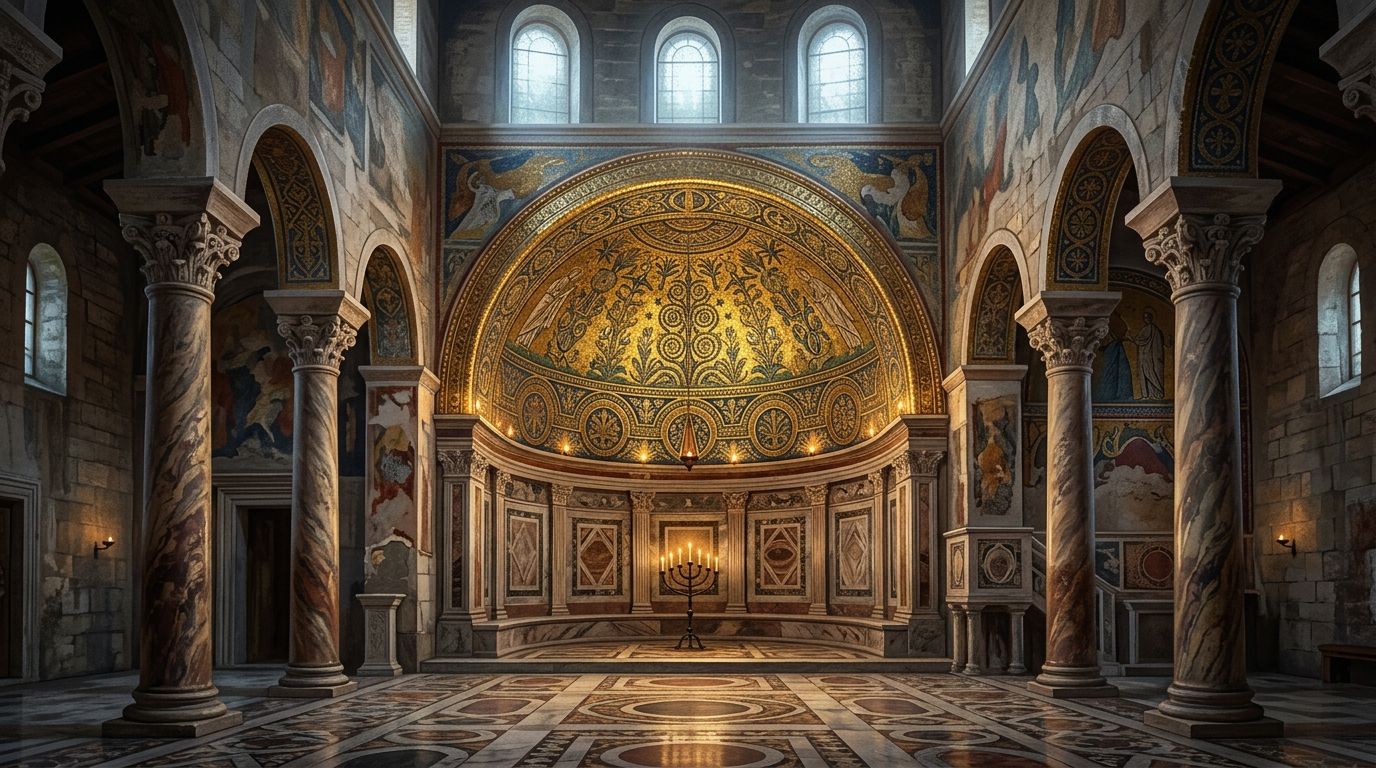
The church of San Vitale, begun under Ostrogothic rule and consecrated in 547/548 under Justinian’s reconquest, wraps its octagon in mosaic. In the presbytery, Christ sits on a globe, flanked by angels, offering a crown to Saint Vitalis while Bishop Ecclesius presents a model of the church. Opposite, Justinian and Theodora process with clergy and court. Below and around, Abel, Melchizedek and other Old Testament offerers prefigure the Eucharist. A lamb occupies the vault of the presbytery.
This is Christian iconography as state and liturgy in one surface. The emperor stands in the sanctuary programme, not as a portrait gallery extra. The Old Testament sacrificers are types: earlier offerings that the Mass claims to complete. The lamb is Christ and the eucharistic victim. You read up (vault), across (imperial panels), and down (narrative types). Style here is Byzantine-inflected late antique mosaic; the grammar is already Western church politics: bishop, martyr, emperor, altar.
Ravenna’s other fifth- and sixth-century buildings (Galla Placidia, Sant’Apollinare) repeat sheep, stars and processions. Use them as a set. Once you have seen twelve lambs walking toward a thirteenth, later “Adoration of the Lamb” altarpieces stop looking like a Flemish invention. They are a late, oil-paint version of an old apse idea.
Duccio’s Maestà: throne on one side, Holy Week on the other
Duccio di Buoninsegna contracted with Siena Cathedral’s Opera in 1308 and the city processed the finished Maestà to the Duomo on 9 June 1311. The National Gallery’s catalogue of the predella fragments (Gordon, 2011) reconstructs a double-sided high altarpiece about five metres square. Most of it is now in the Museo dell’Opera del Duomo, Siena. London holds predella scenes including the Annunciation.
The front is a cult image: Virgin and Child enthroned, angels, apostles, and Siena’s patron saints. An inscription asks the Mother of God to keep peace for Siena and life for Duccio. That is civic theology in gold. The back packed Christ’s Passion into a grid of small fields, with infancy and ministry on predella and crowning sections. One object therefore did two jobs. Facing the congregation: presence and petition. Facing the choir: a narrative a cleric could match to Holy Week.
When the altarpiece was later dismembered, museums inherited “pictures” that were once a machine. If you see a Duccio Annunciation in London, you are holding a sentence from a paragraph whose other sentences hang in Siena. Christian iconography is often architectural. Isolate a panel and you lose the order of reading.
Piero’s Baptism: Trinity, local river, one vertical line
Piero della Francesca painted The Baptism of Christ in egg tempera on poplar, probably about 1437–45, for the church of San Giovanni Battista in Val d’Afra at Borgo Sansepolcro. It is now NG665. Christ stands in a shallow stream. John pours from a bowl. A dove hovers on the central axis. Three angels watch. Behind, a man strips for his own baptism. Distant figures wear Eastern hats the Gallery links to Byzantine visitors in Italy during union councils of that decade.
The iconography is textbook Baptism: water, John, dove, implied voice of the Father from Matthew 3. Piero’s job is to make the Trinity visible without a bearded ancient in the sky. Alignment does it. Dove, bowl, Christ’s hands and the pale tree trunk stack on one vertical. Landscape does a second job: walnut tree, plants and a turreted town pull Sansepolcro into the Jordan, so a local congregation could place the Gospel on their own ground. The water stopping at Christ’s feet, pebbles showing, is a pictorial choice the Gallery reads as inviting you to stand in the river.
This is Christian iconography under early Renaissance perspective. The grammar did not vanish when painters learned vanishing points. It got a new scaffold.
Van Eyck’s Ghent altarpiece: the lamb as public theology
The Adoration of the Mystic Lamb, completed in 1432 for St Bavo’s Cathedral, Ghent, and associated with Hubert and Jan van Eyck, is the most famous late-medieval staging of the lamb as eucharistic centre. Wings open to show the lamb on an altar in a meadow, blood into a chalice, angels, prophets, apostles, martyrs and confessors approaching. Inscriptions and the fountain of life keep the image tied to Revelation and to the Mass.
Here the old Ravenna lamb has become a landscape crowded with the Church in its orders. Oil paint lets van Eyck describe jewels, botany and distant cities, but the subject is still a type: Christ as victim and as gathering-point of the saved. The closed altarpiece shows other Christian types (Annunciation, donors, sibyls and prophets). Like Duccio’s machine, Ghent is a folding programme. Tourists photograph the lamb; the original user opened and closed it with the feast.
Caravaggio’s Emmaus: recognition as still life and gesture
Caravaggio painted The Supper at Emmaus in 1601 for Ciriaco Mattei in Rome. It is NG172, oil on canvas, 141 × 196.2 cm. Luke 24: two disciples walk with the risen Christ, fail to know him, and recognise him when he blesses and breaks bread. Caravaggio picks that second. One disciple starts from the chair. The other throws his arms wide, a bodily cross. The innkeeper stands in shadow, thumbs in his belt. Christ is beardless and young, a choice that startled viewers used to a bearded type.
The Gallery’s technical notes record how staged the “instant” is: light from the left, a near-halo shadow on the wall, fruit basket on the table’s edge, a fish-shaped shadow on the cloth. Bread and wine are Gospel props and Mass props. The scallop on a cloak is a pilgrim sign. Christian iconography here hides inside genre naturalism. If you only see a tavern scene, you have missed the subject. If you only see symbols, you have missed how Caravaggio forces your body into the table’s empty place.
How living artists still use the grammar
Contemporary artists inherit a public that still knows a handful of types (Last Supper, Madonna, saint with an object) even when churchgoing has dropped. They use that residue. Andy Warhol, raised in the Byzantine Catholic Church, spent 1985–86 on a Last Supper series after a commission from Alexander Iolas: silkscreens and paintings after Leonardo’s mural, first shown in January 1987 in a former refectory across from Santa Maria delle Grazie in Milan. Serial colour, camouflage and doubled tables treat the type as a brand the culture cannot retire. The grammar survives as repetition.
Bill Viola’s video The Greeting (1995) restages the encounter structure of Pontormo’s Visitation: two women meet, a third is drawn in, time stretches. Viola does not copy Pontormo’s surface. He keeps the type (visitation, greeting, pregnancy as news) and moves it into duration. The Royal Academy later hung Viola beside Michelangelo to show shared subjects (birth, death, resurrection) rather than a claim that video “replaces” fresco.
Michael Landy’s Saints Alive (National Gallery, 2013) built kinetic sculptures from scrap and from body parts quoted out of the Gallery’s own fifteenth-century paintings. Visitors cranked machines that replayed martyrdoms until parts failed. The show was comic and harsh. It also proved the Gallery’s educational point: attributes still identify saints, and once you detach wheel, grid or stigmata from a gold ground, the violence of the legend returns as mechanics. Mark Wallinger’s Ecce Homo (1999), a bound Christ on the Trafalgar Square Fourth Plinth, used a public type (“behold the man”) in civic space without a church.
None of these works needs you to share the artists’ beliefs. They need you to know the type they are handling. That is the same literacy a Sienese crowd brought to Duccio’s procession in 1311.
How to identify it when you are in the room
Start with the building, then the frame, then the props. Ask what the object faced: nave, choir, bedroom, guild hall. A high-altar Madonna and a predella Flight into Egypt answer different questions. Read any inscription before you guess. Then hunt attributes in pairs. Two keys are stronger than one. A wheel plus a crown plus a female martyr is Catherine until proven otherwise.
Check companions. Saints travel in sets: Peter and Paul as princes of the apostles; Cosmas and Damian as physician brothers (the sixth-century apse of Santi Cosma e Damiano in Rome stages them with Peter and Paul presenting). A lone figure with a lion is a weaker ID than Jerome with lion, cardinal’s hat and a book.
Name the episode before you name the style. “Is this a Baptism?” is a better first question than “Is this Piero?” Once the type is fixed, style tells you how the painter wants you to feel the doctrine: Piero’s stillness, Caravaggio’s lunge, van Eyck’s inventory of the saved.
Use museum tools without shame. The National Gallery’s saints tour and object pages exist because even specialists forget obscure martyrs. The Met’s Heilbrunn chronologies (Italian peninsula 1–500; Constantine’s basilicas; Theodosius making Christianity the state religion in the 390s) give political dates that explain why Christian subjects fill public buildings after the fourth century. Walk the museums directory when you plan a trip; Christian iconography is concentrated in church treasuries and in the European painting wings of civic galleries.
If a label says only “religious scene,” do the work the label skipped. Count figures. Find the table or the water or the throne. That is enough to sort Last Supper from Emmaus from Marriage at Cana.
Confusions that waste looking time
Iconography versus icons. Iconography is the study and the system of subjects. An icon is one kind of sacred image, above all in Eastern Christian practice. Western altarpieces are not “icons” in the technical sense, even when they function as cult images.
Iconography versus iconology. In twentieth-century academic English, iconography names the subject; iconology names the cultural interpretation layered on top. Erwin Panofsky’s scheme is the usual citation. It is a method for writing about pictures, not a medieval workshop rule. Do not reteach it here; use the sibling article.
Symbol sheets. A dove is the Spirit in a Baptism and a lover’s bird in a cassone. A skull is Jerome’s meditation, a Franciscan memento, or a Dutch still-life. Context first.
Passion sensationalism. Western art includes the Crucifixion in thousands of versions. Reading it as gore misses its liturgical job (altar, Good Friday, donor salvation). This guide keeps examples on architecture, gold ground, baptism, supper and lamb for that reason, and because search thumbnails of torture help no one.
Orthodox versus Catholic as a fight. Shared types (Virgin and Child, evangelist beasts, the lamb) moved across Greek and Latin Christianity for centuries. Differences of panel theology, iconostasis and perspective are real. They are not a scoreboard. Ravenna is not a weapon.
“Secret symbols” and persecution romance. The fish was an early Christian sign. Treating every later still life as a crypto-Christian code is fan fiction. Caravaggio’s fish shadow is a painter’s joke inside a known Gospel subject, not a catacomb password.
Confusing donor with saint. A kneeling man in contemporary dress at the left is often the payer. He may wear a saint’s name-saint attributes as a portrait disguise. Check scale, gaze and whether he occupies the same gold ground as the holy figures.
FAQ
What is Christian iconography?
It is the set of subjects, attributes and compositional types Western (and, in related forms, Eastern) Christian artists used to identify holy persons and biblical events, plus the modern study of those subjects. In a museum sentence: the content of the picture, as distinct from brushwork or perspective.
What are the main Christian symbols in art?
There is no official list of three. Recurring public signs include the cross, the chi-rho, the lamb, the fish, the dove, the four evangelist beasts, and Mary’s later blue mantle. More useful than a list is the distinction between a sign (lamb), an attribute (Peter’s keys) and a full scene type (Annunciation). Search interest in “Christian symbols in art” is real; the gallery skill is matching the sign to a named work.
How do you recognise saints in paintings?
Look for attributes tied to legend or office, then confirm with inscriptions and companion saints. The National Gallery teaches this with objects (keys, wheel, ointment, cleaver) and animals (Jerome’s lion). Workshop pattern-books and the Golden Legend (Jacobus de Voragine, thirteenth century) supplied many of those stories to painters.
Is Christian iconography the same as religious iconography?
Religious iconography is the broader term (US volume is much higher) and includes non-Christian sacred systems. Christian iconography is the subset this article maps for Western Christ, Mary, saints and feast cycles. Do not flatten Hindu, Buddhist or Islamic image traditions into the same cheat-sheet.
What is the difference between a cult image and a narrative cycle?
A cult image presents a holy figure for prayer and presence (a Maestà, a statue on an altar). A narrative cycle orders episodes in time (Giotto’s Padua walls, Duccio’s Passion reverse). Many altarpieces combine both.
Why do early Christian works show a lamb or shepherd instead of the Crucifixion?
Makers used types already legible in Roman art (shepherd, sacrificial animal) and texts (John 1, Psalm 23, Revelation). Monumental Crucifixion imagery becomes common later. Councils even debated whether Christ should be shown as a lamb. Survival in catacombs and mosaics is also a filter: what was buried or tessellated lasted.
Where should I go to practise?
Start with a concentrated Western collection: the National Gallery’s Italian and Netherlandish rooms in London, Siena’s cathedral museum for Duccio, Ravenna for mosaic programmes, Ghent for the lamb altarpiece. Use the museums listings to plan. Read one wall text, then ignore it and test yourself on the next room.
Related reading

Ana Vaz: The Camera is the Body at Mudam Luxembourg
Mudam stages the inaugural major institutional survey of the Brazilian filmmaker's interdisciplinary practice
An immersive exhibition reimagines cinematic perception through embodied filmmaking, ecological inquiry, and postcolonial critique.
Lovis Corinth: Then Came Berlin!
How a mid-life relocation ignited a German modernist revolution
An expansive survey at the Berlinische Galerie traces how Lovis Corinth's 1901 move transformed him into a cornerstone of early twentieth-century avant-garde practice.

Bridging Japanese Craftsmanship and Contemporary Design
How international makers engage with Tokai's industrial heritage at the V&A
An exploration of how global designers collaborate with Japanese artisans to fuse ancestral techniques with modern conceptual frameworks.