
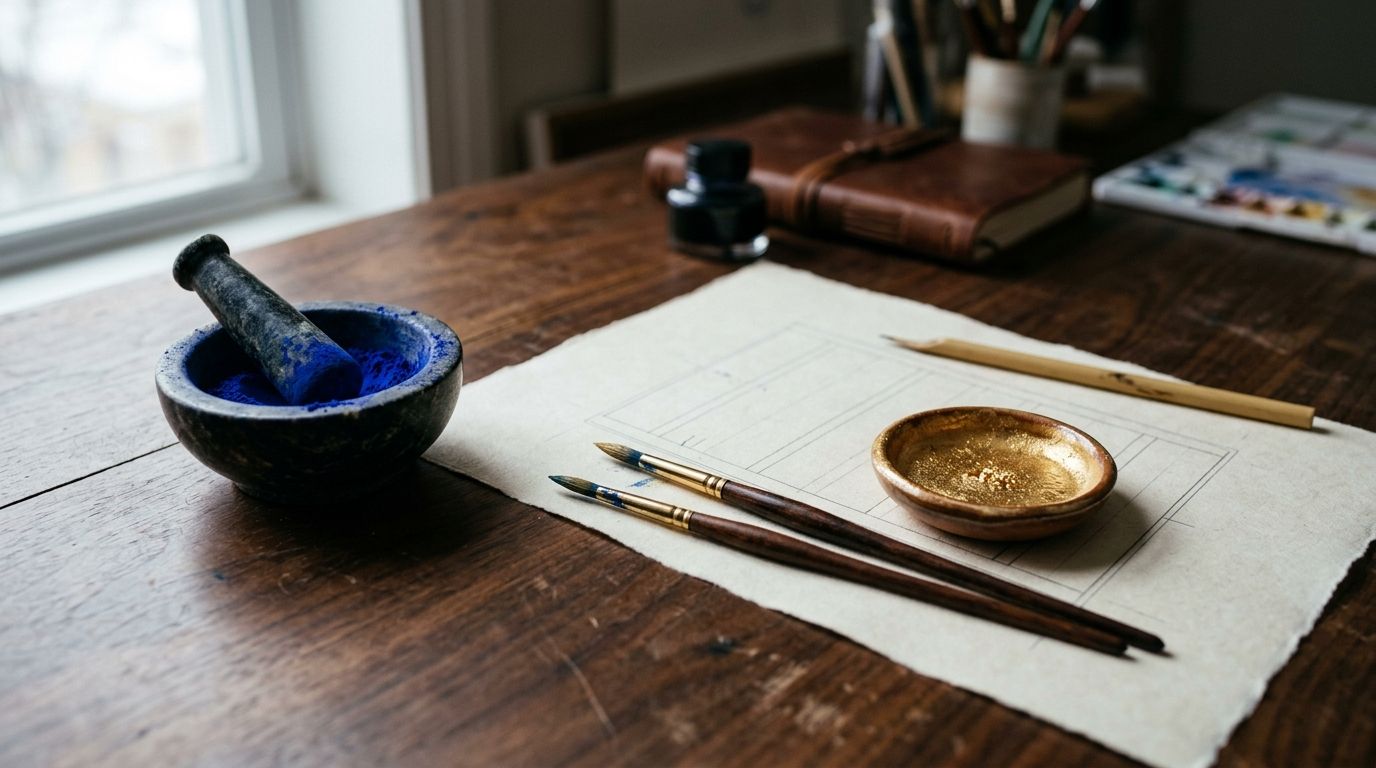
Exhibo Editorial
Mughal and Persian Miniature Painting
Safavid kitabkhana practice, Mughal imperial albums and four named folios in New York and London collections you can still study
Persian miniature painting is small-scale figurative work in opaque watercolour, ink and gold on paper, made chiefly for illustrated manuscripts and later for album pages called muraqqa. Searchers who type the phrase often meet Etsy prints, hobby brush kits and one-page lists of "famous miniatures." The historical answer is a workshop tradition tied to royal libraries (kitabkhana) in Iran, Central Asia and Mughal India, where calligraphers, painters, gilders and binders collaborated under a director who planned which episodes of Firdausi's Shahnama or Nizami's Khamsa received pictures.
Mughal painting grew from that Persian root when Babur's descendants hired Iranian masters at Delhi and Agra. You recognise a late Timurid folio by stacked rocky horizons and figures in profile; a Shah Tahmasp Shahnama page by gold-sprinkled margins and painter signatures in the rocks; a Jahangir-era portrait by botanical borders and measured likeness. This article belongs to the Islamic Art & Architecture series. Broader definitions of "Islamic art," dynasties and media sit in the hub What Is Islamic Art?. Indian sculpture, temple architecture and the full subcontinental survey belong on Indian art history. Ottoman court painting gets a brief pointer toward Ottoman art. Manuscript collation, binding and calligraphy handbooks belong in the pending Islamic manuscripts sibling. Collection pages for institutions named below sit in the museums directory.
What "Persian miniature painting" names in museum usage
Western museums use the phrase for book painting in Persianate courts from the thirteenth century to the eighteenth, whether the patron ruled in Tabriz, Herat, Isfahan, Bukhara or Delhi. Makers themselves spoke of negargari (picture-making) or simply "work of the royal library." The word miniature does not mean "small" alone: it entered English from post-medieval European album culture and stuck to Islamic book pictures that were often large by modern standards. Shah Tahmasp's Shahnama pages measure roughly 48 by 32 centimetres.
Three habits define the field for visitors. First, pictures serve text: epic poetry, history, romance, science and dynastic chronicle. Second, skill is line. A painter's reputation rested on contour, pattern fill and facial type as much as on modelling. Third, workshops are corporate. A folio may credit an author, a calligrapher, a painter, a workshop director and a patron on different parts of the same sheet. Attributions shift when styles merge; museum labels often say "attributed to" or "circle of" for good reason.
Mughal painting is included here because its first generations trained in Persian idioms. Akbar's atelier copied Timurid compositions and hired masters from Safavid Iran. By Jahangir's reign portraiture and natural history studies pushed the brief beyond book illustration, but the materials chain (sized paper, mineral colour, squirrel-hair brushes) stayed recognisably Persianate. Rajput and Deccan schools developed parallel tracks; this page stays with imperial Mughal and Iranian court production to about 1700, then points south Asian breadth back to Indian art history.
Conditions that produced the traditions
Book painting in Persian flourished when paper replaced parchment at scale, when courts competed through luxury manuscripts, and when epic and romance literature supplied repeatable narrative episodes. Ilkhanid rulers in thirteenth-century Iran and Iraq patronised illustrated history and scientific books; Chinese scroll conventions entered through Mongol exchange, visible in cloud bands, lotus motifs and diagonal landscape. When Timur and his successors rebuilt Herat and Samarkand as cultural centres in the fifteenth century, Shah Rukh and Sultan Husayn Bayqara funded scriptoria where Bihzad and his colleagues tightened composition: single ground planes, high horizons, architecture framing action.
Safavid Shah Isma'il I (r. 1501–24) and Shah Tahmasp I (r. 1524–76) moved the main kitabkhana to Tabriz, then Isfahan. They treated the illustrated Shahnama as dynastic propaganda: a Persian past legitimising a new Shi'i monarchy. Shah Tahmasp spent decades on one manuscript with 258 miniatures. Shah 'Abbas I (r. 1587–1629) later gifted prized books to shrines and foreign rulers, which is how folios entered Ottoman, Indian and European collections.
Mughal conditions differed in patron but not in craft. Babur (r. 1526–30) brought Central Asian taste; Humayun (r. 1530–40, 1555–56) returned from Safavid exile with painters. Akbar (r. 1556–1605) expanded the kitabkhana, ordered illustrated chronicles and epics, and mixed Hindu and Muslim artists. Jahangir (r. 1605–27) preferred portrait and nature study; Shah Jahan (r. 1628–58) folded paintings into imperial albums with floral borders. Stable paper supply from Kashmir and Gujarat, imperial salaries, and a bilingual court culture (Persian literary, Hindavi spoken) kept the atelier busy.
Religious law mattered at the margins. Jurists debated figural images in private versus public space; the sibling article on aniconism in Islamic art carries that argument. Miniature painters still illustrated kings, prophets in history books, and lovers in romance. Patron taste, not a single legal code, set the limits.
Paper mills in Kashgar, Samarkand and later Kashmir fed the trade. Rag and mulberry fibres produced sheets strong enough for burnishing yet thin enough to bind in hundreds. Pigment routes moved lapis from Badakhshan, cinnabar from Spain and indigo from India into the same palette whether the patron sat in Isfahan or Agra. When Akbar ordered the illustrated Hamzanama (c. 1562–77), over a hundred artists produced more than 1,400 large-format cloth-backed pages, an outlier in scale that proved imperial kitabkhana capacity. Jahangir's memoirs (Tuzuk) record gifts of Persian manuscripts and single portraits; he valued likeness over battle crowds. That shift in brief did not end book illustration, but it redirected senior painters toward album sheets and dynastic portraiture preserved in volumes such as the Shah Jahan Album at the Met.
Workshop practice: paper, pigments and division of labour
Royal kitabkhanas ran as organised ateliers. A director (ustad) received the commission, chose episode subjects, distributed face types and palette rules, and checked finished folios before presentation. Calligraphers copied text first on polished paper; painters added colour; gilders applied shell gold and burnished highlights; binders assembled gatherings. Pattern books and pounced cartoons moved figures between manuscripts. Pay registers from Mughal and Ottoman archives (the Ottoman nakkashane is surveyed in Ottoman art) show salaried ranks; Persian evidence survives chiefly in colophons and royal histories.
Materials set the look. Paper was sized with starch, rice water or plant mucilage so pigment would not sink. Brushes used hairs from squirrel tail, cat or camel for fine line. Colours came from minerals and plants ground with gum arabic or egg yolk. Gold often arrived as shell gold (powdered leaf in honey or glue), then burnished after application. Conservators note that silver leaf on many folios has oxidised to black; labels sometimes misread those passages as ink.
Paper preparation and layout
Scribes ruled margins and text blocks with a pointed instrument (sargar). Illustrations occupied spaces left blank during copying or were planned on separate sheets later inserted. Shah Tahmasp's Shahnama used exceptionally large text pages with wide gold-flecked borders so painters could stage crowds without crowding script. Album culture later cut folios from worn manuscripts and remounted them with new illumination, which complicates provenance: a "Safavid" border may frame a Timurid picture.
Burnishing closed the surface. A smooth stone or agate polisher compacted pigment layers and made gold shine. British Institute of Persian Studies workshop notes describe cucumber-seed and marshmallow mucilage in sizing recipes recorded in medieval Persian technical texts. When you compare a matte modern reproduction with a museum original, that burnish is part of what you lose.
Pigments and colour hierarchy
Lapis lazuli for ultramarine blue was costly; workshops reserved it for sky, water and elite costume, mixing indigo or azurite for secondary blues. Malachite and verdigris supplied greens. Red lead, vermilion and madder filled different registers of red. Lead white and orpiment built highlights and yellows. Treatises attributed to Sadiqi Bek and Qadi Ahmad list these materials for Persian painters; Mughal palette lists overlap with added local plant dyes.
Layering was standard. Painters laid flat colour fields, added pattern in wet or dry brush, then finished faces and hands. Mistakes were scraped or patched; luxury manuscripts seldom show correction on the face side. The table in the next section maps courts to typical supports and named museum anchors.
Roles in the kitabkhana
Not every hand signed. Workshop directors such as Mir Musavvir at Tabriz or Abu'l-Hasan at Jahangir's court coordinated teams. Specialist "face painters" (suratgar) sometimes finished portraits after juniors blocked colour. Calligraphers could outrank painters in court prestige: Mir 'Ali Haravi's script appears on Mughal album verso pages opposite Jahangir portraits. When a label names only the author of the text, check the painting credit line lower on the mount.
Designers transferred figures with pounced cartoons: pin-pricked outlines dusted with charcoal through to a fresh sheet. That method let a successful composition reappear in a second manuscript without freehand redrawing. Met conservators studying Shah Tahmasp leaves note underdrawing in black ink beneath colour washes, evidence of planning before pigment. Junior painters blocked landscape and costume; seniors often reserved faces and hands. The hierarchy explains uneven quality within a single manuscript: one folio may blaze with portrait skill while a neighbour stays routine.
A chronology of schools and courts
Period labels are scholarly shorthand; artists moved when cities fell or patrons migrated. Dates below follow Metropolitan Museum of Art timeline essays and British Library catalogue conventions where those sources give explicit ranges. Use the table as a map, then read the object label.
| Court / school (approx.) | Rough dates | Main centres | Workshop focus | Museum anchor |
|---|---|---|---|---|
| Ilkhanid | 1256–1353 | Tabriz, Baghdad | World history, scientific compendia; early Chinese-influenced landscape | "Siyavush Displays his Skill at Polo," Met, dated 741 AH / 1341 CE |
| Jalayirid / Muzaffarid | 1336–1410 | Baghdad, Shiraz | Shahnama and romance illustration; softer palette | Shiraz school folios in BL and Met collections |
| Timurid | 1370–1507 | Herat, Samarkand | Shahnama, Khamsa; Bihzad-era composition | Mantiq al-tayr manuscript begun 892 AH / 1487 CE, Met |
| Turkmen / Aq Qoyunlu | 1378–1508 | Tabriz, Shiraz | Battle scenes, Turkmen costume details | BL Or. 13859 Shahnama, late fifteenth-century Transoxiana |
| Safavid (early) | 1501–1550 | Tabriz | Monumental Shahnama projects; Sultan Muhammad, Mir Musavvir | Shah Tahmasp Shahnama, dispersed; Met holds 78 painted folios |
| Safavid (Isfahan) | 1587–1722 | Isfahan | Album single sheets; single-figure studies; Riza-yi 'Abbasi | "The Lovers," Met acc. 50.164, dated 1039 AH / 1630 CE |
| Mughal (Akbar–Jahangir) | 1556–1627 | Fatehpur Sikri, Lahore, Agra | Chronicles, epics, portraiture; mixed Hindu-Muslim teams | Shah Jahan Album, Met acc. 55.121.10.23 and related folios |
| Mughal (Shah Jahan) | 1628–58 | Delhi, Agra | Album assembly, floral borders, court portraits | V&A Khusraw and Shirin manuscript MSL/1885/364; detached lion folio O103287 |
| Deccan / Rajput (pointer only) | 16th–18th c. | Bijapur, Rajasthan | Regional romance and devotional sets | Survey on Indian art history |
Between rows, two shifts repay attention. Timurid Herat turned book painting into a prestige export: rulers sent manuscripts as gifts. Safavid Isfahan then pivoted toward album art for private collectors, with smaller intimate sheets. Mughal Delhi absorbed both modes and added measured portraiture from life.
Key masters and atelier directors
Islamic miniature history is not a list of solitary geniuses. When names survive, they often mark directors or star painters within teams.
Bihzad and the Timurid synthesis
Kamāl al-Dīn Bihzad (active later fifteenth century, d. 1535) worked in Herat under Sultan Husayn Bayqara. Later biographers praised his groups, architecture and colour. Scholars attribute pages in the Mantiq al-tayr manuscript (Met, begun 1487) to his circle; Safavid restorers added folios including "The Concourse of the Birds" (acc. 63.210.11) around 1600. Bihzad's balanced spaces and animated courtiers became a model copied in Bukhara and Mughal India for decades.
Sultan Muhammad and Shah Tahmasp's generation
Sultan Muhammad (active c. 1505–50) directed early work on Shah Tahmasp's Shahnama. Dust Muhammad's sixteenth-century account singles out his "Court of Gayumars" folio (now Aga Khan Museum, AKM165) as a zenith of the age. Mir Musavvir (active c. 1525–55) succeeded as workshop head and reshaped how miniatures aligned with text blocks. Aqa Mirak and Mir Sayyid 'Ali also painted major folios now scattered across museums.
Riza-yi 'Abbasi and the Isfahan album sheet
Riza-yi 'Abbasi (c. 1565–1635) served Shah 'Abbas I and later patrons. He signed dated single sheets: youths reading, lovers embracing, dervishes. "The Lovers" (Met acc. 50.164, 1630 CE) merges two bodies in one outline, reflecting relaxed court taste under Shah Safi. British Museum holds related portrait drawings (Smarthistory publishes a young page reading). V&A holds a 1632 Nizami folio of Khusraw slaying a lion (O103287), signed by Riza-yi 'Abbasi.
Mughal masters from Iran and India
Khwaja 'Abd al-Samad, Mir Sayyid 'Ali and other Iranians joined Humayun's retinue. Abu'l-Hasan (active c. 1600–30) painted natural history and portraits for Jahangir. Manohar (active c. 1582–1624) documented court ceremony; his "Jahangir and His Vizier, I'timad al-Daula" (Met acc. 55.121.10.23) pairs portrait with Mir 'Ali calligraphy on the reverse. Govardhan and Balchand adapted Persian landscape to Indian settings. Names on Mughal folios increasingly record individual authorship as portraiture rose in value.
Four folios, read closely
Survey articles name schools; search gaps are dated objects with accession numbers and looking notes. The four below span Timurid-Safavid poetry illustration, imperial Safavid epic, intimate Isfahan album art and Mughal portraiture. Stand in front of originals when you can: reproduction flattens gold burnish and paper texture.
"The Concourse of the Birds" (Metropolitan Museum of Art)
Met acc. 63.210.11 illustrates Farid al-Din 'Attar's Mantiq al-tayr (Language of the Birds), folio 11r. The manuscript was copied in Herat in 892 AH / 1487 CE; Shah 'Abbas I had Safavid artists restore it around 1600, adding this painting among others before gifting the book to the Ardabil shrine in 1608/9. Habiballah of Sava signed the scene. Ink, opaque watercolour, gold and silver on paper show birds assembled in a landscape led by a hoopoe, allegory for souls seeking the simurgh.
The page teaches composite history. Timurid palette and spacing survive in earlier folios; Habiballah's hunter with a firearm marks a later Safavid hand. Met curator notes flag the anachronism: the hunter has no place in 'Attar's text. You see how dynasties reused prestige manuscripts rather than always commissioning new ones. Compare the rocky ground and vegetable colours with Shah Tahmasp battle scenes and you read continuity across two centuries.
Bird species in the assembly carry Sufi symbolism in 'Attar's poem: the hoopoe leads souls toward annihilation in the divine. Habiballah packed dozens of recognisable types into one hillside without Western depth cues. Gold and silver catch light on wings and river bands; ultramarine appears in sky segments. If you know the poem only from Rumi memes, this folio shows the older Persian allegorical tradition that later Safavid patrons still funded.
"Siyavush and Jarira Wedded," Shah Tahmasp Shahnama (Metropolitan Museum of Art)
Met acc. 1970.301.27 belongs to the Shahnama Shah Tahmasp commissioned in Tabriz, folio 183v, attributed to 'Abd al-Vahhab with workshop direction by Mir Musavvir, c. 1525–30. Opaque watercolour, ink, silver and gold on paper; page size about 47 by 32 centimetres. The wedding scene stages Siyavush in white robes amid courtiers and musicians; architecture frames the couple without Western perspective.
Shah Tahmasp's project ran from the 1520s for decades and included 258 miniatures on 759 text folios. Arthur Houghton donated many leaves to the Met in 1970; others sit in private collections and the Museum of Fine Arts, Boston. Met essays note Ottoman Turkish inscriptions added around 1800 when the manuscript lived in Topkapi Palace, proof that later rulers studied these images. Look for silver used in armour highlights; many such passages have tarnished.
Wedding scenes in Firdausi's epic carry political weight: Siyavush's marriage ties Persian royalty to neighbouring courts. 'Abd al-Vahhab stages musicians, torchbearers and gilt architecture in Timurid-Turkmen dress mix. Mir Musavvir's directorship meant episode choice and painter assignment; codicological studies show he altered how illustrations spaced along the text after Sultan Muhammad's early plan. Even in reproduction you can trace contour line under colour, a habit that separates Persian workshop training from later Mughal modelling.
"The Lovers" by Riza-yi 'Abbasi (Metropolitan Museum of Art)
Met acc. 50.164, dated 1039 AH / 1630 CE, Isfahan. Opaque watercolour, ink and gold on paper; painting size about 17.5 by 11 centimetres. Two figures share one contour, faces close, garments merged in burgundy and gold pattern. Riza signed the sheet. Shah 'Abbas-era album culture prized such intimate subjects for private viewing rather than public manuscript narrative.
The work shows a shift from epic crowds to single-scene emotion. Line weight varies from hair-thin textile pattern to thick outer silhouette. Yellow and rose dominate; ultramarine appears sparingly. Francis M. Weld funded the Met purchase in 1950. Compare with earlier wedding scenes: space collapses, psychology replaces ceremony. For binding and album assembly technique, see the pending Islamic manuscripts article rather than duplicating collation here.
"Jahangir and His Vizier, I'timad al-Daula," Shah Jahan Album (Metropolitan Museum of Art)
Met acc. 55.121.10.23, recto painted by Manohar, c. 1615; verso calligraphy by Mir 'Ali Haravi, c. 1530–45. Ink, opaque watercolour and gold on paper with Shah Jahan-era floral borders. Jahangir and his minister greet each other formally; I'timad al-Daula's daughter married the emperor in 1611, linking portrait to real alliance.
The folio belongs to the album Jahangir started and Shah Jahan expanded, known as the Kevorkian or Shah Jahan Album. Hagop Kevorkian sold forty-one folios to the Met in 1955; nine went to the Freer Gallery. Met essays describe rebinding around 1820 with later imitative pages. You see Mughal hybridity: Persian calligraphic prestige on the back, Indian portrait on the front, borders flowering in Shah Jahan's taste. Natural-history and portrait sheets in the same album reward comparison in the Islamic galleries or via the museums directory when you plan travel.
How styles spread and mutated
Styles travelled with artists, manuscripts and albums. Timurid Herat models reached Safavid Tabriz when Shah Isma'il patronised the same families. Shah Tahmasp sent the Shahnama to Ottoman Sultan Selim II in 1568; Ottoman workshop response is summarised in Ottoman art, not duplicated here. Humayun's exile at Shah Tahmasp's court returned painters to India. Akbar's atelier copied Persian compositions in the Hamzanama and Baburnama while adding Indian palette and broader figural roles.
Mutation happened locally. Shiraz workshops kept flatter, brighter romance illustration while Isfahan pursued refinement. Bukhara absorbed Herat refugees after Uzbek conquest. Mughal portraiture under Jahangir absorbed European prints brought by Jesuit missions: shading on faces, single-point perspective in architectural backgrounds, still filtered through Persian line. Deccan sultanates and Rajput courts developed their own manuscript habits; Indian art history owns that map.
British Library Add. 27257, a Shahnama copied at Qazvin c. 1590–95, shows Safavid epic illustration when the capital had moved toward Qazvin and Isfahan. BL Or. 13859 preserves late Timurid Transoxiana style with two distinct painter hands, useful for comparing regional line before Safavid unification. V&A manuscript MSL/1885/364 (Nizami's Khusraw and Shirin) lost one folio to a detached album mount (O103287) before Churchill sold the book in 1885; Robinson reconnected them in 1962, a cautionary tale about cut pages.
Colonial sales dispersed folios. Bernard Berenson and other collectors acquired Safavid sheets; British consuls in Tehran sold manuscripts to the V&A (Sidney Churchill's 1885 Nizami is one case). Met and British Library holdings now anchor public study. Gulf museums re-enter the market for Persianate art; provenance research continues on shrine gifts and nineteenth-century removals.
Critics, then and now
Pre-modern Persian biographers (tazkira) ranked painters by pupil chains and court favour, not by modern "originality." Dust Muhammad's account of Shah Tahmasp's Shahnama is both history and praise poetry. Mughal emperors judged work by likeness and event clarity; Jahangir claimed he could name the artist of a portrait from style alone.
European collectors in the nineteenth century often cut albums apart to sell single "miniatures," destroying codicological context scholars now reconstruct. Arthur Upham Pope and mid-twentieth-century surveys popularised "Persian miniature" as a decorative category, sometimes divorcing images from text. Recent exhibitions (Met's Shah Tahmasp dispersal studies; British Library Persian digitisation programme) stress workshop process and manuscript integrity.
Debates continue. Attribution of Shah Tahmasp folios between Sultan Muhammad, Mir Musavvir and anonymous pupils shifts with stylistic analysis. Safavid "restoration" of Timurid books raises questions about authenticity versus living tradition. Restitution discussions touch manuscripts acquired during imperial expansion; this article states museum locations without resolving legal claims.
Popular web writing still treats miniatures as generic "Islamic art wallpaper." Museum education emphasises patron, poem and painter instead. When catalogues disagree on dates, both views deserve mention until technical study settles the point.
What miniature painting left behind
The residue includes techniques still taught: squirrel-hair line, shell gold burnish, indigo and lapis hierarchy, and the habit of reading image with text. Album format influenced Ottoman and Indian collecting into the nineteenth century. Composition models from Bihzad and Sultan Muhammad still appear in contemporary Iranian and diaspora painting, often quoted knowingly.
For museum visitors, the inheritance is a visual literacy for pattern, profile and poetic allegory without Renaissance perspective. For historians, dispersed Shah Tahmasp folios are a laboratory for workshop organisation: directors planned illustration spacing; later heads changed the plan mid-manuscript, as codicological studies of the Shahnama show.
Contemporary artists in Iran and the diaspora still train in negargari line, sometimes quoting Safavid album sheets in installation or satire. Qajar-era lacquer boxes and nineteenth-century Tehran bazaar portraits extend the same pigment habits into portable objects; those later centuries belong chiefly to decorative-arts surveys, not this miniature core. Digital repatriation projects at the British Library and other institutions now let students zoom folios that once circulated only in auction catalogues.
If you build a reading path, start from the series hub What Is Islamic Art?, add this page for book painting, then Indian art history for subcontinental context beyond the Mughal atelier. Follow Islamic manuscripts for binding and script. Use the chronology table above once; use the four close readings twice. The objects will correct both.
FAQ
What is Persian miniature painting?
Persian miniature painting is detailed figurative illustration in opaque watercolour, ink and gold on paper, produced mainly in royal kitabkhanas of Iran and Persianate Central Asia from the thirteenth century onward, and influential on Mughal India. Works illustrate manuscripts of epic poetry, history and romance, or stand as album sheets. The term is a modern museum label; historical makers spoke of picture-making within the book arts.
How is Mughal miniature painting different from Persian?
Mughal painting begins with Persian materials and workshop structure, then adds Indian subjects, broader artist recruitment and, under Jahangir and Shah Jahan, stronger portraiture and natural history. Palette and line stay related to Safavid models through the sixteenth century. By the seventeenth century Mughal albums emphasise court likeness and floral borders; contemporary Isfahan sheets often pursue single-figure intimacy. Full Indian regional schools sit on Indian art history.
Who are the most famous Persian miniature painters?
Timurid Herat: Bihzad and his circle. Safavid Tabriz: Sultan Muhammad, Mir Musavvir, Aqa Mirak. Safavid Isfahan: Riza-yi 'Abbasi. Mughal courts: Khwaja 'Abd al-Samad, Abu'l-Hasan, Manohar. Names attach to workshop roles; many folios remain anonymous. Signatures appear on rocks, steps or margins rather than in a modern corner cartouche.
What materials do Persian miniatures use?
Sized paper; brushes of squirrel or cat hair; mineral pigments including lapis lazuli, malachite, vermilion and lead white; organic reds from madder; gold as shell gold burnished after application. Silver leaf appears on armour and water but often tarnishes to grey-black. Binders include gum arabic and egg yolk. Exact recipes vary by city and century; conservators confirm pigments case by case.
What is a kitabkhana?
A kitabkhana is a royal book workshop combining calligraphy, illustration, illumination and binding under court patronage. Directors planned which texts received pictures and assigned folios to teams. Safavid and Mughal kitabkhanas are the main setting for the masterpieces discussed here. Ottoman equivalents (nakkashane) are covered in Ottoman art.
Where can I see Persian and Mughal miniatures?
Major holdings include the Metropolitan Museum of Art (Islamic Art galleries), the British Library (Persian manuscript digitisation programme), the Victoria and Albert Museum (South Asian and Islamic collections), the Freer Gallery of Art (Mughal album folios), and the Aga Khan Museum, Toronto (Shah Tahmasp masterpieces including "Court of Gayumars"). Use the museums directory to locate institutions when you travel.
Why are Shah Tahmasp Shahnama pages scattered?
Shah Tahmasp's illustrated Shahnama was a diplomatic gift to the Ottoman court in 1568, later kept in Topkapi Palace. Folios were removed and sold from the nineteenth century onward. Arthur Houghton and other collectors acquired leaves now in the Met, Boston and private hands. Scholarly catalogues reconstruct the original sequence from text and painting numbers.
Does Islamic law forbid miniature painting?
Religious opinion varied by place, genre and century. Mosque decoration often avoided figural tile; private manuscripts and albums frequently included humans and animals. Law and practice diverge; see aniconism in Islamic art for nuance rather than a single yes-or-no rule.
Related reading
Sharjah Biennial 17 Unveils Curatorial Vision and Opening Schedule
Angela Harutyunyan and Paula Nascimento frame the 2027 edition around archival residue and spatial memory
The seventeenth iteration of the Sharjah Biennial runs from January to June 2027, presenting a dual curatorial methodology that examines historical legacies and infrastructural critique across multiple emirate locations.
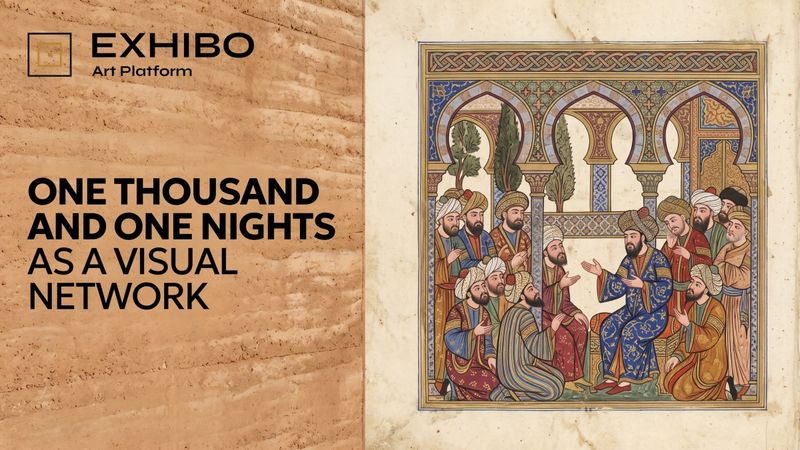
One Thousand and One Nights as a Visual Network
The book that taught Europe to picture the East arrived with no pictures at all. Three centuries of illustrators — Dutch, Egyptian, Persian, French, German, Iraqi — each gave it a face, and every face was a self-portrait.
Open Galland's Thousand and One Nights, the edition that conquered Europe, and there is nothing to look at: no genie, no lamp, not one illustration. The most visually imagined book in the world began blind — and because its text was never fixed either, no picture of it could ever be a copy.
Curating Tomorrow's Archive: Hamburger Kunsthalle Seeks Contemporary Collections Lead
A new permanent appointment will steer the museum's post-1960 holdings across paper, photography, and media formats.
The Hamburger Kunsthalle is inviting applications for a senior curatorial position focused on contemporary acquisitions, exhibition strategy, and digital collection management. Applications close October 2026 for a January 2027 start.