
Exhibo Editorial
Star Wars Filming Locations in Tunisia: The Complete Tatooine Travel Guide
Every Star Wars filming location in Tunisia, from the sand-swept Mos Espa set to the cave hotel where Luke grew up — with maps, tips and a 3-to-7-day route.
Tunisia is the real Tatooine. George Lucas filmed here across four films — the original A New Hope (1977) and the entire prequel trilogy, The Phantom Menace (1999), Attack of the Clones (2002) and Revenge of the Sith (2005) — using the country's deserts, salt flats and Berber villages to build the desert planet where both Luke and Anakin Skywalker grew up. The planet even takes its name from a real Tunisian town: Tataouine.
There's a nice historical irony in it: Lucas came to Tunisia in 1975 needing a world that didn't look like Earth, and southern Tunisia turned out to have one ready-made. Contrary to a common myth, most of the "Tatooine dunes" were shot in Tunisia, not Morocco — the very first image of the desert planet in A New Hope is Tunisian sand. Decades later, the country is still cast as an alien world; Denis Villeneuve's Dune films used the same southern deserts.
Most of the locations survive and can be visited today, though they're spread across a large area — the western desert around Tozeur and the cave-and-ksar country around Matmata, Tataouine and Djerba are 300–400 km apart, so no single base lets you see everything. This guide covers every major Star Wars site in Tunisia, exactly what was filmed at each, how to get there, which are eroding, and how to combine them into a 3-, 5- or 7-day trip.
Quick reference: every Star Wars location in Tunisia
| Location | Region | Appears in | What was filmed | What it is today |
|---|---|---|---|---|
| Mos Espa set (Ong Jmal) | Near Tozeur/Nefta | Episode I | Anakin's home town; podrace | Purpose-built set, eroding |
| Ong Jemal | Near Tozeur | Episode I | "Camel's neck" rock; Qui-Gon/Watto area | Rock formation, quad-tour stop |
| La Grande Dune (Nefta) | Near Nefta | Episodes I, IV, VI | Sarlacc Pit, Krayt Dragon, C-3PO landing, first desert shot | Open dune sea |
| Sidi Bouhlel ("Star Wars Canyon") | Near Tozeur | Episodes I & IV | Jawas capture R2-D2; Obi-Wan rescues Luke; podrace wide shots | Desert canyon |
| Chott el-Djerid | Near Tozeur/Nefta | Episodes IV, II | Lars homestead exterior dome; twin-suns sunset | Salt flat + rebuilt dome |
| Hotel Sidi Driss | Matmata | Episodes IV, II | Lars homestead interior (kitchen, courtyards) | Working cave hotel |
| Ksar Hadada | Near Ghomrassen | Episode I | Most Mos Espa slave-quarters streets; Qui-Gon & Shmi | Berber granary + hotel |
| Ksar Ouled Soltane | Near Tataouine | Episode I | Slave-quarters (intercut with Hadada) | Berber granary (best preserved) |
| Ksar Medenine (Ommarsia) | Medenine | Episode I | Anakin's arrival in the storm; Shmi's farewell | In-town ksar + Berber museum |
| Ajim | Djerba | Episode IV | Mos Eisley cantina exterior; street to the cantina | Working fishing port |
| Sidi Jmour | Djerba (coast) | Episode IV | Obi-Wan Kenobi's house; Anchorhead | Seaside marabout (shrine) |
Where is Tatooine? The name comes from Tataouine
Tatooine is named after Tataouine, a real town and governorate capital in southern Tunisia. Lucas's team was scouting and filming in the area, liked the name, and adapted it for the desert planet. The town itself sits in a region full of ksour (fortified Berber granaries), several of which appear on screen. So while "Tatooine" is fictional, the word — and much of the look — is pure southern Tunisia. Worth noting: Tataouine town isn't itself a filming location, but it's the gateway to the ksour that are, and its name is the reason the whole planet is called what it's called.
The Tozeur cluster: desert sets near the salt flats
The western desert around Tozeur holds the most iconic Star Wars scenery, and it's the easiest cluster to reach because Tozeur has its own airport with direct flights from Tunis.
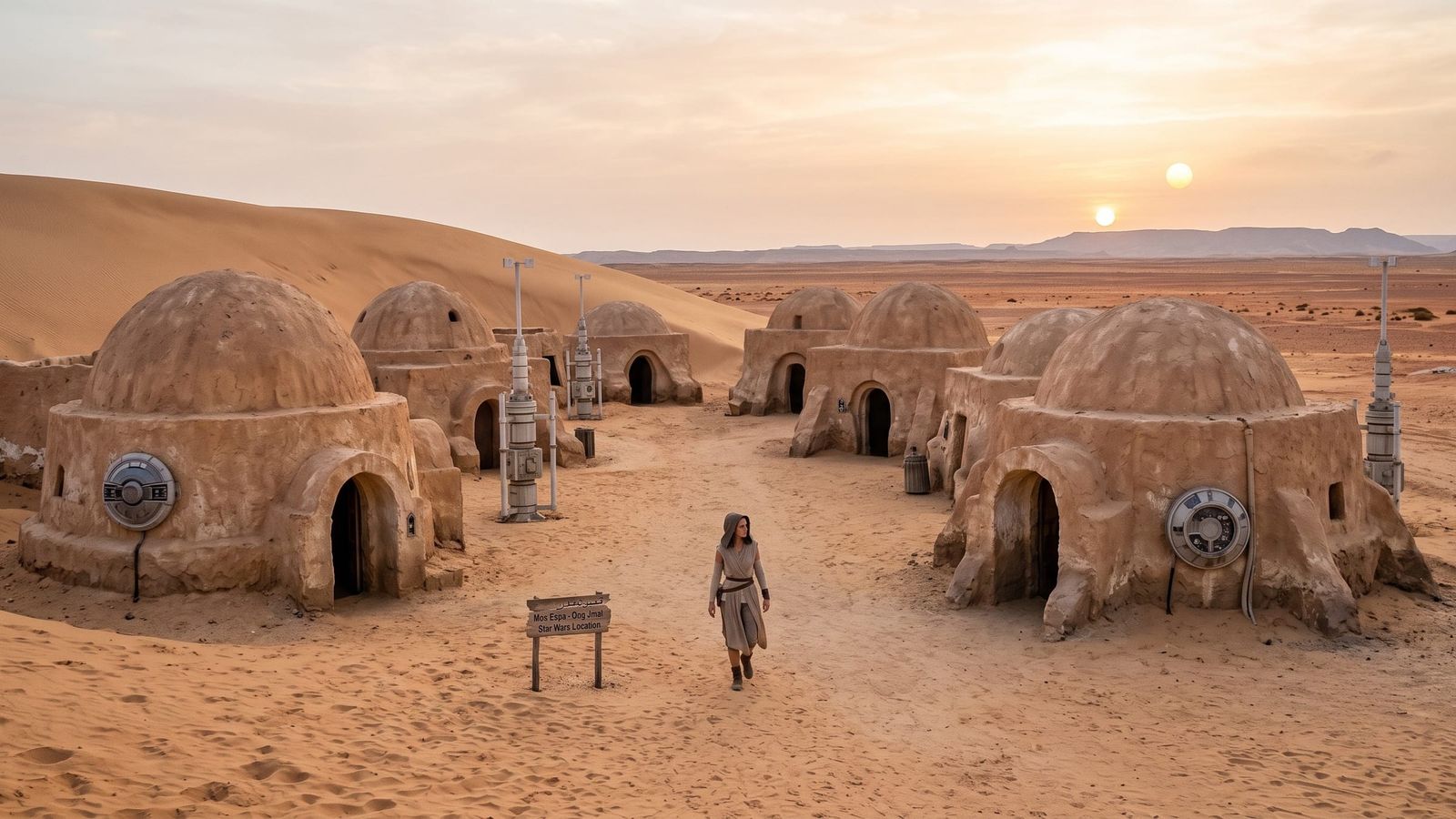
Mos Espa (Ong Jmal) — the main Star Wars set
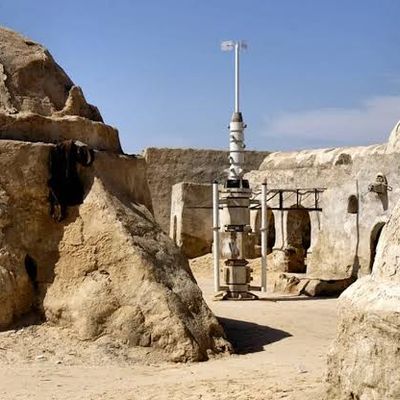
Mos Espa is the spaceport town where Anakin Skywalker lived in The Phantom Menace, and it's the single most recognisable Star Wars site in Tunisia. It was purpose-built in the late 1990s in the open desert near Ong Jmal, north of Tozeur and close to Nefta, and around twenty domed buildings still stand. You can walk the main street among the façades and moisture-vaporator props; a few souvenir stalls operate on site. This is the one location that was actually constructed for the films — everything else on this list is real Tunisian architecture or landscape that Lucas borrowed.
The catch: the set is slowly being buried by a moving sand dune, and periodic clearance only holds it back temporarily — no permanent restoration is being done, so it changes year to year, and one day the desert will win. Some see the encroaching sand as adding to the authentic Tatooine atmosphere. Visit as late in the day as possible for the best light and the smallest crowds.
- Getting there: 4×4 with driver or an organised desert tour from Tozeur (soft sand, no paved access).
- Combine with: Ong Jemal, La Grande Dune, Sidi Bouhlel and Chott el-Djerid — all within about 40 km of Tozeur.
Ong Jemal — the "camel's neck" rock
A short distance from the Mos Espa set, Ong Jemal is a large rock formation in the desert south of Chott el-Gharsa, named for a shape that resembles a camel's neck and head ("ong jmal" means roughly "camel's neck"). You can climb up onto it, and the surrounding area was used for scenes around Mos Espa in The Phantom Menace. It's a popular stop on a camel or quad tour from the Mos Espa set or from Tozeur, and gives you the sweeping dune backdrop fans recognise.
La Grande Dune (Nefta) — Sarlacc Pit and Krayt Dragon
The dunes near Nefta, sometimes called La Grande Dune, are where several unforgettable desert moments were shot. This area stood in for the Great Pit of Carkoon — the Sarlacc pit from Return of the Jedi — and it's where the Krayt Dragon skeleton lay and where C-3PO landed after the escape pod crash in A New Hope. The dunes here are pale, almost blonde, forming the clean undulations used for the film's wide desert shots; the very first image of the desert planet in A New Hope was filmed in this dune sea. It's open desert, reached by 4×4 from Tozeur.
Sidi Bouhlel — "Star Wars Canyon"
This narrow red-rock ravine near Tozeur is nicknamed "Star Wars Canyon," and it's one of the most identifiable locations for fans because so many A New Hope shots were filmed along its walls. This is where the Jawas capture R2-D2 after the two droids split up, and where Obi-Wan Kenobi rescues Luke from the Sand People at the foot of the cliffs. It was reused for wide desert shots in the prequels. A neat piece of trivia: the canyon's natural echo added so much reverberation that the dialogue recorded here had to be re-dubbed in the studio.
The canyon takes its real name from a nearby marabout (a shrine to a holy man). It wasn't only Star Wars, either — Sidi Bouhlel also appears in Raiders of the Lost Ark and The English Patient. It's about 30 minutes east of Tozeur toward Chott el-Djerid (look for the turn signed toward Dghoumes); the canyon is unmarked, so a guide or a driver who knows it helps. Reachable by car or 4×4; you walk in on foot from the parking area.
Chott el-Djerid — the Lars homestead dome (exterior)
Tunisia's vast salt lake, Chott el-Djerid, is where the exterior igloo-dome of the Lars homestead — Luke's home — sits, alone in the middle of the shimmering salt flat near Nefta. This is the spot where Luke gazes at the twin-suns sunset, one of the most famous images in cinema. Here's the trick most fans don't realise: the Lars homestead is two separate places 300 km apart. The domed exterior is here on Chott el-Djerid; the interior (the sunken kitchen and courtyards Luke walks down into) is at Hotel Sidi Driss in Matmata. Walk down the dome's steps in real life and you'd come out 300 km away.
The dome you see today was rebuilt by fans and has since been maintained, so it's relatively stable. Time your visit for late afternoon and you can watch a (single-sun) sunset from the exact spot. The salt lake itself is a spectacular stop, especially at sunrise.
Matmata: sleep in Luke Skywalker's home
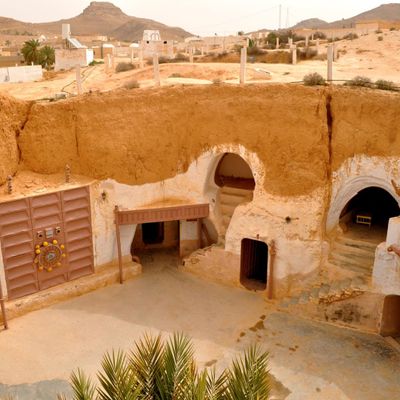
Matmata is a Berber village where houses are dug down into the ground: a deep pit is carved into the soft rock, with rooms hollowed out around a central courtyard. One of these underground homes, Hotel Sidi Driss, was used as the interior of the Lars homestead in A New Hope and again in Attack of the Clones — the sunken dining room and courtyards where Luke lives with his aunt and uncle. (Remember the "one homestead, two deserts" trick: the domed exterior is 300 km away on Chott el-Djerid.)
It still operates as a hotel and café. You can stay overnight in the actual set rooms, or visit as a day guest for a small charge, and some of the film's set decoration survives on the walls, alongside photos of the filming and memorabilia. It's a working, lived-in place rather than a preserved museum, which is part of the charm. Matmata is roughly four hours by road east of Tozeur (about 100 km / 1h20 from Djerba), making it a natural base or stop on a longer southern loop. The wider Matmata landscape, incidentally, was part of what inspired the lunar-desert look of the films.
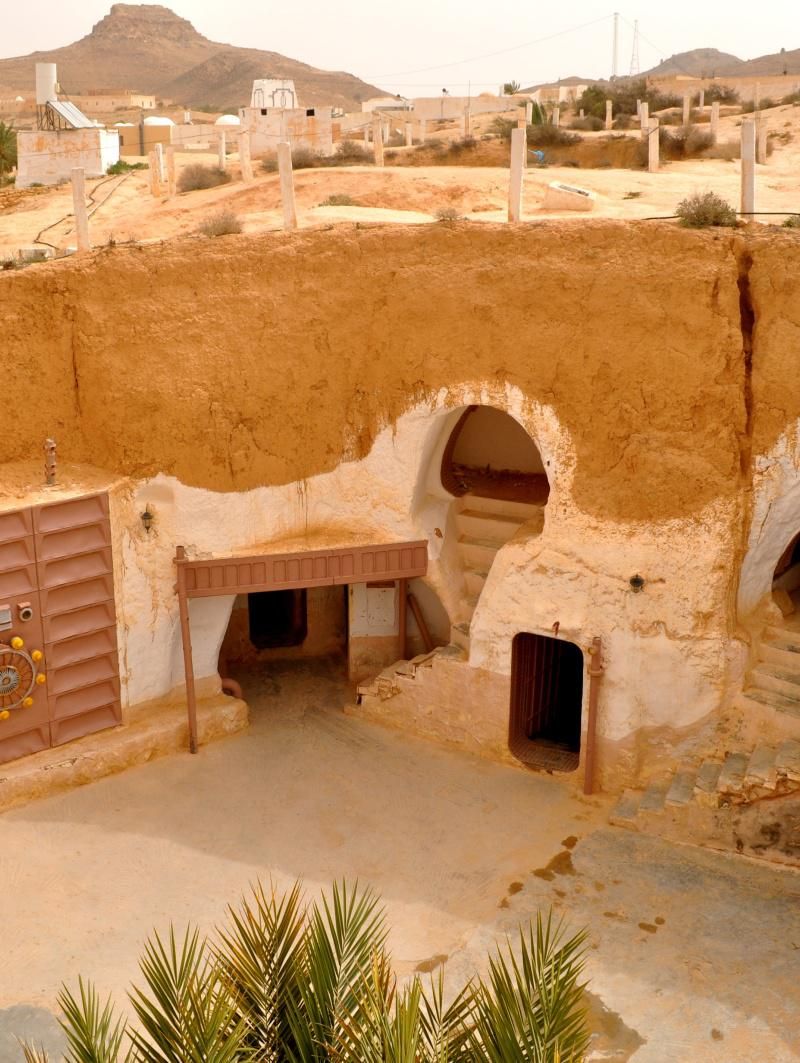
Hotel Sidi Driss, Matmata
A troglodyte pit-dwelling that became Luke Skywalker's childhood home — and is still a working hotel.
The point Exhibo would draw out is that Lucas designed none of this. He found a form of Amazigh architecture refined over generations and pointed a camera at it. Matmata carries a harder history too — modernisation-era resettlement in the 1960s, and underground homes reportedly used to shelter resistance fighters under French rule — beneath the science-fiction surface most visitors arrive for.
The ksour near Tataouine and Medenine: the Mos Espa slave quarters
South of Matmata, the landscape fills with ksour — hilltop Berber granaries made of stacked, vaulted mud-brick cells called ghorfas, built to store grain and protect it from raiders. Several of them played the slave quarters of Mos Espa, Anakin's home district, in The Phantom Menace, and they're worth visiting for the architecture alone — genuine five-century-old Amazigh engineering that reads, on screen, as a frontier settlement on a distant planet.
Ksar Hadada
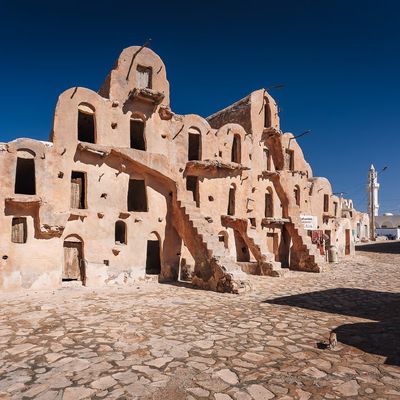
Near Ghomrassen, Ksar Hadada is where most of the Mos Espa slave-quarters street scenes were filmed — including the scene where Qui-Gon Jinn talks with Anakin's mother, Shmi, while the boy works on his podracer. It's now a modest hotel with a café; non-guests can enter for a token fee (around 2 TND), wander the vaulted alleyways and climb the stairs. A few posters and leftover set pieces mark the scenes, and you can stay overnight in the converted ghorfa rooms.
Ksar Ouled Soltane
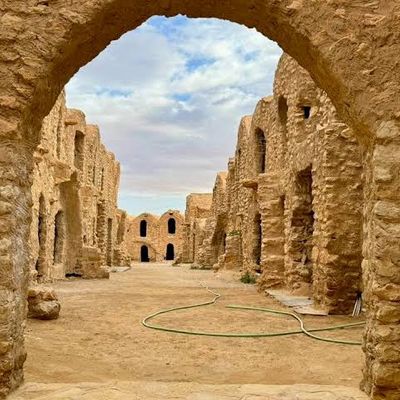
Near Tataouine town, Ksar Ouled Soltane is the best-preserved and most photogenic ksar in Tunisia — four storeys of honeycombed ghorfas around two courtyards, the older of which dates to around 1699. It's intercut with Ksar Hadada in the films' slave-quarter sequences. Even setting Star Wars aside, it's one of the finest examples of Berber granary architecture anywhere, and still relatively untouristed.
Ksar Medenine (Ksar Ommarsia)
In the town of Medenine sits another ksar used in The Phantom Menace — often called Ksar Ommarsia. Two scenes were shot here: Anakin's arrival in the sandstorm, and the emotional farewell where Shmi watches her son leave with Qui-Gon Jinn. The ksar in the middle of town is fairly run-down and has less of a "set" feel than Matmata — here it's more about the architecture and scale, with the Star Wars link sitting quietly alongside the buildings' original purpose. There's also a small Berber ethnographic museum inside the ksar. It's the kind of stop where an exact map pin helps, as it isn't heavily signed.
Chenini and Douiret (the inspiration, not a set)
Worth a mention because tours often include them: the dramatic hilltop Berber villages of Chenini and Douiret, near Tataouine, weren't filming locations, but they're the living landscape of ghorfas, white mosques and troglodyte homes that shaped the Tatooine look. Chenini is one of the last still-inhabited ksour, and some converted cave dwellings there operate as guesthouses. If you're doing the southern loop, they add real context to the built sets.
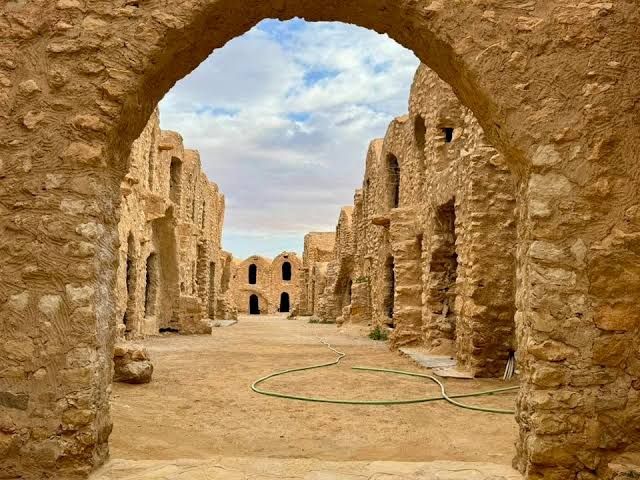
Ksar Hadada
A Berber granary-turned-hotel that played the main slave-quarters streets of Mos Espa.
Where Ksar Ouled Soltane is the best-preserved and most photogenic ksar, Hadada is where most of the actual filming happened — the two are intercut on screen. Both are, first and last, Amazigh granary architecture: engineered to keep grain cool and safe from raiders, and expressive enough that a film crew needed to change almost nothing.
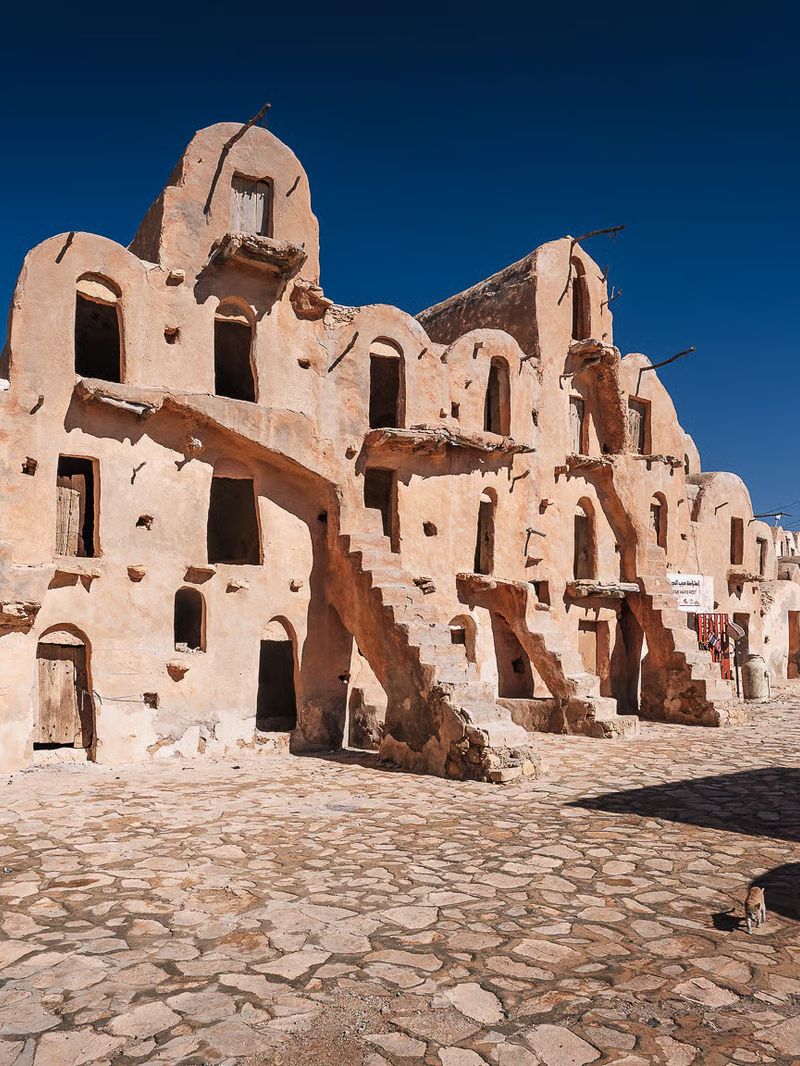
Ksar Ouled Soltane, Tataouine
A fortified Berber granary of honeycombed vaults — mud-brick architecture that reads like another planet.
Ksar Ouled Soltane sits at the heart of an inversion Exhibo finds worth naming: the vernacular architecture of the Arab world's deserts is forever cast as science fiction precisely because outsiders don't recognise it as history. This is a five-century-old feat of Amazigh desert engineering — not a film set — and one stop on a southern-Tunisian circuit that runs from the pit-houses of Matmata to the street-art walls of Djerbahood on Djerba.
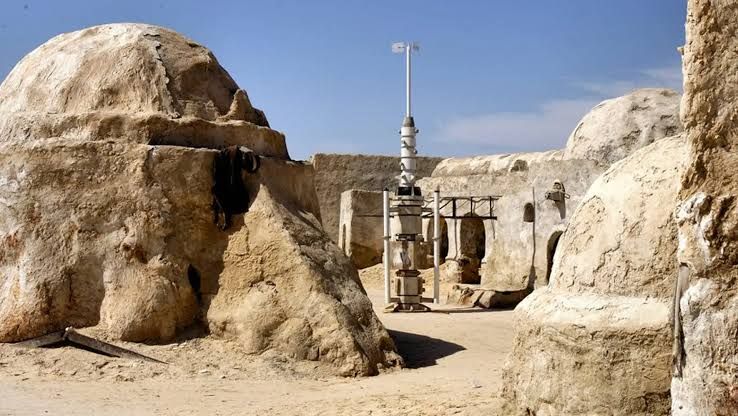
Mos Espa Film Set, Ong Jmal
A purpose-built Star Wars town in the sand near Tozeur — and a reference point for real dune science.
A set built to fake an alien desert became a calibration tool for measuring real ones — the same scientists study barchans on Mars. It is a monument to a fictional desert being swallowed by a real one, on a timetable science can predict. A 2014 "Save Mos Espa" campaign clears the sand periodically; officials admit it only buys the set a few more years.
Djerba: Mos Eisley and Obi-Wan's house
The island of Djerba hosted three Star Wars locations, all for A New Hope, and it's the easiest cluster to visit because the island is flat and fully paved — a normal hire car or a taxi is fine.
Ajim — Mos Eisley
The port town of Ajim, on Djerba's south-western coast about 20 km from the island capital Houmt Souk, stood in for the streets of Mos Eisley — the spaceport Obi-Wan famously calls "a wretched hive of scum and villainy." The cantina exterior was filmed here, along with the street Luke and Obi-Wan walk down to reach it, before the famous cantina scene (the interior was a studio set back in England). Ajim is a working fishing port, not a preserved set, but the whitewashed, flat-roofed buildings and narrow lanes are still recognisable, and fans track down the exact camera angles — including the spot associated with the cut "Tosche Station" material. There's no ticket; you simply walk the streets.
Sidi Jmour — Obi-Wan Kenobi's house
About 10 km north of Ajim, on a rocky promontory over the Mediterranean, the small white marabout (shrine) of Sidi Jmour became Obi-Wan Kenobi's isolated home on the edge of Mos Eisley — the hermit's hut where Luke and Obi-Wan head before going into town. The location doubled for Anchorhead as well. It's remarkably intact: the rocky rise, the sandy path, the sea beyond — every camera angle is still identifiable, and the perfect isolation is exactly why the art directors chose it for a Jedi's retreat. There's even a mosaic of Obi-Wan Kenobi on the side of the building, created by the French street artist Invader (of Space Invader fame) — a neat link to Djerba's wider street-art scene. It's about 15 minutes from Ajim or 40 minutes from Houmt Souk by car, and it's a free, quiet, still-sacred spot, so visit respectfully.
Djerba beyond Star Wars
Djerba is worth a day in its own right. The whole island was inscribed as a UNESCO World Heritage Site in 2023 for its centuries of Muslim, Jewish and Christian coexistence, and the village of Erriadh hosts Djerbahood, an open-air street-art museum of 300-plus murals by artists from around the world — the same Invader who mosaicked Obi-Wan's house took part. Erriadh also holds the El Ghriba synagogue, traditionally the oldest in Africa. It's a rewarding, and thematically fitting, non-Star-Wars stop to round out the trip.
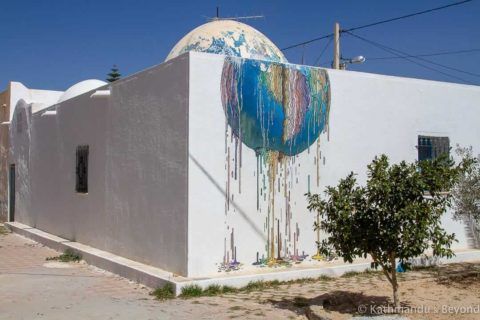
Djerbahood, Erriadh
An open-air street-art museum painted onto a Djerban village where three faiths have lived together for centuries.
This is the article's Exhibo core: contemporary art written directly onto a two-thousand-year-old wall. Djerbahood matters not as a photo-op but as working cultural infrastructure — a growing, curated street-art museum sustaining a real village's economy, born of the creative energy that followed Tunisia's 2011 revolution.
Distances and how the trip actually works
The single most important thing to grasp before planning: the Star Wars sites fall into two clusters about 300–400 km apart, and no single base lets you day-trip both.
- The Tozeur cluster (western desert): Mos Espa, Ong Jemal, La Grande Dune, Sidi Bouhlel and Chott el-Djerid — all within roughly 40 km of Tozeur. This is the iconic scenery, and Tozeur has its own airport with direct flights from Tunis.
- The Matmata / Tataouine / Djerba cluster (cave houses, ksour and towns): Hotel Sidi Driss, the ksour, Ajim and Sidi Jmour. Most package travellers reach these from Djerba, which also has an airport (Djerba-Zarzis).
Between them lies a transfer of several hours. Matmata is about four hours from Tozeur, but only ~100 km (1h20) from Djerba. The Ajim–Djerba mainland crossing is by a short, frequent ferry (free for foot passengers, a small charge for cars). So the efficient shape of a full trip is a loop: fly into one airport, work through that cluster, transfer across, do the other cluster, fly out of the second airport — rather than backtracking.
How many days do you need?
You can tailor the trip to how much time you have. Realistically, doing everything well takes about five days.
- 3 days (Tozeur cluster): Fly Tunis–Tozeur. Base in Tozeur for two nights and take a 4×4 with driver to cover Mos Espa, Ong Jemal, La Grande Dune, Sidi Bouhlel and Chott el-Djerid. This gets you the headline desert scenery — the sets, the canyon and the twin-suns dome.
- 5 days (+ Matmata & the ksour): Add the drive east to Matmata (sleep at Hotel Sidi Driss for the full effect), then loop the southern ksour — Ksar Hadada, Ksar Ouled Soltane and Ksar Medenine — with Chenini for context.
- 7 days (+ Djerba): Finish on Djerba for Ajim (Mos Eisley), Sidi Jmour (Obi-Wan's house) and Djerbahood, before flying home from Djerba-Zarzis.
Rough costs: Organised multi-day tours covering the main sites start around US$140 per person for a 2-day group tour from Tunis; a private tour with a dedicated guide and 4×4 runs closer to US$400+ per person for two days. Self-guided visits to the accessible sites (Matmata, the ksour, Ajim, Sidi Jmour) are free or nearly free — you're mainly paying for transport.
Practical tips for visiting
- Best time to go: October to April for comfortable temperatures. Spring (March–April) and autumn (October–November) are ideal, with warm days around 25–30°C. Avoid June–September, when desert sites like Mos Espa and Ong Jemal regularly exceed 40°C.
- Time of day: Early morning or late afternoon — better light, cooler, fewer tour groups. Mos Espa in particular is best late in the day.
- Getting around: A normal hire car covers the villages, ksour and all of Djerba (flat and paved). The open-desert sets near Tozeur — Mos Espa, Ong Jemal, La Grande Dune, Sidi Bouhlel — need a 4×4 or an organised tour, because of soft sand and unmarked approaches.
- Guides: For the desert cluster, a local driver-guide is the easiest way to link the sites and avoid getting stuck in the sand; several sites (Sidi Bouhlel especially) are unsigned.
- Cost: Most sites are free or charge only a small entry fee (Ksar Hadada around 2 TND, for instance).
- Respect: Sidi Jmour is a working shrine and the villages are people's homes, not theme parks — visit accordingly.
Frequently asked questions
Was Star Wars really filmed in Tunisia?
Yes. Tunisia was a filming location for A New Hope (1977) and all three prequels (1999–2005), primarily for scenes set on the planet Tatooine.
Is the planet Tatooine named after Tataouine in Tunisia?
Yes — the name is widely understood to come from the Tunisian town of Tataouine, in the country's south, near several of the filming locations.
Can you still visit the Mos Espa set?
Yes, the Mos Espa set at Ong Jmal near Tozeur is still standing and open to visitors, though a shifting sand dune is gradually encroaching on it.
Can you stay in Luke Skywalker's house?
Yes. The interior of the Lars homestead is Hotel Sidi Driss in Matmata, a working troglodyte hotel where you can book a room in the original set.
Where was Mos Eisley filmed?
Mos Eisley scenes were shot in the port town of Ajim on the island of Djerba.
Do I need a 4×4?
For the open-desert sets near Tozeur (Mos Espa, Ong Jemal, La Grande Dune, Sidi Bouhlel), yes — or join an organised tour. The Berber villages, ksour and all of Djerba are reachable by ordinary car.
Was the Lars homestead one place?
No — it's two, about 300 km apart. The domed exterior with the twin-suns sunset is on the Chott el-Djerid salt flat near Tozeur; the interior (kitchen and courtyards) is Hotel Sidi Driss in Matmata.
Where was the Sarlacc pit filmed?
The Great Pit of Carkoon (the Sarlacc) and the Krayt Dragon skeleton were shot in the dunes near Nefta, sometimes called La Grande Dune, west of Tozeur.
Where is Obi-Wan Kenobi's house in Tunisia?
It's the Sidi Jmour marabout, a small seaside shrine about 10 km north of Ajim on Djerba. It still bears a mosaic of Obi-Wan by the street artist Invader.
Were the Tatooine desert scenes filmed in Morocco?
Mostly no. Despite a common belief, the majority of the Tatooine dune shots — including the first desert image in A New Hope — were filmed in Tunisia, around Nefta and Tozeur.
Can you visit all the Star Wars sites from one base?
No. The sites split into two clusters (Tozeur, and Matmata/Tataouine/Djerba) about 300–400 km apart, so you need at least two bases and a transfer day, or an organised multi-day loop.
Galleries mentioned
Museums mentioned
Places mentioned
Related reading
Gladiator and Game of Thrones: Inside Aït Benhaddou
The earthen ksar that has played Rome, Jerusalem and Yunkai survives only because people keep rebuilding it. What cinema films as eternity is, wall by wall, a work of constant repair.
Nasreddin: The Trickster Everyone Claims
A padlocked gate with no walls, two rival graves, and stories told among two dozen peoples: how the wise fool of the Islamic world became a shape every culture fills with itself.
Sharjah Biennial 17 Unveils Curatorial Vision and Opening Schedule
Angela Harutyunyan and Paula Nascimento frame the 2027 edition around archival residue and spatial memory