
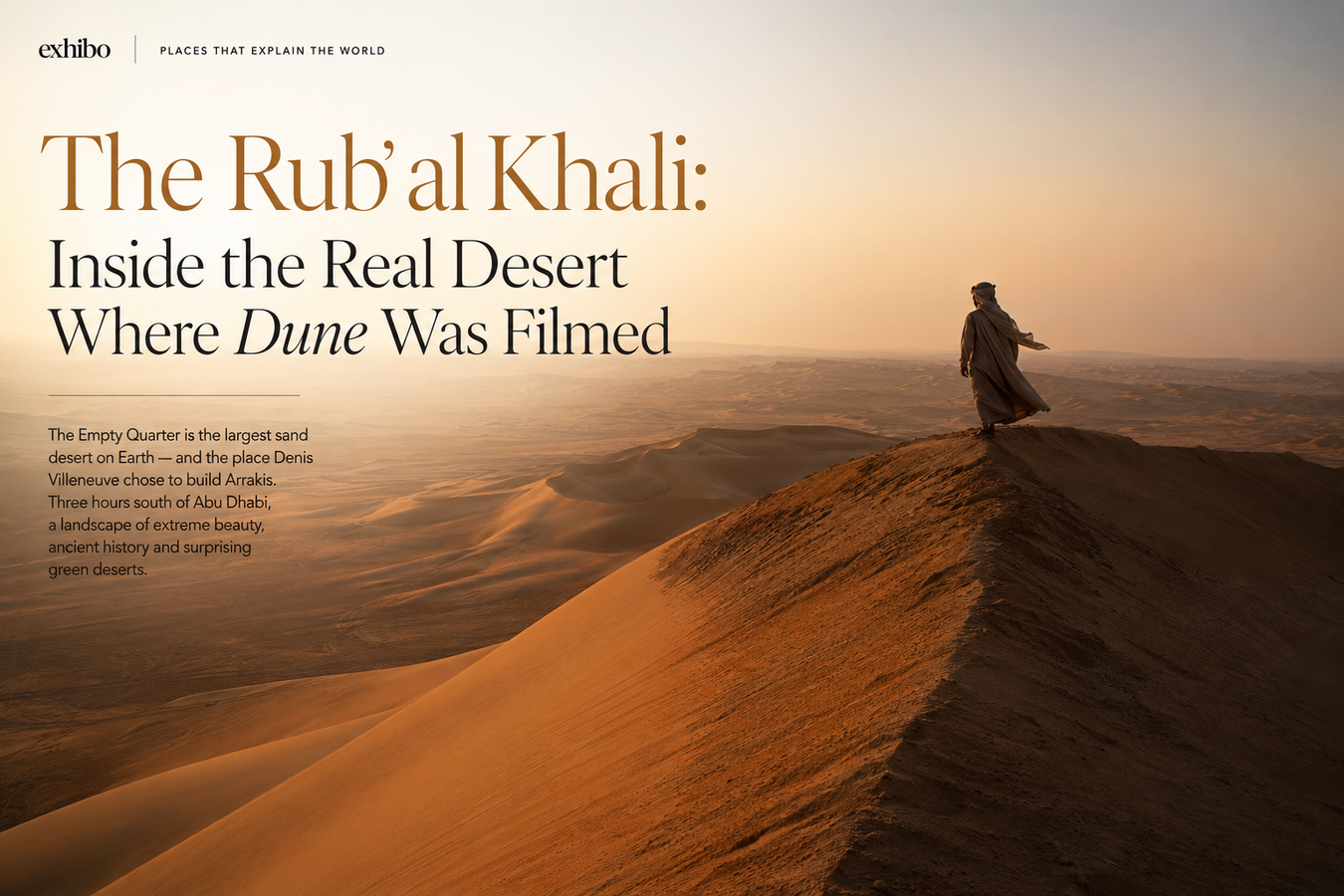
Abu Dhabi · United Arab Emirates
The Rub' al Khali: Inside the Real Desert Where Dune Was Filmed
How the Liwa desert — the Empty Quarter's northern edge, and the real Arrakis — became one of the most filmed, least understood landscapes on Earth.
Roughly three hours south of Abu Dhabi, the tarmac gives out at a junction town called Muzayri', and the last thing that behaves like infrastructure is a fork in the road. Take either branch and within twenty minutes the dunes have closed over everything. No skyline, no roadside, no horizon that isn't sand meeting sky. This is Liwa, the oasis crescent on the northern lip of the Rub' al Khali — the Empty Quarter — and it is where Denis Villeneuve pointed his cameras to build the planet Arrakis.
Most people who search for the Dune filming location get pointed at Wadi Rum in Jordan, and they're half right. Villeneuve used both. But the endless, unbroken sand — the shots that made audiences feel the scale of a desert planet — those were filmed here. Villeneuve shot in Liwa across all three films; for Part Three, the desert exteriors were filmed exclusively in Abu Dhabi, with the Abu Dhabi Film Commission confirming the emirate as the on-screen home of Arrakis. The director has been open about why: in a behind-the-scenes interview he described choosing Liwa as Arrakis's double for the quality of its dunes, later shooting even in summer to catch the diffused light and the atmospheric haze off the sand.
Wadi Rum gave him sandstone — cliffs, arches, monumental rock to frame a shot against. Liwa gave him the opposite: almost nothing but sand, no landmark to hold onto, the horizon doing the work. On a planet meant to feel like it could swallow a person whole, the absence is the point.
Where is the Rub' al Khali, and how big is it really
The Empty Quarter sits across the southern third of the Arabian Peninsula, spilling over four countries: Saudi Arabia holds the bulk of it, with the rest shared by Oman, Yemen, and the United Arab Emirates. Liwa is its Emirati edge.
The size is where it stops being a place and starts being a statistic that doesn't quite fit in the head. The commonly cited figure is around 650,000 square kilometres; NASA, measuring more conservatively, puts it closer to 583,000. Either way, unlike the Sahara — which breaks itself up with gravel plains and rocky outcrops — the Rub' al Khali is sand and then more sand. That makes it the largest erg, or continuous sand sea, on the planet. Guinness lists it under exactly that title.
Roughly a thousand kilometres long, five hundred wide. A quarter of the Arabian Peninsula. Fewer than three centimetres of rain in an average year, and some years not a single drop falls anywhere in it. Recorded highs near 51°C. These are not numbers you argue with. They're the operating conditions.
The dunes, and why the sand is that colour
The dunes here run to 250 metres, with individual massifs pushing 300 — tall enough that the linear ridges sprout secondary dunes of their own, crescent-shaped barchans splattered across the backs of the long ones. Between them lie sabkhas, the salt flats of ancient lakebeds, some hard enough to drive across and some that turn to squelch the moment your weight arrives.
Just south of Liwa stands Tal Moreeb — "the Terrifying Mountain" — about 300 metres of sand at a fifty-degree slope, one of the great hill-climbs on Earth, and the site of an annual festival where people drive quad bikes and buggies straight up it for sport.
And the colour — that red-gold that every frame of Dune leans on — isn't a grading trick. The grains here carry iron-oxide coatings, and the tone shifts across the day as the light angle changes: flat and pale at noon, molten at the two ends of it. Villeneuve's cinematographer didn't invent the palette of Arrakis. He showed up at the right hour and let the desert hand it over.
The green desert underneath: what the sand is hiding
Here is the fact that reorganises everything else. The Empty Quarter has not always been empty. It has not always even been desert.
Under the sabkhas lie the beds of real lakes. During wet phases driven by intensified monsoons — one around 130,000 to 70,000 years ago, another in the early Holocene roughly 11,000 to 5,000 years ago — large freshwater lakes stood across this basin. At the Mundafan palaeolake in the Saudi stretch of the Rub' al Khali, archaeologists working the old shorelines have recovered Middle Palaeolithic and Neolithic tools, ostrich-eggshell fragments and animal bone, evidence of people repeatedly moving into the desert whenever it turned green. Related luminescence work places some human presence in the region at around 100,000 to 80,000 years ago — part of the case rewriting how and when Homo sapiens first moved out through Asia.
People came into this desert whenever it stopped being one. Then the lakes dried, the monsoon retreated, and the sand came back over the top and kept the receipts.
Sit with that against the plot Frank Herbert wrote. Arrakis is a desert planet whose native people are secretly, patiently terraforming it back toward water. Herbert's known sources were elsewhere — the shifting Oregon Dunes he first went to write about, the ecological reading he did around them — and there's no record of the Rub' al Khali among them. But the parallel is hard to unsee: a desert that has been water before, and carries the proof in gypsum and diatomite a few metres down. Whether Villeneuve knew it or not, he set his terraforming fable on a real desert that has done the thing the Fremen dream of.
Liwa is where the country started
The Rub' al Khali reads as the definition of nowhere. Liwa is the opposite: it's an origin point, and specifically the origin of the state that now runs the place.
Liwa was the historic heartland of the Bani Yas, the tribal confederation whose ruling line, the Al Nahyan, governs Abu Dhabi to this day. The oasis had what the coast didn't — sweet-water wells and date-palm groves — and archaeological evidence places the Bani Yas here from at least the fourteenth century, predating the earliest written mention of them, on a Turkish map of 1559. Life ran on a seasonal loop that tells you exactly what this landscape demanded: in summer the men went to the coast to dive for pearls, and in winter they came home to Liwa to tend the dates.
Then, in 1761, a hunting party sent out from Liwa tracked a gazelle to a brackish spring on an island off the coast. Fresh water. A settlement followed, and by 1793 the centre of power had shifted there permanently. That island is Abu Dhabi. The capital of the United Arab Emirates traces back to a gazelle, a spring, and a party that set out from these dunes.
Liwa never stopped mattering because of it. Even after power moved to the coast, the oasis remained the tribe's spiritual and cultural anchor, a place its leaders returned to, and it still reads that way to Emiratis today — the setting of the annual Liwa Date Festival, of weekend drives out to the dunes, of a national origin story people can point to on a map. Which is why filming Dune here was never going to be a quiet logistical arrangement. When Villeneuve's crew set up in the sand, they were working on the ancestral ground of the country's ruling family, with the Abu Dhabi Film Commission, the Creative Media Authority, and Image Nation behind them. The desert that plays a planet at the far edge of the galaxy is, on the map, the place the nation came from.
The explorers who crossed it, and the book that made it famous
Before it was a film set, the Empty Quarter was the last great prize of European desert exploration — the blank on the outsiders' maps where the caption read border undefined, and for a stretch of the twentieth century a small number of Europeans nearly came to blows over who would be first across it. First, that is, by their own reckoning. The Bedu had known these sands for centuries: where the water was, which passes stayed open, how the seasons moved a caravan through country that looks blank only to someone who can't read it. The crossings that made headlines in London were retraced from knowledge that was already old.
Bertram Thomas took it in the winter of 1930–31, from Dhofar to Doha in fifty-nine days, and landed on the front page of the New York Times. Harry St John Philby, adviser to the Saudi king and desperate to be first, learned he'd been beaten and reportedly shut himself away for a week in a fury before making his own crossing in 1932.
But the name that stuck to this desert belongs to Wilfred Thesiger, who wasn't first and didn't care. Attached to a locust-control unit after the war, Thesiger crossed the Rub' al Khali twice between 1946 and 1948 — and his second crossing ran straight through Liwa and on to Abu Dhabi, the exact ground Villeneuve would film seventy-odd years later. He walked barefoot. He rationed himself to two pints of water a day. He called the Empty Quarter the greatest prize of Arabian exploration, and the book he made from it, Arabian Sands (1959), is still the thing you read before you go.
Thesiger never pretended he'd done it alone. He couldn't have. The Bedu had been crossing and re-crossing this sand for thousands of years before any European arrived to be impressed by it, and he said as much: they notice everything, they forget nothing, and their judgment of an outsider is merciless. The explorers got the headlines. The guides got them home.
The desert as a canvas: art that has claimed the Rub' al Khali
Long before a film crew arrived, artists had already worked out what Villeneuve later confirmed with a camera — that this particular emptiness does something to scale, to the human figure, to the sense of where a made thing ends and the land begins. The Rub' al Khali doesn't sit for a portrait so much as it swallows one. That is exactly what keeps drawing artists to it.
The most audacious attempt to answer the desert on its own scale belongs to Christo and Jeanne-Claude. In 1977 they conceived The Mastaba — a flat-topped trapezoid built from 410,000 stacked steel barrels, their painted lids forming a mosaic the artists compared to Islamic tilework — and they chose Liwa as its site. The numbers stay hard to hold: 150 metres high, taller than the Great Pyramid of Giza, planned for the desert roughly 160 kilometres south of Abu Dhabi. It would be the couple's only permanent large-scale work anywhere on Earth, and their last. The colours were fixed in 1979, the year they first visited the Emirates. Nearly half a century on, it still hasn't been built. As of early 2026, the project remains stalled — caught between missing government approvals and instability across the wider region — which leaves it in a strange limbo: the largest sculpture never made, waiting in the one place vast enough to absorb it.
That impulse — to meet the desert with something monumental and temporary at once — runs through the region's recent land art. For Desert X AlUla, the Saudi biennial that turns an ancient desert valley into a walk-through gallery, and then for Abu Dhabi's own Manar Abu Dhabi in 2023, the American land artist Jim Denevan hand-formed 448 sand pyramids into nineteen concentric rings spanning almost a square kilometre — a mandala begun with a single circle drawn in the sand with a stick. It was built to erode. Over the months it stood, the wind reworked it, plants took root, and a desert fox moved into one of the mounds; the artwork quietly became landscape again, which was the point.
The Emirati response to the same terrain has tended to be quieter and more intimate. The painter Mahboob Al Awadhi has spent a career in oils on the country's overlooked natural world — the mangroves, the iron-coloured mountains, and above all the windswept dunes of Liwa, painted not as the camera sees them but as they feel to stand before. His work is a deliberate correction: a reminder that beneath the skyline the country is best known for lies a landscape that shaped Bedouin life for centuries, and shapes an Emirati sense of self still.
And then there is the photography, which is where this desert has arguably found its truest medium. The Empty Quarter mostly escaped the nineteenth-century Orientalist painters — it was too remote, too blank, a region their canvases of North African markets and oases never reached. It has been photographed plenty since, from the air and by surveyors, but its fine-art image is a newer and thinner tradition, built first in prose and the documentary camera — Thesiger's stark black-and-white plates in Arabian Sands — and only recently in large-format landscape work like Andrew Prokos's Dunescapes, which chases the way the Liwa dunes shift from pale gold at dawn to salmon-pink and finally deep reddish-orange at sunset. Which is worth sitting with. As a subject for art made to be looked at, this desert is still being discovered — and Villeneuve's Arrakis is now part of that, the largest audience this sand has ever had, looking at a place most of them will never learn the real name of.
Can you actually visit the Dune desert?
Yes — Liwa is the accessible face of the least accessible desert on Earth, which is a strange and useful thing to be.
From Abu Dhabi it's a drivable day trip, three hours or so to Muzayri', and from there the oasis fans out into palm farms, small holdings, and the dunes rising behind them. Tour operators run dune drives, overnight desert camps, and trips out to Tal Moreeb. There's a luxury resort tucked into the sand for people who want Thesiger's view without Thesiger's water ration. The Moreeb Dune Festival draws crowds in season for the hill-climbs and the camel racing.
Go at the two ends of the day. Not for comfort, though noon out here earns its reputation — but because that red-gold, the one the whole look of Arrakis was built on, only shows up when the sun is low and the iron in the sand catches it. Stand at the base of a dune the height of a skyscraper, with no sound and no edge to the world in any direction, and the thing the films spent a fortune trying to manufacture is simply there, doing what it has done for longer than there have been films or nations to film in it.
Which is maybe the truest thing to say about the place. Villeneuve didn't have to build Arrakis so much as agree with it. The Rub' al Khali already reads like another planet — three hours south of a capital city that this same desert, in the end, produced.
Sources and further reading
Filming
- Abu Dhabi Film Commission, Dune: Part Two returns to the Liwa desert
- Variety, Villeneuve on choosing Liwa as Arrakis's double
- The National, Dune: Part Three filmed its desert exteriors exclusively in Abu Dhabi
Geography and science
- NASA Earth Observatory, The Empty Quarter
- Encyclopædia Britannica, Rub' al-Khali
- Crassard, Petraglia et al., Middle Palaeolithic and Neolithic Occupations around Mundafan Palaeolake, PLOS ONE (2013)
- Groucutt et al., Human occupation of the Arabian Empty Quarter during MIS 5, Quaternary Science Reviews (2015)
History and heritage
- Cultural Heritage Resources in Abu Dhabi Emirate (2009), on Bani Yas settlement and the Liwa forts
- Experience Abu Dhabi (DCT Abu Dhabi), on Liwa, the Bani Yas and the founding of Abu Dhabi
- Royal Geographical Society, Wilfred Thesiger
Art
- Christo and Jeanne-Claude Foundation, The Mastaba (Project for Abu Dhabi)
- Domus, The Mastaba's stalled status (2026)
- My Modern Met, Jim Denevan, Self-Similar, Manar Abu Dhabi
- Desert X, Desert X AlUla 2022
- Andrew Prokos, Dunescapes: photographing the Liwa Desert
Getting there: Liwa is approximately 250 km southwest of Abu Dhabi city, reachable by car or bus via Muzayri'. Best visited November through March; go early morning or late afternoon for the light. Liwa itself is open and accessible; access rules for the deeper desert vary by country and route, so check locally before heading further in.
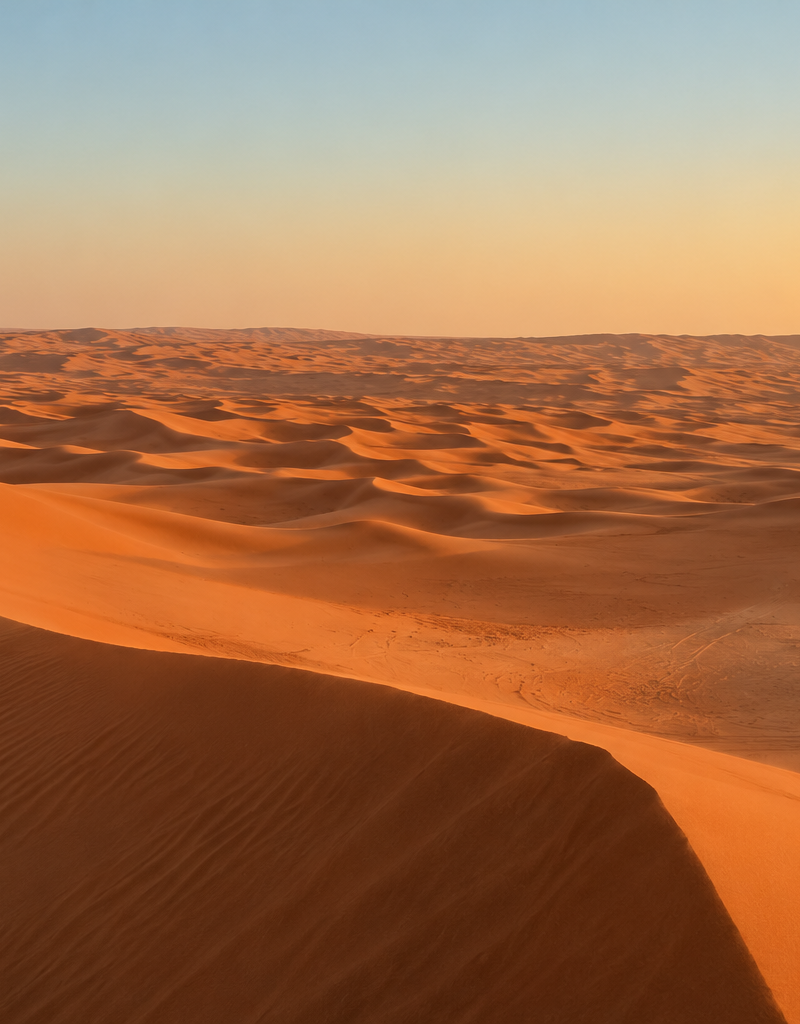
The Liwa Desert
The northern edge of the Rub' al Khali — the largest continuous sand sea on Earth.
<p>Few landscapes carry as many layers as this one. The Liwa desert is at once a geological record — a sand sea that has been freshwater lake more than once in deep time — a national origin story, and, increasingly, a subject for art in its own right: from Christo and Jeanne-Claude's unbuilt <em>Mastaba</em>, conceived for these dunes, to the films and photographers drawn to match its scale. Exhibo lists Liwa not as a gallery but as a place where landscape and image meet — the kind of context the region's art world is built on.</p>
Related reading
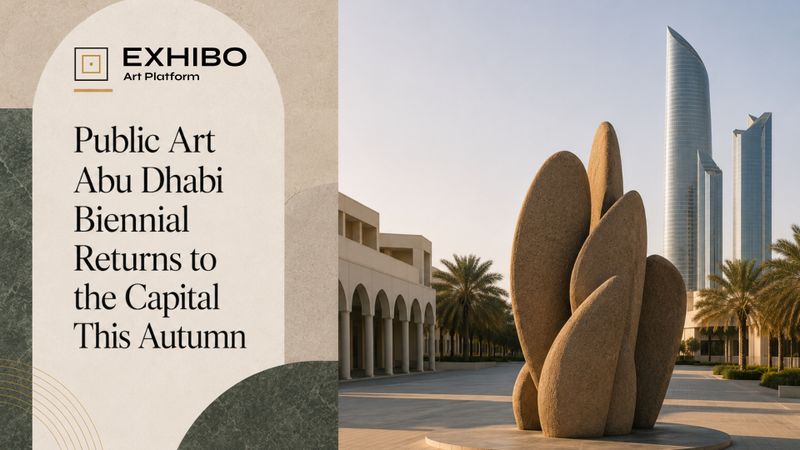
Public Art Abu Dhabi Biennial Returns to the Capital This Autumn
The second edition of the emirate-wide public art event opens in Al Ain in October and Abu Dhabi in November, led by former MACBA director Elvira Dyangani Ose under the theme "Home: A Glossary for a Communal Sense of Place."
The second edition of the Public Art Abu Dhabi Biennial opens in Al Ain on 23 October 2026 and in the capital on 15 November, running into February 2027. Curated by former MACBA director Elvira Dyangani Ose under the theme "Home: A Glossary for a Communal Sense of Place," the free, citywide programme builds on the acclaimed inaugural edition, several of whose works have since become permanent public installations.
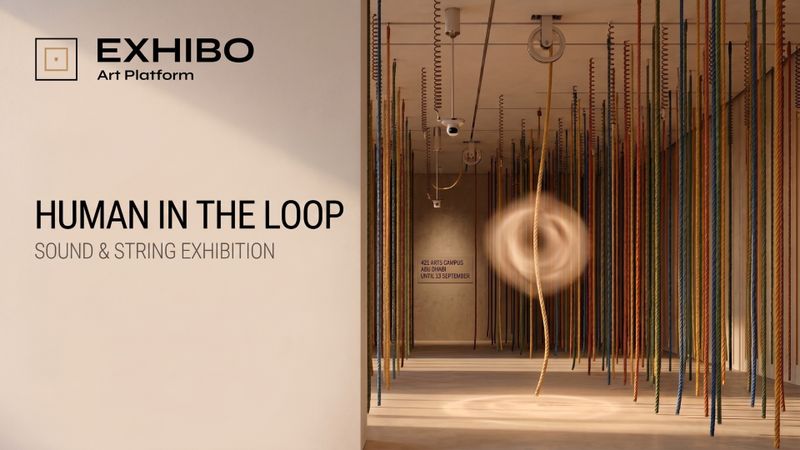
Human in the Loop: A New Sound-and-String Exhibition Opens in Abu Dhabi
At 421 Arts Campus, Emirati robotics engineer Dr Ahmad AlAttar turns the gallery into a field of sound and strings you have to play — his first institutional solo show, on until 13 September.
A field of coloured ropes hangs from the ceiling at 421 Arts Campus, each one wired to respond to touch with sound. Human in the Loop, the first institutional solo show by Emirati robotics engineer and artist Dr Ahmad AlAttar, turns the gallery into a game of hide-and-seek with an unseen algorithm — on until 13 September.
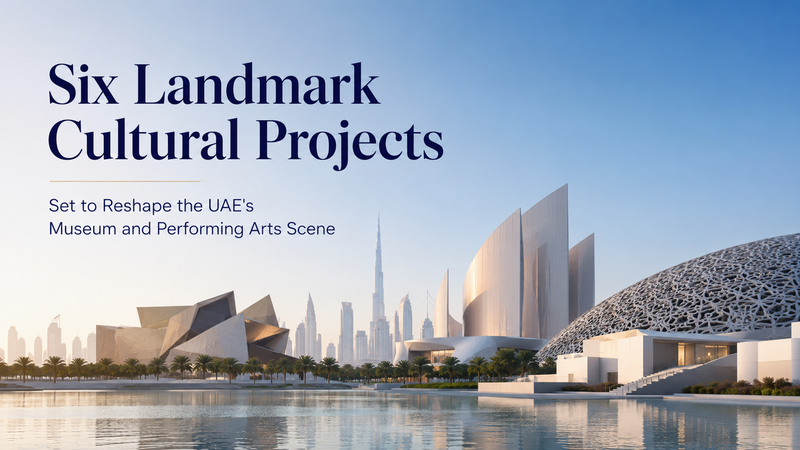
Six Landmark Cultural Projects Set to Reshape the UAE's Museum and Performing Arts Scene
From a Frank Gehry-designed Guggenheim on Saadiyat Island to a floating art museum on Dubai Creek, six major institutions are set to redraw the country's cultural map over the coming years.
The UAE's museum and performing arts landscape is entering one of its most ambitious build-out phases yet, with six major cultural institutions — spanning Abu Dhabi, Dubai and Sharjah — currently in development. From the long-awaited Guggenheim Abu Dhabi to a floating art museum on Dubai Creek, here is what is coming and when.