
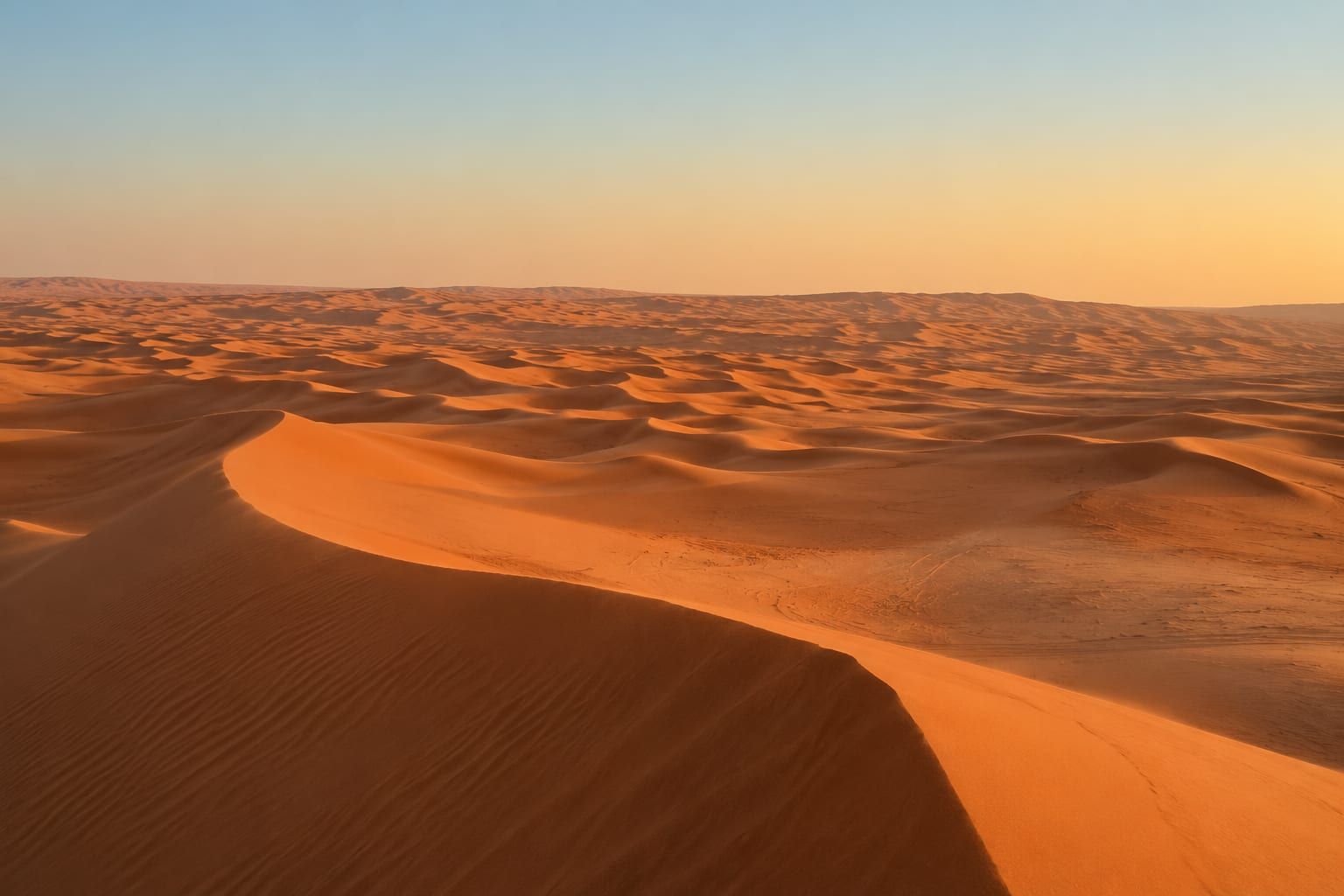
The Liwa Desert
The northern edge of the Rub' al Khali — the largest continuous sand sea on Earth.
The Liwa Desert sits on the northern rim of the Rub' al Khali — the "Empty Quarter" — the largest continuous sand sea on Earth. Its dunes run to 250 metres and beyond, their sand carrying iron-oxide coatings that turn the whole landscape from pale gold at midday to a deep, molten red toward sunset.
Liwa is where the country began. It was the historic heartland of the Bani Yas, the tribal confederation whose ruling line, the Al Nahyan, governs Abu Dhabi today — and the oasis from which, in 1761, a hunting party set out and found the fresh water that would become the capital. It remains the tribe's cultural anchor, and the setting of the annual Liwa Date Festival.
There is also a deeper record here: beneath the sand lie the beds of ancient freshwater lakes, evidence that this "empty" quarter has been green more than once across deep time. The dunes have drawn artists and filmmakers to match its scale — most visibly the Dune films, shot in these sands — but the landscape needs no borrowing to be remarkable.
Vast, quiet, and almost featureless, Liwa is the accessible face of the least accessible desert on the planet — close enough for a day trip from Abu Dhabi, and unlike anywhere else you can easily stand.
Exhibo editorial
Few landscapes carry as many layers as this one. The Liwa desert is at once a geological record — a sand sea that has been freshwater lake more than once in deep time — a national origin story, and, increasingly, a subject for art in its own right: from Christo and Jeanne-Claude's unbuilt Mastaba, conceived for these dunes, to the films and photographers drawn to match its scale. Exhibo lists Liwa not as a gallery but as a place where landscape and image meet — the kind of context the region's art world is built on.
How to find it
From Abu Dhabi city, head southwest toward the Al Dhafra Region — roughly a three-hour drive (about 250 km) via the E11 and E65 toward Muzayri', the main junction town for the oasis. From Muzayri', the Liwa crescent fans out into palm farms and dunes.
For the landmark dunes, continue to Tal Moreeb, signposted south of Muzayri'. A standard car reaches the paved viewpoints and the oasis villages; venturing onto the soft dunes themselves needs a 4×4 and, ideally, a local guide or a booked desert tour. Fuel up in Muzayri' — services thin out fast once you're in.
Similar places
All places
News by Exhibo
Editorial coverage on Exhibo
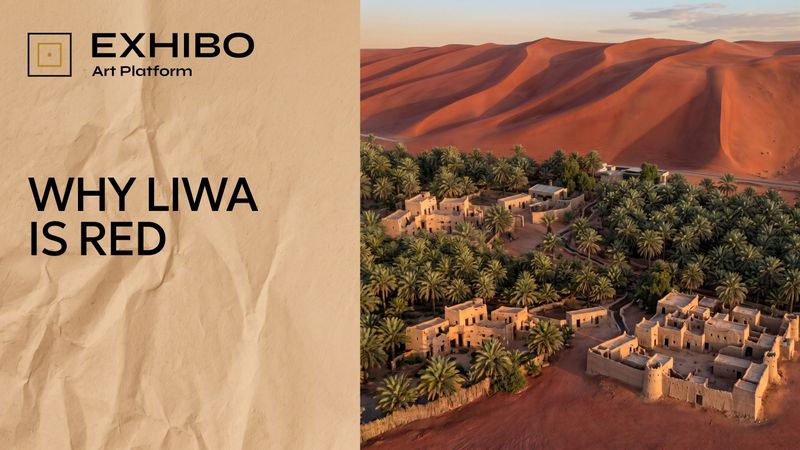
Why Liwa Is Red
The red of the world's tallest dunes isn't a fact about the sand — it's a record of everywhere the sand has been. A drowned sea, an ice-age wind and a buried green Arabia, all pressed into a single colour.
Everyone knows why Liwa is red: iron in the sand. It's true the way "the Gulf is white to reflect heat" is true — the first sentence of a much longer story. The red is a microscopically thin coat of rust on grains of clear quartz, and where those grains came from is almost impossible to picture from the dunes: the floor of a sea that no longer exists, lifted grain by grain and stacked three hundred metres high.
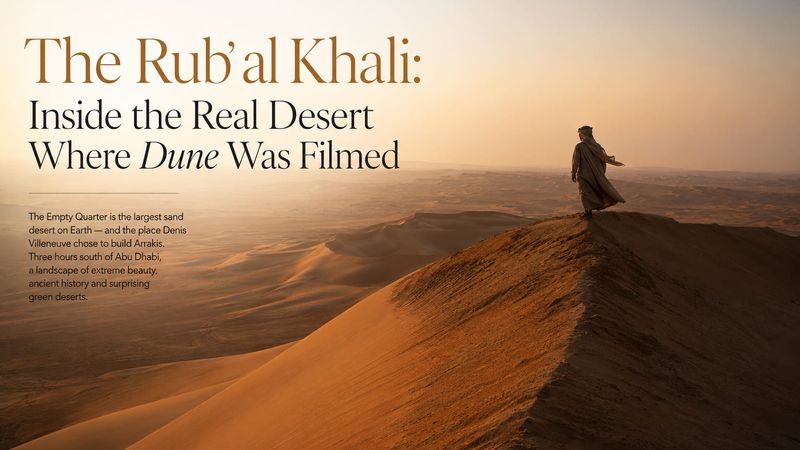
The Rub' al Khali: Inside the Real Desert Where Dune Was Filmed
How the Liwa desert — the Empty Quarter's northern edge, and the real Arrakis — became one of the most filmed, least understood landscapes on Earth.
Denis Villeneuve filmed Dune in Liwa, on the rim of the Rub' al Khali — the largest sand sea on the planet. A desert that has been an ocean, birthed a nation, and is only now being discovered as a subject for art.
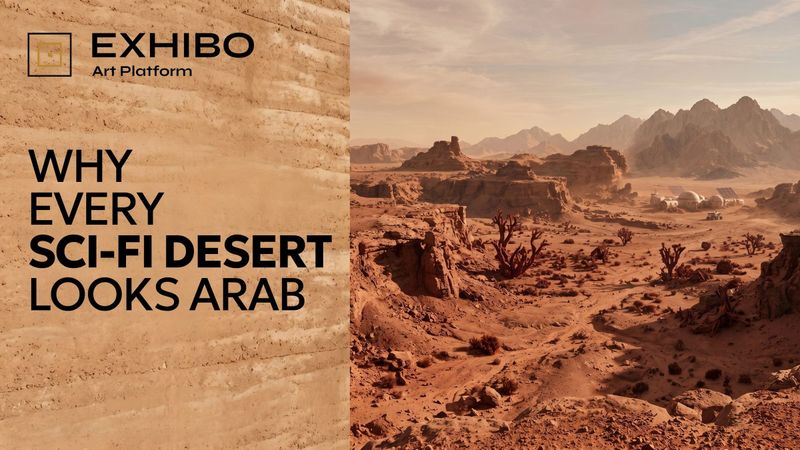
Why Every Sci-Fi Desert Looks Arab
From Arrakis to Tatooine, when a film wants a desert to feel ancient, prophetic and alien, it reaches for an Arab and Berber vocabulary — and reveals more about the West that built it than the region it borrows from.
The wrapped faces, the trilling women, the barely-displaced Arabic: cinema's alien deserts keep sounding Arab. But the vocabulary was assembled in the West — from Orientalist painting to Lawrence to Dune — and it says more about who is looking than about anyone being looked at.