
Abu Dhabi · United Arab Emirates
The Universal Museum, Rebuilt on Arab Soil
How Abu Dhabi took one of the West's most contested ideas — the museum that claims to hold all of humanity — and moved the question of who gets to frame the world
Start on the floor, because the floor tells you what kind of museum this is before you look up.
In the first gallery of the Louvre Abu Dhabi — the Grand Vestibule — set into the marble floor is a map. It is styled as a portolan chart, the kind medieval navigators used, its winding line tracing the coast of the United Arab Emirates, a compass rose at its heart and navigation lines radiating up the walls. But the names inked across it are not the usual ports. They are the places the museum's own works come from, written in the scripts of their cultures of origin — Arabic, Latin, Chinese, Devanagari, Telugu, crowded together so that no single alphabet governs the map. It can be read as the world drawn from Abu Dhabi's vantage, in the world's own hands. A few steps in, one of the first things you meet is a case holding three ewers — vessels for pouring water — one from India, one from China, one from Ottoman Turkey, set side by side. Three cultures, one everyday human gesture, arranged so that no hierarchy is proposed between them.
There is one object the museum announced as its own that you will not find in any of this — the most expensive artwork ever sold at auction, a Leonardo bought for Abu Dhabi within days of the museum opening, promised to these galleries and then, quietly, never shown. But start with what is on view.
That small tableau holds, in miniature, the whole argument of the building. Many of the great encyclopaedic museums have historically organised large parts of their collections by origin: a wing for Egypt, a wing for China, a room where the ancient Greeks are kept apart from everyone else, as though civilisations were filing cabinets. Other museums have experimented with thematic or cross-cultural hangs before — the idea is not unheard of — but the Louvre Abu Dhabi makes it the organising principle of the whole institution. Its galleries run in twelve chronological chapters, from the first villages and the first great powers through the world's universal religions to the challenge of modernity, and inside each chapter it places objects from unrelated cultures next to one another because they were made at the same moment, or answer the same human need. In the gallery of Universal Religions, a mosque lamp stands near a figure of a future Buddha, a French stained-glass window near a sixteenth-century Virgin and Child, all a step from a Syrian Qur'an opened to its first revealed verses. The curatorial wager is that if you stand humanity in one room and let it face itself, a visitor will be encouraged to notice the resemblances before the differences.
Two objects near the start make the point better than any wall text. The oldest piece in the museum's own collection is a small stone-and-marble figure known as the Bactrian "princess," made in Central Asia around four thousand years ago, her robe carved as if it were still heavy with dust. And presiding over an early gallery — on long-term loan from Jordan — stands one of the earliest known large-scale human sculptures: a two-headed figure from Aïn Ghazal, some eight to nine thousand years old, plaster over reeds, its two faces staring out of the Neolithic with an expression sometimes described, metaphorically, as something like the first self-portrait of a species. Neither is European. Both stand at the head of a story the museum frames as everyone's.
This is a serious idea, and a contested one, and it did not originate in the Gulf. What Abu Dhabi has done is take it, pay a great deal for it, and try to remake it — and the interesting question is not whether the museum is beautiful, which it is, but what happens to an old European idea when the institution that once framed much of the non-European world from Europe is rebuilt in an Arab cultural and political context, in a region so often framed through European institutions rather than engaged as an equal.
Where the Idea Comes From, and Why It's Contested
The concept has a name: the universal museum, sometimes called the encyclopaedic museum. It is the idea that a single institution can gather the achievements of all cultures under one roof and present the story of humanity as a whole.
Its lineage runs back to a specific afternoon. On 10 August 1793 — the first anniversary of the storming of the Tuileries, the insurrection that brought down the monarchy — the French Republic opened the Louvre to the public, until then a royal palace whose collections had largely belonged to the crown. What had belonged to Louis now belonged, in principle, to the citizen. That gesture, art wrested from the palace and handed to the public, is the seed of every universal museum that followed, and it was pure Enlightenment: knowledge and beauty as a common inheritance rather than a private hoard. The revolutionary Assembly had conceived the place two years earlier as a home for the monuments of all the sciences and arts. Then, less innocently, Napoleon filled it with treasures seized during his campaigns across Europe and Egypt. Many of those wartime seizures were returned after his defeat, though others remained and shaped the museum that grew up around them. The universal museum was, from the start, capable of being both a gift to the public and a trophy case of empire — the two histories developing inside the same institution.
That double nature is why the idea is contested. In 2002, eighteen of the world's largest museums — the Louvre, the Metropolitan, the Hermitage, the Prado, the Berlin state museums among them — signed a Declaration on the Importance and Value of Universal Museums, asserting that their encyclopaedic collections gave them a unique ability to present the world's cultures to a global public. It sounded high-minded. But the timing was widely read as telling: the declaration was widely interpreted as a response to growing demands for the return of contested objects — the Parthenon Marbles, the Benin Bronzes, the Rosetta Stone. Scholars of cultural property such as John Henry Merryman had long debated exactly this tension between retention and return, and the museum directors' declaration was taken by many critics as a coordinated defence of keeping what they held; The Art Newspaper likened the stance to a "George W. Bush approach to international relations". (The most prominent intellectual defence of the encyclopaedic museum, by the museum director James Cuno, would come a few years later, arguing the case the declaration had only asserted.) "Universality," in that moment, functioned for many as a word rich museums used to keep what they held.
And by 2007 the idea had already been through a reckoning. The decades between Napoleon and the present had seen the universal museum re-read from the outside: by the anti-colonial and postcolonial thinkers who pointed out that the "universal" collection was assembled largely through conquest and unequal trade, and that a museum claiming to speak for all of humanity had, in practice, spoken in one civilisation's voice about all the others. Alongside that broader intellectual shift — Edward Said's Orientalism recast how the West's representations of the East were read, even as it was not itself about museums — ran the concrete argument over objects: the long dispute over the Parthenon Marbles, the mounting restitution claims from Greece to Nigeria. By the turn of the century these had made it impossible to build an encyclopaedic museum innocently, as though the questions had never been asked. And the Louvre Abu Dhabi was not a solitary Emirati answer to the European museum: it was, from the outset, a joint French–Emirati project to build a new version of the thing. What makes it interesting is not that Abu Dhabi borrowed a European model, but that two states took on a model already under sustained intellectual fire — and had to decide, together, what to do about the fire.
You can see the decision, in miniature, back in the galleries. In the room the museum calls Universal Religions, a page of the Qur'an, a Gothic Bible and a Torah scroll sit in a single long case, a few centimetres apart — no wall between the faiths, no gallery given to one and denied to another, the three simply shown as three answers to the same human impulse to make the sacred word beautiful. A visitor raised on the older museums, where Islamic art and European painting occupy separate wings on separate floors, feels the difference physically: the departmental borders that usually organise a collection have been replaced by a different logic, one of theme and chronology. Whether that is a breakthrough or a sleight of hand is exactly the argument this piece is about. But it is not an argument the museum ducks. It stages it, in glass, in the middle of the floor.
So when Abu Dhabi announced, in 2007, that it would build an encyclopaedic museum of its own — and borrow the most famous museum name in the world to do it — the move landed inside this argument. A Gulf state was adopting an Enlightenment idea with an imperial edge, in a region whose cultural histories had often been framed through European institutions rather than through institutions based there. One early reading was mimicry: that Abu Dhabi had bought into the prestige of the model wholesale.
A more interesting reading is that the museum can be understood as attempting something the 2002 signatories never had to. And there is a deeper reframing available still, one that changes what "on Arab soil" even means — because the impulse to draw the world's knowledge together under one roof, while the European museum gave it one powerful institutional form, has appeared in other times and places too. Some of the most ambitious of them grew in this region.
The Older Roots of Gathering the World
The word universal attaches so easily to the Enlightenment that it is worth remembering the impulse behind it is far older than eighteenth-century Paris, and that some of its most ambitious earlier forms grew on this side of the map.
In ninth-century Baghdad, the Abbasid caliphs presided over one of the great knowledge-transfers in human history: a translation movement that, across two centuries, drew the philosophy, medicine, astronomy and mathematics of Greece, Persia and India into Arabic. A court institution known as the Bayt al-Hikma, the House of Wisdom, has often been placed at the centre of this effort — though historians such as Dimitri Gutas have argued that its precise function was much narrower, probably a palace library, and that the great translation movement cannot simply be identified with it. The popular image of a single grand translation academy is more legend than documented fact. What is not in doubt is the movement itself. By later tradition, Caliph al-Ma'mun paid translators the weight of each finished book in gold — a story that captures, even if it cannot be verified, how highly the work was prized. And it was not mechanical copying. The historian A. I. Sabra described it as something more active:
the "appropriation and naturalisation" of other civilisations' learning.
Texts were compared across manuscripts, debated, corrected and built upon. The effort was also strikingly plural: the most celebrated translator of the age, Hunayn ibn Ishaq, was a Nestorian Christian physician and translator who rendered Galen and Aristotle from Greek into Syriac and Arabic; Muslim, Jewish, Christian and Sabian scholars all worked within the same intellectual world. Knowledge crossed religious and linguistic lines as a matter of course, because collecting it was the point.
That knowledge did not stay put. Arabic translations and the original scholarship built on them travelled — through the translation schools of Toledo in Andalusia, the courts of Norman Sicily, Byzantine and Jewish intermediaries, and direct Greek-to-Latin routes — into Latin Europe, where they fed the intellectual currents later associated with the Renaissance from which the European museum would eventually grow. The transmission was tangled, many-centred and slow, not a single pipeline; but the Islamic world's role in it was large. For centuries it was a great centre of transmission, translation and transformation — receiving, reworking and passing on the inheritance of others. That is not far from the posture the Louvre Abu Dhabi now claims: not the origin of all cultures, but a place where they are gathered, set in conversation, and passed on.
There is a mercantile version of the same inheritance, and it ran along this exact coast. Across different periods, the ports of the Gulf and the wider Indian Ocean connected Arabic-, Persian-, Gujarati-, Tamil-, Swahili- and Chinese-speaking trading communities, where Hindu, Muslim, Buddhist and Christian merchants dealt side by side, and where astronomy, navigation, law and credit moved between them along with pearls and spice. Cosmopolitan exchange was not simply an idea imported to this shoreline; for long periods, it was central to the shoreline's economy.
None of this makes the Louvre Abu Dhabi a descendant of the House of Wisdom — the relationship is one of resonance, not inheritance, and the museum is unmistakably a modern institution built on a French template. But it does change the frame. Set beside Baghdad and the bazaar, the museum looks less like a Gulf state simply buying a European idea than like a place where an old regional habit — the entrepôt, the translation house, the marketplace where distant cultures traded goods and ideas as a matter of routine — meets a European institutional form and recognises something of itself in it. The French Enlightenment is one tradition standing behind this museum. The House of Wisdom and the Indian Ocean market are others — not its ancestors, but parallel histories of gathering and reworking the world's knowledge, and they are closer to home.
The Deal, and the Argument It Started in France
The terms were extraordinary, and they were public. But the idea came first, and it came from a particular moment. The ambition to turn a largely undeveloped island into a cultural district was mapped out in the mid-2000s with the help of Thomas Krens, the former Guggenheim director who had made a career of building major museums; his vision for Saadiyat sketched a Louvre by Jean Nouvel, a Guggenheim by Frank Gehry, and more, on a coastal site whose best-known residents were then nesting turtles. Behind it lay a strategic calculation sharpened by the years after 2001. Abu Dhabi was setting out to build an entire cultural and educational infrastructure for the emirate — part of a long-term shift toward a post-oil economy and identity, encompassing tourism, universities, museums and a place in global cultural life. A world-class museum served several of those ends at once: economic diversification, tourism, education, international standing, national identity. Soft power — influence through culture and education rather than force, in the words its own diplomats use — was one function among them. It also drew on an older conviction. Zaki Nusseibeh, cultural adviser to the founding president Sheikh Zayed and an adviser to the museum project from the beginning, has said Sheikh Zayed regarded museums as centres of cultural exchange and dialogue, resting on a belief the whole universal museum was built to embody:
that mankind is one family.
The agreement itself was signed on 6 March 2007, at the Emirates Palace hotel in Abu Dhabi, between the UAE and France. Its terms ran to hundreds of millions of euros across several distinct streams — the use of the Louvre name, artwork loans, temporary exhibitions, and French management and curatorial expertise. The figures most often repeated in the press, roughly US$525 million for the name and several hundred million more for loans and expertise, compress a considerably more complicated financial structure. A dedicated agency, Agence France-Muséums, was created to coordinate the participation of a network of French cultural organisations — seventeen in all — with the opening loans drawn from thirteen French institutions. The deal reached beyond the museum walls, tied into a broader French cultural and educational presence in the emirate that included a Sorbonne campus and the involvement of the École du Louvre. The museum opened with 300 borrowed works alongside its own growing collection — a Leonardo, a Van Gogh self-portrait from the Musée d'Orsay among them.
Not everyone in France was comfortable. When the plan was first floated, some of the country's most senior museum figures pushed back hard. The former director of French museums Françoise Cachin, the art historian Roland Recht and the former head of the Musée Picasso Jean Clair published a manifesto in Le Monde:
"The museums are not for sale."
More than 5,000 French curators and specialists signed a petition supporting it. Their objection was principled: works had traditionally been lent between museums for free, to contribute to knowledge and the history of art, not rented out for money. To them it looked like France trading its patrimony for oil wealth.
It is worth pausing on this, because it complicates the easy story in a useful direction. The most vocal anxiety about the Louvre Abu Dhabi came not from the Gulf but from Paris — from a French establishment worried about what it was giving up. The museum was contested at both ends of the deal.
And France did not merely license a name and retreat. It became a lasting participant: the Paris Louvre and its partner institutions trained staff, guided acquisitions, lent works, and shaped the scientific project, and France earns from all of it. By the end of 2025, France's state auditor reported, the Louvre had received €467.5 million in revenue from the Louvre Abu Dhabi brand licence alone — around €260 million of it channelled into the endowment fund that helps finance the Paris museum, the remaining €207.5 million retained by the Louvre itself. The licence, originally set at thirty years and six months, was extended to 2047 in 2021 against a further advance payment. The same auditor has also, in reports across the years, found shortcomings in how parts of the arrangement were implemented. All of which is a reminder that this was a real negotiation between two states with their own interests and their own leverage — and that the Louvre Abu Dhabi is not simply an Emirati purchase of French prestige but a project that reshaped Abu Dhabi and became a significant financial and institutional asset for France at the same time. Even through the later antiquities investigation, the Paris Louvre maintained that the partnership itself was not in question. This is not, in the end, a story of Abu Dhabi replacing a French model. It is a story of France and Abu Dhabi together testing what that model becomes when it is transplanted.
For both governments, the museum was always about more than art. When it opened, President Emmanuel Macron flew in to inaugurate it and framed it as a bridge between civilisations, adding that "those who want to say that Islam is about destroying other cultures or religions are lying". For Abu Dhabi, a museum that gathered the whole of human achievement under an Arab sky was an argument about the emirate's place in the world — tolerance, openness, modernity — made in stone and loaned canvases. For France, it was a way to extend cultural reach and museum expertise into the Gulf, and to earn from both. Both capitals got something they wanted from the same building.
Ten years and much argument later, the museum opened — in November 2017, after a delay that had pushed the original 2012 target back by half a decade. The global financial crisis and falling oil prices drove costs well past the initial budget, and the turbulence of the Arab Spring years shifted official attention, for a time, from cultural projects to questions of regional security.
What opened was, for most critics who saw it, worth the wait.
The Dome and the Rain of Light
Jean Nouvel, the French architect, did not build a palace. He built a town.
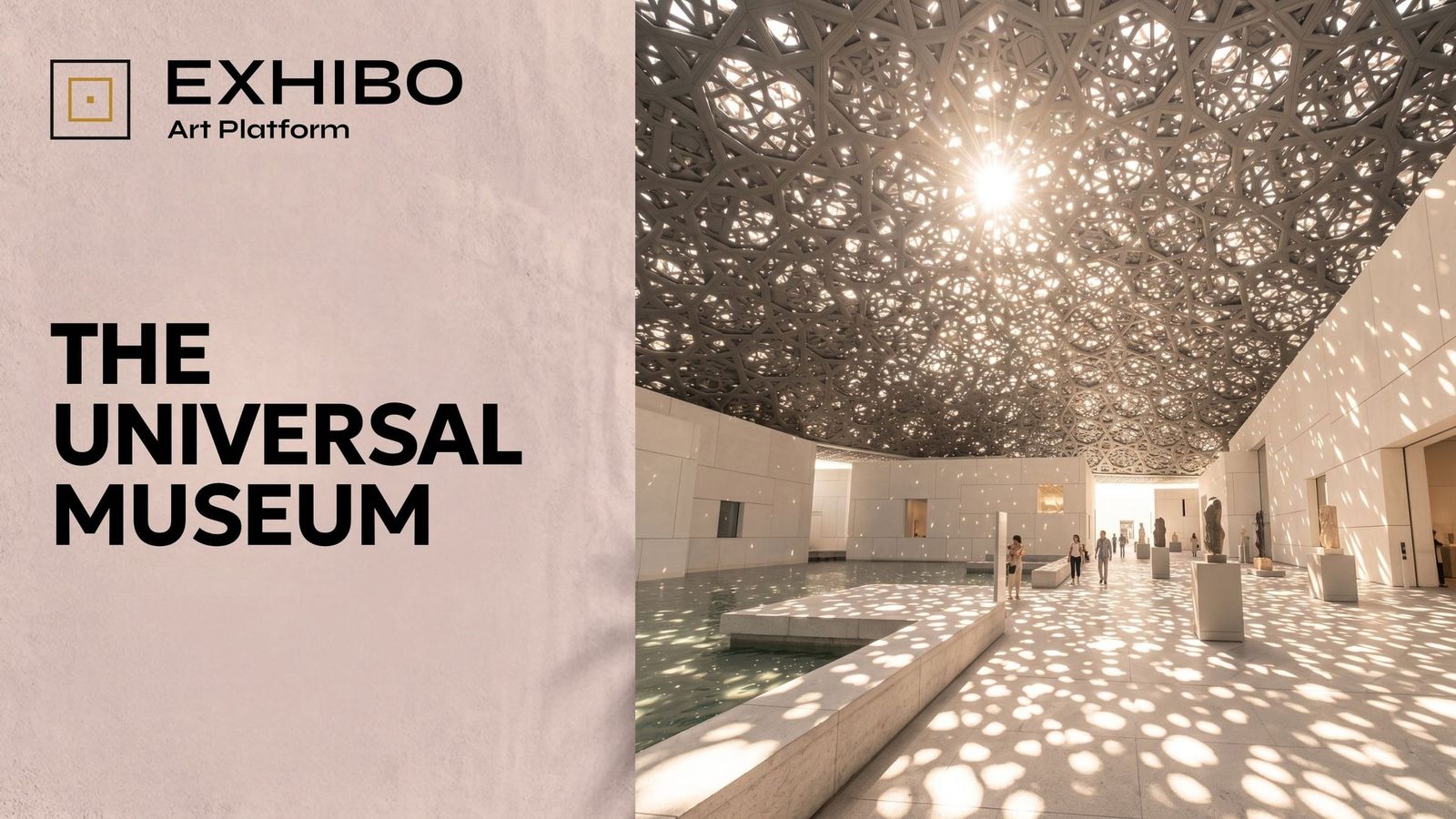
The Louvre Abu Dhabi is a museum-city — some fifty-five low white buildings, twenty-three of them galleries, arranged like the tight lanes and courtyards of an Arab medina, rather than one monumental block. You move between them through shaded alleys, in and out of daylight, the sea visible at the edges. It sits half in the water, so that the Gulf laps against the museum's own streets.
And over the whole thing floats the dome.
It is the single most photographed object in the building and the one that carries its meaning. The dome is 180 metres across at its base and weighs around 7,500 tonnes, roughly the weight of the Eiffel Tower, yet it appears to hover, because it rests on only four hidden piers set 110 metres apart, invisible from most of the museum. It is built from eight superimposed layers, four of stainless steel outside and four of aluminium within, pierced by a pattern the museum counts as 7,850 stars, repeated at varying sizes and angles, the largest a full thirteen metres across and weighing over a tonne, the smallest a hand's width. No two are quite alike.
When the sun crosses it, the light filters down through those thousands of gaps and falls on the white streets below as a shifting, dappled scatter — an effect Nouvel calls the rain of light. It is a deliberate echo of something local: the way sunlight filters through the overlapping fronds of a date palm, softened and broken, the light of an oasis rather than a gallery skylight.
Standing under it is the thing people remember. You come in from the hard, flat glare of the Gulf — the kind of light that makes you squint on the causeway — and step into a vast shaded quiet where the temperature drops and the sun arrives already broken into hundreds of soft coins of light, drifting slowly across the pale stone as the earth turns. The sea is a few metres away, lapping between the white blocks; sound goes muffled and open at once, the way it does inside a large tent. It feels less like entering a building than walking into a grove at midday. Nouvel described the aim as a building that would belong to its country, its history, its geography, and of the drifting light he said:
"It gives a consciousness of time, the passage of time, and eternity."
You feel it before you have seen a single artwork: the architecture seems designed to make the museum's argument physical — dissolving the line between inside and out — before a wall label ever makes it in words.
The engineering was its own feat: a framework of roughly 10,000 components, pre-assembled into eighty-five giant elements and lowered onto the four piers, with the light effect modelled over years so that it would perform through every hour and season.
The building can be read as a summary of the whole project. A French architect, advanced structural engineering, the borrowed authority of a great Parisian museum — arranged to reproduce the shade of an Emirati palm grove. It is the France–Gulf partnership rendered in metal: imported expertise, put in service of something that wants to belong to where it stands.
What the Galleries Actually Do
Inside, the museography carries the argument the floor-map began.
The scientific director who built the display, Jean-François Charnier, described the method plainly: the arrangement is deliberately chronological, intended to create a dialogue between works from different cultures. Rather than a gallery for ancient Egypt and a separate one for ancient China, the museum sets a Chinese object and an Egyptian one from the same era in conversation, so that the visitor's eye is drawn to what they share, the human problem each was solving, rather than to the border between them. In effect it dissolves the departmental walls (Near Eastern antiquities here, Islamic art there, European painting somewhere else) that still structure many of the great encyclopaedic museums. A funerary mask from one civilisation can be set beside a very different one from another, two cultures' answers to the same fact of death sharing a sightline. A room turns on a theme, such as the first villages, universal religions, or the world in motion along trade routes, and lets objects from four continents answer it together.
The walk has a shape that keeps the principle in view. The twelve chapters open with The First Villages and climb through Civilisations and Empires — where an Egyptian sarcophagus and a statue of Rameses II stand among the earliest expressions of power — into Universal Religions, which gathers the faiths in a single room, and on toward the early-modern world, where the European Renaissance and the Islamic world's mathematics of pattern are shown as parallel flowerings, Leonardo's La Belle Ferronnière among them. By the closing chapters the story has reached Manet, Mondrian and a contemporary coda. Even the lobby sets the tone before the chronology begins: nine tall canvases of Cy Twombly's looping "emotional calligraphy," a modern American painter's brushstrokes echoing the traditions of Islamic script. Throughout, the organising idea is not the sequence of rooms but the refusal to file civilisations separately.
The rooms themselves are built to be moved through slowly. The galleries are smaller and darker than the vast white plaza outside — pools of low, careful light around single objects, walls in deep greys and earth tones, so that after the dazzle of the dome your eyes adjust and the world narrows to one carved figure at a time. Ceilings rise and fall; a corridor opens without warning onto a window and a blade of sea light, then closes again into hushed dark. There are few of the long sightlines that make big museums exhausting — you are rarely shown how much is still ahead of you, so the walk feels less like a march than a series of quiet rooms you happen into. It takes a couple of unhurried hours, and it is designed to be done in one sitting: the whole arc of human making, from a Neolithic idol to a Twombly, is short enough to hold in a single afternoon and a single body.
This is where the Louvre Abu Dhabi can be read as placing a different emphasis from the 2002 declaration. Historically, the authority of the great European museums rested heavily on possession, on the sheer mass of what they had gathered and kept, even though today they also lend prolifically, the Paris Louvre alone circulating well over two thousand works a year. The Louvre Abu Dhabi, starting from a collection built new rather than inherited, could not lean on accumulated possession in the same way. So, in the reading its own curators invite, it made relation the primary organising principle of its permanent galleries: universality offered as a way of seeing rather than a hoard, its claim resting less on the mass of treasures it holds than on the connections it draws between the works it has. It is a museum whose argument, one could say, is made in the gaps between the objects rather than in the objects themselves — though museologists would debate how far that amounts to a new kind of museum rather than an old idea pushed further.
Whether it fully works is a fair question, and thoughtful critics have raised it. Go back to those three ewers at the entrance for a moment. To set the Indian, Chinese and Ottoman vessels side by side and let "the human gesture" of pouring water speak is also, unavoidably, to strip each of its specific context — the particular history, faith and use that made it what it is. No display is ever neutral, the tradition of critical museology insists, least of all one that promises to show "humanity" whole: the museum trains its visitors in how to see, and decontextualisation can quietly reduce an object's — or a people's — capacity both to speak and to be heard on its own terms. The scholar Alexandre Kazerouni has argued something more specific still: that the museum, conceived and built through the years of the Arab Spring, softened its explicit profession of Enlightenment values — which point politically toward democracy — into more neutral expressions of a shared human behaviour. It is Kazerouni's reading, not a settled fact, and others would contest it; but it names a real question about what happens to a political philosophy when it is separated from its politics.
That is a serious critique and I won't wave it away. But there is another part of the record that matters, because the institution's subsequent behaviour is also evidence. It now runs a global fellowships-and-grants programme, launched in 2024 and drawing 170 applications from around the world in its first cycle; the inaugural cohort includes a project titled — with real self-awareness — De-centring the Canon: Louvre Abu Dhabi and the Challenge to Eurocentric Art History, and another examining universal museums and religious diversity, comparing the museum's approach with museums in Asia. One of the programme's three research axes is explicitly the global history of museums and collections — how ideas such as the universal museum are defined and debated, and how collections have moved between continents. The museum backs this with a Scientific Laboratory for the material analysis of artworks that it describes as the first of its kind in the Gulf region. A museum that, even through a modest fellowship programme, funds scholars to interrogate the very concept it is built on is doing something more than importing prestige. One should not overstate it — funding research proves neither openness nor honesty on its own, and a sceptic could read it as reputation-management. But it is a gesture in the direction of examining its own premises, and that willingness is, at minimum, consistent with the Enlightenment tradition the museum invokes.
The Collection, Built From Almost Nothing
There is a detail in how the museum was assembled that most accounts skip, and it may be one of the most interesting things about it — and, read properly, one of the most honest.
When the deal was signed, Abu Dhabi had a name, a building site, and only the beginnings of a collection. The British Museum spent two and a half centuries accumulating; the Louvre in Paris had the French crown's holdings and Napoleon's plunder to begin with. The Louvre Abu Dhabi began without the inherited encyclopaedic collection of the older European museums — on a stretch of Saadiyat then inhabited mainly by nesting turtles — and had to build a universal collection almost from scratch, in the space of a decade, in the full glare of the twenty-first-century art market. That is usually told as a weakness. It is closer to the opposite: a museum that has to choose every object in the open, and justify each against the story it wants to tell, cannot pretend the world's treasures simply gravitated to it. It has to say why it wanted each one — which makes its relationship to its own collection unusually explicit.
It started on 23 February 2009, with a single lot. The museum's first acquisition, catalogued fittingly as LAD 2009-001, was Piet Mondrian's Composition with Blue, Red, Yellow and Black of 1922, bought at the Christie's sale of Yves Saint Laurent and Pierre Bergé's collection for around €21.5 million, a record for the artist at the time. The museum's director, Manuel Rabaté, has since called that first painting part of the museum's identity and legacy, and the choice can be read as a pointed one. To open a collection meant to speak for all human cultures with a work of pure European abstraction, a grid of primary colours, looks like a way of planting a flag on a particular idea: that the museum would organise itself around universal impulses, here the human reach for order and pure form, rather than around national schools.
From that one canvas the collection grew fast and deliberately wide. Within about fifteen years it numbered some 700 works and groups of works, around 600 on display at any time, ranging across the whole span the galleries required: an Egyptian turquoise-faience hippopotamus from around 1850 BC at one end, an eighteenth-century chinoiserie commode by the Parisian cabinet-maker Bernard van Risamburgh at the other. The buying was catholic by design. Among the moderns came a Caillebotte, a Manet, a Gauguin, a Magritte, a Picasso portrait, Osman Hamdi Bey's A Young Emir Studying, and it kept reaching outside the Western canon to fill the world map the floor promised. In 2018 the museum bought its first Rembrandt, Head of a Young Man with Clasped Hands, for a reported US$12 million, the first Rembrandt held by any museum in the Gulf. In 2020 alone it added 167 works. It also commissioned living artists to build work into the fabric of the building itself, site-specific pieces by Jenny Holzer and Giuseppe Penone, so that the collection would not be only a gathering of the past.
Alongside the museum's own holdings came the loans, and in the opening years they arrived in extraordinary quantity: in the weeks before the launch, aircraft left Paris roughly every two days carrying French national treasures to the Gulf — Van Gogh's self-portrait, Monet's Saint-Lazare station, Jacques-Louis David's Napoleon Crossing the Alps, Leonardo's La Belle Ferronnière. Around 300 works came on loan from seventeen French institutions for the first year, tapering over the fifteen-year term as the museum's own collection matured enough to stand more on its own.
This deliberate assembly also unfolded during a broader flourishing of museum-building across the Gulf, as several states invested at once in major collections and institutions — part of a wider regional turn toward culture as public infrastructure. Acquiring well in that period was expensive, and Gulf institutions were increasingly present in salerooms that had once been mostly European. The Louvre Abu Dhabi was building its collection within that shared moment, and part of what its purchases secured was standing: a claim to mount one of the region's leading attempts at a universal museum. A collection assembled deliberately, in the open, to illustrate a thesis about shared humanity is a very different thing from one built up over centuries through royal collecting, purchase, excavation, donation and imperial acquisition, and read as universal only in retrospect — more expensive, more exposed, and more visibly contingent on choices made in the present.
The Shows It Puts On
If the permanent galleries make the museum's argument, its temporary exhibitions have been where it tests how far the argument can travel — and they have ranged widely enough to answer the charge that a Gulf museum would only ever show borrowed European prestige.
The inaugural exhibition, fittingly, turned the mirror on the institution itself: From One Louvre to Another (2017–18) told how the Paris Louvre was itself created out of a royal collection opened to the public — the origin myth of the whole idea, shown to the audience about to inherit it. Blockbusters followed, and at their best they turned scholarship into theatre: Rembrandt, Vermeer and the Dutch Golden Age reunited Vermeer's The Lacemaker and Young Woman Seated at a Virginal — painted on canvas cut from the same bolt and hung side by side for the first time in some three hundred years.
But the most revealing shows were the ones that decentred Europe. 10,000 Years of Luxury opened not with a French crown jewel but with the Abu Dhabi Pearl, the oldest known natural pearl in the world, some 8,000 years old, found off the Emirati coast, placing the region's own deep history at the head of a global story; Roads of Arabia traced the archaeology of the peninsula; and the 2025–26 centrepiece, Mamluks: Legacy of an Empire — the first exhibition on the Mamluk Sultanate ever staged in the GCC, brought over from the Musée du Louvre in Paris — gave its main hall to the sultanate that ruled Egypt and the Levant for two and a half centuries, a subject a Western encyclopaedic museum would historically have been less likely to foreground. The programme runs to four major exhibitions a year, and increasingly it is these non-Western shows that carry the museum's identity.
A project of this scale, built quickly in a decade of global scrutiny, drew hard questions. Three are worth setting out honestly — not as an indictment, but because a serious account includes them, and because in each case the more accurate story is one of problems documented and then, over time, addressed.
The workers who built Saadiyat. Saadiyat Island was constructed largely by migrant labour — as across the UAE, where migrants make up the overwhelming majority of the private-sector workforce — and in its early years Human Rights Watch published three reports, from 2009 to 2015, documenting serious problems on the island's building sites: recruitment fees that indebted workers before they began, delayed or unpaid wages, confiscated passports, long hours in extreme summer heat. In October 2015 a wage dispute on the island escalated into a strike, followed by the deportation of workers involved — the kind of episode that drew international attention to how the district was being built, and, when Swiss journalists arrived in 2017 to film labour conditions ahead of the opening, they were briefly detained by police. That was the starting point, and it should be stated plainly.
The record after that is more complicated than either a simple scandal narrative or a clean reform story. The developer, TDIC, adopted an Employment Practices Policy as early as 2009 setting standards for contractors and subcontractors on recruitment fees, wages, housing and safety, and in 2011 appointed PricewaterhouseCoopers as a third-party monitor of compliance. It built a purpose-designed Saadiyat Accommodation Village with capacity for some 20,000 workers. PwC's later audits, based on direct interviews with more than a thousand workers, reported that all those interviewed had health insurance and access to their passports, alongside a functioning grievance procedure and improved accommodation, with a large majority saying they were satisfied with conditions in the village. At the national level the reforms went further. The UAE's 2021 labour law overhaul — Federal Decree-Law No. 33 — introduced wage-protection measures, prohibited discrimination on grounds of gender, race, religion and national origin, mandated equal pay for equal work, and barred dismissal for filing a complaint, alongside the long-standing midday-break rule that bars outdoor work through the hottest hours of summer. None of this erases the early record, and independent voices continue to press: the International Trade Union Confederation notes that the underlying sponsorship structure has not been fully dismantled, and academic assessments of Gulf labour reform reach similar conclusions — one recent peer-reviewed survey characterises the region's measures as often selective, fragmented and, in places, performative, crediting the UAE's wage-protection system while noting slower structural progress than some of its neighbours. HRW's audits, too, found that a substantial share of workers lived outside the monitored village, in accommodation the reports could not fully verify. Both things are true at once: real, audited improvement over a decade, and reform that is not yet finished. The honest sentence holds both.
The antiquities case. Between 2014 and 2018 the museum acquired Egyptian antiquities — among them a pink-granite stele bearing the name of the pharaoh Tutankhamun, bought for €8.5 million — whose provenance documents were later found to have been forged; in all, more than €50 million of antiquities whose paperwork has since been shown to be fake passed to the museum. French investigators linked the objects to a trafficking network suspected of sourcing artefacts looted amid the upheavals of the Arab Spring and selling them on to museums and galleries that, as the inquiry put it, did not ask too many questions. A French investigation opened in 2018 and eventually reached senior figures: the former director of the Paris Louvre, Jean-Luc Martinez, who chaired the joint acquisitions committee, was indicted in 2022 for "complicity in gang fraud and laundering", and the Louvre Abu Dhabi's own scientific director, Jean-François Charnier, for "facilitating" the purchases.
Here precision matters, because an indictment is not a verdict, and the details cut against the lurid headline. Both men have consistently denied wrongdoing, saying they applied vetting standards beyond common protocol and were deceived by traffickers further up the chain; the dealers at the centre of the network, including Christophe Kunicki, who proposed the Tutankhamun stele, and his alleged accomplices, confessed to falsifying provenance documents to fill in the gaps. The public prosecutor actually asked for the charges against both curators to be dropped, finding no serious or consistent suspicion against them; an appeals court kept them anyway. In November 2023 France's Court of Cassation rejected Martinez's appeal and upheld his indictment, but ordered a review of the legality of Charnier's police custody, a ruling that opened the way for his indictment to be annulled on procedural grounds. The two men's situations, often run together, had diverged: Martinez's case continued toward a possible trial while the proceedings concerning Charnier had grown increasingly uncertain. By early 2025 the wider prosecution appeared to be faltering: the dealer alleged to be the network's source, Serop Simonian, had left France, in what one defence lawyer called a sign of the breakdown of a criminal investigation that had dragged on for years. As of August 2026, Martinez's case had still not come to trial and no verdict had been reached; he continues to contest the charge and maintain his innocence. And the detail that reframes the whole affair: within the French criminal proceeding, the Louvre Abu Dhabi itself joined the case as a civil party, the status, under French law, of a recognised injured party seeking access to the files "to establish the facts," not that of a defendant or an accuser of the curators. The museum, in other words, presented itself in the French proceedings as an injured party, in effect the buyer claiming to have been deceived. The episode was followed by tighter procedures rather than denial: France's culture ministry formed a taskforce to overhaul acquisition practices across French museums, and the Louvre Abu Dhabi states that it now applies a strict protocol aligned with the 1970 UNESCO convention against illicit trafficking, with every object, past or prospective, researched and approved by an acquisitions committee. The Paris Louvre, for its part, joined the French proceedings as a civil party too, an injured institution rather than an accused one. The episode therefore belongs in the museum's history not simply as a scandal, but as a test of how its acquisition system worked — and of what changed once that system was found to have failed.
The painting that vanished. This is the painting we began with. The strangest cost is a single object: on 15 November 2017, four days after the museum opened, a painting of Christ attributed to Leonardo da Vinci — the Salvator Mundi — sold at Christie's for US$450.3 million, the most expensive artwork ever sold at auction. Amid contradictory early reports about who had bid, Christie's and the Department of Culture and Tourism – Abu Dhabi confirmed the department had acquired it for the Louvre Abu Dhabi. A grand unveiling was set for September 2018 — then postponed without explanation, and the picture has not been seen publicly since. Part of the reason may be that its attribution is disputed: among the doubters, the Leonardo scholar Jacques Franck has said specialists at the highest level question whether it is by Leonardo's own hand. Whatever the explanation, the episode sits quietly against the museum's founding promise: a work acquired by Abu Dhabi's culture department and announced for the museum's walls — the most valuable painting on earth — has years on still not gone on public view, a reminder that at these prices even a universal museum cannot always keep great art in sight.
None of these invalidates the museum's contribution, though each complicates it. They are the frictions of an enormous thing built fast and in the open, and in each case the record since has been one of documented reforms and measures whose sufficiency is still contested. What an institution does once problems are named is part of how it should be judged — as much as the fact that they arose.
What It Started
For most of its first decade, the Louvre Abu Dhabi looked like a promise the emirate might not keep. It was to be the first of a whole district of museums on Saadiyat Island — a Guggenheim by Frank Gehry, a national museum by Norman Foster, a natural history museum, a maritime museum by Tadao Ando, a performing-arts centre by Zaha Hadid — and for years the Louvre stood almost alone while the rest remained architects' renderings. The gap between the announcement and the skyline was wide enough to invite real doubt about whether the "cultural district" was a plan or a brochure.
Then, quite suddenly, much of the district came into being. Across 2025, teamLab Phenomena Abu Dhabi opened in April, the Natural History Museum Abu Dhabi in November, and the Zayed National Museum — Foster's tribute to the country's founding president, its towers shaped like a falcon's wing feathers — on 3 December, joining the Abrahamic Family House, which had already brought a mosque, a church and a synagogue onto the same site. Gehry's Guggenheim, its cluster of cones drawn from the region's own wind-tower architecture, was given a firm opening date of 11 December 2026, two decades after it was first announced. What had looked like an overreach can now be read as a sequence, and the Louvre as simply its first stone — the first working node of a cultural infrastructure rather than an isolated vanity project. Whether the wager ultimately pays off is not a question anyone can answer yet: a cultural project of this ambition is judged over generations, and the Louvre Abu Dhabi is barely a decade old. It drew 1.4 million visitors in 2025, one of the most visited cultural sites in an emirate that recorded a record 26.6 million visitors that year.
The museum has worked, too, at becoming something other than a destination for fly-in visitors. It operates in three languages — Arabic, French and English, runs a dedicated Children's Museum, and built the education and research apparatus — resource centre, fellowships, school partnerships — that a museum needs if it means to grow its own public rather than only receive the world's.
That last point cuts deeper than it first appears, because the museum sits between two things a universal museum is asked to be at once. Most of its visitors arrive from abroad. On one reading, that makes it a museum whose deepest conversation is still with the world rather than with its own street — the standing question for every young Gulf institution, where large-scale museums are new and their local publics still forming. On another, it is exactly what a universal museum is meant to be: a place the whole world travels to, built where two centuries ago no one in Paris or London would have imagined a centre of anything, no single nationality dominating the crowd under the dome. The Louvre in Paris was once the place the world's art was brought to; Abu Dhabi has made a place the world now travels to see it — and, increasingly, to see the art of the region shown as part of the human story rather than a footnote to it. Which of those two museums it finally becomes — the world's window, or its own society's — is not yet settled, and may be the realest open question the building holds.
Which returns us to the floor of the first gallery, and the map with the many scripts.
The idea of the universal museum came to the Gulf carrying its whole complicated history — the Enlightenment's generosity and the empire's acquisitiveness, the genuine dream of a shared humanity and the convenient shield against giving anything back. Abu Dhabi did not inherit that idea cleanly, and it has not resolved every tension inside it; the softened universalism, the vanished Leonardo, the years of scrutiny over how the place was built are all part of the record. But the more interesting question is whether it has done something more than borrow. Partly it has taken a form through which European universal museums long interpreted much of the world within European institutional frameworks, and begun to ask what that form looks like when it is rebuilt in an Arab cultural and political context rather than a European one — when a region so often framed through European institutions is now among those doing the framing. And partly it can be seen against something older than the European museum altogether — a regional repertoire that predates the first public museum in Paris: the House of Wisdom's drawing-together and reworking of the world's learning, the entrepôt and the port where distant cultures met to trade what each of them had. That history does not make the museum its heir. It makes universality harder to file as a purely European invention, and gives the Gulf a frame of its own to think with. The gathering of the world in one place is not a new idea on this coast. The museum is, among other things, its most recent form.
The three ewers still stand in their case near the entrance — India, China, Turkey, side by side, arranged so that no hierarchy is proposed. The Leonardo is still nowhere anyone can see it. A museum built on the promise that the world's art belongs to everyone, holding one object it cannot, or will not, show: the tension is among the truest things about the place, and the least resolved. For two centuries the universal museum was largely a Western institution describing the rest of the world. What stands on Saadiyat Island is not a settled achievement but a live attempt — a French institutional form and an Emirati centre of gravity built into the same walls, neither quite cancelling the other. Whether that finally moves the centre of the universal museum, or merely moves the Louvre, is the question the building leaves open. Perhaps, for now, it does both at once: the same old form, beginning to be spoken in a different voice.
Museums mentioned
Related reading
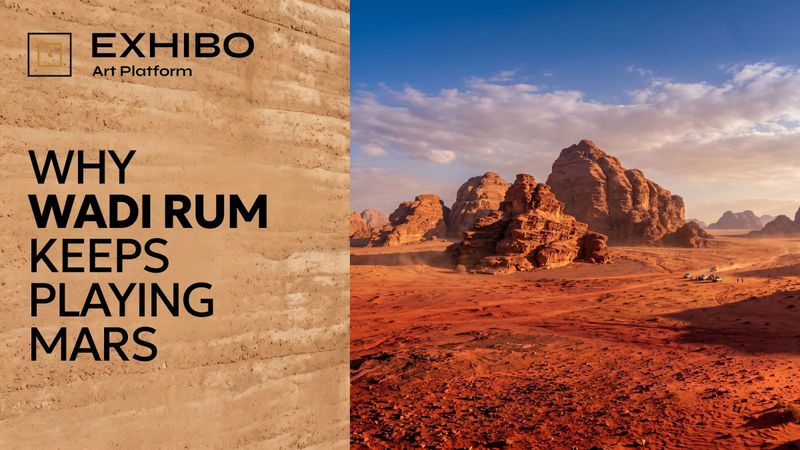
Why Wadi Rum Keeps Playing Mars: A Desert That Is Right About the Wrong Planet
A valley in southern Jordan has become cinema's favourite Mars — not because it is like the planet, but because it looks like the one we carry in our heads.
Put Wadi Rum beside a rover photograph and you can't tell which is Mars. But the desert shares almost nothing with the real planet except its colour — and lately, the illusion has grown powerful enough that real space missions have come to Jordan to rehearse.
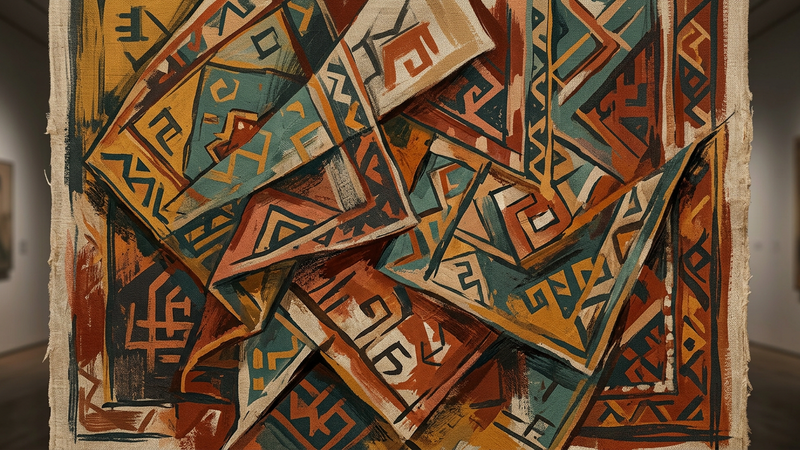
Threads of Heritage: Batima Zaurbekova's Woven Legacy
A survey of Kazakh tapestry pioneers redefines fibre art at Almaty's Kasteyev Museum
Eight decades after her birth, Batima Zaurbekova's textile innovations take centre stage in a major retrospective that bridges Central Asian craft and contemporary visual culture.
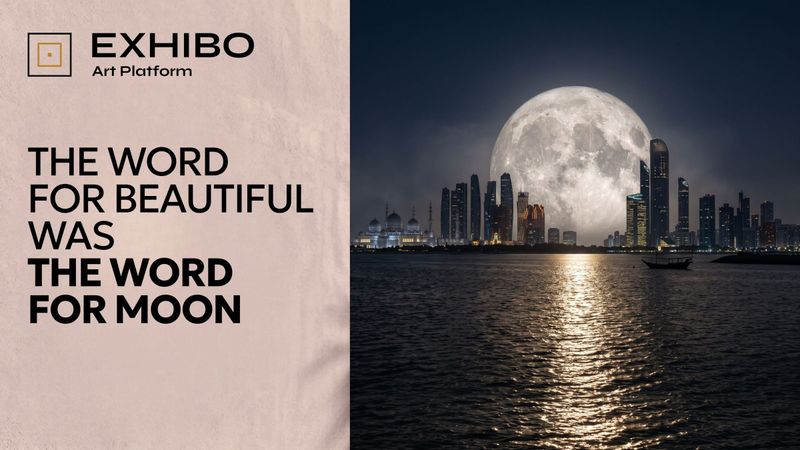
The Word for Beautiful Was the Word for Moon
The moon has been the measure of a beautiful face in Arabic verse for fifteen centuries — but beauty was only one of the things that light was ever asked to carry. A history of one disc, from a pre-Islamic ode to a glowing sphere over an Abu Dhabi harbour.
Ya qamar — you moon — is the oldest compliment in Arabic, and almost nothing about it means what we assume. The moon it praised was not always a woman, not always even a kindness, and in the end not only about beauty at all.