News

Aga Khan Museum

Editorial from Exhibo and official announcements from Aga Khan Museum.

News by Exhibo

Editorial coverage on Exhibo

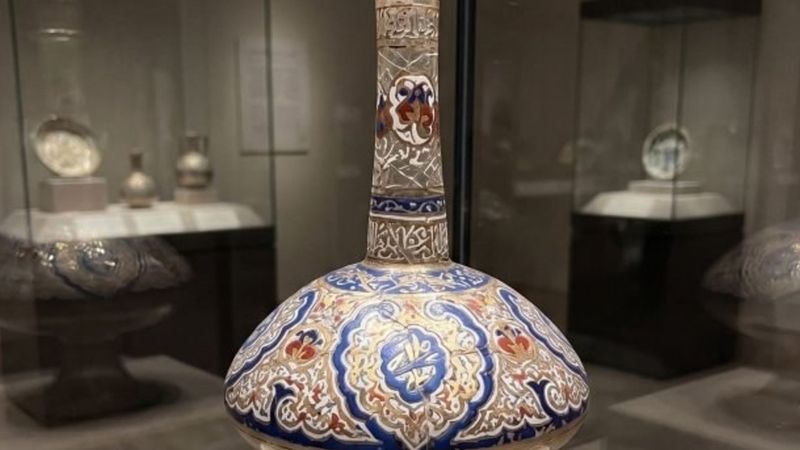
An enamelled medieval Syrian glass bottle in a display case at Cairo's Museum of Islamic Art, restored after the 2014 bombing, the mend faintly visible in the glass.
Editorial

The Bottle That Was in Pieces on the Floor

A car bomb left one of the world's great collections of Islamic art in fragments on the floor. What the Museum of Islamic Art chose to do with the repair — mark it, rather than hide it — turns out to be the most quietly radical decision in the building.

Near the entrance of Cairo's Museum of Islamic Art stands an eight-hundred-year-old Syrian glass bottle with a small gold mark on its label. The mark does not mean the bottle is precious, though it is. It means it was broken — shattered on the floor by the 2014 bombing across the street, then patiently glued back into a single shape.

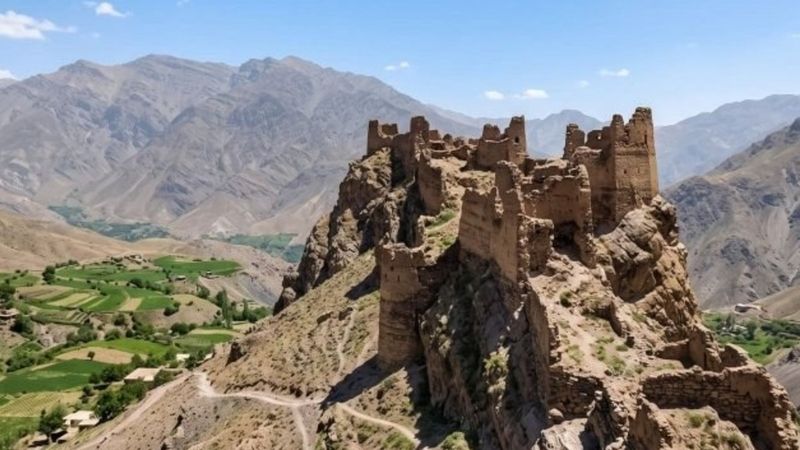
The ruined mountain fortress of Alamut on a narrow rock spur in the Alborz mountains of northern Iran, its broken walls rising above a green valley under a clear sky.
Editorial

Assassin's Creed and the Real Alamut

The world's most widely played version of the Assassins inherits a story that passed through a chain of tellers eight hundred years long — Muslim polemicists, Crusaders, Marco Polo, a Slovenian novelist, Ubisoft — not one of whom spoke from inside the community it described.

Ubisoft's motto "Nothing is true, everything is permitted" comes from a 1938 novel, drawing on Marco Polo, drawing on slander. The real Alamut was no garden of hashish but a puritan fortress where the flute was banned — and most of its own account was lost in Mongol fire.

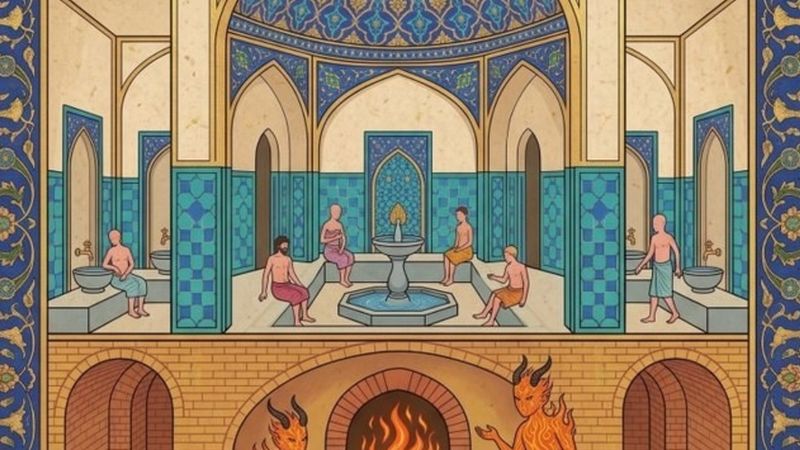
A cross-section of a medieval bathhouse: bathers above, and below them two horned fire spirits tending the furnace that heats the water.
Editorial

The Real Jinn: How the Middle East Imagined Them Before Disney

Seven kings, one for each day of the week. A portrait of Fever. Two spirits keeping a bathhouse warm. What the manuscripts actually show — and what the lamp replaced.

Folio 35v of a manuscript in Oxford shows the public baths at Tiberias in cutaway. Upstairs, people washing. Downstairs, two jinn tending the furnace, mid-conversation. It is not what most of the world expects — and it is much closer to what the unseen was actually understood to be for. A long read across twelve centuries of manuscripts, fieldwork, survey data and horror cinema.