
Exhibo Editorial
Assassin's Creed and the Real Alamut
The world's most widely played version of the Assassins inherits a story that passed through a chain of tellers eight hundred years long — Muslim polemicists, Crusaders, Marco Polo, a Slovenian novelist, Ubisoft — not one of whom spoke from inside the community it described.
One of the most widely seen images of the medieval Assassins is a jump. A figure in a white hood stands at the top of a tower, spreads his arms, and falls — a slow, swan-diving plunge into a cart of hay far below, arms still wide, robes snapping. Ubisoft calls it the Leap of Faith, and since 2007 the Assassin's Creed franchise has sold more than 250 million copies, putting its hooded order in front of players across a dozen historical centuries. It is a beautiful animation. It is also something for which there is no reliable evidence in the historical record. The men this figure is built on left almost no image of themselves at all — no jump, no hood, very nearly no words. What we have instead is largely the picture their enemies drew, elaborated by strangers over eight hundred years, and it is worth asking, before leaping, whose faith the leap belongs to. This essay is about a place that lost most of its own voice, so that everyone else got to speak for it, and about the long relay of tellers — Sunni chroniclers, Crusaders, a Venetian, a Slovenian novelist, a French video-game studio — who each, in turn, made the Assassins into whatever their own moment needed them to be.
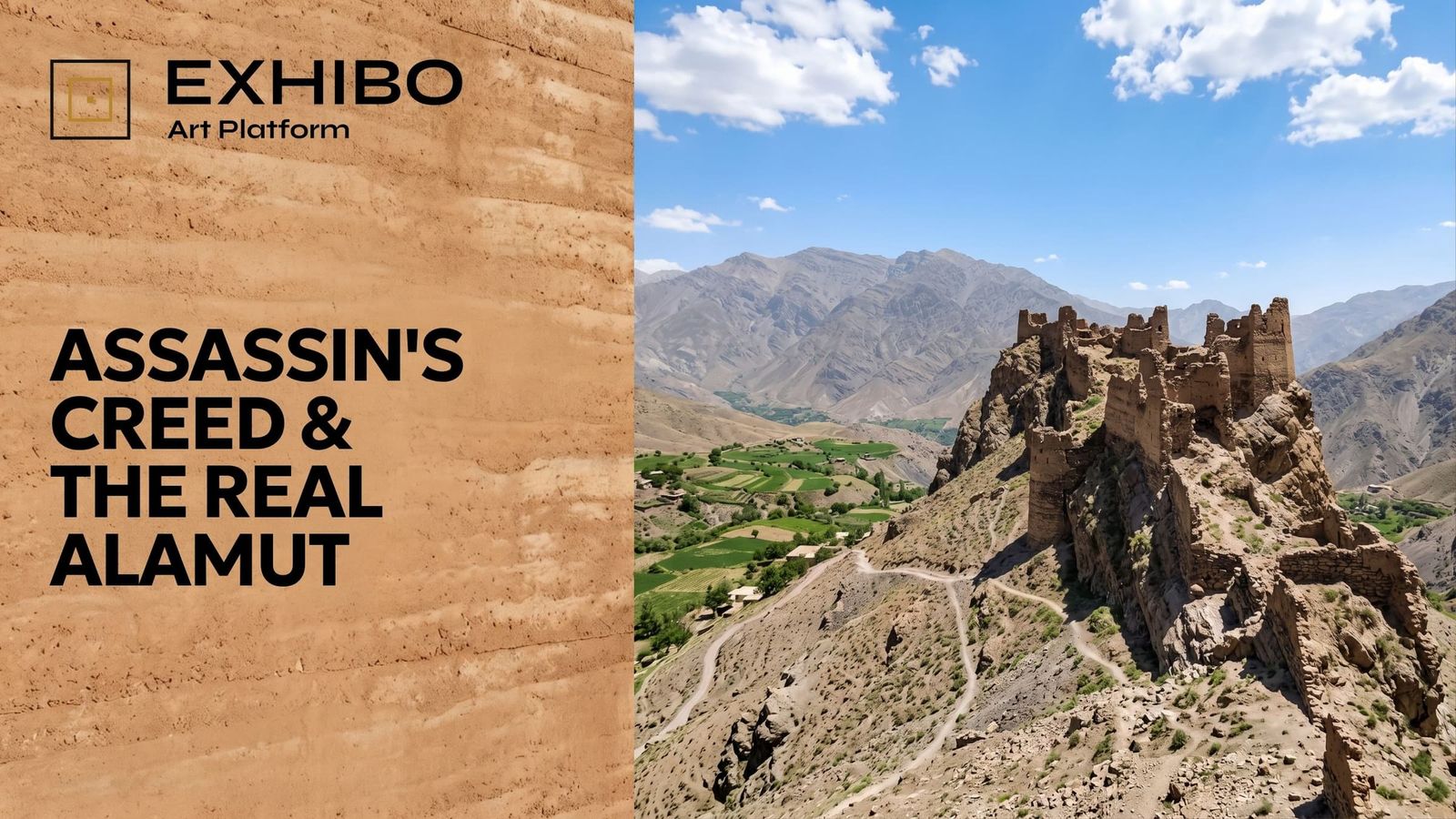
The place is Alamut, and it is real. A ruined fortress on a narrow rock spur in the Alborz mountains of northern Iran, about a hundred kilometres from present-day Tehran, in what is now Qazvin province. Its name is usually glossed from a Daylami phrase meaning eagle's teaching or eagle's nest — a legend has an eagle showing a local ruler the site. In 1090 a Persian missionary named Hasan-i Sabbah seized it, and for the next century and a half it was the headquarters of the Nizari Ismaili state: a scatter of mountain castles across Persia and Syria, held together not by conventional military might — the Nizaris could never hope to match the Seljuks in open warfare — but by conviction, organisation, and a distinctive and terrible strategy of political violence that would give a common noun to European languages. The word is assassin — a name Europe fastened onto the Nizaris rather than one they used of themselves — and untangling how a persecuted Shiʿi minority became the root of it is the whole of the problem.
The negative
Here is the legend, in the form most people have received it. High in the mountains, the Old Man of the Mountain kept a secret garden — a walled paradise of streams running with wine and honey, fruit trees, pavilions, and beautiful women who sang and served. He would drug a promising young man with hashish, and while the boy slept, have him carried into the garden. The boy woke in paradise, spent a few blissful days among its pleasures, and was then drugged again and carried out. Bereft, convinced he had glimpsed the heaven that awaited him, he would do anything to return. And so the Old Man had only to point at an enemy — a vizier, a sultan, a rival prince — and promise the garden back, and the young man would go and kill and die gladly. The drug was the engine of his devotion. The word for the drug, hashish, gave the killers their name: hashishin, the assassins.
It is a magnificent story. It is also, in almost every particular, the opposite of what the historical record and modern scholarship describe. The single most striking fact about Hasan-i Sabbah's Alamut is that it was not a garden of intoxication but a fortress of extraordinary austerity — a community under an exceptionally strict application of Islamic law. Hasan-i Sabbah led an ascetic, puritanical life and imposed it on everyone around him. Later chronicles report — across otherwise hostile sources — that he had both his own sons executed: one for drinking wine, the other on suspicion of an unsanctioned killing. He is said to have expelled a man from the community for playing the flute, because music had no place in the religious life. He reportedly left his own house only twice in the roughly thirty-five years he lived at Alamut, spending the rest in study, administration and prayer. The place the legend paints as a paradise of wine and women and drugs was, in sober fact, a fortress where wine was a capital matter and the flute was banned. The myth is not an exaggeration of the reality. It is its photographic negative.
Hold that inversion, because everything else follows from it. A legend that gets a place merely wrong is a mistake. A legend that gets a place exactly backwards — that turns a house of law into a house of licence — is doing something more interesting than lying. It is telling you what its authors could not imagine and did not want to: that men might kill and die for an idea, a doctrine, a loyalty, rather than for a drug and a trick. The garden can be read as a way of not believing in the conviction. It may have been easier to imagine the Assassins as duped by hashish than to confront the possibility that they meant what they were doing.
The strategy of the underdog
So who were they, if not that? The Nizari Ismailis were a branch of Shiʿi Islam, themselves a minority within a minority, regarded as dangerous heretics by the Sunni Seljuk Turks who then ruled most of the eastern Islamic world, and by many other Shiʿa besides. When the Fatimid caliph al-Mustansir died in 1094, a dispute over the succession split the Ismailis; Hasan-i Sabbah backed the losing claimant, Nizar, and led those who took his name into a permanent schism. This left the Nizaris in an almost impossible position: a small, dispersed, doctrinally isolated community, surrounded by a vastly more powerful empire that regarded their very existence as sedition, and possessed of nothing remotely like the military strength to meet that empire in the field.
What Hasan did with that position is the actual method, and it is colder and cleverer than any garden. Unable to fight armies, he made a weapon of the single killing. From Alamut he sent devotees — fidaʾis, from the Arabic for one who offers his life — to kill specific, named enemies: the vizier, the commander, the qadi, the men whose individual power held the machinery of persecution together. One of the earliest and most famous killings later attributed to the Nizaris was that of Nizam al-Mulk, the great Seljuk vizier, in 1092. The killings were often deliberately public, in mosques, courts and other crowded places, where the act itself could become a political message. This was a strategy of spectacular, targeted political violence: a very small number of carefully chosen deaths, staged for maximum political effect, by a group that could not otherwise project power at the same scale. The Institute of Ismaili Studies, the scholarly centre of the modern community, is careful on the point that matters most — the documented killings targeted prominent political and religious figures rather than civilian populations; and when massacre came, it ran the other way, in the slaughter of thousands of ordinary Ismailis by the Seljuqs in reprisal. The reprisals were often vastly more destructive than the killings that provoked them.
None of this makes them gentle. They did kill; they were feared for real reasons; a régime that executes its own leader's sons for breaches of the law is not a soft place. The honest description is neither the drugged fanatics of legend nor the peaceable scholars of an over-corrected romance, but something harder to hold: a small persecuted community that turned targeted political murder into a strategic instrument, out of a conviction that left no room for wine or flutes, and did it well enough to frighten the most powerful men of the age for a hundred and fifty years. That is the thing the garden was invented to avoid looking at.
The relay
Now watch the story leave their hands, because it left early, and it never came back. Very little of what we have about the Nizaris of Alamut was written by the Nizaris of Alamut. The account is a relay, and at each hand-off the runner is someone with a reason to shape it. And the conditions for a myth were, in a sense, over-determined: a small sect forced by persecution into secrecy, its doctrine deliberately guarded and its literature hard for outsiders to reach, surrounded by hostile chroniclers and, later, by a European imagination hungry for exotic Eastern menace. Concealment on one side and invention on the other met in the middle, and produced a legend neither could have made alone.
The first hands were their Muslim enemies. Arabic and Persian sources — polemicists and chroniclers writing with the contempt reserved for heretics who kill respectable men — used terms such as ḥashīshī and ḥashīshiyya for the Nizaris, apparently as pejorative labels rather than straightforward descriptions of drug use. This is the point where careful attention pays. The best modern scholarship, above all Farhad Daftary's, reads the word not as evidence of a drug cult but as a term of abuse, something like low-life or rabble, the kind of slur that calls a despised group a pack of stoners without meaning it as pharmacology. The terminology appears in Muslim sources well before Marco Polo — and what it never supplied was any reliable evidence that the fidaʾis were actually drugged. Disciplined killing on difficult missions is close to the last thing a dose of hashish would produce. The drug entered the story as an insult and stayed as an explanation — which is a fair summary of the whole legend's method.
The second hands were the Crusaders, and here the story picks up its most durable image through a title that Europe would eventually detach from the man it first described. In Syria, the Crusader states came into contact not with Alamut but with the Nizaris' western branch, led for roughly three decades by a genuinely remarkable man, Rashid al-Din Sinan, who ruled from the fortress of Masyaf. The Syrian Nizari leaders held the title shaykh al-jabal — "shaykh," or "elder," "of the mountain." In European retellings that title became the Old Man of the Mountain, Europe's enduring phantom — a figure fixed first on Sinan in Syria, then later fused with Hasan-i Sabbah and relocated to Alamut, a man dead for decades before most of the tales were told. And the real Sinan is, as usual, more interesting than the ghost: born near Basra, a teacher before he became a missionary, he came west and spent his rule riding between four castles, mending their defences and settling the quarrels of a fractious community, running his network by carrier pigeon. The man Europe remembered as a drug-dealing sorcerer-king was, in life, closer to a travelling headmaster with a genius for administration.
One episode from Sinan's life shows the relay working in miniature, in real time. In 1176 Saladin — the great Ayyubid sultan, scourge of the Crusaders — besieged Masyaf, after the Nizaris had already tried at least twice to kill him. Then he abruptly withdrew, and the reasons given depend entirely on who is telling it. A later Ismaili account, associated with Sinan's biographer, tells it this way: Saladin woke one night to find the lamps in his guarded tent moved, and beside his pillow a note pinned by a poisoned dagger and a plate of the peculiar cakes only the Nizaris baked — a message that they could reach him in his own bed whenever they chose, and he lifted the siege in terror. Other versions give a far less theatrical explanation: that he simply decided the Franks were the more urgent enemy and the Ismailis a waste of his time. In still others, a mystical power held his soldiers back on the mountainside. One event; four Alamuts; each teller's Sinan is the Sinan that teller needs — cunning, or pragmatic, or supernatural. That is the entire problem of the sources, compressed into a single night in a tent.
The third hands, the ones that fixed the legend for Europe, belonged to a Venetian. Marco Polo's account, traditionally tied to his travels through Persia in the 1270s, gave European readers the version that would prove the most durable: the secret garden, the drugged initiates, the manufactured paradise, the whole cynical machinery of devotion. It is worth pausing on the fact that the paradise he describes at Alamut no longer existed when the tale was set down — the fortress had fallen to the Mongols in 1256, and later tradition paints a live portrait of a ruin, adding, historians think, the crowning flourish of the garden itself. The synthesis was irresistible, and it hardened. In 1809 the French orientalist Silvestre de Sacy stood before the Institut de France and established the etymology that would become standard in European scholarship, tracing assassin to ḥashīshī — and yet went on believing the legends the word had carried. His contemporary Joseph von Hammer-Purgstall then packaged the whole apparatus into the standard European account of the sect, a lurid tale of drugged obedience that held its place as accepted history until the 1930s. Six centuries after the fact, the enemies' insult was still the textbook.
The fire
And then there is the reason the relay could never be corrected from the source: the source was burned. In the autumn of 1256 a Mongol army under Hulagu — grandson of Genghis, brother of the Great Khan — moved through the Alborz against the Nizari fortresses. The last Imam, the young Rukn al-Din Khurshah, negotiated and then capitulated, ordering his castles to surrender; Alamut was handed over and systematically dismantled at the end of the year. Among the things Hulagu's men destroyed was the library — a collection assembled and enriched over the hundred and sixty-six years of the Nizari state, one of the great gatherings of Ismaili thought, philosophy, astronomy and history in the medieval world.
The detail that should stop you is who was allowed in first. Hulagu's own historian, the Persian ʿAta-Malik Juwayni — a man writing for the conqueror, no friend of the sect — was given permission to enter the library before it burned and to remove what he judged worth saving. According to his own account, he kept copies of the Qurʾan and a few other works, and consigned the rest, as heretical, to the flames. Among what went were writings of the Nizari state's own making — its histories, its doctrine, the record of how it understood itself. And yet the same man became one of the principal channels through which later historians could learn anything of what those books had contained, because Juwayni read the Nizari chronicles before destroying them and folded what he took from them into his own hostile history. Consider what that means for everything above. The one moment when the community's self-account might have been carried out in bulk, the hand doing the carrying belonged to the victors' chronicler, choosing on the victors' terms — preserving, in his own account and on his own terms, fragments of the very books he burned. A small and fragmentary body of Nizari texts from the Alamut period does survive — treatises the community has since recovered and published — but the great mass of its own record was devastated, and with it much of its power to answer the story told about it. The Assassins did not merely lose their state in 1256. They lost most of the archive with which they might have replied.
Among the most important surviving witnesses to the intellectual world of Alamut is Nasir al-Din al-Tusi, one of the greatest scientists of the medieval world — an astronomer whose planetary model, the "Tusi couple," would echo three centuries later in the work of Copernicus, and an ethicist whose Akhlaq-i Nasiri was written inside the Ismaili fortresses, where he spent something like thirty years. Historians reconstruct much of Nizari thought in the Alamut period through Tusi's surviving works. But Tusi did not go down with the fortress. When the Mongols came, it was he who is said to have counselled the last Imam to surrender — and he then passed into Hulagu's service as a trusted adviser, going on to build the Mongols a magnificent observatory at Maragha. There is an irony here. Two of the people through whom later generations recovered fragments of Alamut's world — Tusi, and Juwayni, who chose what escaped the library — both survived the destruction of the Nizari state by moving into the orbit of its conquerors. The community's own voice is the thread the record most badly lacks, thinned not by a single accident but by fire and by the long persecution that preceded it.
Nothing is true
Skip forward seven centuries, to a small country about to be crushed between larger ones. In 1938 a Slovenian writer named Vladimir Bartol published a novel called Alamut, and it is from this book, more than from any medieval chronicle, that the modern Assassin descends. Bartol took the Marco Polo legend — the garden, the hashish, the manufactured paradise — and built from it a psychological novel about Hasan-i Sabbah as a supreme manipulator, a man who has seen through every illusion and therefore feels free to engineer the illusions of others, sending the deceived to their deaths with perfect calm. Its governing maxim, spoken by Bartol's Hasan, is a line that does not appear in the medieval sources: Nothing is an absolute reality; all is permitted.
Bartol was not writing about the eleventh century. He was writing about the twentieth. Alamut appeared as Mussolini, Hitler and Stalin were remaking Europe into a laboratory of engineered belief, and Bartol — a writer working in the shadow of European fascism — built his Hasan as the leader who fabricates a paradise to command the absolute devotion of young men willing to die on his word: a study of the totalitarian dictator in medieval dress. The book was a parable of its moment, and it kept finding new moments: a cult favourite in Tito's Yugoslavia, a bestseller in Germany, France and Spain during the Balkan wars of the 1990s, read each time as an allegory of whatever fresh manipulation its readers were living through. Bartol's Alamut is a mirror held up to the modern manufacture of fanatics. It has almost nothing to do with the austere, law-bound fortress of the historical Hasan — and everything to do with the century that produced the novel.
The Animus
Which brings us, at last, to the hooded figure on the tower. When Ubisoft's designers built the first Assassin's Creed in the mid-2000s, they took their central creed — "Nothing is true, everything is permitted" — and their whole romance of a secret order of idealist killers not from the medieval Nizaris directly but, as the game's creators have acknowledged, through Vladimir Bartol's 1938 novel Alamut, among other sources. Trace the line and it is very nearly comic in its length. Ubisoft draws on Bartol; Bartol reworks Marco Polo; Marco Polo inherits and embellishes traditions that had already circulated through Crusader and other European accounts; those accounts transform the Syrian Nizaris under Sinan; and behind them all sit the Muslim polemicists who first cast the sect as ḥashīshī rabble. The sect itself, which might have corrected any of them, had its archive burned by Hulagu and what survived carried off by the enemy's historian. The most widely played dramatisation of the Assassins ever made inherits a story that had passed through a chain of tellers seven hundred years long, not one of whom spoke from inside the Nizari community, and its sacred motto is a line coined by a Slovenian novelist in the year before the Second World War.
And here the easy conclusion — that the game is just the latest distortion, the myth in a new console generation — turns out to be too easy, which is the genuinely interesting thing. Assassin's Creed both continues the legend and, oddly, corrects it. It continues it in the obvious ways: the hooded order of superhuman killers, the whole Orientalist scenery of secret Eastern brotherhoods. But it also does something none of the earlier tellers did. It makes the Assassins the heroes — defenders of free will and human self-determination against a Templar order that wants obedience and control — rather than drugged dupes or sinister fanatics. Scholars who have looked closely at the games, including in the pages of Oxford's Classical Receptions Journal, note that for all its sci-fi apparatus and invented "precursor" civilisations, the franchise walks a real line between authenticity and accuracy, and that its early instalments do a surprisingly creditable job of dramatising the historical Nizaris — even, in effect, quietly correcting the centuries-old slander of the drugged killer, by insisting these were people who acted from conviction rather than intoxication. (When the series later reaches for the medieval Islamicate world of learning the legend was invented to obscure, it runs into a stranger problem still — a city so completely erased it had to be rebuilt out of other centuries; that is its own story.)
So the video game is, of all the tellers in the relay, unusually sympathetic — the one that returns to the Assassins something like conviction, and stages, for hundreds of millions of players, a version of the past in which the hooded figure believes in something. It gets a great deal wrong. It also gets one large thing less wrong than Marco Polo did, which is not a sentence I expected to write. The framing device of the series is a machine called the Animus, which lets a modern character relive an ancestor's memories — history as something you re-enter and re-experience. It is a fitting emblem for the whole story. Every teller in this relay has climbed into an Animus of their own, and re-lived the Assassins as their own age required: as heretics, as sorcerers, as drugged slaves, as totalitarian metaphor, as heroes of free will. What none of them could quite do was ask the Assassins themselves, because most of the record that would have answered was lost in Hulagu's fire.
What the fire could not reach
The relay has, at last, one more hand — and this one belongs to the people whose story it always was. The Nizari Ismailis were not exterminated in 1256; the Nizari line of Imams, which the community traces through Hasan-i Sabbah's period, continued past the fall of Alamut and down the centuries into the present. Their forty-ninth hereditary Imam, Prince Karim al-Husseini, the Aga Khan IV, died in Lisbon in February 2025 at the age of eighty-eight, and was succeeded by his son as the fiftieth. It is a strange and moving fact that the line of Imams which Hasan-i Sabbah defended from his mountain fortress in the eleventh century is, in the community's own reckoning, the same line that was mourned, as a global institution, in the twenty-first.
And that community has spent the modern era building the institutions through which its own intellectual and historical traditions can be studied, published and presented — the one thing the fire was meant to make impossible. The Institute of Ismaili Studies in London — the scholarly home of the very corrections this essay has leaned on — exists to recover the history the legend buried. In Toronto, the Aga Khan Museum, designed by the Japanese architect Fumihiko Maki and opened in 2014, was built around the idea of light, and holds more than a thousand objects gathered to show, in its own words, the artistic and intellectual and scientific achievements of Muslim civilisations — precisely the inheritance the "garden of hashish" was invented to hide. Consider the symmetry. In 1256 the community's library was burned by a conqueror, and its learning was scattered so thoroughly that its enemies' insult became its name. In 2014 the same community opened a museum of light to that same learning, and gathered it back, object by object. The fortress of knowledge that Hulagu razed has its answer, seven and a half centuries on, in a museum of knowledge — and this time the people inside it are the ones holding the pen.
Return, at the end, to the figure on the tower, arms spread, about to fall. The Leap of Faith is a beautiful invention, and there is no shame in loving it — but it is worth knowing that it is a leap into someone else's story, the newest re-enactment in a relay that ran for eight hundred years without once pausing to hear from the people it described. The real Alamut was not a garden and not a game. It was a hard, austere, brilliant, frightening little state that made a weapon of the single death, kept a great library, is said to have executed its own for a cup of wine, and then lost almost everything — its fortress, its books, most of its voice — to a fire that let its enemies do most of the remaining talking. The Assassins are the one party in their own legend who were, for the longest time, least able to write it down. Eight hundred years later, at last, they are writing.
Related reading: The City With No Ruins: What Is Left of Abbasid Baghdad — the same franchise, a later game, and the opposite problem: a city so completely gone that Assassin's Creed Mirage had to rebuild it out of other centuries.
Explore the Film Locations of the Middle East & North Africa series for more of the region seen as itself, rather than as somewhere else.
Related reading
Sharjah Biennial 17 Unveils Curatorial Vision and Opening Schedule
Angela Harutyunyan and Paula Nascimento frame the 2027 edition around archival residue and spatial memory
The seventeenth iteration of the Sharjah Biennial runs from January to June 2027, presenting a dual curatorial methodology that examines historical legacies and infrastructural critique across multiple emirate locations.
One Thousand and One Nights as a Visual Network
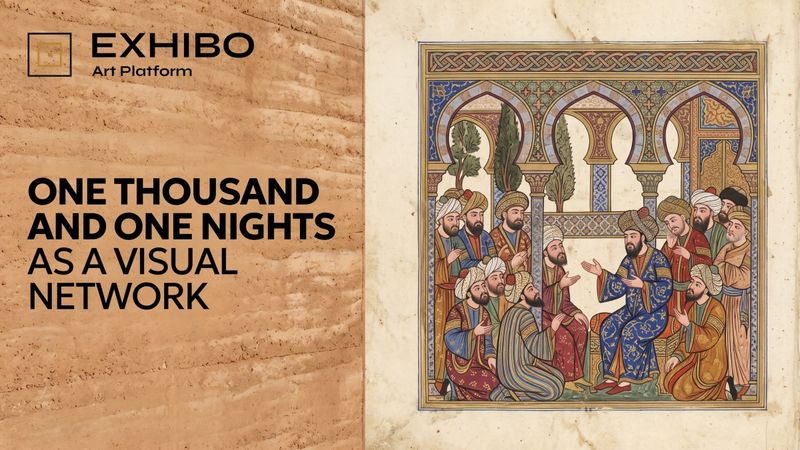
The book that taught Europe to picture the East arrived with no pictures at all. Three centuries of illustrators — Dutch, Egyptian, Persian, French, German, Iraqi — each gave it a face, and every face was a self-portrait.
Open Galland's Thousand and One Nights, the edition that conquered Europe, and there is nothing to look at: no genie, no lamp, not one illustration. The most visually imagined book in the world began blind — and because its text was never fixed either, no picture of it could ever be a copy.
Contemporary Istanbul Expands Footprint and Eyes Anatolian Markets
Founder Ali Güreli outlines spatial upgrades, Asian focus, and proposed fiscal incentives for the growing fair
The latest iteration of Contemporary Istanbul returns to Tersane Istanbul with a unified ground-level layout, a strategic pivot towards Asian galleries, and discussions surrounding potential tax reforms to stimulate corporate collecting.