
Baghdad · Iraq
The City With No Ruins: What Is Left of Abbasid Baghdad
A caliph drew his capital in fire, the Mongols erased it, and a video game rebuilt it out of Isfahan and Samarkand. What actually survives of Abbasid Baghdad, where it is, and who else has tried to put it back.
There is a moment early in Assassin's Creed Mirage when you climb a viewpoint inside the Round City and the camera pulls back to show you the whole thing — the double ring of walls, the four gates, the vast open ground, the Golden Palace at the centre with its green dome.
Hold on that shot for a second, because something unusual is happening in it.
Nobody has ever seen this view. Not a photograph, not a painting, not a drawing made from life. No excavated remains anywhere have been securely identified as the palace you are standing on — not its walls, not its foundations, not its footprint. Ubisoft's Baghdad is the most detailed reconstruction of the ninth-century city ever produced in any medium — and it is a reconstruction of something that exists today only as sentences.
Every other location in this series is a real place a camera visited. Tunisia stood in for Tatooine. Petra stood in for the Grail temple. Wadi Rum has stood in for Mars enough times that it deserves an agent. This one is the opposite problem. The place is gone. The reconstruction is the only version anyone can walk through, and the question of what it was actually like is genuinely open.
Which turns out to be a much better story than accuracy.
The city of the round plan
Baghdad was founded in 762 by the Abbasid caliph al-Mansur, and its official name was Madinat al-Salam, the City of Peace. It was built as a circle, which was unusual then and is unusual now, continuing older Sasanian ideas about how a capital should be laid out.
The dimensions come to us from medieval writers who described the place in obsessive detail — and, tellingly, they do not agree. Estimates of the diameter run from about two thousand metres to nearly three, and the walls are counted as two rings by some reconstructions and three by others. What is consistent is the shape: concentric circles of mud brick, the material of choice in Mesopotamia since antiquity, with a moat outside and four domed gates, each named for the road it faced — Kufa, Basra, Khurasan, Damascus — and each tall enough, the sources specify, for a mounted man carrying a lance to ride straight through. Al-Tabari passes on a legend that the four iron doors had originally been made for Solomon, by demons. Inside, a wide band of deliberately empty ground. At the centre, the Palace of the Golden Gate, crowned by a green dome carrying a bronze horseman who turned like a weathervane with his lance out, visible for miles across the flat plain. Beside it the main mosque, which the sources describe as half the palace's size. Grand avenues ran from the gates into the suburbs, where the actual city lived: markets, gardens, canals, bridges, baths, workshops, and the districts of Karkh to the south and Harbiyya to the north.
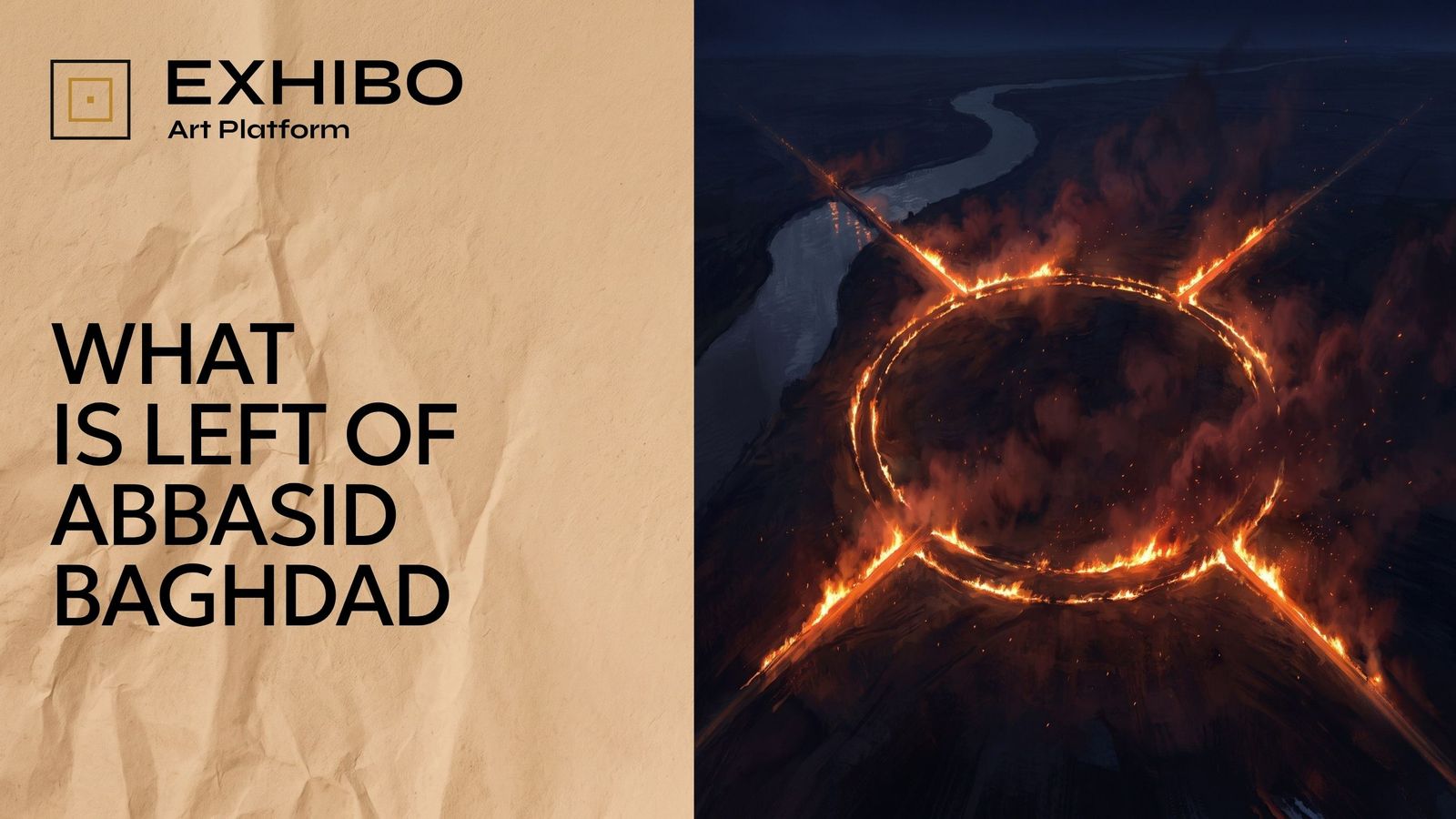
One detail survives that is better than any of the measurements. Al-Tabari reports that before a brick was laid, al-Mansur had the whole plan traced on the ground in ash, walked through the imaginary streets, and then had cotton seed soaked in oil laid along the lines and set alight, so that he could stand back and see his city drawn in fire.
The first image of Baghdad was made of flame. So was the last.
For two centuries this was among the largest and richest cities on earth — quite possibly the largest — and the place where an enormous amount of what became global science and literature was translated, argued over and written down.
Then, in 1258, the Mongols took Baghdad, and the Round City went with it.
Not damaged. Not ruined. Erased so completely that no remains have been securely identified, and the footprint itself is still argued over.
What that means in practice is that everything we know about it comes from text, and everything anyone has ever drawn of it is an interpretation. Saba Sami Al-Ali and Nawar Sami Al-Ali's study in Iraq works through the major attempts — Ernst Herzfeld, K. A. C. Creswell, Jacob Lassner — and finds that the famous architectural drawings, the ones reproduced in every textbook, contradict the written sources at several points and contradict each other at more.
So before Ubisoft drew a single wall, the discipline it was borrowing from was already arguing about what the wall looked like.
The reconstruction: what Assassin's Creed Mirage actually built
The studio was clear-eyed about the problem. "Nobody knows that time period really well," art director Jean-Luc Sala told GamesRadar — and the team went to Baghdad anyway, precisely because the story was too good to skip.
That deserves a small correction, because the period itself is not a blank. Abbasid political, economic and intellectual history has a deep and very active scholarship behind it. What is missing is narrower and more specific: the look of the place. Historians can tell you a great deal about what happened in Baghdad in the 860s. Nobody can tell you what colour the wall behind it was.
The setting is the 860s, during a stretch of Abbasid history known as the Anarchy at Samarra: after the caliph al-Mutawakkil was killed by his own Turkic guards in 861, four more caliphs came and went inside nine years, none of them dying comfortably. It is a strange and rather brave choice for a video game. Not the shining Golden Age of the tourist brochure, but the moment when the machine was visibly shaking.
What the studio built around it is the part worth attention on an art platform.
Ubisoft Bordeaux worked with a group that included Ubisoft MENA's Mohammed Alemam and Malek Teffaha as cultural and linguistic consultants, in-house historians Raphaël Weyland and Maxime Durand, and the Humanities and Inspiration taskforce under Thierry Noël. By the studio's own account, the consultants were not brought in at the end to approve finished work. They were asked to build a lexicon from the ground up — a database of expressions, spellings, pronunciations and audio — and then to go through the scripts and the recordings.
External historians came in too. Among them Ali A. Olomi, a specialist in Islamic occult and astrological history, who described the finished city as feeling real and rich, and made a point I keep thinking about: even the departures from history make sense, because the essence is right.
And then there is the feature that makes this a genuinely unusual object. History of Baghdad puts sixty-six historical sites across the map, each unlocking a researched article across five subjects: economy, government, art and science, belief and daily life, and the city itself. Weyland led the writing and the image selection. It is, functionally, an illustrated encyclopaedia of Abbasid material culture, shipped inside a stealth game, and reached by climbing on things.
Weyland put the case for it plainly enough: there is a little of Baghdad, he suggested, in the animal fables we read to children and in the perfumes people wear.
"A Baghdad that never was"
Here is where it gets properly good, and where I would point any player who wants the real story.
Glaire Anderson, an art historian at Edinburgh who specialises in Islamic architecture and who worked on History of Baghdad, wrote a public assessment of the game she had contributed to. She called the city breathtaking. She also called it completely fantastical — a Baghdad that never was.
Her list of what is actually in it is the single most useful paragraph written about this game.
Inside the Round City, players move through elements evoking Isfahan, Delhi and Samarkand. There are gates and fountains recalling medieval North Africa. Bazaars and mosques from early modern Iran — that is, seven or eight centuries after the setting. Domed tombs from South and Central Asia. Tiled interiors from the Iberian peninsula.
The Round City of ninth-century Iraq is furnished with Spain, Uzbekistan, India and Morocco, across roughly a thousand years.
Anderson is candid that specialists may find this dismaying. And then she does something more interesting than complaining: she argues it was worth it. Islamic architecture, she points out, is one of the world's great building traditions and one of the least familiar to people outside Muslim-majority countries — nowhere near as legible to a general audience as Greek or Roman or Gothic. A game played by millions that makes that vocabulary visible is doing something no monograph can.
She also takes the opportunity to knock down the assumption that figural representation is forbidden in Islamic art, which is not supported by the historical evidence and which anyone who has looked at an illustrated manuscript already knows.
This is exactly the pattern this series keeps finding. Casablanca was not filmed in Casablanca. Ouarzazate has played the entire ancient world without leaving Morocco. Southern Tunisia has been a planet. What is different here is that the substitution was not a budget decision or a scheduling convenience. It was structural. There was no original to shoot.
What is actually left
So where do you go if you want the ninth century itself?
Three answers, in ascending order of surprise.
In Baghdad, almost nothing — but not quite nothing. The visible medieval fabric of the city is mostly thirteenth-century, from the later Abbasid period: the Mustansiriyya Madrasa with its sixteen-metre gate, its geometric patterning and its long dedication inscription; fragments of the minaret of the al-Khulafa Mosque; the Wastani Gate, also called the Dhafariya; and the shrine of Umar al-Suhrawardi, a twelfth-century Persian Sufi, with a conical muqarnas dome. All of it later than the game. All of it worth the trip.
For the ninth century proper, Anderson notes a proposal by the Islamic art historian Bernard O'Kane: a marble prayer niche now in the Iraqi National Museum may be a single surviving piece of the caliphal palace city.
One mihrab. Possibly. That is the physical remainder of the most famous city of its age.
Outside Baghdad, the copies. Two sites were built in imitation of the Round City and have survived rather better: al-Rafiqa at Raqqa in Syria, and Qadisiyya, also called al-Mubarak, not far from Baghdad. If you want to know what standing at a Round City gate felt like, the nearest evidence is a knock-off.
And then Samarra, which is the answer.
About a hundred and thirty kilometres up the Tigris sits the city the Abbasids built in 836 when Baghdad became untenable, and abandoned within a lifetime. Because it was left early rather than continuously rebuilt, UNESCO describes it as the only surviving Islamic capital that keeps its original plan, architecture and decoration — and, with Baghdad's monuments lost, as the only physical trace of the caliphate at its height. It runs 41.5 km north to south. It holds two of the largest mosques in the Islamic world and the largest palaces. The carved stucco style developed there spread across the whole Islamic world; so did the lustreware.
Its most famous structure is the Malwiya, the spiral minaret of the Great Mosque, built for the caliph al-Mutawakkil around 848–852: a square base roughly thirty-three metres to a side, and a ramp winding up the outside of a cone to about fifty-two metres. (UNESCO's own file gives thirty-two and fifty-four; the discrepancy is the sort of thing that happens when a building is measured by different people in different decades.) There is nothing else like it anywhere. Its upper section was damaged by a bomb in 2005.
Eighty per cent of the site remains unexcavated. It has been on the World Heritage in Danger list since 2007.
Which produces the neatest fact in this whole story. If you finish Mirage wanting to stand inside the ninth century, the address is not Baghdad. The closest thing on earth to Ubisoft's Baghdad is a half-buried city a hundred and thirty kilometres upriver that almost nobody is allowed to dig.
The ninth century is still standing. It is just standing somewhere the cameras and the studios do not go.
The hundred paintings
So the architecture is effectively gone. Which leaves the question this whole piece turns on, and it is a better question than the one about accuracy:
If the buildings did not survive, where did Baghdad survive?
The answer is a single book.
On the sixth day of Ramadan in the year 634 — Saturday 9 May 1237, twenty-one years before the Mongols arrived — an Iraqi calligrapher and painter named Yahya ibn Mahmud al-Wasiti signed off a copy of the Maqamat of al-Hariri, a cycle of comic, satirical stories about a silver-tongued con man working his way across the Islamic world. He had illustrated it himself.
The number of paintings is given as ninety-six, ninety-nine or a hundred and one depending on how frontispieces and double-page spreads are counted, which feels appropriate for a book about a man who is never quite what he says he is. Call it around a hundred. Over a hundred medieval copies of the Maqamat survive; only thirteen of them are illustrated, and this is the one everybody reproduces.
They are astonishing, and their subject is ordinary life: caravans, markets, courtrooms, a village, a library, a tavern argument, camels, boats, pilgrims, judges, the rich and the badly-off, all rendered with a directness and a sense of comedy that has nothing medieval about it at all. The manuscript is now BnF Arabe 5847, and it is fully digitised on Gallica, free, at high resolution.
It is known as the Schefer Maqamat, after Charles Schefer, the French orientalist who acquired it somewhere in the Ottoman empire and left it to the Bibliothèque nationale. Where exactly al-Wasiti worked is debated — Baghdad and southern Iraq are both proposed — so it is not a documentary record of the capital, and nobody should sell it as one.
But it is the closest thing that exists to a painter of that world looking at that world. If you have played Mirage and want to see how these streets appeared to someone who was actually in them, rather than to a concept artist working from descriptions, this is the document.
The other reconstruction
Which brings us to the part of this story that closes the loop, and that almost nobody who has written about the game seems to have noticed.
Ubisoft is not the first team to sit down and rebuild a Baghdad that no longer existed. It is the second.
In 1951, the sculptor Jewad Selim and the painter and theorist Shakir Hassan Al Said founded the Baghdad Modern Art Group. Iraq had been a nation-state since 1932 — a flag, a passport, an antiquities collection — but no museum of modern art and barely an art school. The question in front of that generation was what a modern Iraqi art might actually look like.
Their manifesto answered it by naming a date. They would rebuild what had been destroyed in Iraqi painting since the thirteenth-century school of al-Wasiti, and reconnect the chain that broke when Baghdad fell to the Mongols.
Not a figure of speech. A programme. They called it istilham al-turath — seeking inspiration from heritage — and it produced the first major modern art movement in the Arab world.
And the detail that makes it perfect: Saleem al-Bahloly's study in Muqarnas traces how Selim actually encountered al-Wasiti. Not in Baghdad. In reproductions, in a French illustrated magazine, in 1938 — an article titled, with no sense of irony available to anyone at the time, The Mirror of Baghdad.
An Iraqi artist discovered his own city's painting tradition in a European magazine, and used it to invent Iraqi modernism.
Selim went on to design Nasb al-Hurriyya, the Freedom Monument, with his wife and fellow sculptor Lorna Selim — fourteen bronze castings holding twenty-five figures, strung across a fifty-metre travertine wall raised six metres above Tahrir Square, with architectural work by Rifat Chadirji. It is meant to be read right to left, like a line of Arabic. Jewad Selim died of a heart attack in January 1961, months before the unveiling; Lorna saw it finished. It is the most recognisable artwork in the country. Al Said went in the other direction, into abstraction and philosophy, arriving eventually at al-bu'd al-wahid, the one dimension — surfaces as sites of memory, walls and scars and the marks time leaves. The line runs forward from there through artists like Hanaa Malallah, whose work involves burning and ruining the surface itself.
The first major survey of the group, All Manner of Experiments, was curated by the Iraqi art historian Nada Shabout with Tiffany Floyd. It opened at CCS Bard in June 2025, then travelled in expanded form to the NYU Abu Dhabi Art Gallery, where it closed on 7 June 2026. It has been reported as moving on to Mathaf, the Arab Museum of Modern Art in Doha, in October — which would be a homecoming of sorts, since Mathaf owns a good many of the key works and lent them.
Baghdad now
The city did not stop making art, and the last two decades are a long enough story to deserve their own piece rather than a paragraph in someone else's.
The short version. The National Museum of Modern Art lost roughly seven thousand of its eight thousand paintings and sculptures to looting in 2003. A few thousand have come back. Al-Mutanabbi Street — the thousand-year-old book market and the closest thing the city has to a nervous system — was bombed in 2007, and answered by writers and printmakers worldwide with Al-Mutanabbi Street Starts Here, hundreds of artists' books and prints, still touring. The street reopened after renovation in December 2021, with fireworks, which in that city is not a neutral image.
Working now: the Ruya Foundation, founded in Baghdad in 2012, which commissioned Iraq's national pavilion at the Venice Biennale across four editions from 2013 and runs the Ruya Shop, an art library and screening space on Al-Mutanabbi Street; and Hewar, opened in 1992 in the Waziriya district by the artist Qasim Sabti and still standing, garden café and all. Artnet's survey found the scene real but fragile, which is the honest description.
None of it is in the game. But it is what the reconstruction is standing on top of.
What the two reconstructions have in common
Ubisoft and the Baghdad Modern Art Group did the same thing, seventy years apart. Both looked at a city that had been erased, decided the erasure was not acceptable, and built something in the gap.
The difference is what they reached for.
Ubisoft, needing a ninth-century Baghdad and finding no ninth-century Baghdad, reached sideways — to Isfahan, to Samarkand, to Andalusian tile and Moroccan gates — and assembled a city out of the whole Islamic world, across a millennium, because the alternative was an empty ring of mud brick that no player would climb. Selim, needing an Iraqi modernism and finding no continuous tradition, reached backwards to the one surviving witness, and built forwards from a hundred paintings.
Neither is a fake. Both are what people do when the archive burns.
And both leave the same thing open, which is the reason to write any of this down. The ninth century is still lying under sand at Samarra, eighty per cent of it never touched, on a danger list nobody has managed to get it off. Al-Wasiti's manuscript is in Paris, and you can open it right now in your browser. Selim's monument is standing in Tahrir Square. A survey of his movement has travelled from New York to Abu Dhabi and is reported to be heading for Doha.
The game is a door. It is a well-made, seriously researched, openly invented door.
Walk through it and the real city is on the other side, still mostly unexcavated, waiting to be looked at properly.
Galleries mentioned


Museums mentioned
Related reading
Where Is Agrabah? The City Disney Assembled From Real Places
Agrabah was going to be Baghdad. A war made it fictional — and then Disney built it back out of real places, from a tomb in Agra to a valley in Jordan that usually plays Mars.
The Sultan's palace where Princess Jasmine feels trapped has the silhouette of the Taj Mahal — which is not a palace at all, but a tomb. That is how Agrabah works. Disney's fairy-tale city was going to be Baghdad, until the Gulf War made the name impossible; the studio invented a place that could not be found on a map, then quietly rebuilt it out of real ones — Isfahan and Agra, Marrakesh and Mandalay, a Jordanian desert that has played both Arabia and Mars.
The Real Aladdin: The Story That Belonged to No Country
Aladdin has no Arabic manuscript older than its French translation. Behind the gap stands a young man from Aleppo, catalogued for a century as anonymous.
The most famous "Arabian" tale in the world is missing from the oldest Arabic manuscript of the Thousand and One Nights — because before a French translator wrote it down in Paris, there was no manuscript of it to be missing from.
Why Disney Made the Genie Blue
The long material and colonial history behind the most recognizable blue body in popular culture.
Almost everyone remembers that Disney's genie is blue. Fewer ask why. The answer runs backward through five thousand years — Egyptian blue standing in for lapis, cobalt on a Mongol palace, the eye that guards against envy, the last color most languages learned to name, and a layout artist photographing Isfahan just before a war — to a color that was rarely, in this part of the world, quite what it claimed to be.