
Exhibo Editorial
What Is Form in Art?
Three-dimensional volume in sculpture and the illusion of volume on a flat surface: how artists build, imply, and read form.
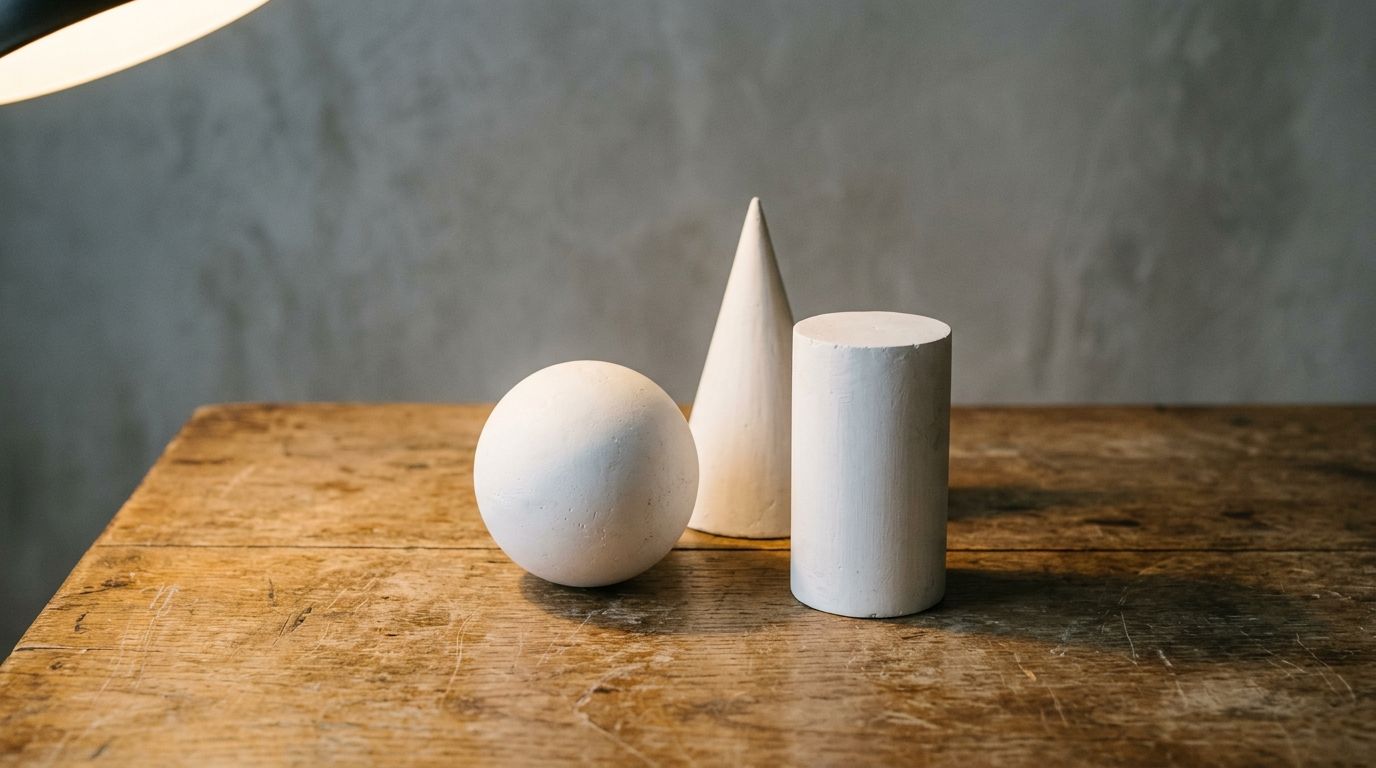
Form, as an element of art, is three-dimensional volume. A form has length, width, and depth. It occupies space, or it pretends to. A bronze figure on a plinth is form you can walk around. An apple in a Cézanne still life is form you cannot pick up, yet the paint still describes a solid that turns away from the light. The Getty’s classroom glossary puts the distinction in one line: shapes are flat; forms express length, width, and depth. Balls, cylinders, boxes, and pyramids are the starter kit.
Students meet the word in two other rooms as well, which is why search results split. Tate’s art-term page notes that “form” can mean the physical nature of a whole work (oil on canvas, carved oak) and, in older criticism, the arrangement of parts that Clive Bell called “significant form.” This page stays with the element: volume, mass, and the ways painters and sculptors make you believe in them. For the rest of the elements and principles of art, follow the series hub. Tonal modelling belongs with what is value in art. The history of sculpture as a medium belongs elsewhere.
What form means as an element of art
Classroom lists in Britain and the United States name seven elements: line, shape, form, value, colour, texture, and space. Form is the three-dimensional member of that set. The National Gallery of Art’s teaching page treats forms as shapes given a third dimension: a circle becomes a sphere, a square a cube, a triangle a pyramid. Those named solids are geometric forms. A clenched fist, a river pebble, a reclining torso are organic forms. Both kinds enclose volume. Both can exist as physical objects or as illusions on paper.
Volume is the useful word. Mass is close, though physicists would quibble: a hollow bronze may look heavy and weigh less than a compact stone. In studio talk, mass means the sense of weight and occupancy. You feel it when a figure crowds a niche, or when a still-life jug sits on a table with a cast shadow that proves the jug has a far side. Contour alone gives you an outline. Form arrives when the outline starts to turn.
The element is older than the classroom list. Egyptian and Greek carvers already thought in blocks, cylinders, and planes even if they did not use those English nouns. Renaissance painters wrote about rilievo, the relief of a figure against air. Nineteenth-century academies drilled plaster casts so that students would copy the fall of light across a known solid before they copied a live model. The modern “elements of art” packet, of the kind the Getty circulated to teachers, is a late teaching device. It still names a real job: make the thing occupy space, or make the picture pretend that it does.
Form is not the same as subject. A painting of a sphere and a painting of a saint can share the same volumetric problem. The saint’s shoulder still has a highlight, a half-tone, a core shadow, and a reflected light if the painter wants you to believe in flesh. Abstract sculpture still has form. Barbara Hepworth’s pierced stones and Henry Moore’s reclining figures keep volume even when the anatomy thins to a ridge and a hole. The hole, Moore said, can carry as much meaning as the solid. That remark is about form, not about biography.
Shape versus form
Shape is the two-dimensional cousin. A shape has height and width. Painters and designers close a line, or they meet a colour field against another, and you read a triangle, a leaf, a silhouette. Posters live on shape. So do many icons, stencil portraits, and Cubist planes that refuse to round. Form adds depth. The same triangle, extruded or shaded, becomes a wedge or a pyramid. You still see an edge; you also see a turn.
Walk a museum with that test. A Greek vase painting of a running figure is, on the pot’s surface, a dark shape against a red ground. The pot itself is a form: a vessel you can grasp. A kouros in the round is form from the start. A drawing of that kouros, if the draughtsman only traces the outline, collapses back toward shape. Add hatching that follows the cylinder of the thigh, and the drawing recovers form. The difference is not moral. Matisse’s late cut-outs chose shape on purpose. So did many Byzantine panels, where gold and contour matter more than the turn of a cheek.
Organic and geometric labels apply to both shape and form. An oval is a shape; an egg is a form. A rectangle is a shape; a crate is a form. Nature supplies plenty of near-geometry (orange, bamboo, crystal) and plenty of irregular bulk (cloud, viscera, eroded rock). Studio teachers still set up a still-life of boxes and bottles because the named solids teach you to see the unnamed ones. Once you can shade a cylinder, a forearm is a cylinder that bends.
Confusion with space in art is common because both words involve depth. Space is the interval: the air between objects, the recession of a floor, the void Moore carved through a torso. Form is the occupant. A sculpture needs both. A painting can imply both: the jug is form; the gap between jug and wall is space. Keep the nouns separate and gallery conversation gets shorter.
How artists construct form
The technical problem splits by medium. A carver or modeller starts with matter that already has volume. The task is to decide where the mass goes, where it thins, and how light will travel across the finished surface. A painter or draughtsman starts with a plane. The task is to fake occupancy with value, colour temperature, overlap, and (when the brief demands it) linear perspective. The two crafts borrow from each other. Sculptors study drawings. Painters light a clay maquette. Neither craft is a history of sculpture as a whole, which is a different article; both crafts share a grammar of highlight, plane, and turn.
Light is the first tool. On a solid, one face toward the lamp receives more illumination than the face that turns away. Between them sits a half-tone. The darkest band often sits just before the form turns fully into shadow, the “core” that academic drawing still names. Reflected light, bouncing from a table or a wall, lifts the shadow side a fraction so the object does not look pasted on. Cast shadow, thrown onto the next surface, proves that the object interrupts a beam. Miss any of those steps and the thing reads as a flat cut-out, even if the outline is perfect.
Modelling, chiaroscuro, and the turn of a plane
Smarthistory’s explanation of chiaroscuro, using Titian as the example, is blunt: if you want a figure to look as if it occupies the world you walk through, you have to paint the transition from light into dark as the surface turns. Oil paint helps because you can grade that transition in thin films. Fresco can do it too, as Masaccio proved, but the plaster clock is short. Printmakers hatch. Digital painters stack value layers. The physics does not change.
Leonardo pushed the same idea into sfumato, edges that dissolve rather than click. The cheek still has form; the contour is no longer a wire. Caravaggio, a century later in Rome, kept the turn of flesh but dropped the surrounding room into darkness. The figures still read as volumes. The drama is a lighting plot, not a new definition of form. Classroom sheets that treat “chiaroscuro” as a mood word miss the older, narrower sense: modelling by light and dark.
Value does the heavy lifting. Hue can help (a warm light, a cool shadow), yet a greyscale study of a plaster cast already shows whether you understand the solid. That is why value in art sits next to this page. A high-contrast poster can still be shapely and flat. A low-contrast charcoal can still be fully formed. Contrast is a separate decision.
Geometric volumes and organic volumes
Geometric forms take names from mathematics: cube, sphere, cone, cylinder, pyramid, torus. Studio still-life teaching piles them on a table because they are easy to light and easy to check. Cézanne’s late tables look like a quarrel between those names and fruit that refuses to sit still. He built apples from adjacent planes of colour, each plane a facet of a sphere, then let the facets disagree enough that you feel looking rather than a single snapshot.
Organic forms follow growth, erosion, or anatomy. They bulge, taper, and fold. Henry Moore’s Recumbent Figure of 1938, carved in green Hornton stone and now at Tate, keeps a head, breasts, abdomen, and legs, yet the torso opens into a hole. The figure remains a volume you can walk around. The hole is not an absence of form; it is form of another kind, a shaped void that still has edges and a measurable depth. Hepworth’s pierced carvings of the early 1930s work the same family of decisions in a more compact register.
Most serious work mixes the two. A Doric column is a geometric cylinder with organic entasis, the slight swelling that stops the shaft looking concave. A portrait head is an egg plus planes plus local bumps. If you only see “organic” as “from nature” and “geometric” as “from a factory,” you will misread both Greek marble and a Brancusi bronze.
Actual form and implied form
Actual form occupies real space. You can change your viewpoint. Highlights migrate. A museum guard will stop you before you confirm the mass with a hand, but the option is there in principle. Sculpture, furniture, ceramics, architecture, and installation all traffic in actual form. The Getty’s formal-analysis page uses Adriaen de Vries’s Rearing Horse (1610–15) as the type: a bronze you read from more than one side.
Implied form lives on a plane. The painter or photographer arranges tones so that your visual system, which evolved to parse sunlight on solids, accepts a fiction. Overlap helps (the nearer apple hides part of the jug). Foreshortening helps (the cylinder of an arm points at you and shortens). Aerial perspective and linear perspective help with the room around the object; they are tools of space more than of the object’s own volume. How to construct a horizon and vanishing points belongs with S17-03 (perspective method), not here. You can imply form with almost no perspective at all: a single apple, well modelled, against a dark ground.
The two modes meet in relief. A temple frieze or a Donatello panel is actual matter with a shallow third dimension, plus implied depth in the carving of farther planes. Coins, medals, and many tomb slabs live in that middle band. When a label says “high relief” or “low relief,” it is grading how much actual form the sculptor allowed.
Six works: how form behaves in practice
Classroom blogs often stop at “spheres and cubes.” Named objects show the decisions under pressure: a grave marker that must read at a distance, a chapel wall that must convince a congregation, a kitchen maid whose pitcher must feel round, a still life that argues with perspective, a reclining stone that includes a hole, a house turned inside out. The table below is a working map, not a canon. Dates follow the holding museums or, for site-specific work, the commissioning record.
| Work | Maker | Date | Medium | Collection / site | Form problem |
|---|---|---|---|---|---|
| Marble kouros (youth) | Attic workshop | c.590–580 BCE | Naxian marble | Metropolitan Museum of Art, 32.11.1 | Actual form; geometric body plan |
| The Tribute Money | Masaccio | c.1425–27 | Fresco | Brancacci Chapel, Florence (cycle also Masolino; later Filippino Lippi) | Implied form; cylindrical figures in light |
| The Calling of Saint Matthew | Caravaggio | 1599–1600 | Oil on canvas | San Luigi dei Francesi, Rome | Implied form; flesh modelled in a dark room |
| The Milkmaid | Johannes Vermeer | c.1660 | Oil on canvas | Rijksmuseum, Amsterdam | Implied form; jug, loaf, and forearm as solids |
| Still Life with Apples | Paul Cézanne | 1895–98 | Oil on canvas | Museum of Modern Art, New York | Implied form; fruit built from colour planes |
| Recumbent Figure | Henry Moore | 1938 | Green Hornton stone | Tate, London | Actual form; pierced organic volume |
| House | Rachel Whiteread | 1993 (demolished 1994) | Concrete cast | Grove Road, London (gone) | Actual form; interior volume made exterior |
Six close readings follow. House sits with the contemporary section because its argument is late-century, even though the table includes it for comparison.
A kouros, then Masaccio’s apostles
The Met’s Attic kouros is one of the earliest marble youths from Attica, about 590–580 BCE, 194.6 cm high without counting later display choices. The left leg steps forward. The arms hang. The formula, the museum notes, comes from Egyptian standing figures. This page cares about the body’s construction: almost abstract geometric forms, with anatomy drawn as analogous patterns rather than as observed flesh. The torso is a tapering block. The thighs are columns. The wig-like hair is a patterned volume of its own. You can walk around the figure. Each viewpoint restates the same clear masses. For the wider Greek sequence that this statue belongs to, see ancient Greek art. The kouros is here as a lesson in actual form, not as a survey of sculpture’s later centuries.
Masaccio’s Tribute Money, frescoed on the Brancacci Chapel wall in Santa Maria del Carmine, Florence, about 1425–27, puts related cylinders into paint. The chapel cycle was a shared commission: Masolino worked alongside Masaccio in the 1420s; Filippino Lippi finished remaining scenes in the 1480s. The Tribute Money itself is treated as Masaccio’s. The apostles stand in a semicircle. Light from the chapel’s actual window (the narrative source is a painted landscape, but the modelling follows a consistent direction) turns each robe and calf. Vasari, writing in the sixteenth century, already treated the chapel as a school for later painters; modern accounts still point to the way Masaccio gives bodies weight on a floor. Linear perspective organises the architecture. Form is the separate claim that Peter’s head is a skull with flesh, not a disk with features. The fresco is implied form at full chapel scale. You cannot walk behind an apostle. You still believe he has a back.
Caravaggio, Vermeer, Cézanne
Caravaggio’s Calling of Saint Matthew (1599–1600) remains in the Contarelli Chapel of San Luigi dei Francesi, Rome. The contract for the lateral canvases dates to July 1599; payment closed in July 1600. A beam of light crosses a gloomy interior and strikes hands, sleeves, and faces. The tax-gatherers are volumes because the oil tracks the turn of a shoulder into shadow. Tenebrism, the word later writers use for this extreme dark, is a compositional choice. The form grammar is still chiaroscuro: highlight, half-tone, core, reflected light, where Caravaggio allows any bounce at all. Hands count. A foreshortened wrist is a short cylinder. Get the ellipse of the cuff wrong and the hand flattens.
Vermeer’s Milkmaid (Rijksmuseum, oil on canvas, 45.5 × 41 cm; the museum prints about 1660, while some catalogues prefer c.1657–58) is quieter and, for form, just as strict. The maid stands like a statue, the museum’s own note says, in a room lit from the left. The earthenware pitcher is a demonstrable solid: highlight on the glaze, a strip of half-tone, a shadow side, a cast shadow on the table. The loaf, the basket, the copper pot on the wall, and the woman’s forearm repeat the same lesson at different scales. Pointillés of light on bread crust do not dissolve the loaf; they specify the grain of a form that remains round. If you squint until colour drops out, the picture still holds as a stack of volumes.
Cézanne’s Still Life with Apples (1895–98, MoMA) keeps the fruit and drops the single-viewpoint contract. The table’s front edge fails to meet. Apples tilt on contradictory ellipses. Cézanne wrote that painting from nature is not copying the object; the canvas records a construction. Each apple is still a form, built from adjacent strokes that behave like facets of a sphere. The drapery is a set of folded planes rather than a display of linen virtuosity. Where Vermeer implies a stable room, Cézanne implies looking over time. Form survives the argument. Flatness never quite wins.
How contemporary artists use form
Late twentieth- and twenty-first-century practice did not retire volume. It relocated the argument. Some artists thin form until it is a polished event in a plaza. Some cast the air that rooms used to hold. Some paint flesh at a scale that makes the gallery wall feel like a close-up of a limb. The element stays recognisable even when the object no longer looks like a museum nude.
Rachel Whiteread’s House (Artangel commission, Grove Road, east London) opened on 25 October 1993 and was demolished on 11 January 1994. Whiteread cast the interior of a Victorian terrace in concrete, then stripped the outer walls so that the rooms became a solid. Fireplaces, door mouldings, and stair soffits read in reverse. The work won the 1993 Turner Prize; Bow Neighbourhood councillors voted the same autumn to remove it. Form, here, is the volume people used to live inside, made visible as mass. You could walk around it. You could not enter it. Negative space, the topic of the space article, became positive bulk. Photographs by John Davies and others now carry the object because the concrete is gone.
Anish Kapoor’s Cloud Gate (Millennium Park, Chicago, stainless steel, 2004–06, often dated 2006 for the public opening) is a continuous convex-concave form that swallows the skyline as reflection. The bean’s underside lifts into an omphalos you can stand under. Highlights skate. The sculpture has no contour in the kouros sense; the contour is a moving glare. It is still form: a bounded volume in a park, readable from all sides, with a void that is part of the massing.
Painters who never weld still work the old problem. Jenny Saville’s large oils of the 1990s onward treat the body as a landscape of planes, bruises, and overlapping contours, closer to Cézanne’s constructive stroke than to Vermeer’s glaze. Lucian Freud’s late nudes, whatever else critics said about them, are inventories of how flesh hangs on a scaffold of bone: actual gravity implied by paint. Digital sculptors in film and games run the same highlight-to-core-shadow checklist on a mesh. The software is new. The light is not.
Installation and ceramics keep actual form in play without pretending to be a chapter in sculpture’s medium history. A Phoebe Cummings clay environment that will crack, a Tonico Lemos Auad textile that sags, a Thomas Schütte model that you read as architecture at table scale: each one asks where the mass sits and how light reports it. If the work is only a diagram on the wall, you have left form for line and shape.
How to identify form when you look
Start with the question: can I imagine the far side? If the answer is yes, you are dealing with form, actual or implied. Walk. For sculpture, take three viewpoints and notice which masses persist and which silhouettes are accidents of one angle. Moore’s Recumbent Figure looks like a ridge from one end and like a reclining person from another. Both readings are volumes.
For painting, half-close your eyes until colour weakens. The value pattern should still describe solids. Find the light source. Trace one object from its brightest plane, through the turn, into the shadow, and out again if reflected light exists. Name a geometric cousin: this sleeve is a cylinder; this skull is an egg; this jug is a truncated cone on a sphere. The names are crude. They stop you from tracing outline as if outline were enough.
Check cast shadows. A shadow that matches a second light source, or that fails to meet the object’s base, is a form error unless the painter wanted the error. Check ellipses. The mouth of a cup is a circle in space; on the picture plane it is an ellipse whose minor axis points toward you. A “flat” still life often fails there first.
In a gallery, use the collection as a kit. Cast rooms and Greek marble teach actual form. Dutch interiors and Caravaggesque chapels teach implied form under directional light. Cézanne and Cubist galleries teach form under dispute. Decorative arts galleries (silver, furniture, porcelain) are honest because nobody pretends a tureen is a metaphor until after you have seen it as a solid. The museums directory is a practical next step if you want a place to try the checklist on real objects rather than on a phone.
Draw. A ten-minute tonal study of a mug under a desk lamp will teach more than a page of synonyms. Shade the cylinder; do not outline it twice. If the mug still looks like a doughnut, the ellipse of the rim is the culprit, not your “creativity.”
Form among line, value, and space
The elements share labour. Line can be the edge of a form, a cross-contour that travels over a surface, or a hatch that stands in for tone. A contour drawing that never leaves the outline will describe shape. A cross-contour that rings a forearm like a bracelet describes form. That is the brief for what is a line in art, not a second essay here.
Value is the painter’s main instrument for implied volume. A full scale from white to black can model a sphere with no hue at all. Colour can model too: a warm plane advancing, a cool plane receding, Cézanne’s method in the apples. The sibling article on value should carry the scales, keys, and chiaroscuro vocabulary in more detail. This page only needs the reminder that form without value, in paint, is usually a diagram.
Space is the field. Overlap, diminution, and perspective place forms in a room. A crowded Baroque ceiling can be full of figures and still muddled if the intervals collapse. An Ingres portrait can sit a figure in shallow space and still give the arm full volume. Do not credit “perspective” with work that modelling did. Linear perspective can be perfect and the heads still flat.
Texture reports the surface of a form: glaze, skin, Hornton fossil, stainless steel. Texture does not create volume by itself. A highly detailed bark rubbing can remain a flat rectangle. Combine texture with a value turn and the tree trunk rounds.
Common confusions and misuses
Search and classrooms recycle the same collisions because English loads one short noun with several jobs. Painters, critics, exam boards, and museum educators all say “form” and mean different files. The collision is legitimate in each room. Trouble starts when a glossary answer for the element borrows a sentence from another room and leaves the reader holding a definition that will not survive a still-life test. Name the other uses, keep them short, then return to volume: length, width, and depth, actual or implied.
A second source of muddle is adjacency. Shape, space, value, and the history of carved objects sit next to form in every textbook diagram. Each has a job. If you treat the diagram as a single smear, you will credit perspective with rounding a head, or you will write a sculpture survey when the searcher wanted to know why an apple looks solid. The splits below are fences, not insults to those other topics.
Art forms, catalogue “form,” and formalism
People say painting, dance, and cinema are art forms. That is a genre or medium list. It is not the element. A page titled “what is form in art” that spends its length on dance versus sculpture has left the brief.
Tate is right that critics also call a bronze “the form of the work,” meaning the object-type. Conservators speak of support and format in related ways. Useful in a catalogue entry. Different from “this apple has form.”
Clive Bell, in 1914, used form for relations of line and colour that he thought carried aesthetic emotion even without representation. David Bomberg, the same year, wrote of “Pure Form” after stripping naturalistic extras. Those debates belong to modernism and to the history of abstraction. They overlap this page only where abstract sculpture still has volume. They do not license you to call any successful composition “form” and stop looking at mass.
Exam papers contrast how a work is made (form) with what it is about (content). That pairing is a method of analysis, sometimes called formal analysis in the Getty teacher materials. It is broader than the element. You can do a formal analysis of a flat poster that has almost no three-dimensional form.
Shape, space, paperwork, and sculpture history
The failure mode with shape is calling every closed outline a form. If it has no depth, actual or implied, keep “shape.” A hole in a Moore is both space and form: a shaped void with a rim that is itself a volume. Say which you mean.
English also uses form for paperwork and for the verb “to shape.” Skip both in a glossary answer.
A tour from kouros to Rodin to installation is a medium history. This page uses sculptures as examples of volume. It does not rank periods or retell that history.
FAQ
What best describes form in art?
Form is three-dimensional volume: length, width, and depth. It may be actual, as in a marble figure you can walk around, or implied, as in a painted jug whose tones mimic the fall of light on a solid. Getty teaching materials contrast that volume with shape, which stays flat.
What are examples of form in art?
A geometric example is a carved cube or a painted sphere. An organic example is Moore’s Recumbent Figure (1938, Tate) or a modelled portrait head. Implied examples include Vermeer’s pitcher in The Milkmaid (Rijksmuseum, c.1660; catalogues also c.1657–58) and Cézanne’s apples (1895–98, MoMA). Whiteread’s House (1993) made the volume of rooms into a concrete exterior.
How do painters create the illusion of form?
They model with value: highlight, half-tone, core shadow, reflected light, and cast shadow, often under one consistent source. Colour temperature and overlapping contours help. Linear perspective places the object in a room; it does not by itself round the object.
Oil, fresco, charcoal, hatching, and digital layers can all carry the same light logic. A plaster-cast drawing in graphite is still a form study if the tones turn. A brightly coloured illustration can stay flat if every plane sits at the same value.
What is the difference between shape and form?
Shape has two dimensions. Form has three. A circle is a shape; a sphere is a form. Silhouette portraits and many posters are shape-led. Sculpture in the round is form-led.
A drawing can be either, depending on whether the marks only close an outline or also describe a turn. Cross-contour and shading push the same sheet toward form. A clean contour with no interior tone stays with shape.
Is form only for sculpture?
Sculpture and ceramics give you actual form. Drawing, painting, print, and photography imply form on a plane. Relief sits between: real thickness plus implied recession in the farther planes.
A painting with no implied volume has chosen shape, pattern, or surface instead. That can be a complete artistic decision. It is still a different element.
What is form versus content?
In essays, “form” can mean the work’s arrangement and materials, while “content” means subject and meaning. That is a method, not the element. The element named form is volume. You can analyse a work’s form in the essay sense and still note that its figures are volumetrically flat.
Why do art teachers set up boxes and bottles?
Named geometric solids are easy to light and easy to check. Once you can shade a cylinder and a sphere, a sleeve and an apple are less mysterious. The exercise is not a claim that art should look like packaging.
Does abstract art have form?
If the work occupies space or implies occupancy, yes. A Hepworth piercing, a Kapoor blob, a constructed relief, and a Cézanne table all keep volume in play. An arrangement of flat colour fields may have compositional order without three-dimensional form. Use the far-side test.
Related reading
Kiasma Outlines a Robust 2027 Season Featuring Major Surveys and Prize Showcase
Helsinki's Museum of Contemporary Art Kiasma unveils a comprehensive schedule balancing institutional retrospectives, immersive solo projects, and regional award programmes.
The 2027 calendar at Kiasma positions spatial experimentation and critical historiography at the forefront of Nordic contemporary practice.
Ukrainian Museum Celebrates Half-Century With Community-Led Lobby Project
Molly Gochman transforms archive fragments into a projected collage marking five decades of cultural preservation
As the institution turns fifty, an immersive lobby installation invites locals to contribute personal artefacts, weaving private histories into a broader narrative of Ukrainian heritage and resilience.
When Defending Heritage Becomes a Crime: The Arrest of Iraqi Archaeologists
Whistleblowers targeted over corruption claims and controversial investment legislation
Detentions of leading experts raise alarms over censorship, rapid site clearance, and the future of Iraq's archaeological record.