
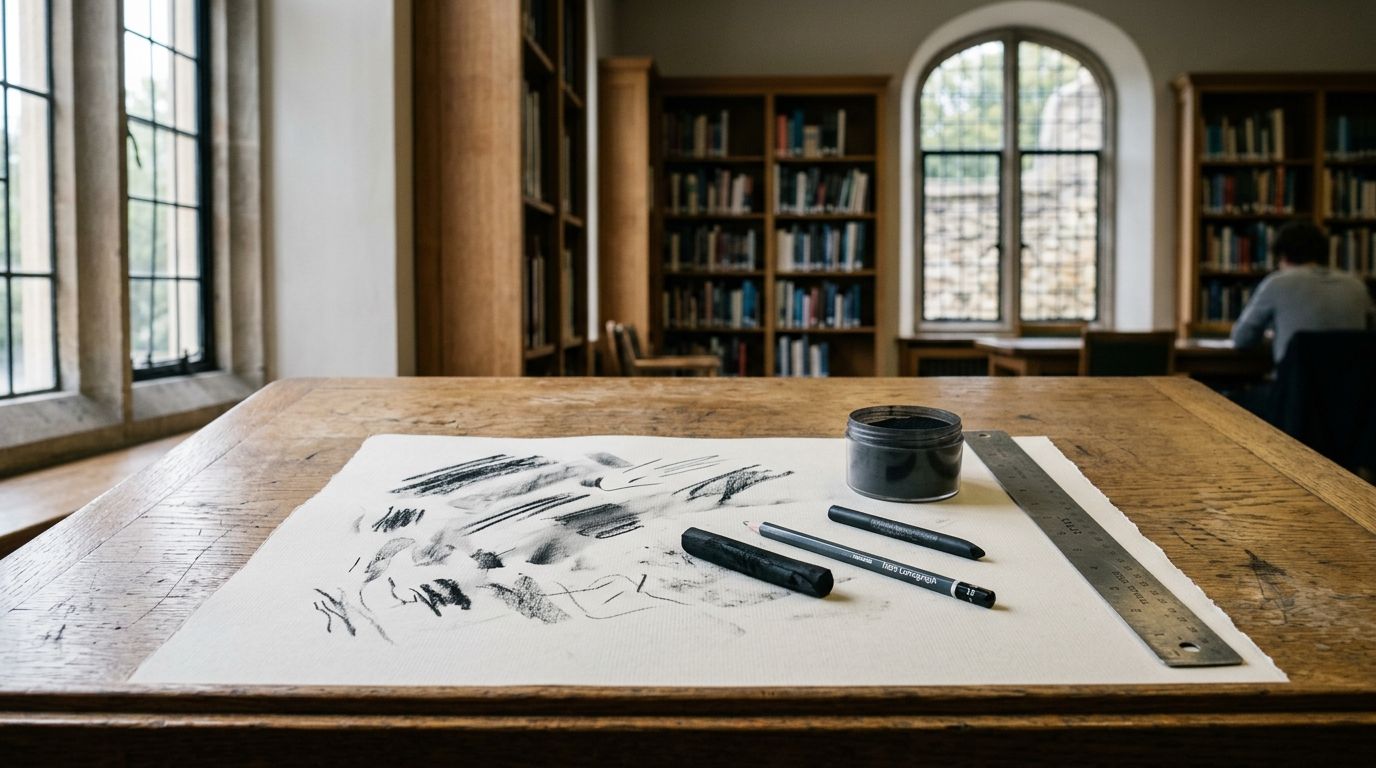
Exhibo Editorial
What Is Line in Art?
A gallery vocabulary of contour, gesture and implied line, read through named museum works rather than classroom drawing exercises.
A line in art is a path a point traces through space. The Getty Education glossary calls it one-dimensional: it has length and direction, and it can vary in width, yet it remains thinner than the area it bounds. The National Gallery of Art’s classroom note is more physical. Line is a mark made with a drawing tool or a brush. Both definitions are useful. One describes what the eye reads. The other describes what the hand left.
Line is one of the elements of art, the inventory of visual facts that sit under composition and the principles of design. Students meet it as “a moving dot.” That phrase is a classroom shorthand, not a law of optics. In a gallery you meet line as contour around a bull at Lascaux, as the drypoint burr of Rembrandt’s The Three Crosses, as the pointing fingers that invent a path across Caravaggio’s The Calling of Saint Matthew, and as the scissors-cut edge of Matisse’s Icarus. This page stays with looking. It belongs to the series Elements and Principles of Art. How line builds the illusion of volume belongs with form. How a composition sends the eye around a picture, as a principle named movement, belongs in a later article in this cluster.
What “line” names in a picture
Search results mix three jobs. First, line is an element: a visible or implied path that describes edges, directions and rhythms. Second, “line art” in illustration and print means an image built from strokes with little or no continuous tone: a woodcut, a comic panel, a vector drawing. Third, in digital studios “line art” is a clean layer of outlines waiting for colour. This article stays with the first job. The second appears only as a confusion to mark. You can look at a fully modelled oil painting and still talk about line. Ingres’s Madame Moitessier (1856, National Gallery, London, NG4821) is oil, not a drawing, and the National Gallery’s own description still tracks a sinuous line from elbow to fingers, echoed in the table leg and the sofa back.
Classroom lists often freeze five types: vertical, horizontal, diagonal, zigzag, curved. Those are directions, not a complete taxonomy. Contour, gesture, implied line, outline and hatching name different jobs a path can do. A single stroke can do more than one job. A contour around a shoulder can also be a gesture if the hand that made it moved fast. An implied line can be as decisive as an inked one. The useful question in front of an object is not “which of the five is this?” but “what is this path doing for the picture?”
Line also sits next to neighbouring elements. A closed line becomes a shape. Repeated, weighted or hatched lines can suggest form, the sense of volume in space. Parallel lines that recede toward a vanishing point belong to perspective method (S17-03), which this series leaves to a later cluster. Here the task is smaller and stricter: name the path, say whether it is actual or implied, and say what it organises.
How line works when you look
The eye does not meet a line as geometry class meets a Euclidean infinite. You meet a difference: pigment against plaster, a furrow of drypoint burr, a cut in paper, a row of heads that align. The Getty teacher sheet still gives the working properties that survive that difference. A line has length, direction and width. It can be continuous or broken. It can sit on the surface or describe an edge in depicted space. Those properties are what you can point to with a finger.
Before the named types, two distinctions do most of the work. One is actual versus implied. The other is the character of the mark: weight, speed, and whether the line is an edge or a trail of the tool. Both distinctions keep you from treating every dark stroke as an “outline” and every empty gap as “nothing.”
Actual line and implied line
An actual line is a physical mark: charcoal on limestone, engraved furrow, brush ridge, a cut silhouette. You could, in principle, follow it with a fingertip without inventing a connection. The black contours of the aurochs in Lascaux’s Hall of the Bulls are actual. So are Dürer’s engraved hatchings in Melencolia I (1514). So is the graphite study of Madame Moitessier’s right hand in the Fitzwilliam Museum (inv. 2689).
An implied line is a path the viewer completes. Alignment of shapes, a sequence of highlights, a pointing hand, a gaze, a row of columns: none of these need a continuous stroke. The Getty formal-analysis page describes implied continuation in landscape, where horizontal bands suggest the land going on beyond the frame. In narrative painting the same mechanism is social. In Caravaggio’s The Calling of Saint Matthew (1599–1600, Contarelli Chapel, San Luigi dei Francesi, Rome), Christ’s extended hand and the chain of glances across the tax-gatherer’s table invent a diagonal you cannot scrape off the canvas. The line is in the looking.
Implied line is easy to over-claim. Not every coincidence of edges is a designed path. Test it. Does more than one element participate? Does the path land on a face, a hand, a vanishing interval, or a break in the architecture? If you have to force the connection, you are drawing on the picture rather than reading it.
Weight, direction and the classroom mood chart
Weight is the thickness and darkness of the mark relative to its neighbours. A swelling contour can turn a calf into volume without shading. A hair-thin engraved line can sit behind a denser nest of hatching and read as distant air. Direction is the orientation on the picture plane: horizontal, vertical, diagonal, curved, broken. The Getty sheet assigns feelings to those directions. Horizontals suggest rest because objects parallel to the earth are at rest. Verticals can read as stable or as aspiring, depending on context. Diagonals are unstable; they read as motion or as collapse. Curves can soften a field of straight edges.
Treat that chart as a starting hypothesis, not a codebook. A horizontal in a seascape is not the same horizontal as a recumbent corpse. Mondrian’s black grids in Composition with Yellow, Blue and Red (1937–42, Tate, T00648) are horizontal and vertical without pastoral calm. They lock planes. Direction is evidence. Mood is an inference you still have to justify from the rest of the picture.
Speed is harder to prove and still worth naming. A dragged drypoint burr records a hand that did not lift. A carefully ruled LeWitt wall drawing records a decision that someone else executed later. When you say a line is “gestural,” say what on the surface lets you make that claim: skips, thickening, overlap, a change of pressure.
Types of line: contour, gesture, hatching, outline
School posters love a numbered list. Museums rarely hang one. The types below are jobs you can verify on named objects. They overlap. Hatching is a way of packing lines so they read as tone; it is not a personality of line separate from contour. Outline is a subset of contour, the silhouette edge, and it is the type students over-use because colouring books trained them to stay inside it.
Keep the fence in view. This is not a lesson in how to hatch a sphere or how to “loosen up” a life drawing. Those are studio procedures. The question here is what those families of mark look like when they are already on the wall, and what they are doing.
| Job | What you can point to | Typical work in the picture | Named object | Where to look |
|---|---|---|---|---|
| Contour (including interior) | Edge where one area meets another | Names a body or fold without filling it | Ingres, Madame Moitessier, 1856 | National Gallery, London, NG4821 |
| Outline / silhouette | Closed outer edge, little interior modelling | Reads as a profile or cut shape | Matisse, Icarus from Jazz, 1947 | MoMA 291.1948.8; Met 1983.1009.8 |
| Gesture | Path that records speed, pressure or later reworking | Turns the field into an event | Rembrandt, The Three Crosses, 1653 | British Museum F,4.171; Rijksmuseum RP-P-OB-616 |
| Implied line | Gaze, pointing, alignment; no continuous stroke | Sends looking across figures or architecture | Caravaggio, The Calling of Saint Matthew, 1599–1600 | Contarelli Chapel, San Luigi dei Francesi, Rome |
| Hatching (as looking) | Parallel or crossed lines packed into tone | Distinguishes substances and value | Dürer, Melencolia I, 1514 | Met 43.106.1 |
| Structural / register line | Ruled or architectural path | Stacks narrative or locks planes | Nebamun hunting fragment, c. 1350 BCE; Mondrian, Composition with Yellow, Blue and Red, 1937–42 | British Museum; Tate T00648 |
| Instructional line | Mark executed from a written rule | Makes the rule visible at wall scale | LeWitt, first wall drawings 1968; Wall Drawing #254, 1975 | MIT List Visual Arts Center (254) |
Contour line
Contour is the line where one area meets another: the profile of a form, an interior fold, the meeting of a sleeve and a wrist. LibreTexts and most foundation handbooks stress that contour is not always the complete outline of a shape. An interior contour can describe a collarbone without closing a silhouette. When you look at Ingres’s seated Madame Moitessier, the National Gallery text asks you to follow the contour from the right elbow along a seemingly boneless hand, then to notice the same curve returning in furniture. The oil paint conceals the graphite studies underneath. The contour remains the organiser.
Egyptian painting makes contour a public fact. The British Museum’s fragments from the tomb-chapel of Nebamun (Thebes, late 18th Dynasty, around 1350 BCE; the hunting scene is among the best known, often cited as EA37977) show animals, reeds and the hunter’s body bounded by dark, even outlines, with interior detail kept subordinate. Register lines, the ruled horizontals that stack the narrative, are also contours of a kind: they are edges of depicted space, not of bodies. You read them as structure before you read them as drawing.
Contour can be cut rather than drawn. Matisse’s Icarus (Icare), plate VIII from Jazz, published 1947 by Tériade in Paris, exists as pochoir prints after gouache-painted paper cut-outs. MoMA holds impressions (among them 291.1948.8). The black figure is a silhouette whose edge is a scissor contour. There is no interior modelling. The red disc on the chest and the yellow bursts around the body sit as separate shapes. The line you see is the cut.
Gesture line
Gesture, in looking rather than in the life room, is a path that records motion or the impulse of the hand more than a measured edge. Rembrandt’s The Three Crosses (drypoint and burin, signed and dated in the third state, 1653) is the test case. Impressions sit in the British Museum (F,4.171 among others), the Rijksmuseum (RP-P-OB-616) and the Philadelphia Museum of Art. The Rijksmuseum notes that Rembrandt worked the scene almost entirely in drypoint, scratching the copper so the burr holds extra ink. In later states he gouged vertical curtains of line through the sky. Those scores are not tidy contours of clouds. They are directional fields that darken the world around Christ. You read speed because the burr and the overlap of states leave a history of the needle.
Gesture is not a synonym for mess. A slow, heavy contour can be as decided as a fast one. The word earns its keep when the mark’s path is more informative than the edge it might have described. Cy Twombly’s later paintings and drawings, held in depth at Tate and MoMA, push that extreme: loops and scrawls that remain lines even when they refuse to outline a body. You do not need a biography of Abstract Expressionism to see the fact. The marks are paths.
Hatching as something you see
Hatching is a set of roughly parallel lines whose spacing and direction the eye blends into tone. Cross-hatching adds a second direction. Stipple uses dots. In a print, those devices are how a copper plate, which cannot lay a wash, still produces a range of darks. Dürer’s Melencolia I (1514) is the standard demonstration because the plate is small and the inventory of textures is large. The Metropolitan Museum holds several impressions, including 43.106.1 (Harris Brisbane Dick Fund, 1943). Brooklyn Museum commentary on another impression notes directional shading, cross-hatching and stipple used to distinguish stone, fur, metal and flesh. You are not being asked to copy the plate. You are being asked to notice that “shadow” here is still line, packed until it reads as value.
Hatching can also be a contour in disguise. Parallel curves that follow a thigh describe the turn of the form; they are both tone and interior contour. When foundation courses treat hatching only as a shading recipe, they hide that double job. In front of a print, name both.
Six works: what the lines are doing
Classroom pages on line recycle the same clip-art arrows. Named objects force the vocabulary to pay rent. The six below run from painted rock to pochoir, and they are chosen for different jobs, not as a tour of styles. Dates for Lascaux remain debated. The French Ministry of Culture’s Lascaux site records radiocarbon results that have placed material from the cave between roughly 23,500 and 17,000 years before present, with cultural attributions shifting between late Solutrean, Badegoulian and early Magdalenian; later AMS programmes have also clustered occupation around 21,500–21,000 BP. There is no single settled date for the Hall of the Bulls figures. UNESCO inscribed the Vézère decorated caves, including Lascaux, in 1979. The original Hall of the Bulls is closed; visitors see facsimiles at Lascaux II and Lascaux IV in Montignac.
Lascaux and Nebamun: contour before the academy
In the Hall of the Bulls the largest aurochs runs more than five metres. Dark contours ride the swell of the limestone. Interior modelling is spare. Legs overlap. Horns cross other animals. The line does two jobs at once. It names the species by profile, and it lets later figures share the wall without a ruled perspective box. You are looking at contour as a technology for putting many bodies on one surface.
Nebamun’s hunting fragment, about three thousand years later and made for a tomb-chapel rather than a cave, uses contour with a different social brief. The hunter, the cat, the birds and the papyrus umbels are outlined so a visitor to the chapel can read status and provision at a glance. Interior pattern (spots on the cat, chevrons on wings) sits inside those bounds. The register system, which Egyptian painters used across tomb walls, is a family of straight lines that organise time and rank. If you only hunt for “expressive” stroke, you will miss the most important lines in the room.
Dürer and Rembrandt: line as tone and as event
Melencolia I is an engraving, 24 by 18.5 cm in the Met’s 43.106.1. Every dark is a density of line. The polyhedron, the purse, the sleeping dog and the folded wings are distinguished by the direction of the hatch as much as by their silhouettes. That is the looking lesson. Contour alone would give you a diagram of objects. Hatching gives you substances. The iconography of melancholy is a separate problem, treated in other series on this site; here the plate is evidence of how far line can go toward value without a brush loaded with wash.
The Three Crosses shows the other extreme. Drypoint burr prints as a velvety bloom around the scratch. In the third state Rembrandt signed and dated the plate; the British Museum’s commentary (via its published notes on F,4.171) treats that state as the moment he considered the image complete, with supernatural light around the cross and darkness in the corners. In the fourth state he re-scored the sky. Gesture here is historical. You see a line that was added later, over other lines, to change what the scene is. That is not a drawing-class prompt. It is a fact about states.
Ingres, Caravaggio, Matisse: painted contour, implied path, cut edge
Ingres’s Madame Moitessier was finished in 1856 after a long campaign of sittings that had already produced a standing portrait in 1851 (National Gallery of Art, Washington). The London picture is oil, yet line remains the structural fact the Gallery’s text isolates: elbow, hand, table leg, sofa, ribbons. Graphite studies survive; the Fitzwilliam sheet isolates the right hand. Contour, in a finished academic portrait, can be almost invisible as a dark stroke and still govern every adjacent curve.
Caravaggio’s chapel painting in Rome is the textbook of implied line because the actual contours of sleeves and table are relatively quiet. The drama is the vector of hands and eyes. Christ’s gesture quotes Michelangelo’s Adam on the Sistine ceiling, a fact many catalogues note; the quotation works because a viewer can complete the path from one hand to the next. Implied line is often social. It is people aiming at people.
Matisse’s Icarus closes the set by removing the drawn stroke. Scissors make the contour. The pochoir edition of 1947, in book form of 250 and a portfolio of 100, keeps the gouache colour of the studio papers. MoMA and the Met (1983.1009.8) both hold plates. The black body against blue is an outline in the strict sense, a silhouette, with almost no interior contour except the red disc. If your only definition of line is “a pencil moving,” this object will not fit. The definition has to include an edge produced by a cut.
How contemporary artists still use line
The jobs do not expire. What changes is the support and the division of labour. Sol LeWitt (1928–2007) made his first wall drawing in 1968 for the opening of Paula Cooper’s gallery in New York. Assistants still execute the works from certificates and diagrams. Tate Papers on the early wall drawings records LeWitt isolating four “absolute directions” of line: vertical, horizontal, and the two diagonals, numbered and combined in grids. Wall Drawing #254 (1975), a later example documented at MIT’s List Visual Arts Center, specifies white lines from the centre of a yellow wall to points the draughtsperson chooses for that architecture. Line here is an instruction that becomes a mark. The looking task is to see both: the pencil on plaster, and the rule that produced it.
Bridget Riley’s early black-and-white paintings, such as Movement in Squares (1961, Arts Council Collection, often on loan), pack edges so tightly that the contour of each unit starts to shimmer. The principle that textbooks call movement (how a composition directs the eye) is a later article in this series. Riley is in this paragraph because her unit is still an edge: a boundary between black and white that the retina refuses to keep still. You can name the line without writing a survey of Op art.
Julie Mehretu’s large canvases, including works shown at Tate Modern and the Whitney, layer architectural plans, stadium diagrams and calligraphic marks. Up close you are in a nest of actual lines; from a few metres the same marks collapse into weather. The double scale is the point. Kara Walker’s cut-paper silhouettes, shown widely since the mid-1990s, return to Matisse’s scissor contour with a different subject. The edge is elegant. The narrative it bounds is not. Contour, in her rooms, is a historical weapon: the nineteenth-century profile portrait and the racist caricature share a technique, and she makes you look at the shared edge.
Frank Stella’s 1960s black paintings and later reliefs treat the stripe as both line and object. A stripe has width, so purists will call it a shape. In the room, you still follow it as a path. The vocabulary is allowed that overlap. Digital drawing (Hockney’s iPad landscapes, shown in Westminster Abbey’s Royal Collection exhibitions and at the National Portrait Gallery in recent years) restores the “moving point” as a lit pixel trail. The Getty definition still holds. The tool changed.
How to identify line when you are in front of the work
Stand far enough to see the whole field, then walk in until individual marks separate. The two distances answer different questions. From the far position you can trace implied paths: gazes, pointing, alignments of architecture, the way a river or a road exits the frame. From the near position you can name actual marks: engraved hatch, brush ridge, cut paper, pencil sheen.
Ask five questions and stop when they are answered.
- Is the path actual or implied? If implied, what completes it?
- Is it an edge (contour, outline) or a trail (gesture, hatch, scribble)?
- What is its weight relative to neighbours?
- What direction does it take, and does that direction repeat?
- Does it close into a shape, suggest a volume, or stay a path?
Write the answers in ordinary nouns. “Dark engraved lines packed on the dog’s back, running with the fur, denser than the lines on the polyhedron.” That sentence is better than “expressive hatching.” If you cannot point to the mark, you do not yet have a line; you have a mood.
Prints need one extra habit. Check the state and the impression. Rembrandt’s third and fourth states of The Three Crosses are different pictures made of different lines. Dürer’s plate wears; late impressions lose burr and look thinner. Museum labels usually give state when it matters. Believe the label before a poster.
Sculpture and architecture use line too, as silhouette against a window, as a joint in stone, as a rod in a construction. The element does not belong only to drawing. A Giacometti figure is almost all contour in space. A Gothic rib is a structural line you can walk under. The same five questions apply. The difference is that the “mark” may be a shadow at 3 p.m. rather than ink.
Common confusions and misuses
Line as element versus “line art.” Line art, in publishing, is an image without continuous tone. Line as an element can live inside a Titian. If a search result shows you only outline drawings, it has answered a different query.
Contour versus outline. Outline is the silhouette. Contour includes interior edges. Calling every edge an outline flattens folds, overlaps and the meeting of colour fields. Bare contour line in search is also a cartography trap (height isolines on maps). If you mean the art element, keep the in-art phrasing.
Implied line versus wishful composition. A path you invent from two unrelated corners is not evidence. Implied line needs cooperation: gesture, gaze, alignment, or a documented device such as linear perspective (method reserved for S17-03).
The five-types poster. Vertical, horizontal, diagonal, zigzag and curve are directions. They do not replace contour, gesture or hatching. Zigzag is a compound of diagonals. You will not find a canonical “five” in the Getty or NGA sheets.
Mood as code. “Horizontal equals calm” is a teaching aid. Test it against the subject. A dead calm sea and a dead body can share a horizontal and share nothing else.
Hatching as a how-to. Looking at Dürer is not the same as practising a value scale. If a page starts selling pencils, it has left the element for the exercise.
Line versus form. Packed lines can suggest volume. Volume as an element is form: mass, the sense of three dimensions. Keep the words apart so the two articles in this series do not cannibalise each other.
Art movements. Line is not a period. Using this page to narrate Cubism, Expressionism or Minimalism as a sequence would break the fence. Name a work. Name the marks. Leave the school history to the movement series.
“Line art for kids.” That query wants simplified outlines and activity sheets. It is a real search (it appears in related terms). It is not this page’s job.
Line beside the other elements
The elements are a toolkit, not a ranking. Line often arrives first in a syllabus because a child can make one with a stick. In a museum the order is less polite. Colour can carry an edge. A sharp value change can act as a line with no stroke at all. Texture can be a field of tiny lines (a dense engraving, a woven ground). Space can be organised by orthogonals that are still lines. The hub article on the elements of art sets the inventory. This page is the entry for one item.
When line closes, you have shape. When shape turns and takes light, you are toward form. When a sequence of lines or edges sends you through the picture, you are toward the principle of movement, which this cluster will treat separately so that “movement” does not collapse into a list of historical -isms. If you want to stand in front of the objects themselves, the museums directory is the practical next step: National Gallery (Ingres), British Museum (Nebamun; Rembrandt impressions), Metropolitan Museum (Dürer; Matisse), Tate (Mondrian; LeWitt-related holdings and Riley loans), MoMA (Matisse Jazz). Lascaux IV at Montignac is the facsimile for the Hall of the Bulls.
The vocabulary earns its keep only in those rooms. A definition you cannot test on a named surface is a poster.
FAQ
The questions below repeat what search boxes and classroom posters actually ask. Several collapse line as an element into “line art,” or treat five directional labels as a complete taxonomy. The answers stay with looking: what you can point to on a surface, which museum object makes the distinction visible, and which neighbouring term belongs on another page in this series. If a question wants a how-to (how to hatch, how to draw line art on a tablet), it has left this article. If it wants a history of Cubism or Expressionism as a sequence of styles, it has left the fence. The eight replies that follow are definitional, and they send you back to named works rather than to a poster of arrows.
What is a line in art, in one sentence?
A line is a path a point traces in space, whether as a physical mark (stroke, cut, engraved furrow) or as an implied route the eye completes from gazes, gestures and alignments.
What are the types of line in art?
Useful types name jobs: contour (edges, including interior ones), outline (silhouette), gesture (a path that records motion or the hand’s impulse), implied line (a completed path with no continuous stroke), and hatching (packed parallels that read as tone). Directional labels (horizontal, vertical, diagonal, curved) describe orientation. They are not a rival list of five eternal kinds.
What is a contour line?
A contour is the line where areas meet. It can bound a whole figure or describe an interior edge such as a fold or a collarbone. It is not a height isoline on a map. Matisse’s Icarus is almost pure silhouette contour. Ingres’s Madame Moitessier hides the stroke in oil while still organising the portrait as a system of matching curves.
What is an implied line?
An implied line is a path you can follow even though no continuous mark is there. Caravaggio’s chain of hands and glances in The Calling of Saint Matthew is the usual museum example. Alignment of heads, a pointing finger, a road that exits the frame, or a sequence of windows can do the same work. If only you can see the path, it is not yet evidence.
Is “line art” the same as line as an element?
No. Line art in illustration and print usually means an image built from strokes without continuous tone. Line as an element of art is present in paintings, sculptures and buildings whenever an edge or a path organises looking. A Titian has lines. A woodcut is line art.
Do horizontal lines always feel calm?
No. Teaching sheets (including the Getty’s) use rest and instability as first hypotheses because we live with gravity. Subject matter can override the hypothesis. Check the picture before you import the poster.
How is line different from shape and form?
A line is a path. A shape is an area, often a closed path, with height and width. Form is the sense of volume, height, width and depth. Hatched lines can suggest form; they do not automatically become it. Keep the three words so you can point to three different facts.
Where should I look at line in public collections?
Start with objects already discussed: Ingres NG4821 in London; Nebamun fragments and Rembrandt impressions in the British Museum; Dürer Melencolia I and Matisse Jazz plates in New York; Mondrian T00648 at Tate. Then pick any print room. Engraving and drypoint make line impossible to ignore. The museums index lists institutions by city.
Related reading
Kiasma Outlines a Robust 2027 Season Featuring Major Surveys and Prize Showcase
Helsinki's Museum of Contemporary Art Kiasma unveils a comprehensive schedule balancing institutional retrospectives, immersive solo projects, and regional award programmes.
The 2027 calendar at Kiasma positions spatial experimentation and critical historiography at the forefront of Nordic contemporary practice.
Ukrainian Museum Celebrates Half-Century With Community-Led Lobby Project
Molly Gochman transforms archive fragments into a projected collage marking five decades of cultural preservation
As the institution turns fifty, an immersive lobby installation invites locals to contribute personal artefacts, weaving private histories into a broader narrative of Ukrainian heritage and resilience.
When Defending Heritage Becomes a Crime: The Arrest of Iraqi Archaeologists
Whistleblowers targeted over corruption claims and controversial investment legislation
Detentions of leading experts raise alarms over censorship, rapid site clearance, and the future of Iraq's archaeological record.