
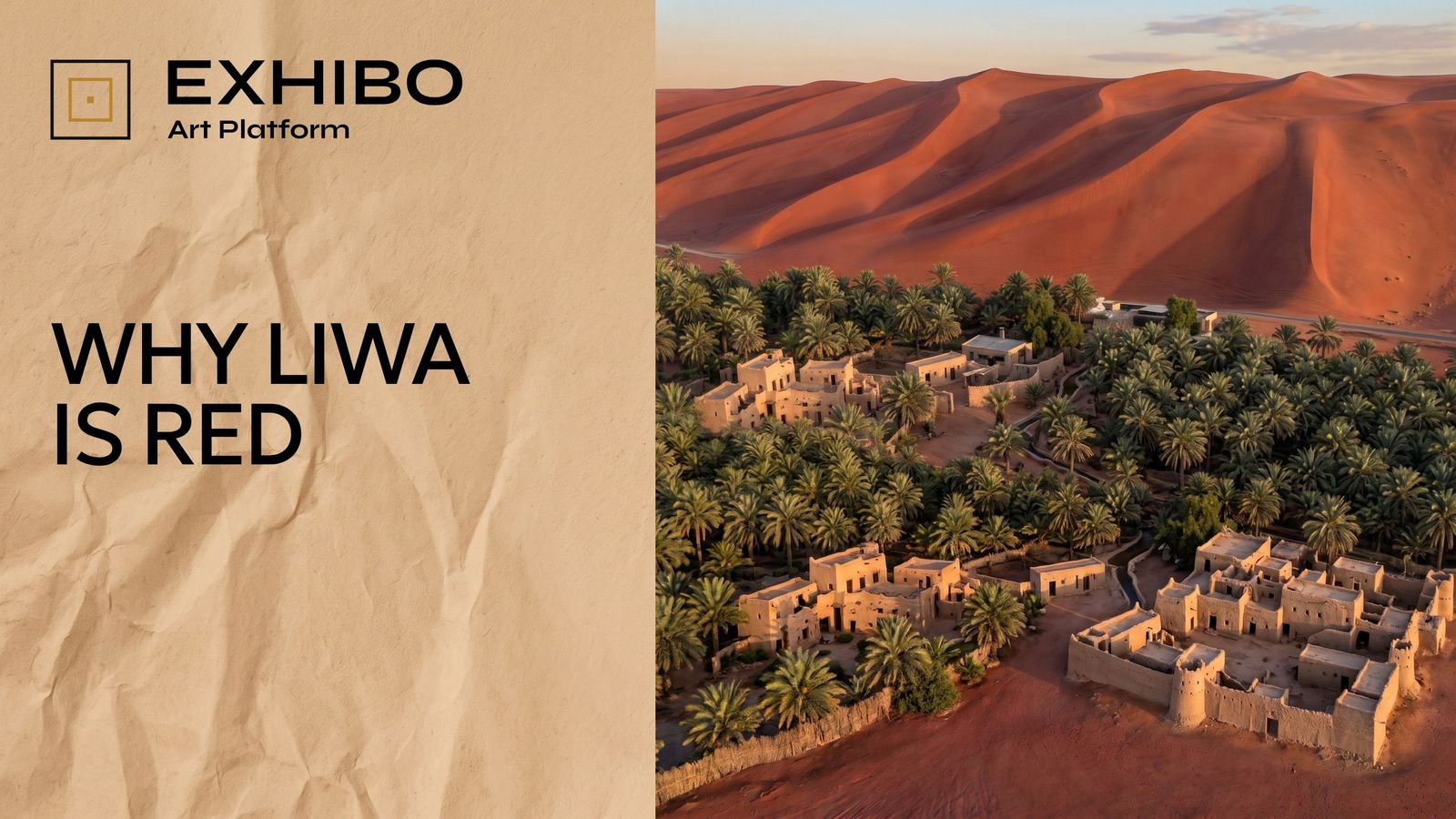
Abu Dhabi · United Arab Emirates
Why Liwa Is Red
The red of the world's tallest dunes isn't a fact about the sand — it's a record of everywhere the sand has been. A drowned sea, an ice-age wind and a buried green Arabia, all pressed into a single colour.
Late afternoon, the Liwa crescent, about two hundred kilometres south of Abu Dhabi, and the sand in front of you is doing something the eye refuses to quite believe. It is red. Not sunset-red, not the flattering red the low light lends everything at this hour — it is red at noon too, red in the hand, red the way a brick is red. Pick up a handful and the colour doesn't wash out with the light; crush it between your fingers and the dust stays that same rust. It is not a trick of the sun. It is the sand itself. And the dune behind it climbs and climbs until Tal Mireb rises somewhere past three hundred metres, one of the tallest heaps of sand on the planet, and all of it that same impossible colour.
The easy answer is the one everybody gives. Iron. There is iron in the sand, iron oxidizes, rust is red, therefore the desert is red. It is true in the way "the Gulf is white because white reflects heat" is true — which is to say, it is the first sentence of a much longer story, and if you stop there you miss the thing that makes this place extraordinary.
Because the red is less a property of the quartz than of the grain's history. Every grain at Liwa is carrying a biography — of the rock it broke off, the sea it crossed, the wind that lifted it, the tens of thousands of years it has sat here weathering — and the colour is simply the outermost layer of that history, the most recent entry in a very long diary. Liwa is not red, in the end, because of what its sand is. Liwa is red because of what its sand has done. Read the colour closely enough and it tells you the whole story.
So let's read it.
The colour is a coat the grain picked up along the way
Put a single grain of Liwa sand under enough magnification and you find, mostly, quartz — clear, glassy, colourless quartz, the same mineral as clean window glass or a mountain stream's white sand. The dunes of the Rub' al-Khali often exceed ninety per cent quartz, which by itself would make them pale. The red is a skin. Each grain wears an extraordinarily thin film of iron oxide — primarily goethite and hematite, the same rust chemistry as the ochre of Marrakech and the mud walls of the Najd — wrapped around a transparent core. A red dune is not a mountain of red material. It is a mountain of clear glass beads, each painted with a coat of rust so fine it would take a microscope to measure, and the coat is the whole of the colour.
That coat is the grain's first diary entry, and geologists can read the handwriting. They call the process rubification: iron mobilised during weathering, oxidized, creeping across the surface as a stain that skews yellow when thin and deepens toward red as it thickens. Which sounds, tantalizingly, like it should be a clock — more rust, more time, redder grain, older sand.
It isn't a clock. And the reason it isn't is the first real clue to how this desert works.
The colour is largely inherited, not earned here
When researchers dated dune sands directly and set the ages against their redness, the tidy correlation wasn't there. In the Negev, sand active in the last century carried much the same red as sand that had lain still since the Pleistocene; one study concluded there was no direct relationship between reddening and the absolute age of the sand at all.
The colour, it turns out, is often inherited. A grain frequently arrives already stained, its coat acquired somewhere upstream in an older environment, and may carry that coat across several environments before it settles — deepening in some, losing it in others. The red is not the dune's age. It is the grain's life story — and that story, in this desert, begins somewhere almost impossible to picture from where you're standing.
A sea floor, lifted into the sky
The geologists keep circling one paradox. The land around the Rub' al-Khali is largely limestone, carbonate rock that holds very little quartz — and yet the dunes are nearly pure quartz. Where does an ocean of quartz sand come from, in a basin ringed by rock that contains so little of it?
The answer runs back through the ice ages. At glacial maxima sea level fell a hundred metres and more, and the Arabian Gulf — shallow to begin with — drained almost entirely, its floor lying bare to the wind. Down that dry basin ran the ancestral Tigris and Euphrates and the old drainage of the Wadi Al-Batin, spreading quartz sand recycled from the ancient sandstones of interior Arabia across the emptied seabed. Then the shamal — the great northwesterly that still blows down the Gulf today — lifted that sand off the exposed floor and drove it south, onto the peninsula, into the basin at Liwa. Some grains still carry marine shell fragments from the seabed they were scoured from.
The red mountain at Liwa is, in part, the floor of a vanished sea, lifted grain by grain into the air and stacked three hundred metres high by the wind. This is the middle chapter of the biography, and it dwarfs the rest: before Liwa was a desert it was the bed of a drowned gulf, and before that the sandstone heart of Arabia. When you say Liwa is red, part of what you are saying is that its sand has crossed a sea that no longer exists to get here.
The reddest dunes are the ones that stopped
Here the record stops being about travel and starts being about rest — and it explains why the tallest dunes are the reddest.
You might assume the great dunes are the most active, that height means sand roaring across the landscape. At Liwa it is close to the opposite. The mega-barchans here are among the largest dunes of their kind on Earth, some a hundred and sixty metres from floor to crest, and their great bodies barely move; only the smaller dunes riding on their backs still migrate. The giants are thought to have been stabilised during ancient wetter phases, pinned by moisture and vegetation and by salt crusts drawn up from the flats between them, then stacked over tens of thousands of years into layered mounds — several generations of dune, one built on the ruins of the last.
And a grain that sits still is a grain that reddens. Movement tends to abrade the coat off; stillness lets the iron mature undisturbed, which is why a survey of central Arabia's sand seas found the reddest dunes were consistently the ones not migrating but building up. The red of Liwa is, in part, the red of patience — the colour of sand that arrived, and stayed, and had the time to deepen where it stood.
Which would make the story almost tidy, if the colour held still. It doesn't.
Red is a stage, not a state
And what stillness deepens, water can undo. The iron coat is not permanent: waterlogged in a salt flat, the iron is chemically reduced and carried away, and a red grain that tumbles into a wet sabkha can come out yellow — add the pale gypsum that evaporation leaves behind and it can turn nearly white. The reds and yellows and whites scattered across the Empty Quarter are frequently the same sand caught at different points in a cycle, reddening as it rests, bleaching as it floods, reddening again.
Liwa is red the way a leaf is green: for now, under these conditions, until the conditions change. The colour is not the last word on the sand. It is the current word — the latest entry, always being written over.
And what the newest entry is written over is the part the desert hides best. Because between the red dunes, out of sight, there is water.
The green chapter, still not finished
Liwa is not only a desert. It is an oasis — one of the oldest continuously inhabited stretches of the southern Gulf, ancestral home of the Bani Yas, the confederation from which the ruling families of Abu Dhabi and Dubai descend. Down the length of the crescent runs a broken line of green: date palms, thousands of them, gardens set into the sand between the dunes, watered for centuries from shallow wells.
That green survives because of what the red is standing on. The dunes of Liwa overlie part of an aquifer system — groundwater recharged during wetter climatic periods, now resting on a floor of impermeable carbonate near sea level. Where the water table rises to the surface at the dunes' edges it feeds the palms, and in the low flats it seeps out to form the salt sabkhas. The dating is precise and slightly haunting: this groundwater formed when Liwa received something like twenty centimetres of rain a year, between roughly nine thousand and six thousand years ago — and then, in a window of a few centuries around fifty-five hundred years ago, the rains failed and the desert we see today closed in.
The palms of Liwa are drinking the last of a wetter world. The research says so plainly, and it is worth saying plainly too: the water is being drawn down faster than it is replenished. The oasis lives on a savings account that stopped taking deposits six thousand years ago — which is the same fact as the colour, read at a different depth. The red is the dry present. The water is the green past, still trickling into it.
And that past was greener than the palms let on. Working across the Rub' al-Khali, researchers recently reconstructed an ancient lake — around eleven hundred square kilometres, forty-odd metres deep — fed by monsoon rains that once reached far north into what is now the driest place on the peninsula, its overflow carving a valley a hundred and fifty kilometres long. During the wet phases of the last few hundred thousand years the Empty Quarter held rivers and grasslands; it was a corridor, not a barrier, for the animals and the humans moving out of Africa. The green is not even entirely gone: in the sabkhas at Liwa, under a translucent crust of salt, researchers have found living microbial mats, photosynthetic communities sealed against the arid air by the salt itself — studied, of all things, as an analogue for possible life on Mars. A red landscape coloured by iron oxide, hiding water and life between its dunes. The resemblance to the other red planet is not only in the colour.
The door that closes behind you
The person who wrote most unforgettably about crossing this sand was Wilfred Thesiger, who came through the dunes toward Liwa in the winter of 1947 with a handful of Bedu companions, half-starved, on the first of his two crossings of a place he called the greatest prize of Arabian exploration. Threading the towering dunes of the Uruq al-Shaiba, he looked back at one of them: "Looking back I fancied the great, red dune was a door which was slowly, silently closing behind us." The gap narrowed as he watched, until there was only a wall of sand.
He meant a feeling — the desert sealing him in. But it is a better description of the geology than he knew. These red dunes really are doors that have closed: parked, fixed, reddening in place, sitting on the drowned memory of a wetter Arabia and drinking its buried water. Thesiger read the great red dune as an ending. It is closer to an archive — the whole biography stacked a hundred and sixty metres high, the sea chapter and the green chapter and the dry red present all pressed into the same wall of sand.
The people of Liwa built into that archive without needing to read it. The old forts of the oasis — Dhafeer, low and thick-walled, restored in mud brick — are the colour of the dunes because they are built from the local earth, much as the Marrakech ramparts are the red plain stood upright. The newest arrivals do it too: the resort out at Qasr Al Sarab is built as a great ochre sandcastle, its walls tuned to vanish into the dunes around it — a modern building reaching for the colour of the sand so it can disappear into the newest chapter of the sand's long life.
So why is Liwa red? Not because iron is a fact about the sand, but because red is the last thing that happened to it. A sea floor of clear quartz was lifted into the sky by the wind, picked up a microscopic coat of rust over a journey of tens of thousands of years, and came to rest in a basin where the dunes stopped moving and stood still long enough for the colour to deepen undisturbed. The red is the outermost ring of a very old tree — and under it, where the palms stand and the salt crust hides its living green and the wells pull up water older than the pyramids, the earlier rings are still legible. The Empty Quarter is not empty, and it was not always red. It is a wet world wearing a dry coat.
There is one entry newer still. That red now travels a second time — printed in tourism campaigns, echoed in resort walls, folded into the visual language of Abu Dhabi as a signature of place. It has become an emblem, which is a strange fate for a colour that began as an accident of chemistry and wind. The dunes were red for tens of thousands of years before there was anyone to find them beautiful.
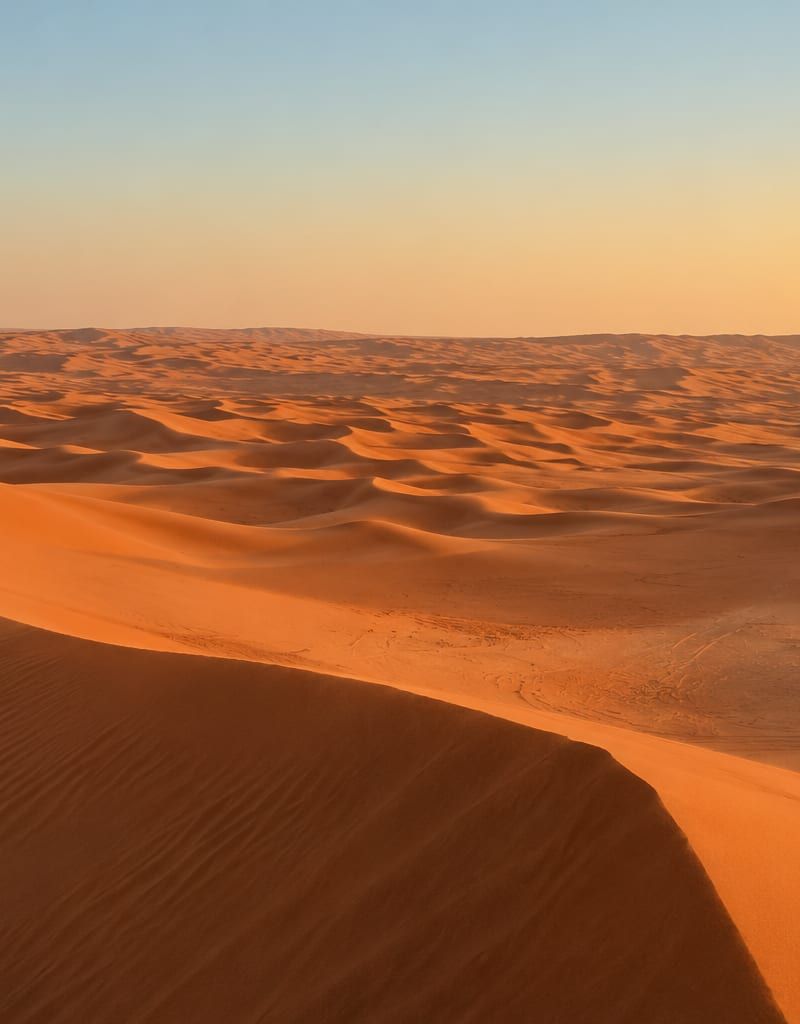
The Liwa Desert
The northern edge of the Rub' al Khali — the largest continuous sand sea on Earth.
Few landscapes carry as many layers as this one. The Liwa desert is at once a geological record — a sand sea that has been freshwater lake more than once in deep time — a national origin story, and, increasingly, a subject for art in its own right: from Christo and Jeanne-Claude's unbuilt Mastaba, conceived for these dunes, to the films and photographers drawn to match its scale. Exhibo lists Liwa not as a gallery but as a place where landscape and image meet — the kind of context the region's art world is built on.
Related reading
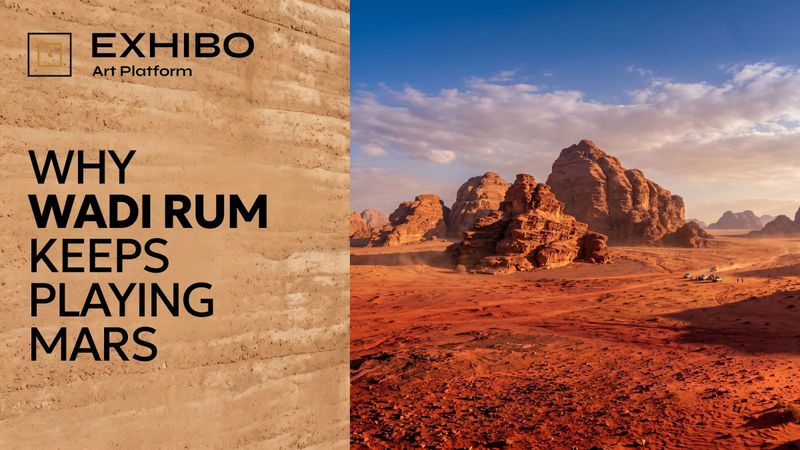
Why Wadi Rum Keeps Playing Mars: A Desert That Is Right About the Wrong Planet
A valley in southern Jordan has become cinema's favourite Mars — not because it is like the planet, but because it looks like the one we carry in our heads.
Put Wadi Rum beside a rover photograph and you can't tell which is Mars. But the desert shares almost nothing with the real planet except its colour — and lately, the illusion has grown powerful enough that real space missions have come to Jordan to rehearse.
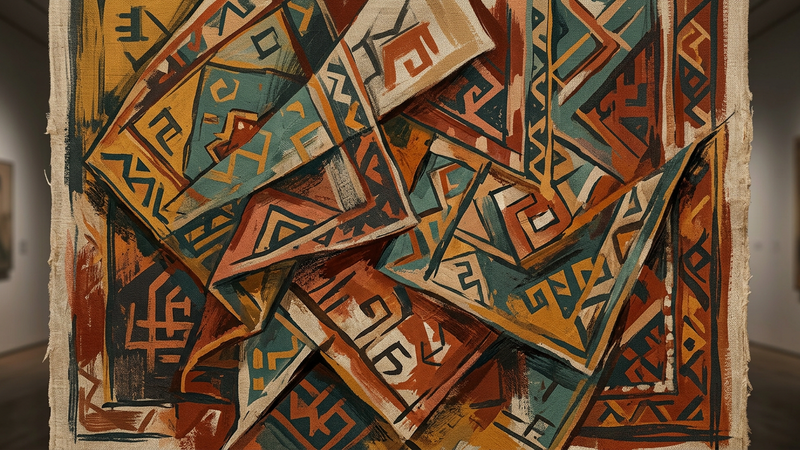
Threads of Heritage: Batima Zaurbekova's Woven Legacy
A survey of Kazakh tapestry pioneers redefines fibre art at Almaty's Kasteyev Museum
Eight decades after her birth, Batima Zaurbekova's textile innovations take centre stage in a major retrospective that bridges Central Asian craft and contemporary visual culture.
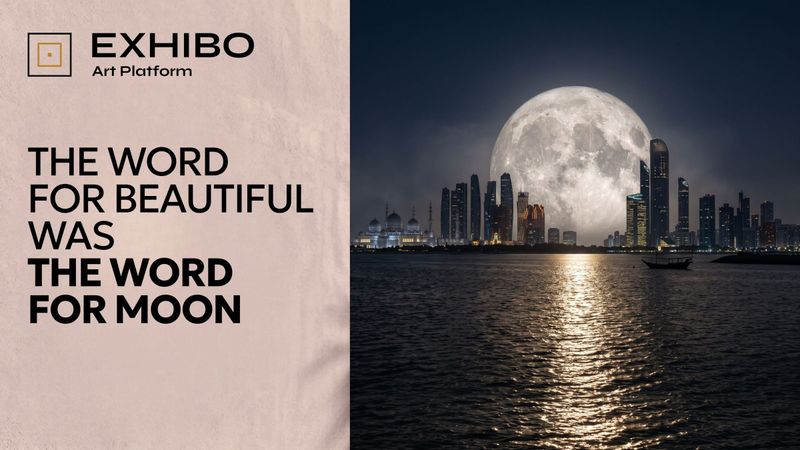
The Word for Beautiful Was the Word for Moon
The moon has been the measure of a beautiful face in Arabic verse for fifteen centuries — but beauty was only one of the things that light was ever asked to carry. A history of one disc, from a pre-Islamic ode to a glowing sphere over an Abu Dhabi harbour.
Ya qamar — you moon — is the oldest compliment in Arabic, and almost nothing about it means what we assume. The moon it praised was not always a woman, not always even a kindness, and in the end not only about beauty at all.