
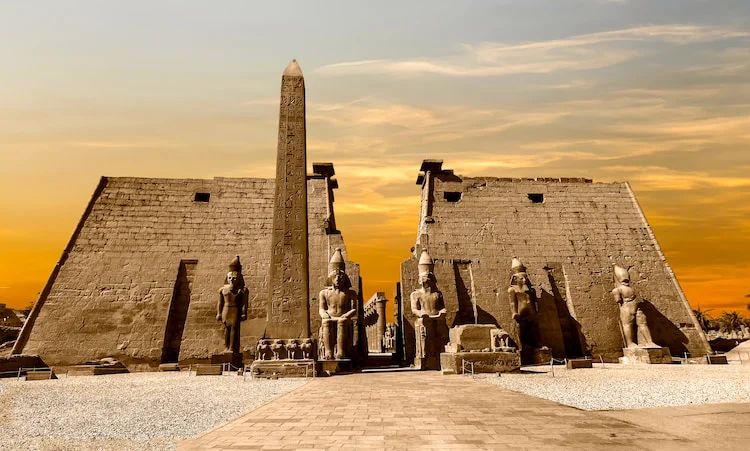
Luxor Temple
Amenhotep III's temple of the Opet festival in the heart of Luxor — with Roman frescoes and a mosque on its colonnade.
The southern sanctuary
Luxor Temple stands in the centre of modern Luxor, on the east bank of the Nile. Known in antiquity as Ipet-resyt, "the southern sanctuary", it was dedicated to the Theban triad of Amun, Mut and Khonsu and closely linked to Karnak, about three kilometres to the north. Every year during the Opet festival, the sacred barques carrying the statues of the gods were taken in procession from Karnak to Luxor along the Avenue of Sphinxes or by river, in a ceremony that renewed the divine power of the king. Unlike most Egyptian temples, it was devoted less to a god in one form than to the rejuvenation of kingship itself.
Builders across the ages
The core of the temple was built by Amenhotep III in the fourteenth century BC: a great colonnade of fourteen papyrus columns, a vast peristyle court and the inner sanctuaries. Tutankhamun and Horemheb decorated the colonnade with reliefs of the Opet festival. Ramesses II added the great forecourt and the entrance pylon, carved with scenes of the Battle of Kadesh, in front of which stood colossal statues of the king and a pair of obelisks; one of these still stands, while the other has stood in the Place de la Concorde in Paris since 1836. Later rulers left their mark too: Alexander the Great rebuilt a shrine for the sacred barque in his name.
Rome, Christianity and Islam
In the late third century AD, the Romans turned part of the temple into a sanctuary of the imperial cult within a military camp, plastering over pharaonic reliefs in one chamber and painting it with frescoes of the emperors, which have since been conserved. Christians later built churches in and around the temple. In the medieval period, when the temple was largely buried, the Mosque of Abu al-Haggag, dedicated to Luxor's patron saint, was built on top of the court of Ramesses II; it still stands there today, its doorway hanging high above the excavated floor.
Visiting
Luxor Temple is beautifully lit after dark and is one of the few Egyptian temples open into the evening. It is part of the UNESCO World Heritage Site of Ancient Thebes with its Necropolis, and the restored Avenue of Sphinxes begins at its gates.
Exhibo editorial
Come at dusk. As the light fades the floodlights come on, and Luxor Temple turns from sandstone into gold: the seated colossi of Ramesses glowing at the gate, the great colonnade standing like a row of lit candles, the minaret of Abu al-Haggag rising above it all, its call to prayer drifting over the pharaohs' court.
That layering is the temple's real gift. Walk from the obelisk to the sanctuary and you pass through Amenhotep, Ramesses, Alexander, Rome, the early Church and medieval Islam in a few hundred metres — a mosque door three storeys up, Roman emperors painted over Egyptian gods. Few places hold so much of Egypt's story in one frame.
How to find it
Luxor Temple stands in the centre of town between the Corniche el-Nil and the Mosque of Abu al-Haggag, a short walk from most east-bank hotels. The entrance and ticket office are on the north side, at the start of the Avenue of Sphinxes; enter past the obelisk and the colossi of Ramesses II, then continue south through the court and the colonnade to the inner sanctuaries.
Similar places
All places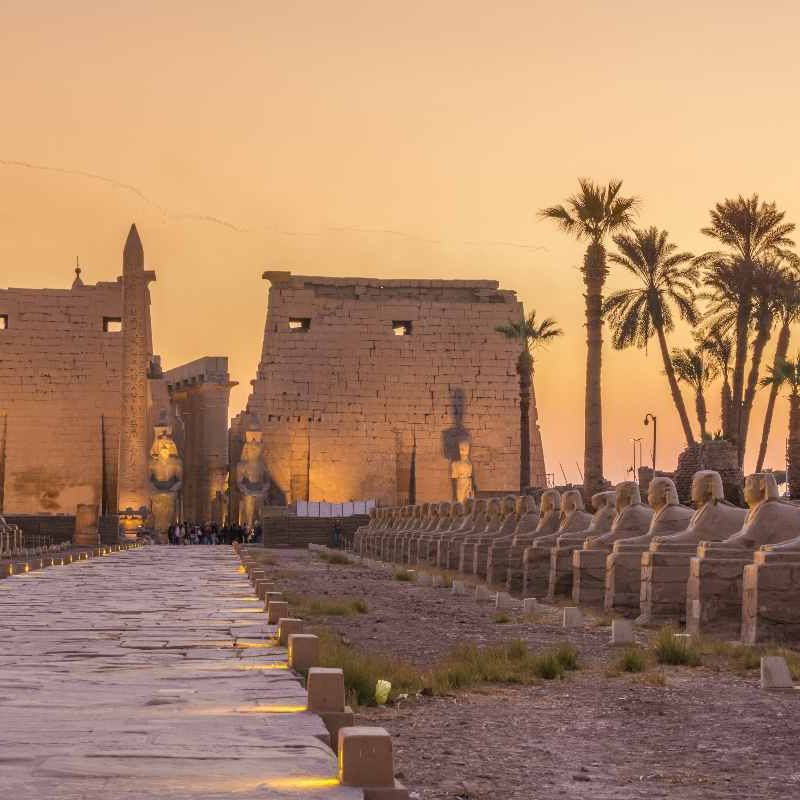
News by Exhibo
Editorial coverage on Exhibo
Unearthing the Golden City: Daily Life in Ancient Egypt
How a newly excavated workers' quarter reframes pharaonic history
A major survey travels to the West Coast, bringing ancient artefacts that shift focus from royal opulence to the daily lives of those who built the empire.
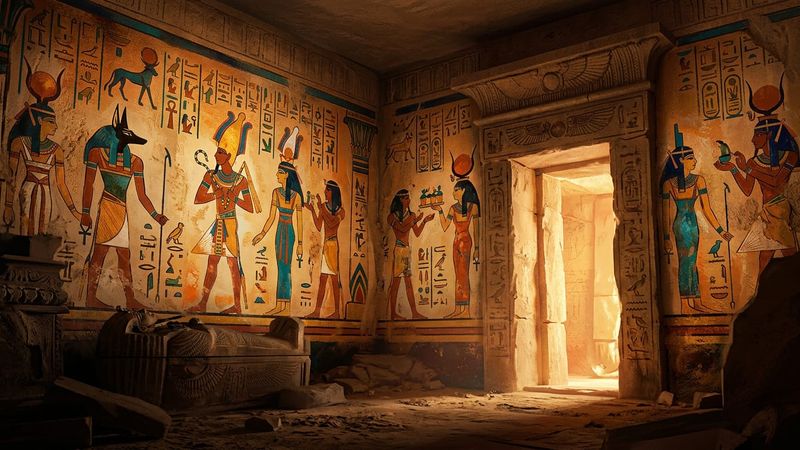
Ancient Egyptian Tomb with Vibrant Murals Unearthed in Luxor
Dutch excavation reveals well-preserved Ramesside period burial with rare coloured wall paintings
Archaeologists have uncovered a 3,000-year-old tomb on Luxor's west bank featuring brightly painted murals that provide valuable insights into elite burial practices during Egypt's New Kingdom period.