Terra — The Sustainability Pavilion
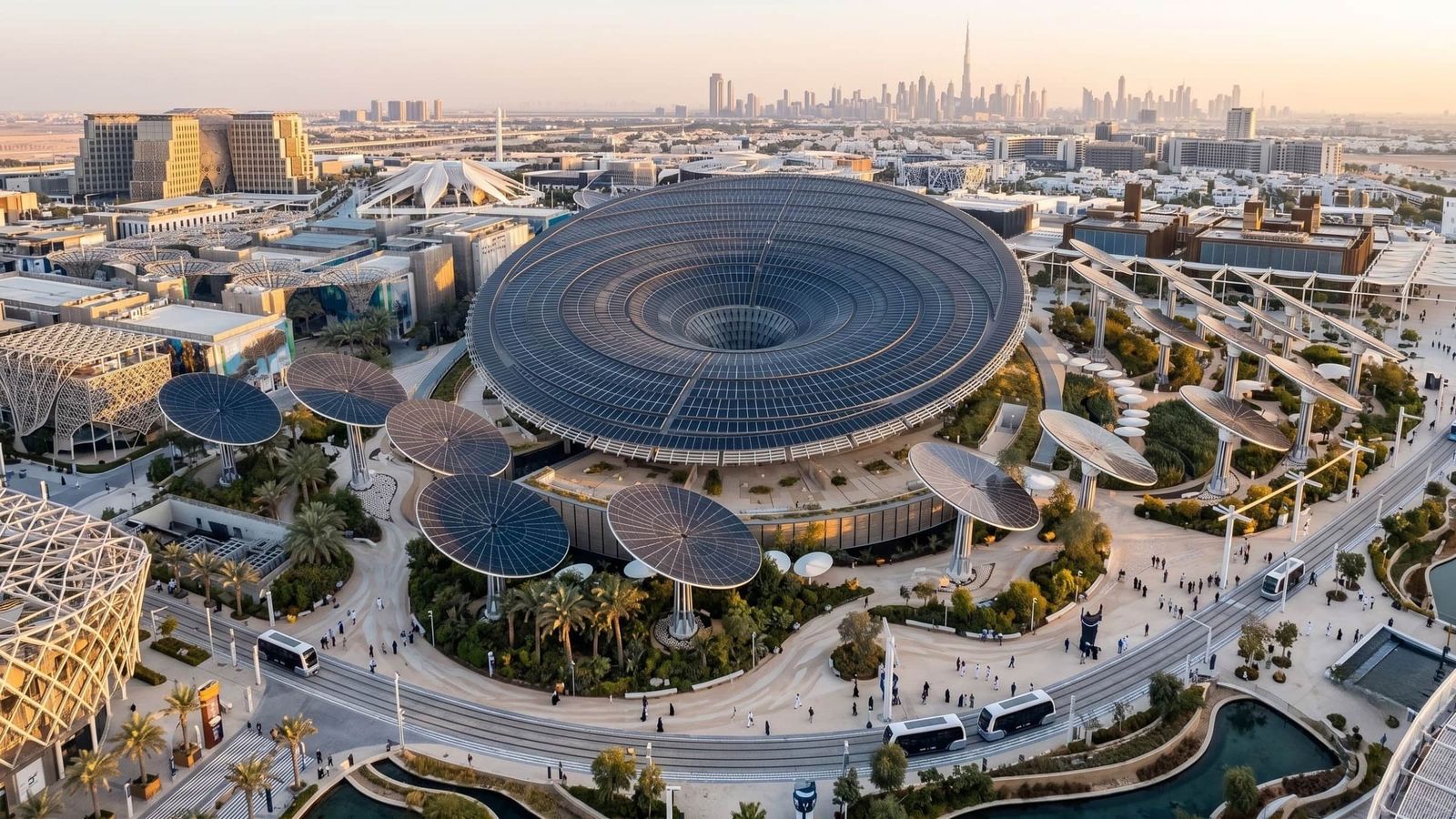
Grimshaw's 130-metre solar canopy — a great steel tree that harvests its own energy and water, ringed by rotating 'Energy Trees'.
Terra — The Sustainability Pavilion is one of the three signature thematic pavilions of Expo 2020 Dubai, now anchoring the sustainability district of the permanent Expo City Dubai. Designed by UK studio Grimshaw with engineering by Buro Happold and facade work by Inhabit, it opened to the public in October 2021 and was among the Expo's top attractions. As a permanent legacy building it now operates as a science centre, and it is designed to LEED Platinum standard.
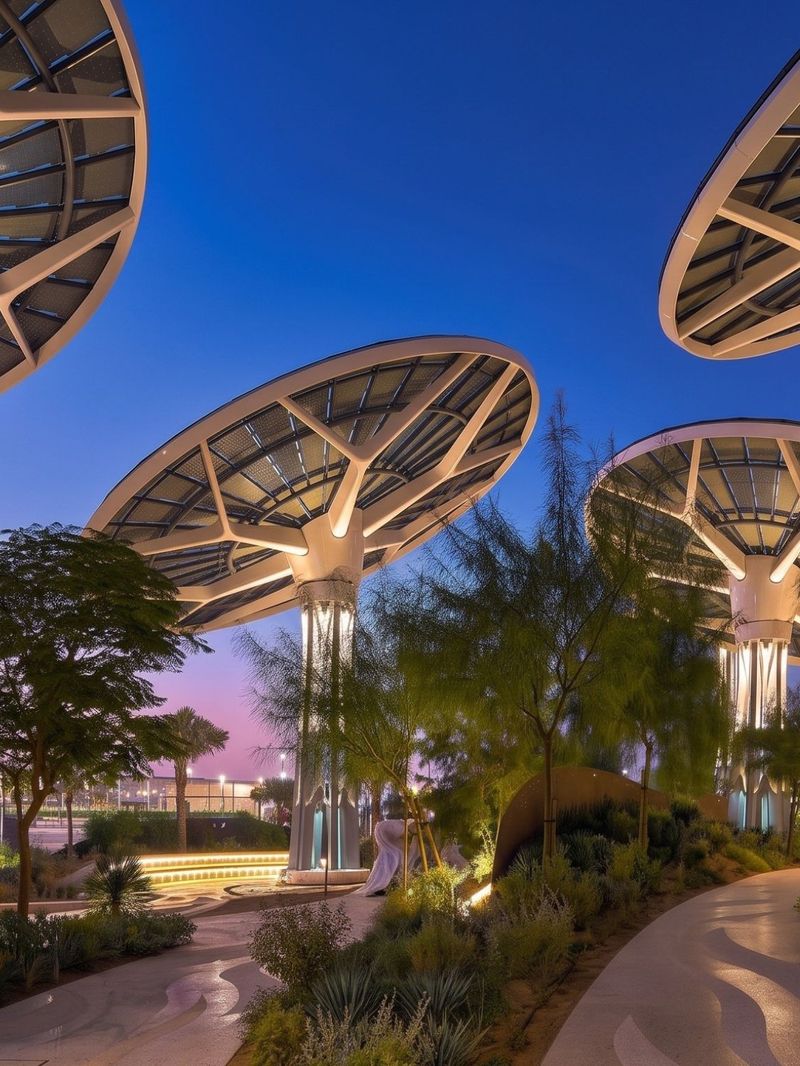
The pavilion's form is drawn from natural processes — photosynthesis, and the drought-tolerant desert Ghaf and Socotra dragon trees — to create a building that generates its own energy and water. Its defining element is an angled, oval canopy roughly 130–135 metres wide, carried on a single central column like a giant tree. The canopy is clad in more than 1,055 photovoltaic panels (around 6,000–8,000 square metres of cells), and is ringed by eighteen smaller rotating 'Energy Trees' that track the sun; together they are designed to generate about four gigawatt-hours of electricity a year — and the pavilion is designed to reuse 100 per cent of its water, drawing none from Dubai's potable network in operation.
Most of the roughly 6,000 square metres of exhibition space is embedded in the ground beneath earth roofs, shaded by the canopy, so the building cools passively in a climate where summer temperatures reach 50°C. The canopy and surrounding water trees harvest stormwater and dew, and the gardens around the pavilion filter, supply and recycle water. Inside, visitors travel through immersive galleries into the world's forests and oceans and confront the human impact on them.
Exhibo editorial
Terra makes its whole argument before you go in. A 130-metre disc of solar panels floats on a single stem, an obviously artificial object shaped like the most natural thing in a desert — a tree wide enough to shade a village — and around it eighteen smaller mechanical trees turn slowly to follow the sun. The building is a machine pretending to be a forest, and it means it: it makes its own power and drinks none of the city's water.
What's clever is how little of it is above ground. The exhibitions are buried under earth roofs in the canopy's shade, so the desert does the cooling and the great steel tree does the rest. Of all the Expo pavilions, this is the one that most wants to be believed rather than admired — and standing under that canopy at midday, in shade it generated itself, you mostly do.
Gallery
How to find it
Terra stands in the Sustainability District of Expo City Dubai, in Dubai South, near one of the main entrances to the site. The vast solar canopy is impossible to miss across the district; approach on foot to walk beneath it and see the eighteen rotating Energy Trees around the perimeter. The exhibition galleries are largely below ground beneath the canopy — enter and descend into the earth-sheltered spaces.
Similar places
All places
News by Exhibo
Editorial coverage on Exhibo
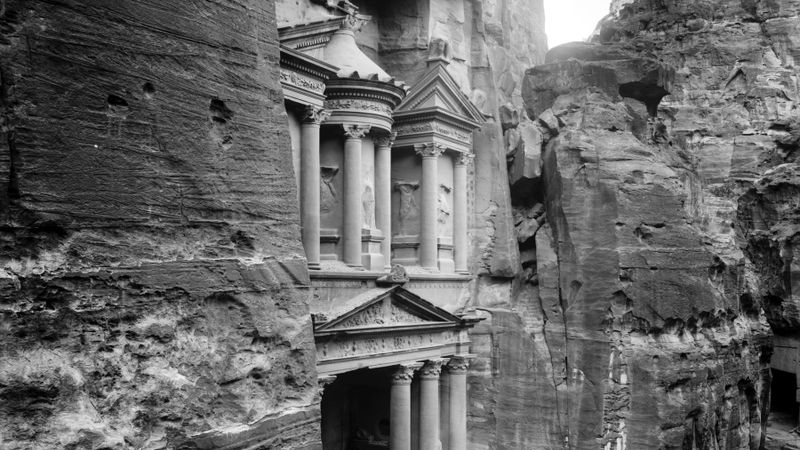
Filmed, but Not Recorded: The Arab World’s Missing Film Locations
Wikidata knows Gladiator was filmed in Morocco. It doesn’t know where.
Ouarzazate is the second most filmed place in the Middle East and North Africa, yet 25 of its 27 productions are recorded only in Wikipedia prose. We compared filming records worldwide and found that in the Arab world, Wikidata usually knows the country but not the place.
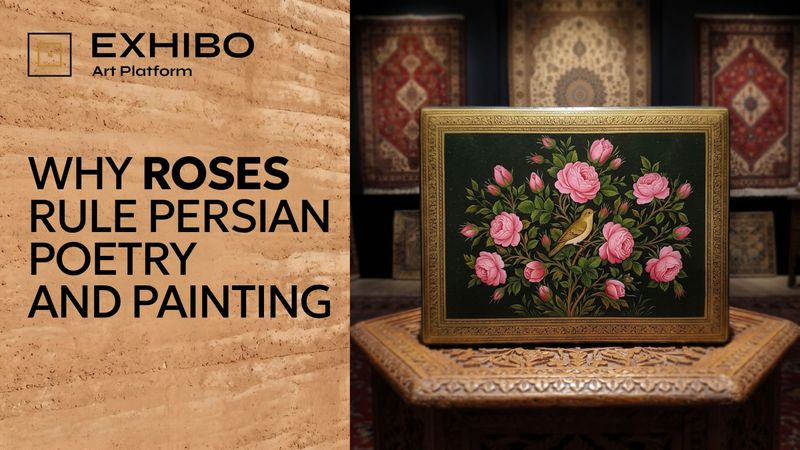
The Flower That Was Never Only Beautiful
The rose rules Persian poetry and painting — but under the sweetness sits a thorn, a bleeding bird, and a national emblem quietly assembled out of Chinese, European and Persian parts. A history of gol o bolbol, from a medieval still to a Dubai gallery.
Gol o bolbol — the rose and the nightingale — is among the most beautiful images in a thousand years of Persian art, and in modern Persian it also means sweet, empty talk. Under the tile, the picture is darker: a bird singing in blood for a flower that will not answer and will not last.
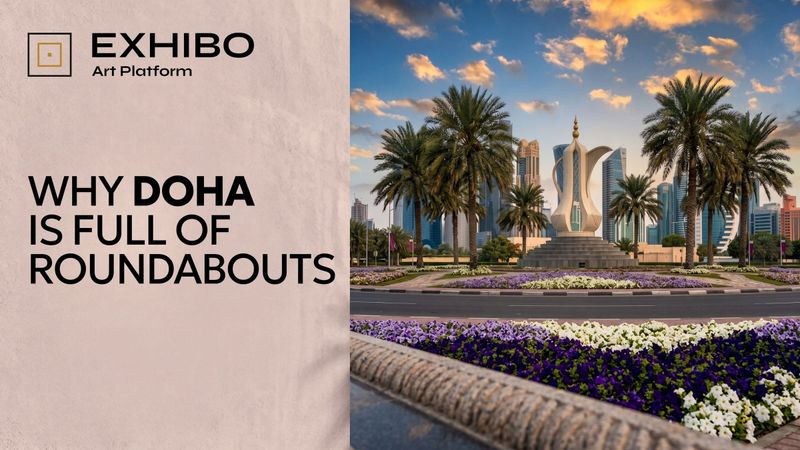
Why Doha Is Full of Roundabouts
An old circle at a crossroads, sharpened by British road engineering, became the way an Arabian city found its way and remembered itself — and it took the bulldozers to reveal it.
In a city where a landmark was more useful than an address, Doha's roundabouts became its navigation, its landscaping and its national image all at once. Now they're being torn out for signalled junctions — and the affection for them arrived, as one scholar put it, only posthumously.