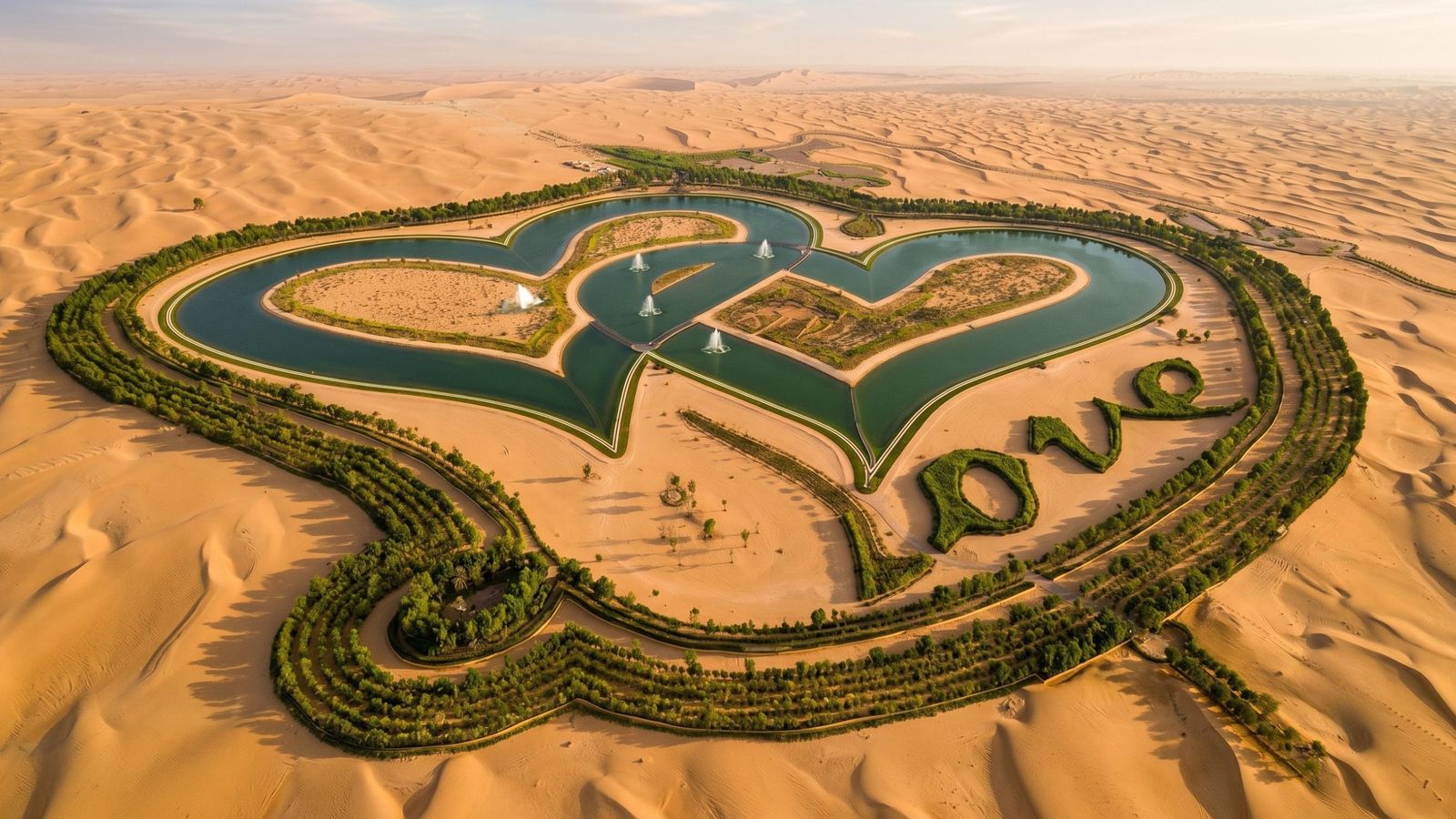
Love Lake, Al Qudra
Two interlocking heart-shaped lakes carved into the desert, with trees planted to spell LOVE — land art visible from space.
Love Lake is a man-made lake in the Saih Al Salam desert at Al Qudra, on the outskirts of Dubai within the Al Marmoom Desert Conservation Reserve. Commissioned through the engineering office of Sheikh Mohammed bin Rashid Al Maktoum, construction began on 11 March 2018 and was deliberately kept secret, so that the finished project could be revealed as a surprise. It was unveiled in November 2018 by Sheikh Hamdan bin Mohammed Al Maktoum, Crown Prince of Dubai, in an Instagram post — to widespread astonishment that a lake had seemingly appeared overnight.
The work is essentially land art at territorial scale: two enormous interlocking heart-shaped lagoons cut into the dunes, designed to be read from above rather than from the ground. The composition is completed by an adjacent strip of planting that spells out the word 'LOVE' in trees, and by thousands of desert-hardy trees and shrubs planted around the shoreline. The forms are so large that they are legible from orbit — in 2021 the Mohammed bin Rashid Space Centre captured the lake from space using the KhalifaSat satellite. A crescent-shaped Moon Lake was later added nearby.
Ecologically, the project doubles as habitat: it is filled with treated sewage effluent, planted with species selected to survive the harsh desert climate, and lit with solar-powered lighting. Like the neighbouring Al Qudra Lakes, it draws flamingos, swans and a wide range of migratory birds. Access is free and open around the clock, with walking trails, shaded picnic areas and viewpoints along the shore.
Exhibo editorial
Somebody in Dubai decided the desert needed a pair of hearts, built them in secret over a few months, and then let the Crown Prince announce them on Instagram. That's the whole story of Love Lake, and it tells you something about how this city makes landscape: not as a garden, but as a gesture aimed at a camera in the sky.
Because that's the catch — from the ground it's a pleasant lake with trees and birds. The work only resolves from above, which is why the drone footage went everywhere and why a satellite eventually photographed it from orbit. Land art usually asks you to walk into it; this one asks you to leave. Go anyway, at sunset, when the water goes copper and the flamingos come in — and know that the shape you're standing inside is only really visible to something flying.
How to find it
Love Lake lies off Al Qudra Road in the Saih Al Salam desert, within the Al Marmoom Desert Conservation Reserve, roughly 45 minutes from central Dubai by car — a vehicle is essential. Free parking and entry, open 24 hours, though daytime and sunset visits are advised as lighting is minimal after dark. Walk the shoreline trails to see the tree planting spelling 'LOVE'; the heart shapes themselves are only fully legible from the air, so bring a licensed drone if you want the signature shot. Last Exit Al Qudra nearby has food trucks.
Similar places
All places
News by Exhibo
Editorial coverage on Exhibo
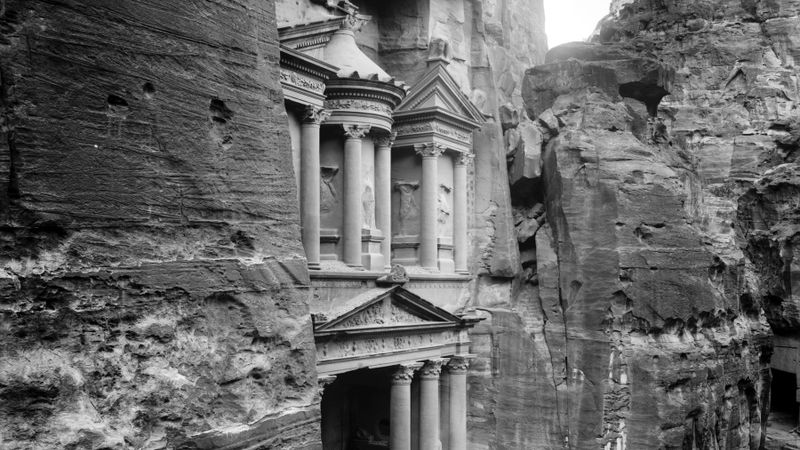
Filmed, but Not Recorded: The Arab World’s Missing Film Locations
Wikidata knows Gladiator was filmed in Morocco. It doesn’t know where.
Ouarzazate is the second most filmed place in the Middle East and North Africa, yet 25 of its 27 productions are recorded only in Wikipedia prose. We compared filming records worldwide and found that in the Arab world, Wikidata usually knows the country but not the place.
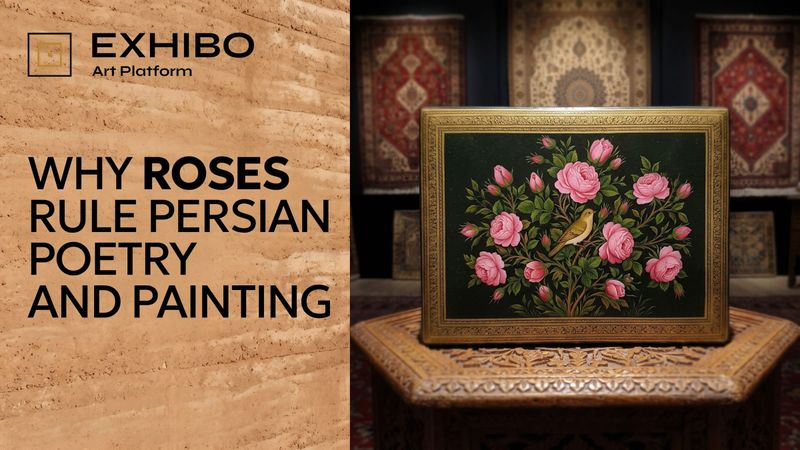
The Flower That Was Never Only Beautiful
The rose rules Persian poetry and painting — but under the sweetness sits a thorn, a bleeding bird, and a national emblem quietly assembled out of Chinese, European and Persian parts. A history of gol o bolbol, from a medieval still to a Dubai gallery.
Gol o bolbol — the rose and the nightingale — is among the most beautiful images in a thousand years of Persian art, and in modern Persian it also means sweet, empty talk. Under the tile, the picture is darker: a bird singing in blood for a flower that will not answer and will not last.
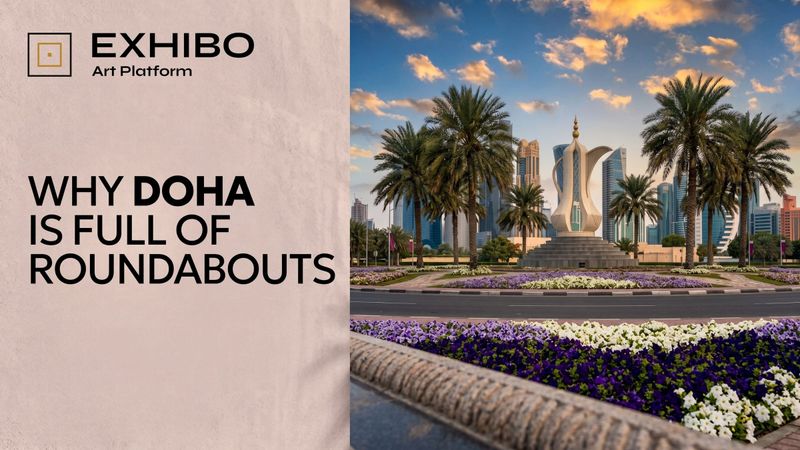
Why Doha Is Full of Roundabouts
An old circle at a crossroads, sharpened by British road engineering, became the way an Arabian city found its way and remembered itself — and it took the bulldozers to reveal it.
In a city where a landmark was more useful than an address, Doha's roundabouts became its navigation, its landscaping and its national image all at once. Now they're being torn out for signalled junctions — and the affection for them arrived, as one scholar put it, only posthumously.