Expo City Entry Portals
Asif Khan's 21-metre carbon-fibre gateways — a mashrabiya 'drawn in the sky', with vast doors thin and light enough to be opened by one person.
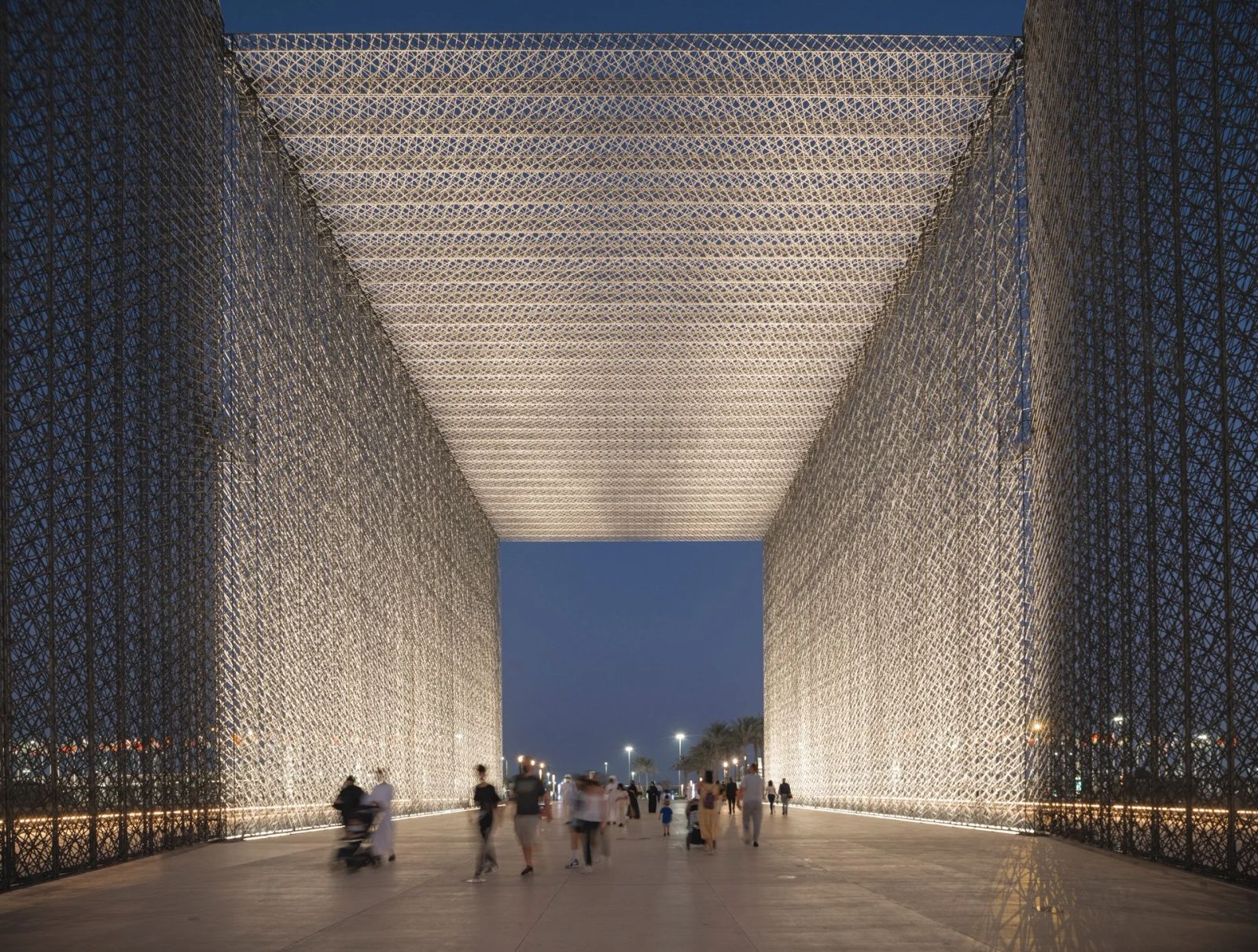
The Expo Entry Portals are a trio of monumental gateways designed by the British architect Asif Khan for Expo 2020 Dubai, now part of Expo City Dubai. Conceived as the first and last thing visitors encounter, one portal serves each of the site's three thematic districts — Opportunity, Mobility and Sustainability — each leading into a tree-filled arrival courtyard also designed by Khan, as part of the more than six kilometres of public realm his studio created for the site.
Each portal stands about 21 metres high — taller than a six-storey building — and 30 metres long, yet is woven entirely from strands of ultra-lightweight carbon-fibre composite, with no additional structural support. Khan set out to create 'a mashrabiya like no other… impossibly thin and impossibly light, like a drawing in the sky', at a scale where the lattice becomes architecture in itself. To achieve it, his studio developed a new carbon-fibre technique with an aircraft engineer and a specialist manufacturer: carbon-fibre ribbon, made of thousands of ultra-fine fibres, was wrapped around a rotating mandrel in a 3D-weaving process, then craned into place. From a distance the portals read as translucent planes; up close they resolve into hundreds of fine woven lines, and from the correct angle the geometry echoes the Expo 2020 logo.
Each portal carries two vast doors, 21 metres high and 10.5 metres wide, yet so finely engineered that a single person can open them. During the Expo they were opened every morning across the 173-day run in a symbolic act of welcoming the world; they can be held anywhere from slightly ajar to flung fully open for major events. Drawing on the traditional mashrabiya's control of light and airflow, the portals also provide shade and let air move freely — a piece of shared Islamic design language recast in the material of Formula One and aircraft.
Exhibo editorial
Asif Khan wanted a mashrabiya 'like a drawing in the sky', and the maddening thing is that he got it. Each portal is 21 metres tall, the height of a six-storey building, and appears to be made of almost nothing — a haze of fine lines that only resolves into a solid lattice as you get close. It's carbon fibre, the stuff of race cars and aircraft, woven into something that looks like it might blow away.
The proof of the engineering is the doors: 21 metres high, and light enough for one person to swing open. During the Expo that's exactly what happened every morning — the world's biggest doors, opened by hand, as a daily act of welcome. Approach one straight on and it's a wall of shifting lines; step to the correct angle and the Expo logo appears in the geometry. Walk through slowly, and notice how the light falls.
How to find it
The three Entry Portals mark the gateways into Expo City Dubai in Dubai South, one for each of the Opportunity, Mobility and Sustainability districts, each opening onto a tree-filled courtyard. They sit at the thresholds of the site, so you pass through one as you enter — approach head-on to see the lattice resolve from translucent planes into fine carbon-fibre lines, and look for the angle where the geometry forms the Expo logo. Best appreciated on foot, walking through the doorway.
Similar places
All places
News by Exhibo
Editorial coverage on Exhibo
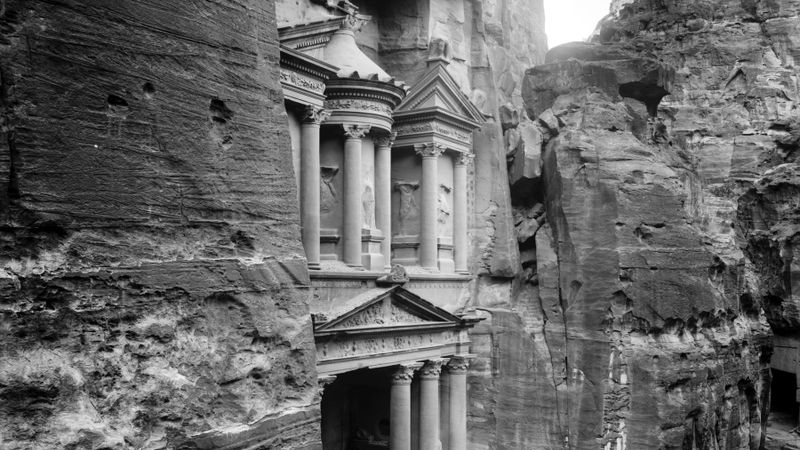
Filmed, but Not Recorded: The Arab World’s Missing Film Locations
Wikidata knows Gladiator was filmed in Morocco. It doesn’t know where.
Ouarzazate is the second most filmed place in the Middle East and North Africa, yet 25 of its 27 productions are recorded only in Wikipedia prose. We compared filming records worldwide and found that in the Arab world, Wikidata usually knows the country but not the place.
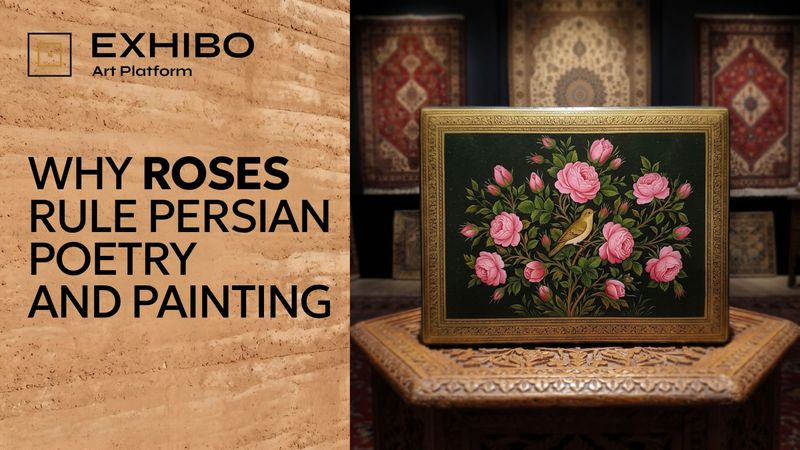
The Flower That Was Never Only Beautiful
The rose rules Persian poetry and painting — but under the sweetness sits a thorn, a bleeding bird, and a national emblem quietly assembled out of Chinese, European and Persian parts. A history of gol o bolbol, from a medieval still to a Dubai gallery.
Gol o bolbol — the rose and the nightingale — is among the most beautiful images in a thousand years of Persian art, and in modern Persian it also means sweet, empty talk. Under the tile, the picture is darker: a bird singing in blood for a flower that will not answer and will not last.
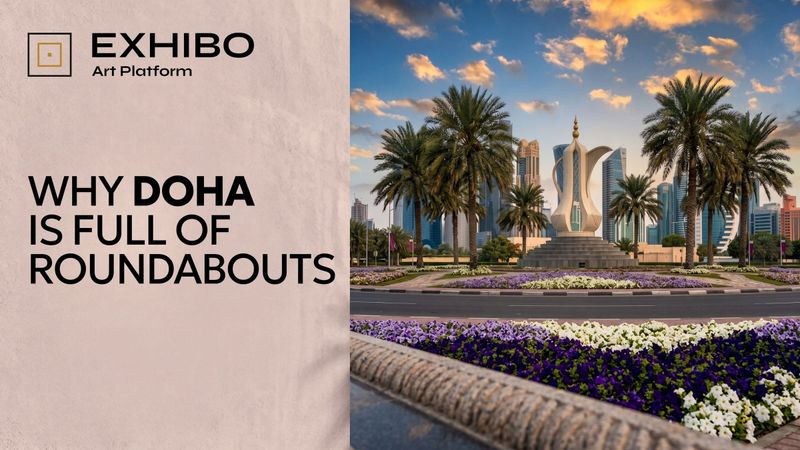
Why Doha Is Full of Roundabouts
An old circle at a crossroads, sharpened by British road engineering, became the way an Arabian city found its way and remembered itself — and it took the bulldozers to reveal it.
In a city where a landmark was more useful than an address, Doha's roundabouts became its navigation, its landscaping and its national image all at once. Now they're being torn out for signalled junctions — and the affection for them arrived, as one scholar put it, only posthumously.