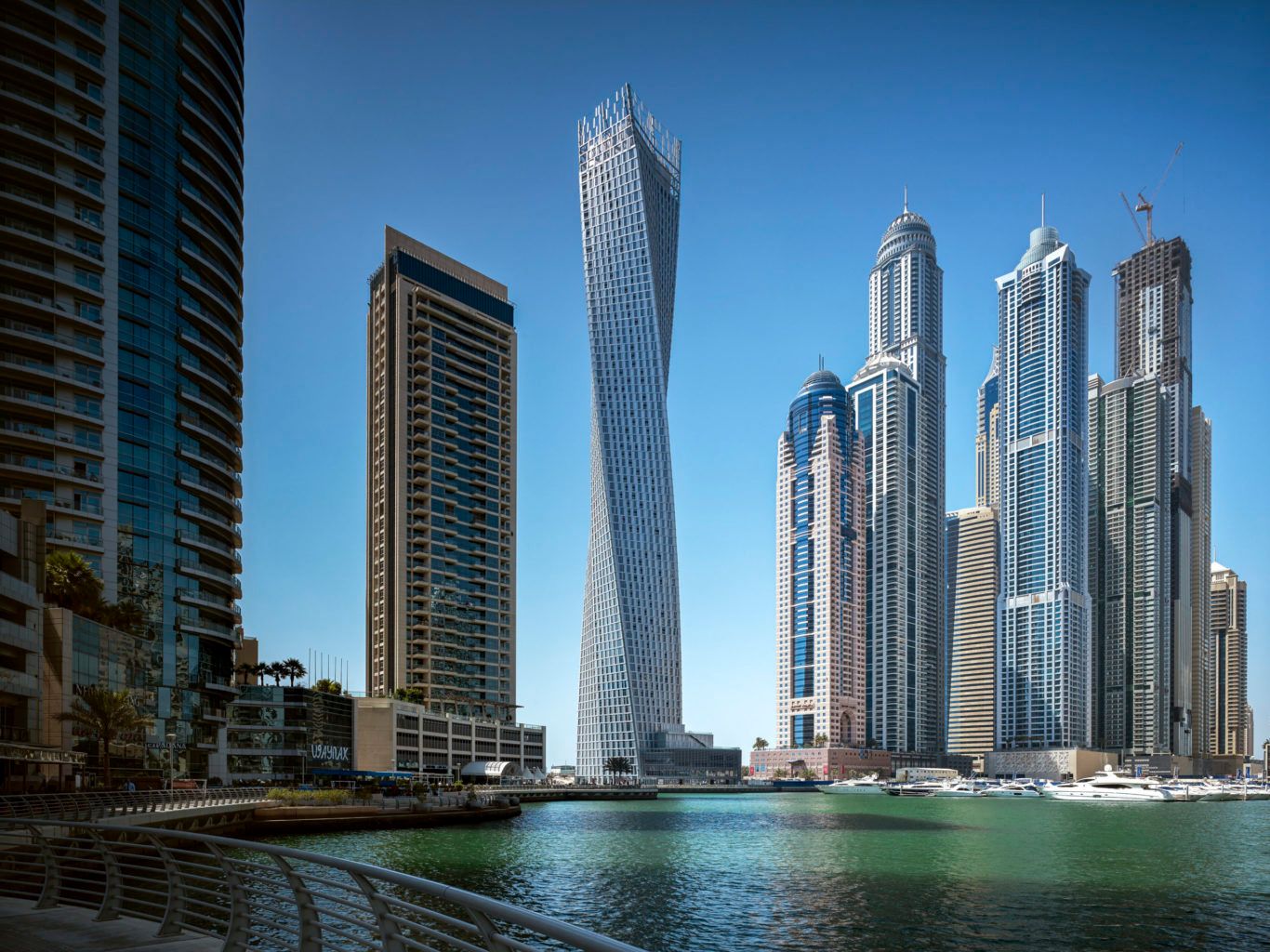
Cayan Tower Helix
The world's tallest 90-degree twisting tower when it opened — a helix by the architects of the Burj Khalifa.
Cayan Tower is a 306.4-metre, 75-storey residential skyscraper on the waterfront of Dubai Marina, designed by Skidmore, Owings & Merrill (SOM) — the firm behind the Burj Khalifa — for developer Cayan Real Estate Investment & Development, with Arabtec as main contractor. Known as Infinity Tower during construction, it was completed and opened on 10 June 2013.
The building's defining feature is its helix: the tower rotates a full 90 degrees from base to crown. This is achieved not with irregular floors but with 75 near-identical floor plates, each rotated 1.2 degrees clockwise relative to the one below, spiralling around a central cylindrical concrete core. Because the plates repeat, SOM preserved the economies of standard layouts and a unitised facade while still producing a continuously twisting form — the structure was raised using a 'jump form' system that exploited that repetition.
The twist is more than sculpture. Rotating the mass reduces wind loads up the height of the building and improves structural performance, while giving each of the roughly 495 apartments changing views — the lower floors oriented toward the Marina promenade, the upper floors turned to face the Arabian Gulf. The facade of pre-finished metal panels on cast-in-place concrete columns, with deeply recessed glass, shades the interiors from direct sun. On opening, Cayan Tower was the world's tallest building with a 90-degree twist, a record later surpassed by the Shanghai Tower.
Exhibo editorial
From the Marina Walk the Cayan Tower looks like a building caught mid-gesture — a skyscraper wringing itself out. What saves it from being a gimmick is that the twist is doing a job: it cuts the wind, it hands every apartment a different view, and it does all that out of 75 floors that are essentially the same floor, turned.
That's the quiet genius of it. SOM didn't build 75 strange floors; they built one sensible floor and rotated it into a spiral, so the drama is entirely in the stacking. Walk the promenade at its base and try to follow a single line up the facade — you can't, quite, and that's the pleasure of it. Best caught late in the day, when low sun rakes across the panels and the whole helix seems to turn.
Gallery


How to find it
Cayan Tower stands at the mouth of Dubai Marina, near the Marina Walk on the Al Sufouh side. The best vantage points are along the Marina promenade and the Marina Walk, where the full 90-degree twist reads clearly against the sky; it is also visible from the tram and from JBR across the water.
Similar places
All places
News by Exhibo
Editorial coverage on Exhibo
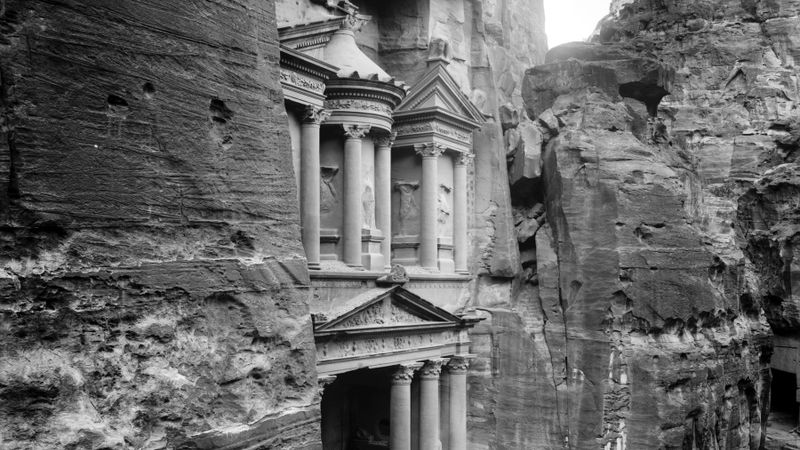
Filmed, but Not Recorded: The Arab World’s Missing Film Locations
Wikidata knows Gladiator was filmed in Morocco. It doesn’t know where.
Ouarzazate is the second most filmed place in the Middle East and North Africa, yet 25 of its 27 productions are recorded only in Wikipedia prose. We compared filming records worldwide and found that in the Arab world, Wikidata usually knows the country but not the place.

The Flower That Was Never Only Beautiful
The rose rules Persian poetry and painting — but under the sweetness sits a thorn, a bleeding bird, and a national emblem quietly assembled out of Chinese, European and Persian parts. A history of gol o bolbol, from a medieval still to a Dubai gallery.
Gol o bolbol — the rose and the nightingale — is among the most beautiful images in a thousand years of Persian art, and in modern Persian it also means sweet, empty talk. Under the tile, the picture is darker: a bird singing in blood for a flower that will not answer and will not last.
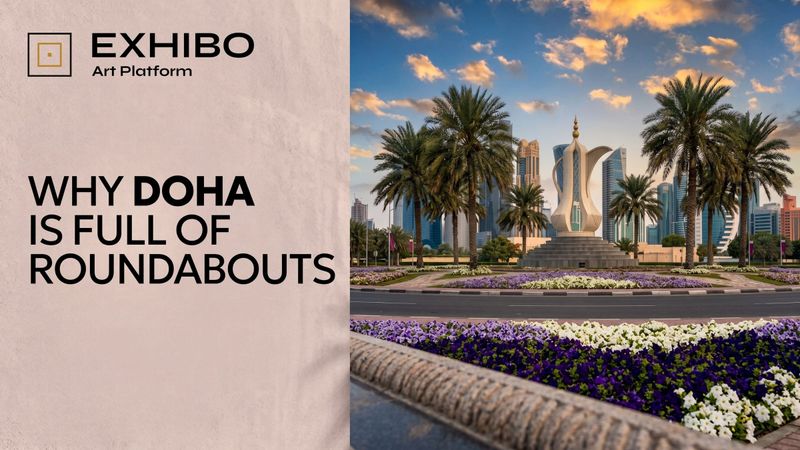
Why Doha Is Full of Roundabouts
An old circle at a crossroads, sharpened by British road engineering, became the way an Arabian city found its way and remembered itself — and it took the bulldozers to reveal it.
In a city where a landmark was more useful than an address, Doha's roundabouts became its navigation, its landscaping and its national image all at once. Now they're being torn out for signalled junctions — and the affection for them arrived, as one scholar put it, only posthumously.