Alif — The Mobility Pavilion
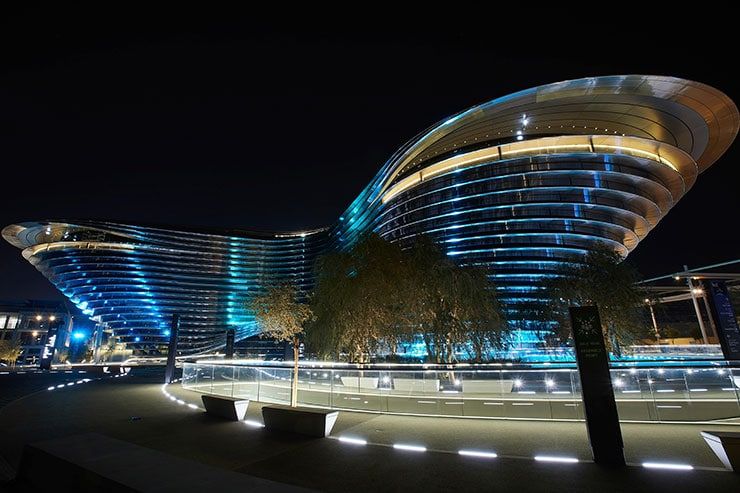
Foster + Partners' gleaming stainless-steel trefoil, with three cantilevered petals and the world's largest passenger lift.
Alif — The Mobility Pavilion is one of the three signature thematic pavilions of Expo 2020 Dubai (now part of the permanent Expo City Dubai), designed by Foster + Partners around the sub-theme of mobility. It opened with the Expo in October 2021 and remains as a legacy building.
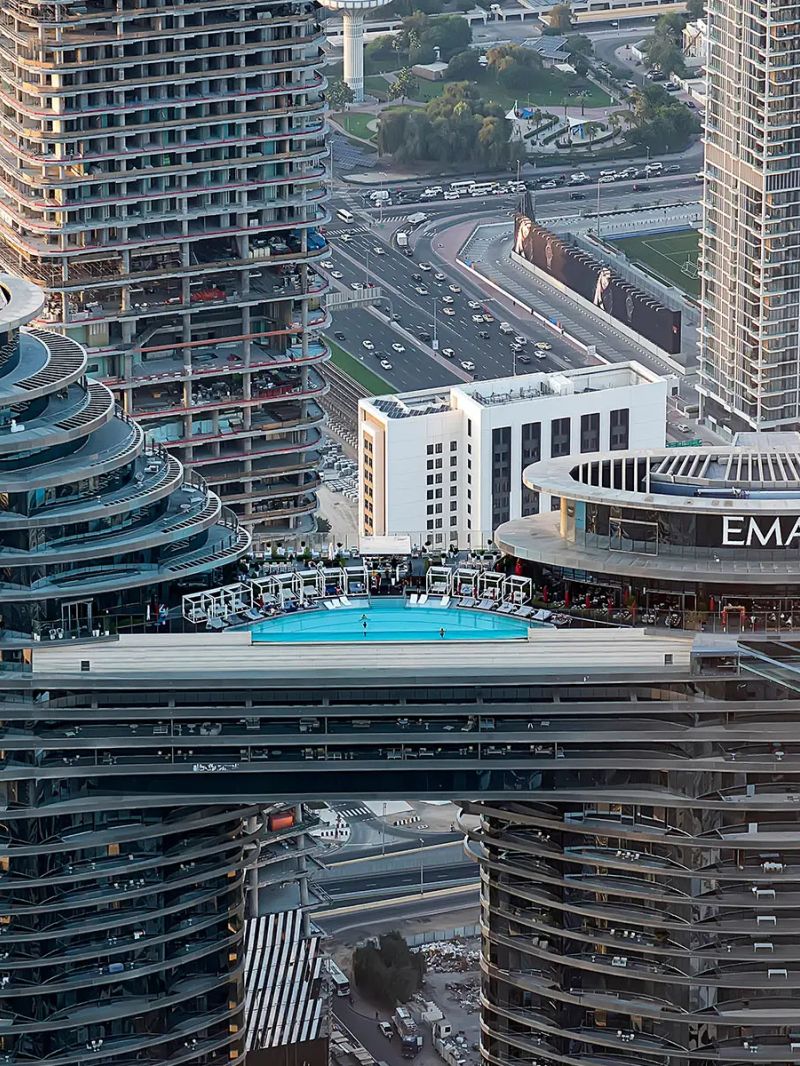
The pavilion has a distinctive trefoil plan: three large petals that cantilever and unfold from the building's base, creating three areas for its major thematic exhibitions. The whole form is wrapped in bands of highly reflective stainless steel — a self-shading facade of horizontal fins that fold down toward the ground, reflecting heat and shading the glazing behind, while forming a canopy over each of the three entrances. Photovoltaic and solar hot-water panels sit on the roof.
The visitor sequence is built around movement itself. Guests enter the central core and rise in what was billed as the world's largest passenger lift — capable of carrying more than 160 people at once — to the third level, then descend through interconnected galleries (exhibitions designed by MET Studio) to the lower ground floor. From there a 330-metre track, partly underground and partly open-air, lets visitors see cutting-edge mobility devices in action. The gleaming, propeller-like silhouette was conceived to communicate dynamism and speed through the fluidity of its form.
Exhibo editorial
A pavilion about movement had a tricky brief: how do you make a building feel like motion? Foster's answer at Alif was to wrap the whole thing in ribbons of mirror-polished steel that fold toward the ground, so the surface never sits still — it catches the light and slides it around as you walk past, like something mid-spin.
The theatrical stroke is on the inside. You don't take an escalator; you're loaded into the largest passenger lift in the world, 160 people at a time, and delivered to the top to wind your way back down. It's mobility staged as spectacle, which is exactly the point. Now that the Expo crowds have gone and it lives on in Expo City, it's a far calmer place to appreciate the steel.
Gallery

How to find it
Alif sits in the Mobility District of Expo City Dubai, in Dubai South near Al Maktoum International Airport, a short walk from the central Al Wasl Plaza. The trefoil form and reflective steel bands are visible across the district; enter at ground level beneath one of the three petal canopies. Inside, the visitor route begins with the giant central passenger lift up to the top gallery, then descends through the exhibition levels to the mobility track below.
Similar places
All places
News by Exhibo
Editorial coverage on Exhibo
Filmed, but Not Recorded: The Arab World’s Missing Film Locations
Wikidata knows Gladiator was filmed in Morocco. It doesn’t know where.
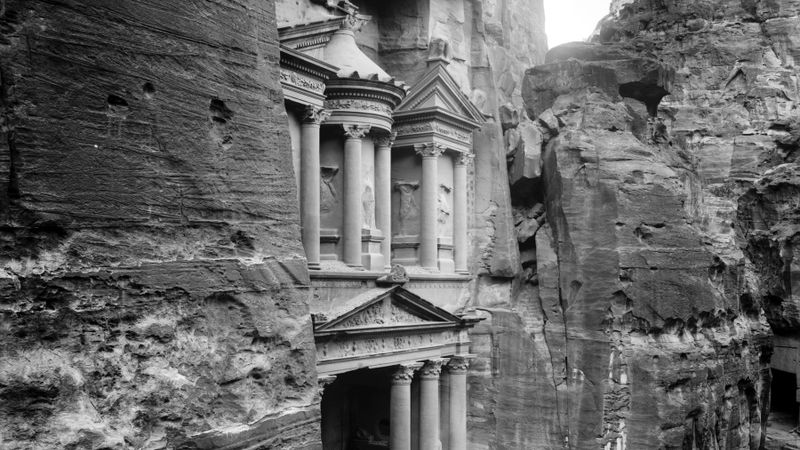
Ouarzazate is the second most filmed place in the Middle East and North Africa, yet 25 of its 27 productions are recorded only in Wikipedia prose. We compared filming records worldwide and found that in the Arab world, Wikidata usually knows the country but not the place.
The Flower That Was Never Only Beautiful
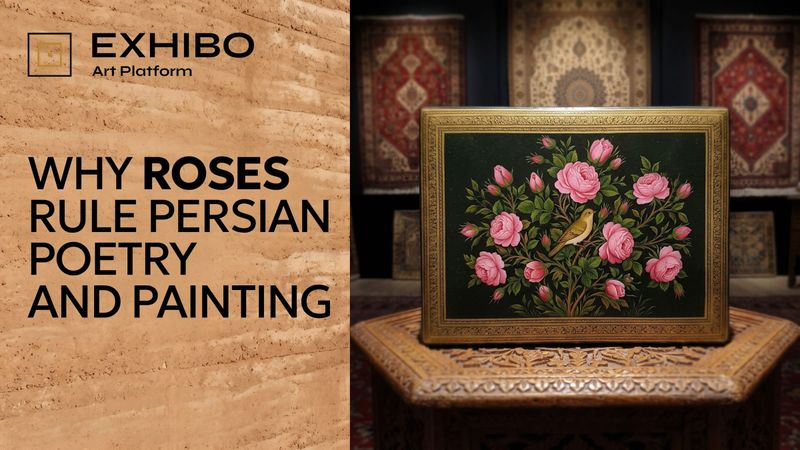
The rose rules Persian poetry and painting — but under the sweetness sits a thorn, a bleeding bird, and a national emblem quietly assembled out of Chinese, European and Persian parts. A history of gol o bolbol, from a medieval still to a Dubai gallery.
Gol o bolbol — the rose and the nightingale — is among the most beautiful images in a thousand years of Persian art, and in modern Persian it also means sweet, empty talk. Under the tile, the picture is darker: a bird singing in blood for a flower that will not answer and will not last.
Why Doha Is Full of Roundabouts
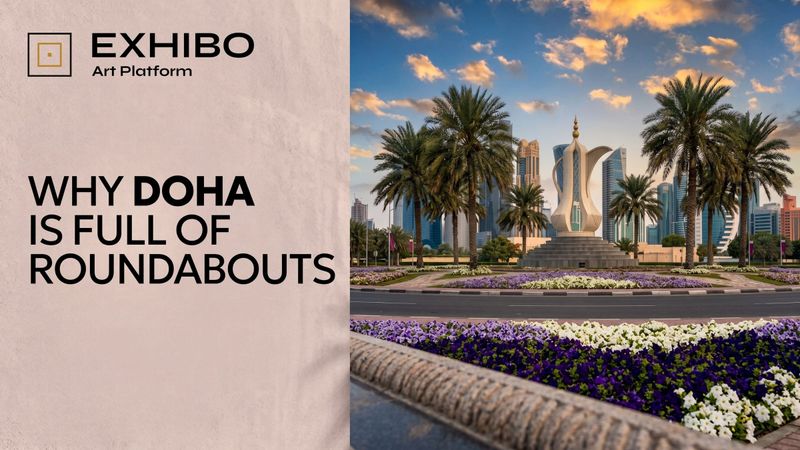
An old circle at a crossroads, sharpened by British road engineering, became the way an Arabian city found its way and remembered itself — and it took the bulldozers to reveal it.
In a city where a landmark was more useful than an address, Doha's roundabouts became its navigation, its landscaping and its national image all at once. Now they're being torn out for signalled junctions — and the affection for them arrived, as one scholar put it, only posthumously.