A queen of the pyramid age
Meresankh III was a queen of Egypt's Fourth Dynasty: a granddaughter of Khufu, builder of the Great Pyramid and the wife of King Khafre. Her tomb, cut into the rock of the Eastern Cemetery at Giza, just east of the Great Pyramid, was originally prepared by her mother, Queen Hetepheres II and given to her daughter after Meresankh's early death. It was discovered in 1927 by the American Egyptologist George Reisner during the excavations of the Harvard–Boston expedition.
Colour and statues
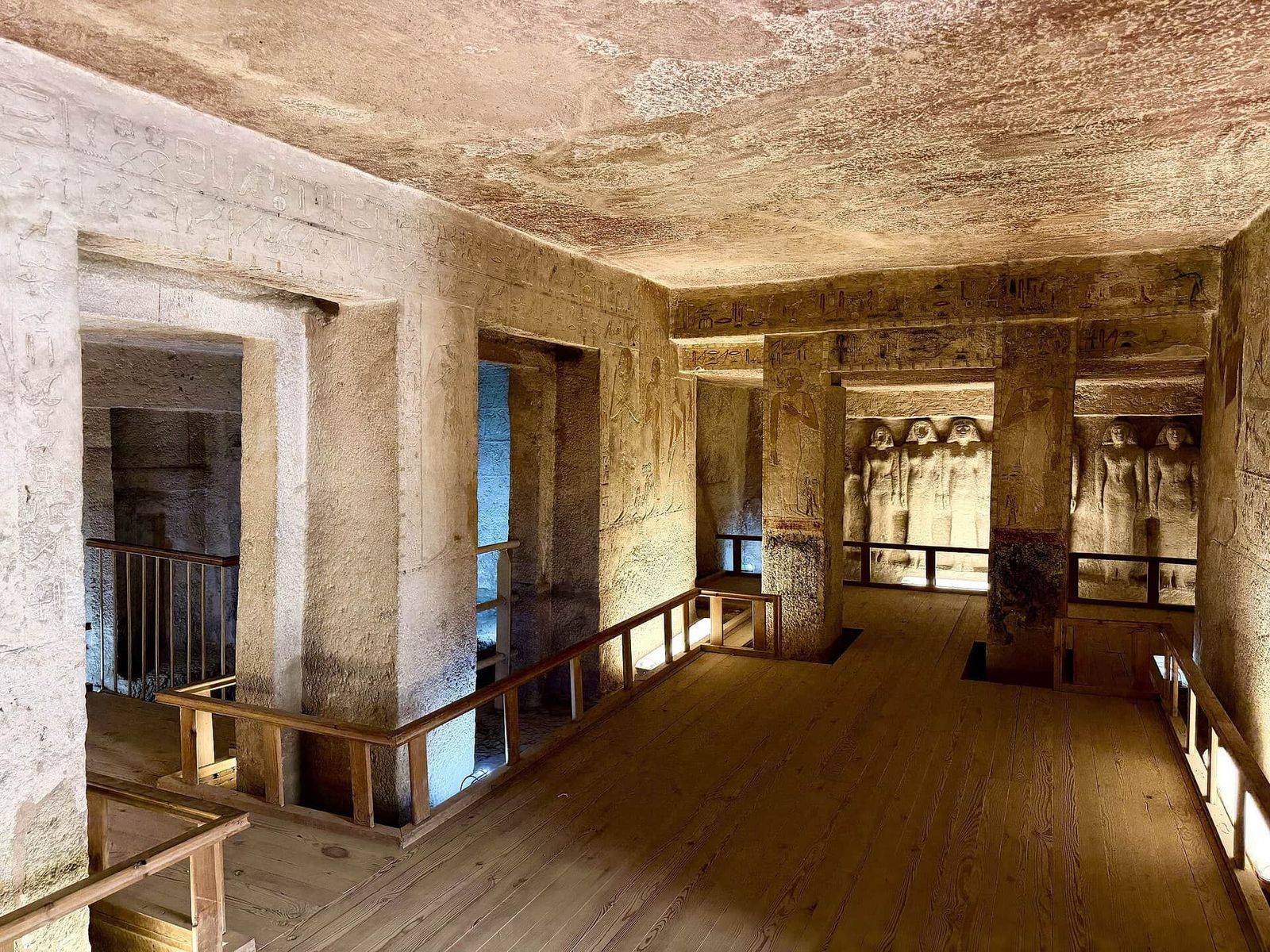
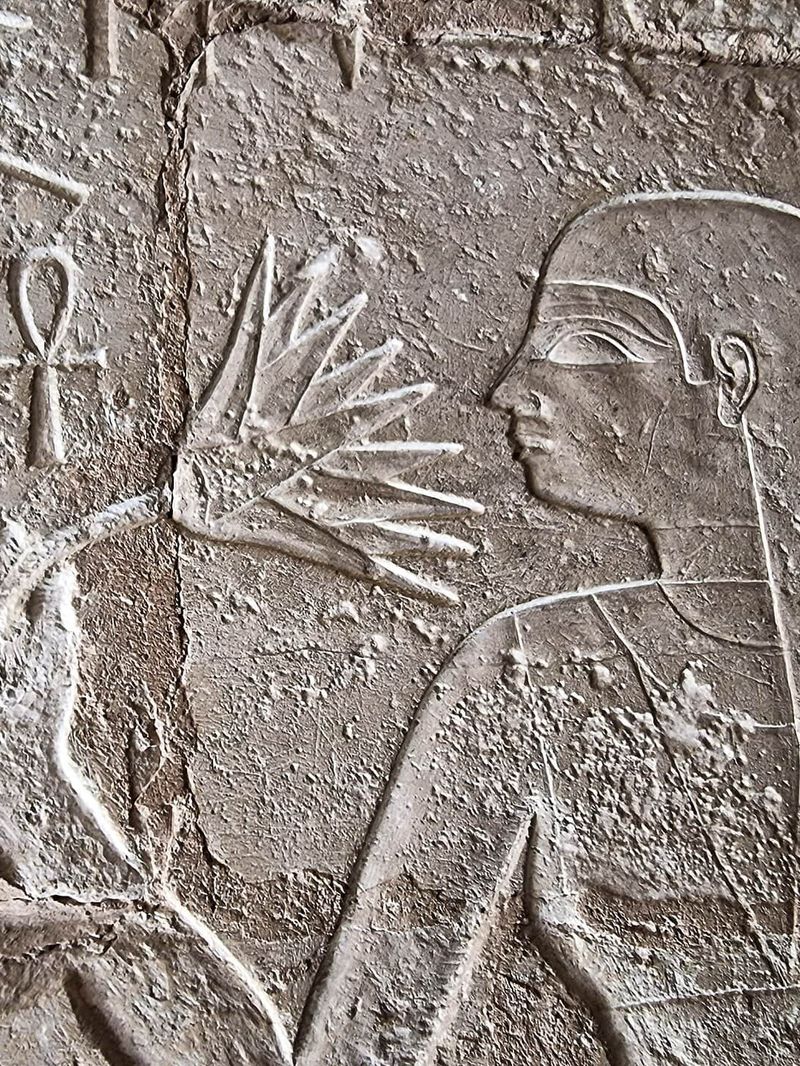
The tomb is famous for the exceptional preservation of its painted relief decoration, which retains much of its original colour. The chapel walls show scenes of daily life and the preparation of the funerary cult, craftsmen at work, agriculture, boats, offerings and processions, together with portraits of the queen and her mother; Hetepheres II is depicted with unusual yellow hair. The most striking feature is a row of statues of women carved directly from the living rock along one wall, representing the queen, her mother and other female members of the family, a rare and moving ensemble. A shaft leads down to the burial chamber where the queen's black granite sarcophagus was found; her remains are now in Cairo.
Visiting
The tomb is reached by a short walk from the Great Pyramid and is visited on a separate ticket. Because it is small and lit with care, it gives a quiet and intimate counterpart to the monumental scale of the pyramids.
Exhibo editorial
After the immensity of the pyramids, this is the place where the Fourth Dynasty turns into people. You go down a few steps out of the glare into a low, cool chapel and suddenly there is colour everywhere (red, ochre, blue) and a row of women carved out of the rock, standing shoulder to shoulder like a family at a funeral.
It is a mother's gift to a daughter who died young. You can feel it in the care of every scene. Very few visitors buy the extra ticket, so there is a good chance you will have the tomb to yourself for a few minutes. Take them.
Gallery
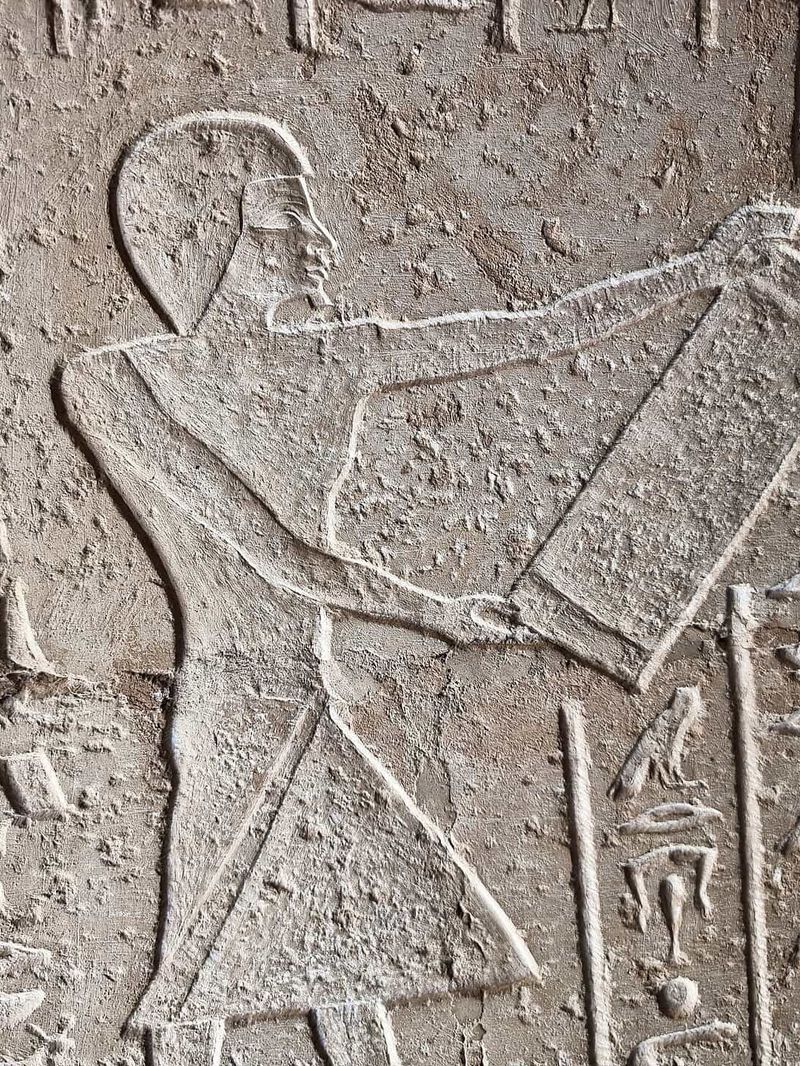
How to find it
In the East Field cemetery on the Giza plateau, just east of the Great Pyramid near the queens' pyramids. Look for the steps leading down to a low entrance in the rock among the mastabas.
Similar places
All places
News by Exhibo
Editorial coverage on Exhibo
The Museum of Everything That Became a Tomb
Egypt built a museum to tell the story of an entire civilisation — seven thousand years of it, from flint tools to the present. The public knows it for one thing: the room where twenty dead kings lie in the dark.
In a black, hushed hall beneath the National Museum of Egyptian Civilization in Old Cairo lie the mummified bodies of Ramesses II, Hatshepsut, and eighteen other rulers of the New Kingdom — carried here in 2021 in a televised parade watched around the world.
Ancient Egyptian Art
Images built to work for gods, kings and the dead: canon, craft and change along the Nile across nearly three millennia.
Ancient Egyptian art was rarely made for the museum wall alone. This period survey explains why statues and reliefs functioned as cult tools, how a stable visual canon held for centuries, where Old, Middle and New Kingdom styles diverge, and which collections still make those differences visible today.
Agatha Christie's Egypt: Three Abu Simbels, a Pharaoh and a Murder on the Nile
Christie set one famous murder on the Nile and two lesser-known stories in ancient Egypt. The temples, letters and film sets behind all three.
The Abu Simbel of Death on the Nile has since moved up a hill. Christie's two other Egyptian stories lead to a pharaoh's dismantled temples at Karnak and a farmer's 4,000-year-old letters now in New York.