
Al-Azhar Park
Thirty hectares of Islamic gardens built on a centuries-old rubbish heap — with the Ayyubid wall and Cairo's best skyline view.
From rubbish heap to park
Al-Azhar Park occupies a 30-hectare hill on the eastern edge of Historic Cairo, between the medieval city and the City of the Dead. For some five hundred years the site, known as al-Darassa, was a dumping ground for the city's debris. In 1984 Aga Khan IV announced his decision to give Cairo a park to mark the city's foundation by his Fatimid ancestors in 969, and the Aga Khan Trust for Culture, through its Historic Cities Programme, took on the project. Around 80,000 truckloads of rubble were removed, three large reservoirs for the city's water supply were built beneath the site, and the park, costing more than 30 million US dollars, opened to the public in March 2005. Its master plan was developed with the landscape architects Sasaki Associates and the Egyptian firm Sites International.
Gardens and views
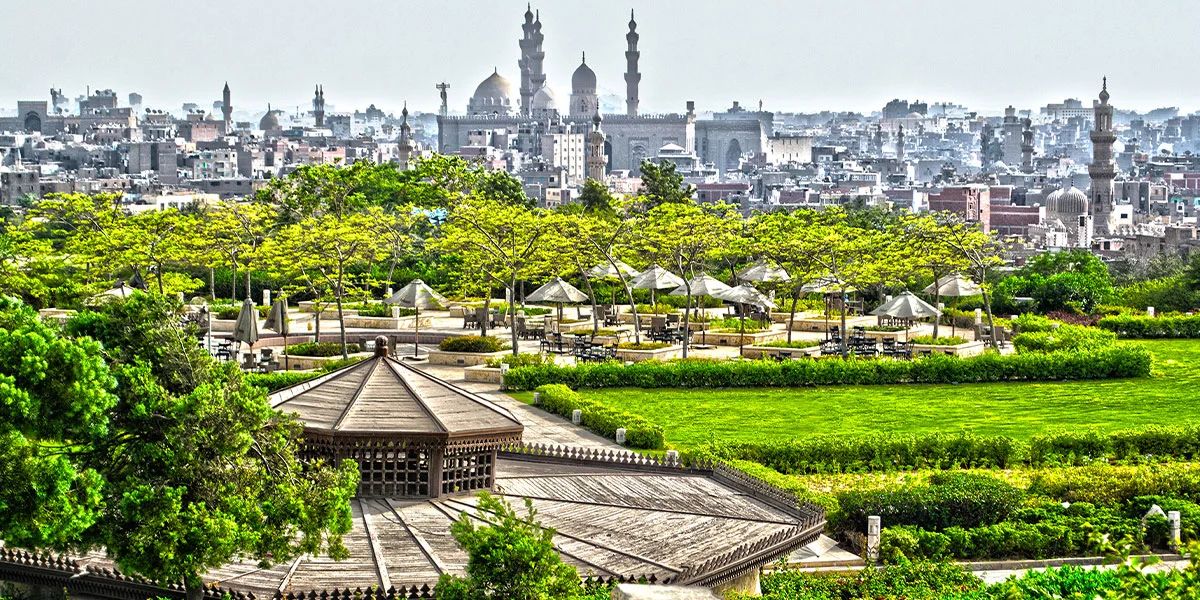
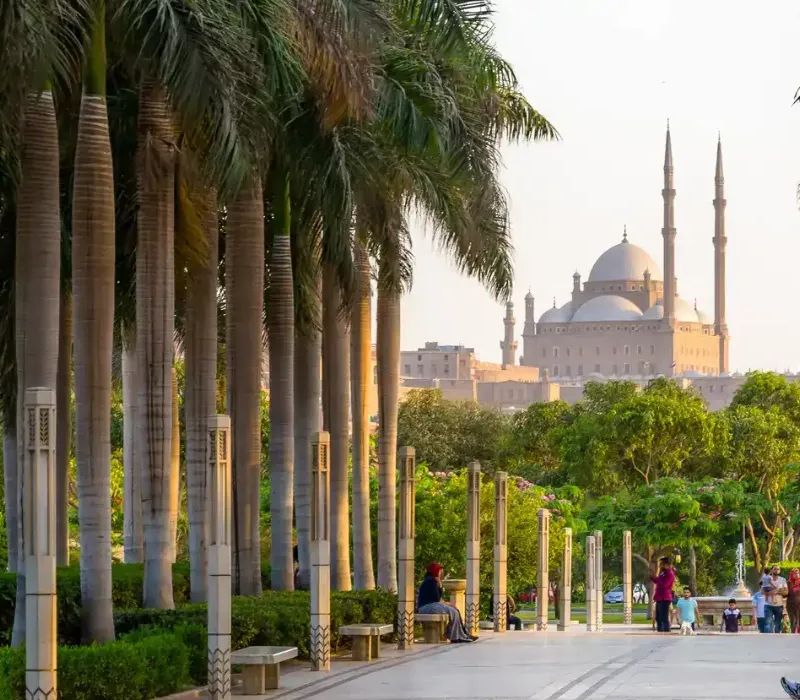
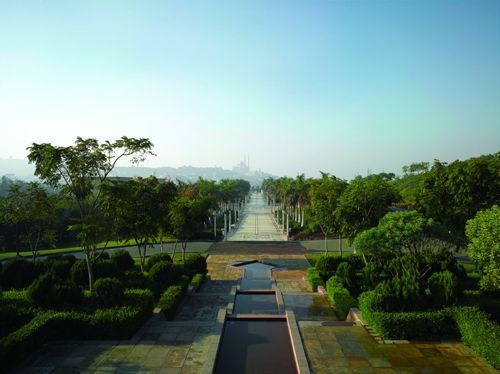
The park is laid out in the tradition of Islamic gardens: a long formal axis of water channels and fountains, terraces planted with palms and fruit trees, orchards, sunken gardens and shaded walks, combined with a lake, playgrounds and open lawns. Its pavilions and restaurants, including a hilltop café and a lakeside restaurant, are built in a contemporary interpretation of Fatimid and Mamluk architecture. From its high points the park offers one of the finest panoramas of Cairo: the minarets and domes of the old city, the Citadel and the Muqattam hills.
The Ayyubid wall
During the works, a section of the twelfth-century city wall built under Salah al-Din was uncovered along the park's western edge: about 1.5 kilometres long and in places some 15 metres deep, buried for centuries under the debris. It has been excavated and conserved, together with the gates of Bab al-Barqiyya and Bab al-Mahruq, and a promenade runs alongside it. The park was the catalyst for a wider programme by the Aga Khan Trust for Culture to restore monuments and improve housing, health and employment in the neighbouring district of al-Darb al-Ahmar. Since opening, it has welcomed more than two million visitors a year and is regularly listed among the world's great public spaces.
Exhibo editorial
Cairo is not a green city, and nothing quite prepares you for coming over the rise in Al-Azhar Park: lawns, palms, water running down a long stone channel, families on blankets, and behind them, across the whole horizon, the domes and minarets of the old city with the Citadel on its spur. It is the view the city never gives you anywhere else.
That it was a mountain of rubbish for five centuries makes it better. Walk the western edge to see Saladin's wall, dug out of the debris, then take a table at the hilltop café as the sun goes down and the call to prayer starts rolling across the rooftops below. It is the most beautiful hour you can spend in Cairo for the price of an entrance ticket.
Gallery
How to find it
The main entrance is on Salah Salem Street on the park's eastern side — the easiest arrival by taxi or ride-hailing. Pedestrians coming from Historic Cairo can use the western entrance at Bab al-Mahruq from al-Darb al-Ahmar. From the main gate, follow the central water axis uphill towards the hilltop café for the best view of the old city and the Citadel; the Ayyubid wall promenade runs along the western boundary.
Similar places
All places
News by Exhibo
Editorial coverage on Exhibo
The Bottle That Was in Pieces on the Floor
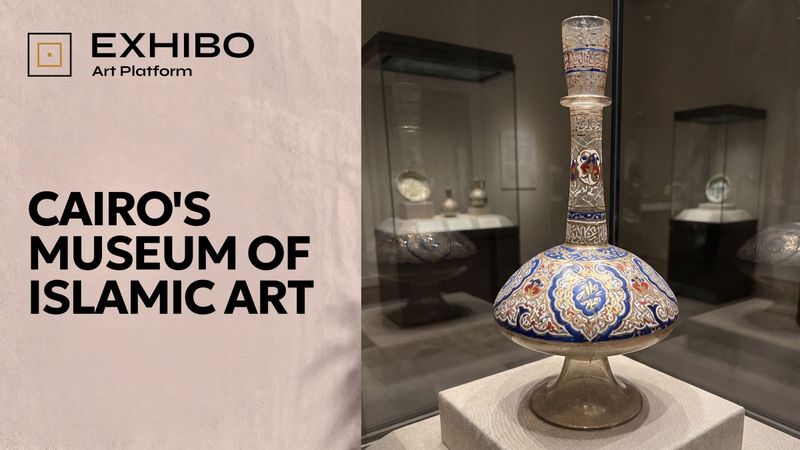
A car bomb left one of the world's great collections of Islamic art in fragments on the floor. What the Museum of Islamic Art chose to do with the repair — mark it, rather than hide it — turns out to be the most quietly radical decision in the building.
Near the entrance of Cairo's Museum of Islamic Art stands an eight-hundred-year-old Syrian glass bottle with a small gold mark on its label. The mark does not mean the bottle is precious, though it is. It means it was broken — shattered on the floor by the 2014 bombing across the street, then patiently glued back into a single shape.
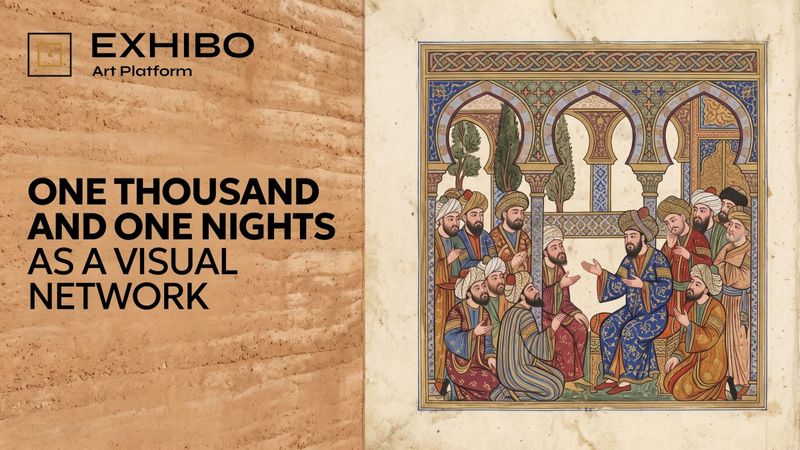
One Thousand and One Nights as a Visual Network
The book that taught Europe to picture the East arrived with no pictures at all. Three centuries of illustrators — Dutch, Egyptian, Persian, French, German, Iraqi — each gave it a face, and every face was a self-portrait.
Open Galland's Thousand and One Nights, the edition that conquered Europe, and there is nothing to look at: no genie, no lamp, not one illustration. The most visually imagined book in the world began blind — and because its text was never fixed either, no picture of it could ever be a copy.
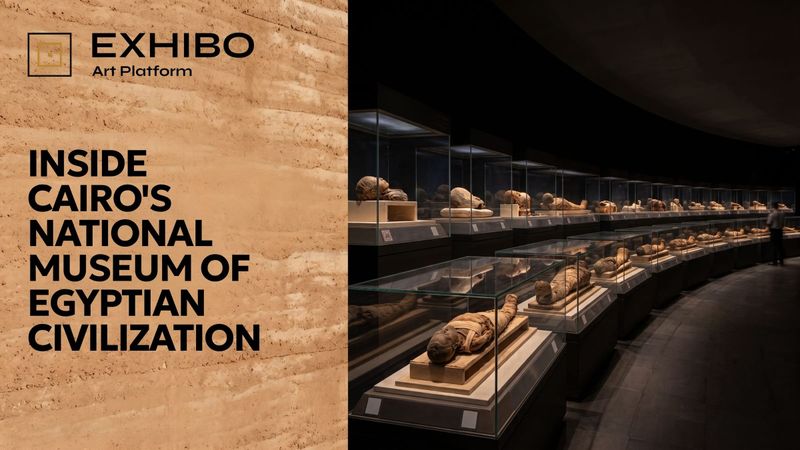
The Museum of Everything That Became a Tomb
Egypt built a museum to tell the story of an entire civilisation — seven thousand years of it, from flint tools to the present. The public knows it for one thing: the room where twenty dead kings lie in the dark.
In a black, hushed hall beneath the National Museum of Egyptian Civilization in Old Cairo lie the mummified bodies of Ramesses II, Hatshepsut, and eighteen other rulers of the New Kingdom — carried here in 2021 in a televised parade watched around the world.