
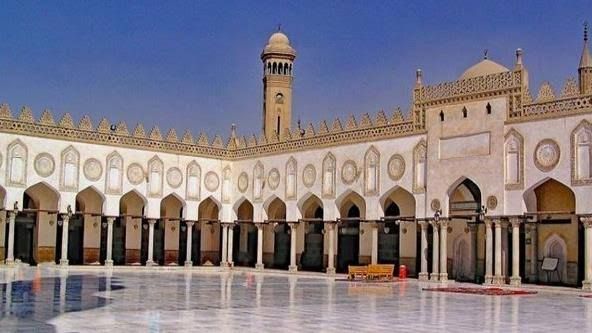
Al-Azhar Mosque
Founded in 970 with the city itself — Cairo's first mosque and one of the world's oldest seats of learning, under five minarets.
The first mosque of al-Qahira
Al-Azhar Mosque was founded in 970, a year after the Fatimid conquest of Egypt, by the general Jawhar al-Siqilli on behalf of the caliph al-Mu'izz li-Din Allah, as the congregational mosque of the new royal city of al-Qahira — Cairo. The first Friday prayer was held there in 972. In 988–989 the vizier Ya'qub ibn Killis appointed a group of scholars to teach there with stipends, the beginning of the institution that would grow into one of the oldest continuously operating centres of learning in the world. Its name, "the resplendent", is usually linked to Fatima al-Zahra, the daughter of the Prophet, from whom the Fatimid caliphs claimed descent.
From Ismaili to Sunni
Al-Azhar was founded as a centre of Ismaili Shi'i teaching. When Saladin abolished the Fatimid caliphate in 1171, the Sunni Ayyubids withdrew its status as a Friday mosque and its stipends, and for nearly a century it was eclipsed. The Mamluk Sultan Baybars restored the Friday sermon in 1266, and under the Mamluks Al-Azhar became the pre-eminent Sunni institution of the Islamic world, drawing students from West Africa to Central Asia, who lodged in riwaqs organised by region of origin. In the twentieth century its teaching was reorganised as Al-Azhar University, which now has campuses across Egypt, while the mosque remains the symbolic heart of Sunni scholarship.
A building of many centuries
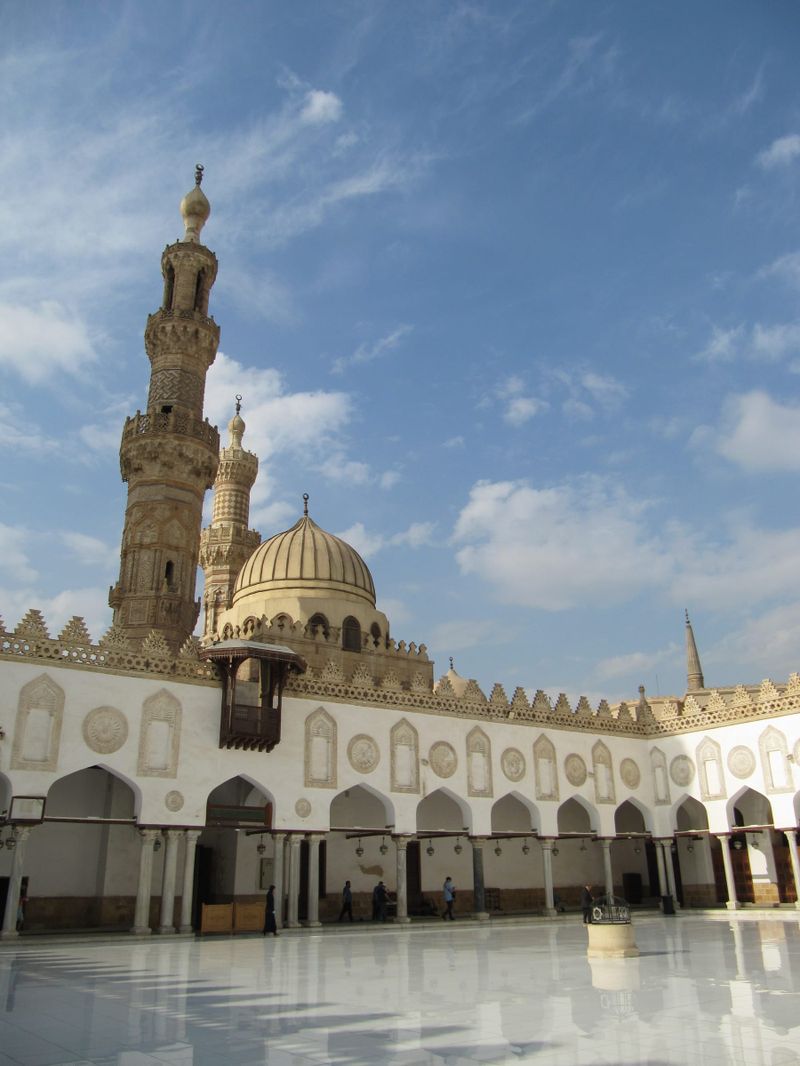
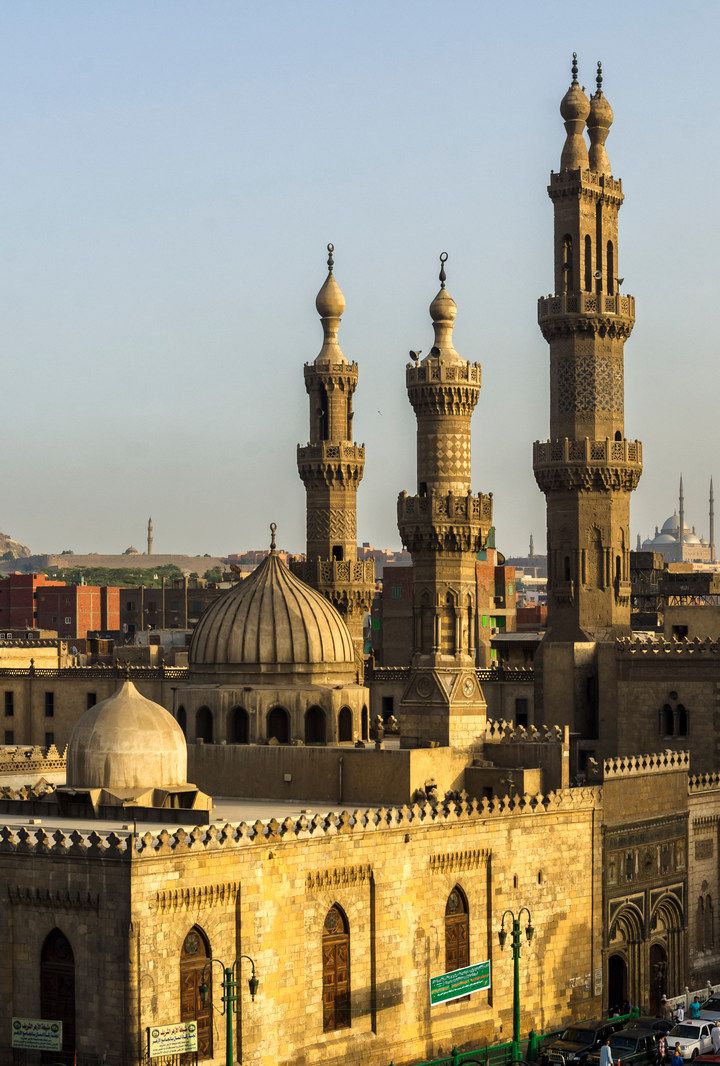
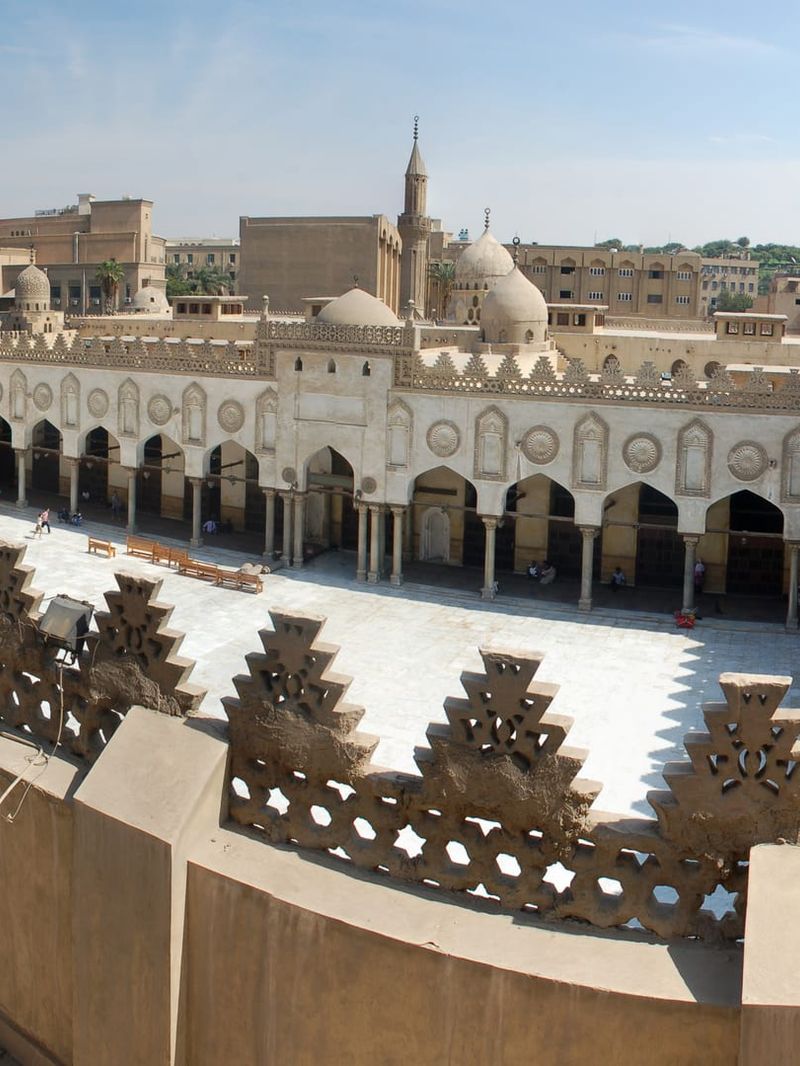
Almost every era of Cairo's history has added to the mosque. The marble-paved courtyard and its arcades of keel-shaped arches with stucco decoration belong largely to the Fatimid period, including the twelfth-century additions of the caliph al-Hafiz. The Mamluks added madrasas and minarets: the minaret of Aqbugha (1340), that of Sultan Qaytbay (1469) and the distinctive double-finial minaret of Sultan al-Ghuri (1510). In 1753 the Ottoman emir Abd al-Rahman Katkhuda extended the prayer hall to the east and built new gates, including the Gate of the Barbers, where students once had their heads shaved before entering. Today the mosque has five minarets, and its prayer hall is a forest of marble columns gathered from across the centuries. It is part of the UNESCO World Heritage Site of Historic Cairo.
Exhibo editorial
Al-Azhar doesn't perform for visitors; it gets on with being itself. Students sit cross-legged on the carpet with books open, an old man sleeps against a column, a teacher talks to a circle of young men in a dozen accents. The courtyard marble is so white at midday it hurts, and the five minarets around it are a short history lesson in stone — Fatimid, Mamluk, Ottoman, each generation adding its voice.
Come in the morning, take off your shoes, accept the borrowed headscarf if you need one, and simply walk the arcades slowly. This is the oldest working address in Cairo. Then step out through the Gate of the Barbers into the noise of the square, and the thousand years close behind you like a door.
Gallery
How to find it
Al-Azhar faces Al-Azhar Square, opposite the Mosque of al-Husayn and the start of Khan el-Khalili. The visitor entrance is the main western gate on the square side, through the Gate of the Barbers (Bab al-Muzayinin); leave your shoes at the gate and walk into the central courtyard. The Mamluk minarets are best seen from the middle of the courtyard looking back towards the gate.
Similar places
All places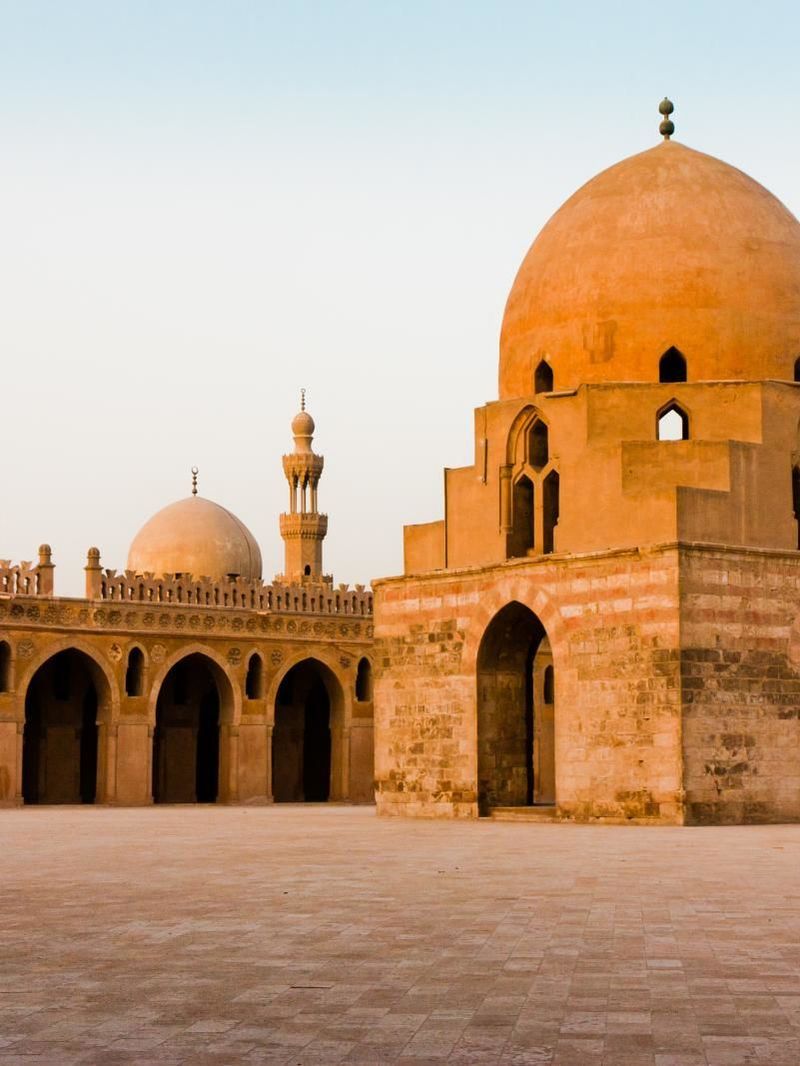
News by Exhibo
Editorial coverage on Exhibo
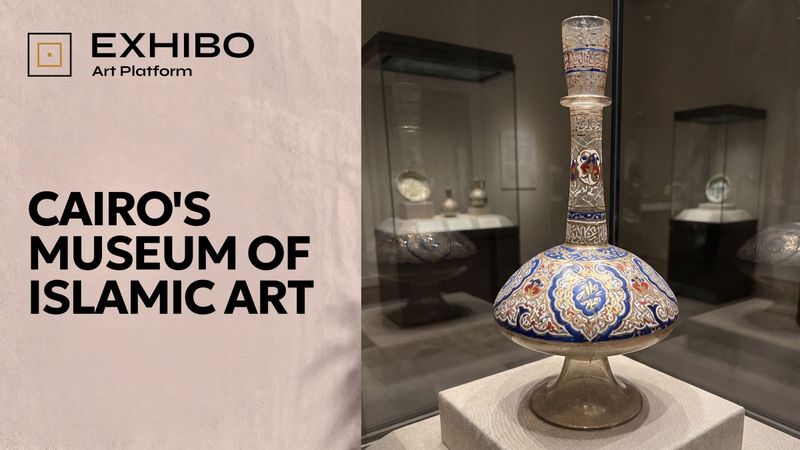
The Bottle That Was in Pieces on the Floor
A car bomb left one of the world's great collections of Islamic art in fragments on the floor. What the Museum of Islamic Art chose to do with the repair — mark it, rather than hide it — turns out to be the most quietly radical decision in the building.
Near the entrance of Cairo's Museum of Islamic Art stands an eight-hundred-year-old Syrian glass bottle with a small gold mark on its label. The mark does not mean the bottle is precious, though it is. It means it was broken — shattered on the floor by the 2014 bombing across the street, then patiently glued back into a single shape.
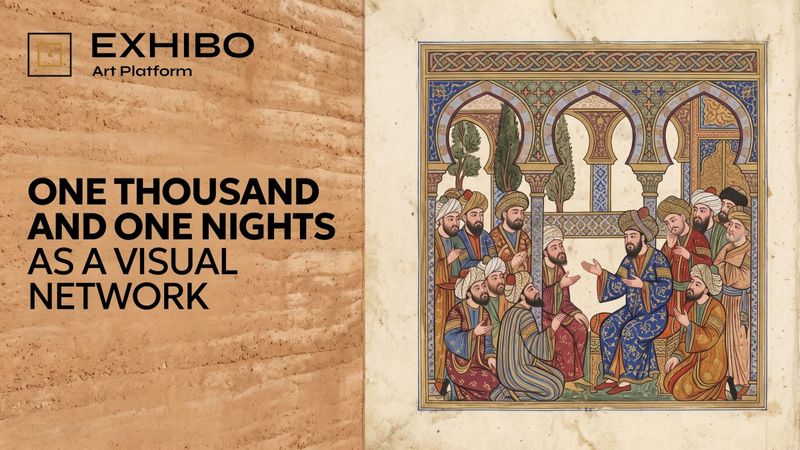
One Thousand and One Nights as a Visual Network
The book that taught Europe to picture the East arrived with no pictures at all. Three centuries of illustrators — Dutch, Egyptian, Persian, French, German, Iraqi — each gave it a face, and every face was a self-portrait.
Open Galland's Thousand and One Nights, the edition that conquered Europe, and there is nothing to look at: no genie, no lamp, not one illustration. The most visually imagined book in the world began blind — and because its text was never fixed either, no picture of it could ever be a copy.
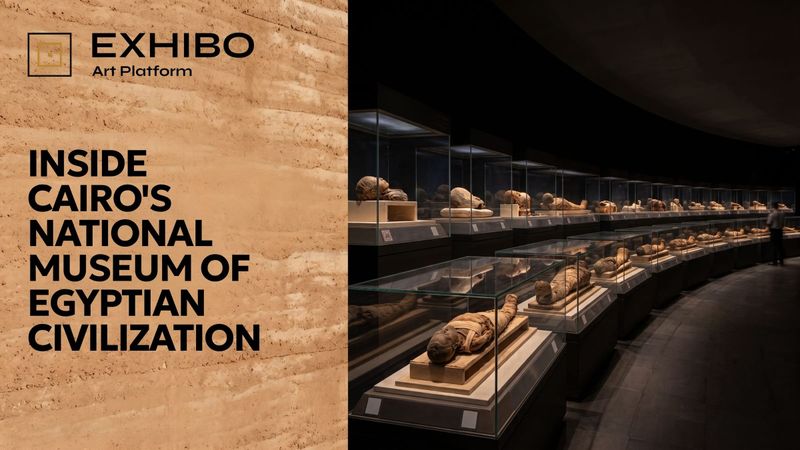
The Museum of Everything That Became a Tomb
Egypt built a museum to tell the story of an entire civilisation — seven thousand years of it, from flint tools to the present. The public knows it for one thing: the room where twenty dead kings lie in the dark.
In a black, hushed hall beneath the National Museum of Egyptian Civilization in Old Cairo lie the mummified bodies of Ramesses II, Hatshepsut, and eighteen other rulers of the New Kingdom — carried here in 2021 in a televised parade watched around the world.