The last of the Seven Wonders
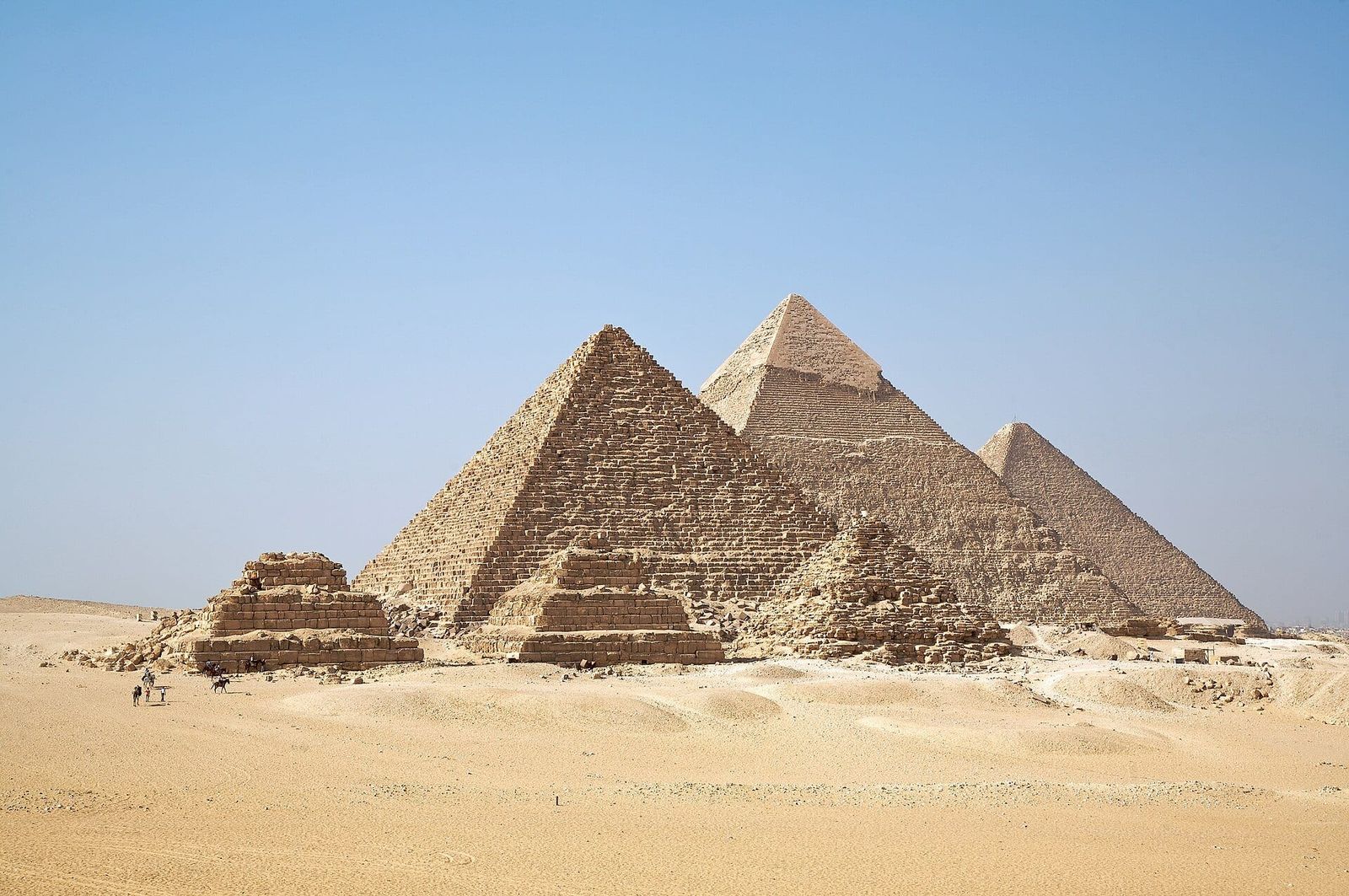
The Giza pyramid complex stands on a limestone plateau on the western edge of greater Cairo and is the only one of the Seven Wonders of the Ancient World still standing. It was built during Egypt's Fourth Dynasty, in the middle of the third millennium BC, as the burial place of three successive kings: Khufu (known to the Greeks as Cheops), his son Khafre (Chephren) and Menkaure (Mycerinus). Together with the Sphinx, the temples, causeways, smaller queens' pyramids and the cemeteries of officials around them, the pyramids form part of the UNESCO World Heritage Site of Memphis and its Necropolis, the Pyramid Fields from Giza to Dahshur.
The Great Pyramid of Khufu
The Great Pyramid, built for Khufu around 2560 BC, is the largest of the three. It originally rose to about 146 metres and was the tallest human-made structure on earth for more than three and a half millennia; having lost its outer casing of fine white limestone, it now stands about 138 metres high. It was constructed from some two million blocks of limestone, with granite brought from Aswan for the interior. Inside, an ascending passage leads to the Grand Gallery, a soaring corbel-vaulted corridor nearly 9 metres high and on to the King's Chamber, lined with red granite and holding Khufu's empty sarcophagus. Pits around the pyramid once held dismantled boats; the best preserved of them, Khufu's solar boat, is now displayed in the Grand Egyptian Museum nearby.
Khafre and Menkaure
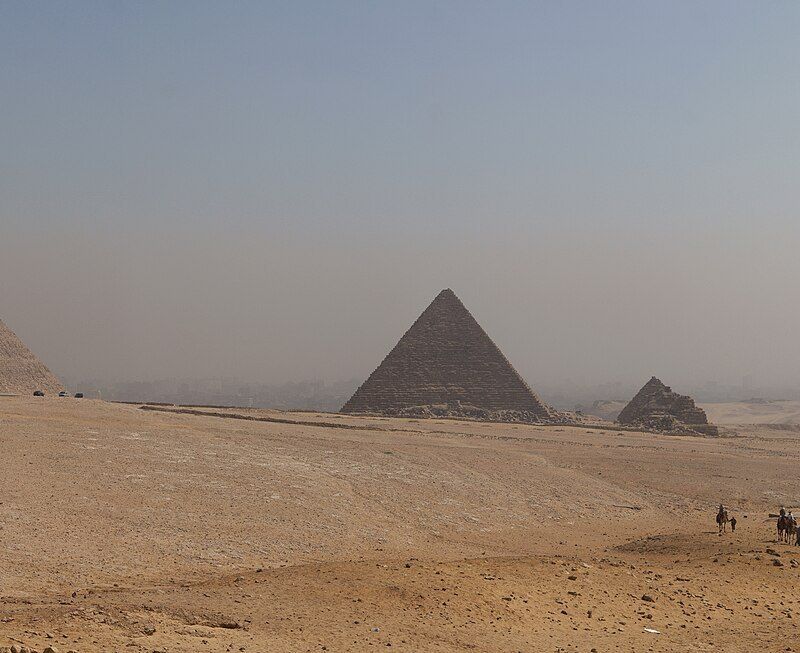
The Pyramid of Khafre appears taller than Khufu's because it stands on higher ground and still keeps part of its original casing near the summit; its interior is simpler, with a burial chamber cut partly into the bedrock. Khafre's complex includes the Great Sphinx and his granite Valley Temple. The smallest of the three, the Pyramid of Menkaure, was partly cased in red granite and is accompanied by three small queens' pyramids.
Visiting the plateau
The site is a vast open area best explored over several hours. The interiors of the pyramids of Khufu and Khafre can be entered on separate tickets; the passages are narrow, steep and hot and not recommended for visitors with claustrophobia or heart conditions. A panoramic viewpoint in the desert south-west of the pyramids offers the classic view of all three in a row and the Grand Egyptian Museum lies about two kilometres away.
Exhibo editorial
Nothing prepares you for the scale, however many photographs you have seen. Up close the Great Pyramid is not a smooth triangle at all but a staircase of rough blocks, many of them waist-high or more. Then you look up and up and the mind simply refuses the arithmetic.
Come at the opening hour, before the coaches, when the plateau is quiet and the light is low and gold. Go inside the Great Pyramid if your knees and nerves allow: the Grand Gallery is one of the most astonishing interior spaces ever built. Then walk out to the viewpoint in the desert and let the three of them line up against the sky, with Cairo's towers crowding at their feet. Forty-five centuries and still the best view in the city.
Gallery
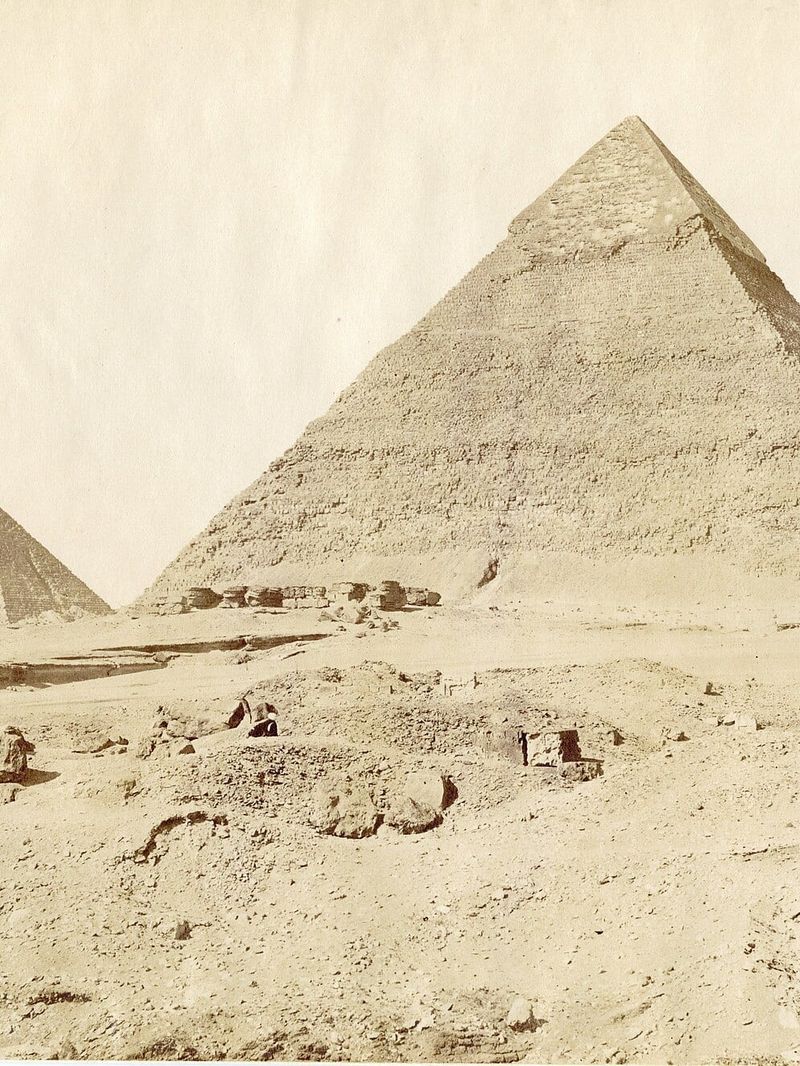
How to find it
The main entrance is on the Mena House side at the top of Pyramids Road, with a second entrance at the Sphinx Gate in Nazlet el-Samman. Shuttle buses run across the plateau to the panoramic viewpoint in the desert south-west of the three pyramids.
Similar places
All places
News by Exhibo
Editorial coverage on Exhibo
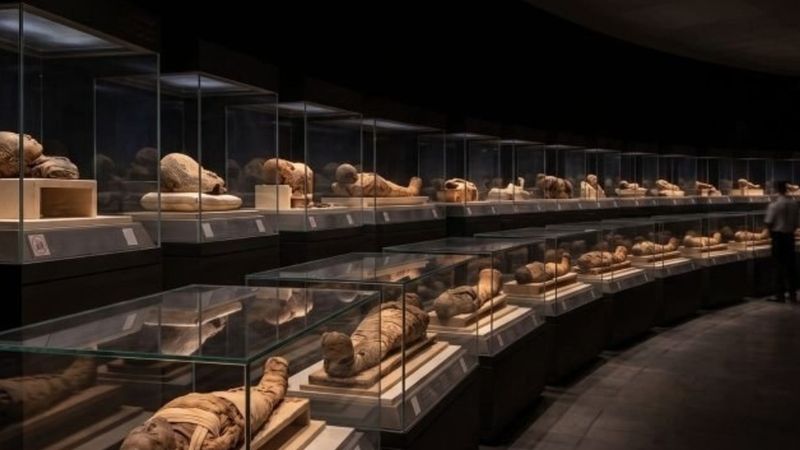
The Museum of Everything That Became a Tomb
Egypt built a museum to tell the story of an entire civilisation — seven thousand years of it, from flint tools to the present. The public knows it for one thing: the room where twenty dead kings lie in the dark.
In a black, hushed hall beneath the National Museum of Egyptian Civilization in Old Cairo lie the mummified bodies of Ramesses II, Hatshepsut, and eighteen other rulers of the New Kingdom — carried here in 2021 in a televised parade watched around the world.
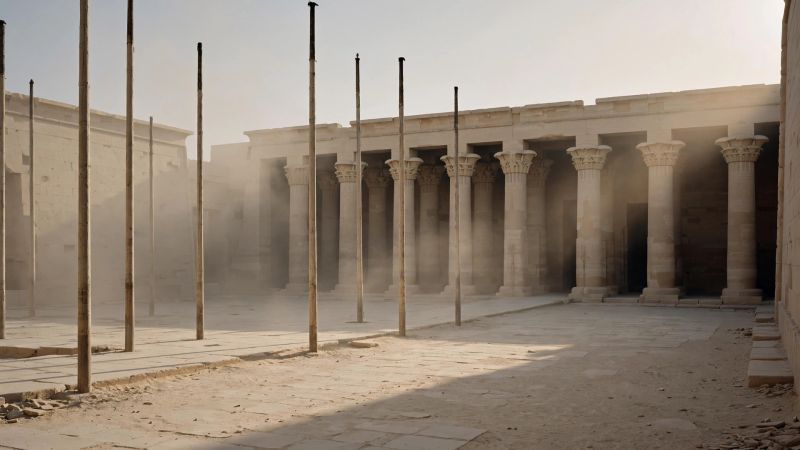
Ancient Egyptian Art
Images built to work for gods, kings and the dead: canon, craft and change along the Nile across nearly three millennia.
Ancient Egyptian art was rarely made for the museum wall alone. This period survey explains why statues and reliefs functioned as cult tools, how a stable visual canon held for centuries, where Old, Middle and New Kingdom styles diverge, and which collections still make those differences visible today.
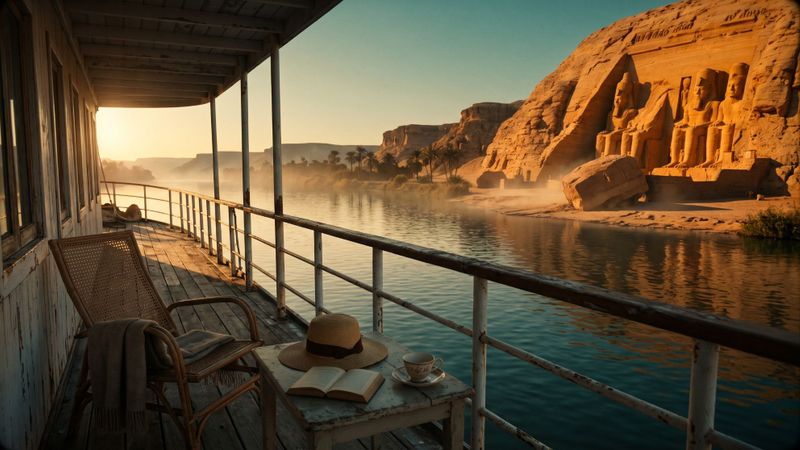
Agatha Christie's Egypt: Three Abu Simbels, a Pharaoh and a Murder on the Nile
Christie set one famous murder on the Nile and two lesser-known stories in ancient Egypt. The temples, letters and film sets behind all three.
The Abu Simbel of Death on the Nile has since moved up a hill. Christie's two other Egyptian stories lead to a pharaoh's dismantled temples at Karnak and a farmer's 4,000-year-old letters now in New York.