
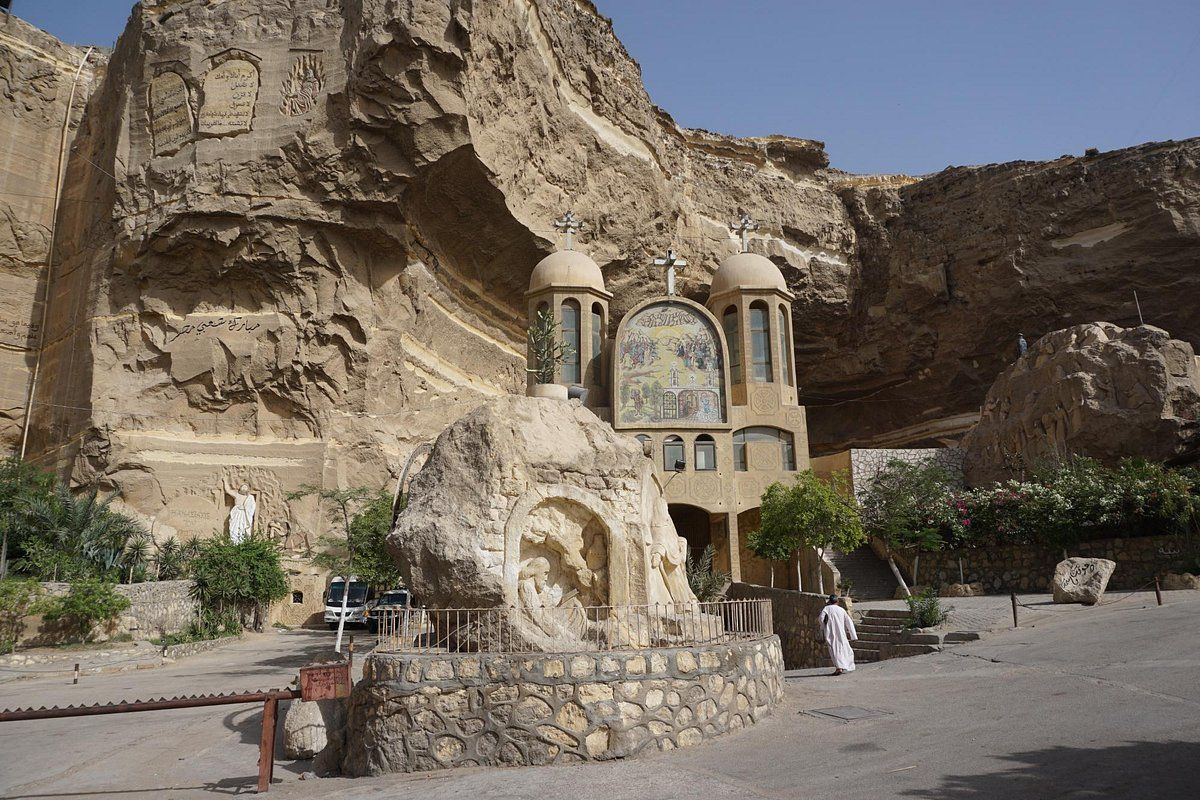
Cave Church (Monastery of St Simon the Tanner)
A 20,000-seat Coptic amphitheatre carved into the Muqattam cliffs above Cairo's community of garbage collectors.
A church in the rock
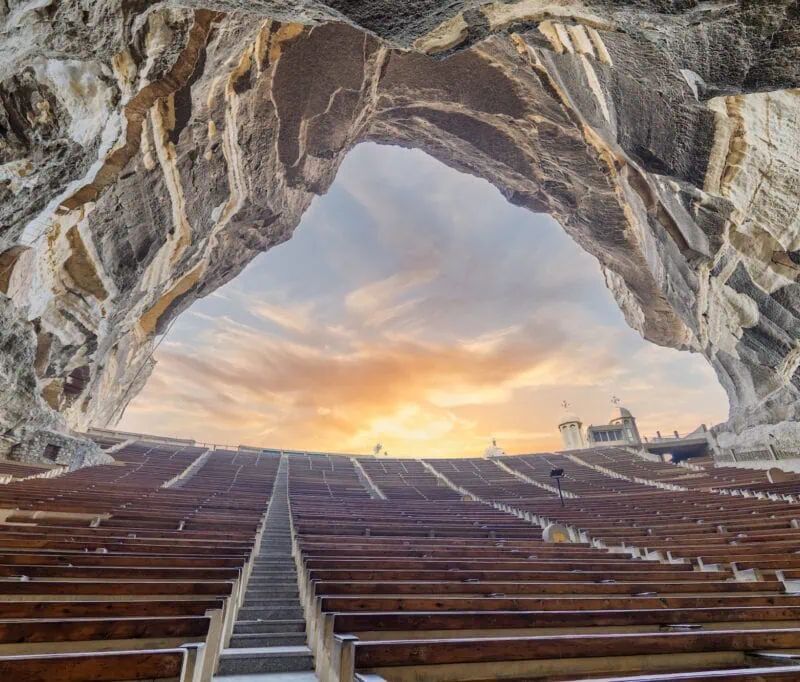
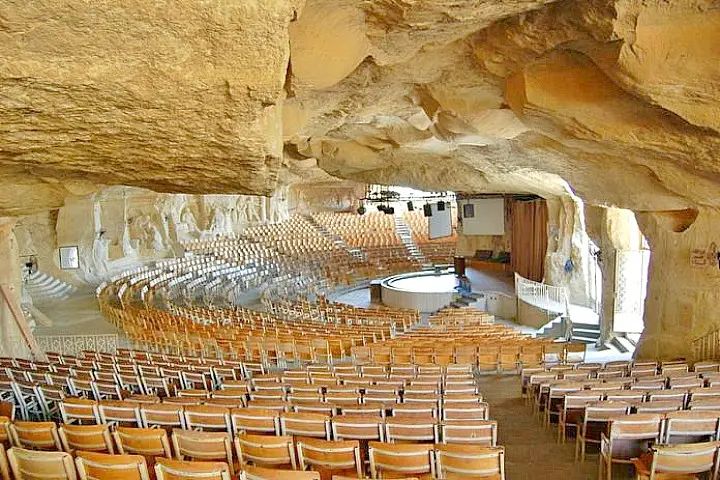
The Monastery of St Simon the Tanner, known as the Cave Church, is carved into the cliffs of the Muqattam hills on the south-eastern edge of Cairo, above the district of Manshiyat Nasser. It is the largest church in Egypt and one of the largest in the Middle East: its main sanctuary, an open amphitheatre set into a huge natural cave, seats around 20,000 people, and the complex includes several more churches, chapels and halls cut into the rock.
The community of the Zabbaleen
Manshiyat Nasser is home to the Zabbaleen, Cairo's traditional garbage collectors, a largely Coptic Christian community descended from rural migrants from Upper Egypt who came to the capital in the mid-twentieth century and built their livelihood on collecting, sorting and recycling the city's waste. After being moved from other parts of Cairo, they settled under the Muqattam cliffs in the 1970s. A local church was established in 1975; after a fire swept the area in 1976, a first church was built below the mountain, and the discovery of a large cave in the cliffs led to its transformation, with tons of rock removed by hand, into the vast complex completed in the 1990s.
St Simon and the moving of the mountain
The monastery is dedicated to Simon the Tanner, a Coptic saint of the late tenth century. According to Coptic tradition, the Fatimid caliph al-Mu'izz challenged the Coptic patriarch to prove the Gospel saying that faith can move mountains; after days of prayer, the Muqattam hill was miraculously moved through Simon's faith. His relics, rediscovered in 1991, are kept in the church. The cliff faces around the amphitheatre are carved with large reliefs of biblical scenes and saints by a Polish artist known as Mario, adding to the extraordinary setting.
Visiting
The church is reached through the streets of Manshiyat Nasser, where the work of the Zabbaleen continues around you; nearby, the mural Perception by the artist eL Seed covers some fifty buildings of the district.
Exhibo editorial
The drive up is part of it: through streets stacked with bags of sorted plastic and paper, past workshops where families pull Cairo's waste apart by hand, the smell sharp in the heat. Then the cliff opens, and you are standing at the top of a stone amphitheatre for twenty thousand people, the rock overhead carved with Christ and the apostles.
It is one of the great sights of Cairo, and one of the least expected — a cathedral made by the city's poorest community out of a hole in a mountain. Come on a weekday morning for quiet, or on a Sunday to hear it full. Then climb to a viewpoint above the district and look for eL Seed's circle of calligraphy across the rooftops.
Gallery
How to find it
Take a taxi or ride-hailing to 'Deir Samaan al-Kharraz, Manshiyat Nasser'; the road climbs through the Zabbaleen district to the monastery gate at the foot of the cliffs. From the gate, walk up through the courtyard to the main amphitheatre, set into the largest cave; the smaller churches and the relics of St Simon are off the same terraces.
Similar places
All places
News by Exhibo
Editorial coverage on Exhibo
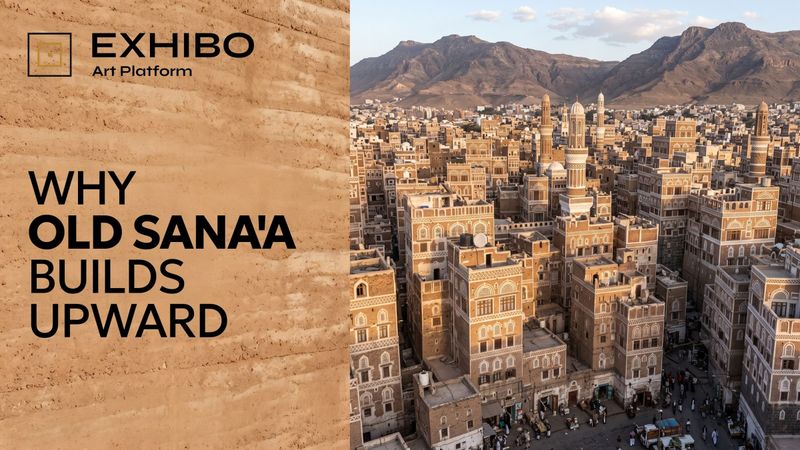
Why Old Sana'a Builds Upward
The tower houses of Old Sana'a rise five to nine storeys of stone and mud — and the usual reasons, defence and lack of space, are both too small.
In one of the oldest cities on earth, families live stacked from the animals on the ground floor to the poetry room at the top, in mud towers nine storeys high. Why Sana'a built vertically has half a dozen answers, heat least of all — and the system that raised the towers is the same one now dissolving them.
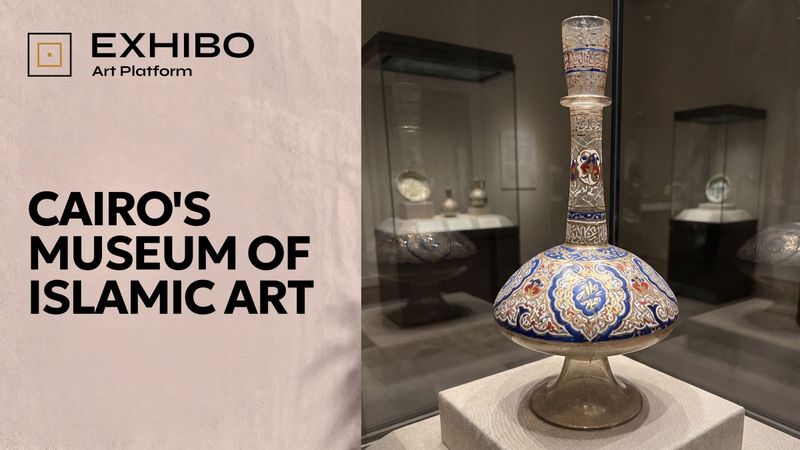
The Bottle That Was in Pieces on the Floor
A car bomb left one of the world's great collections of Islamic art in fragments on the floor. What the Museum of Islamic Art chose to do with the repair — mark it, rather than hide it — turns out to be the most quietly radical decision in the building.
Near the entrance of Cairo's Museum of Islamic Art stands an eight-hundred-year-old Syrian glass bottle with a small gold mark on its label. The mark does not mean the bottle is precious, though it is. It means it was broken — shattered on the floor by the 2014 bombing across the street, then patiently glued back into a single shape.
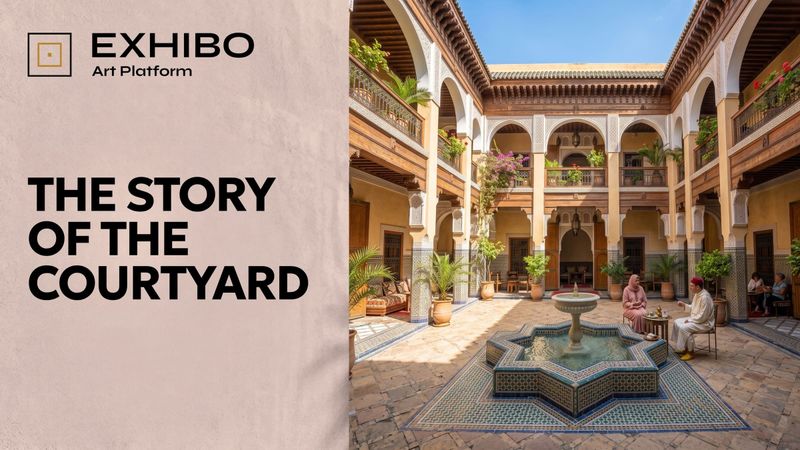
Why North African Cities Turn Inward: The Story of the Courtyard
A courtyard plan far older than Islam turned North African houses — and the medinas built from them — to face inward. Climate and religion only half-explain why, and what finally displaced the courtyard says the rest.
The blank walls and inward courtyards of Fez, Tunis, Algiers and Cairo are usually explained by heat or religion. Both are true; neither is the whole story. The clue is in what eventually pushed the courtyard out of the modern city.