
Cairo Tower
A 187-metre lattice lotus on Gezira Island, built with money the CIA meant as a bribe — and the city's highest public viewpoint.
A tower with a story
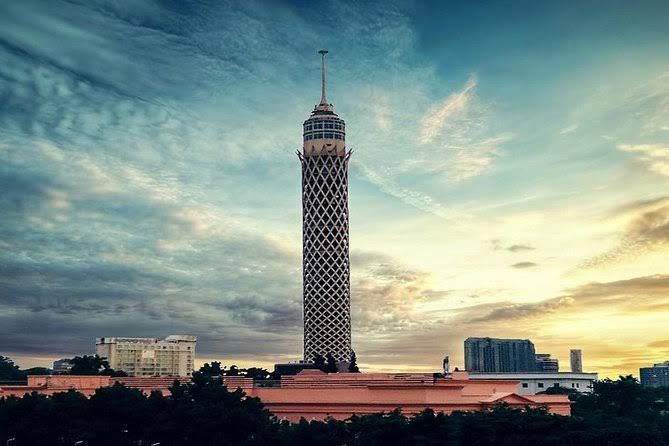
The Cairo Tower stands on Gezira Island in the Nile, beside the Opera grounds and the Zamalek district. It was built between 1956 and 1961 and inaugurated in April 1961. Its origin is one of the most famous anecdotes of the Nasser era: according to accounts by the former CIA officer Miles Copeland and others, the United States, through the CIA and Kermit Roosevelt, had offered President Gamal Abdel Nasser a substantial sum of money as a personal gift intended to influence his policy, including his support for the Algerian war of independence. Nasser, the story goes, used the money instead to build a tower visible from across the city — a lasting gesture of defiance. Construction was interrupted for a time by the Suez Crisis of 1956.
Architecture
The tower was designed by the Egyptian architect Naoum Shebib, who also acted as its structural engineer and main contractor, and who later designed the Al-Ahram newspaper building. Rising 187 metres — some 50 metres higher than the Great Pyramid — it was among the tallest reinforced-concrete towers in the world when completed, and for decades the tallest structure in Africa. Its structure consists of a central concrete core, four peripheral columns and circular platforms; the exterior is wrapped in a latticework that opens slightly towards the top like a stylised lotus, the ancient Egyptian symbol of rebirth, and is covered with some eight million small mosaic tiles. A team of around 500 workers built it.
The view
At the top, an observation deck at about 143 metres offers a 360-degree panorama over greater Cairo: the Nile and its islands, Zamalek and downtown, the minarets of Historic Cairo, the Citadel and, when the haze lifts, the Pyramids of Giza on the horizon. A café and a revolving restaurant occupy the levels just below.
Exhibo editorial
It is the most unapologetically twentieth-century thing in a city of five thousand years: a concrete stem with a lotus for a crown, built by a newly independent Egypt that wanted the world to see it. And the money story — a bribe turned into a monument you can see from the embassy windows — is too good not to love, whatever the precise accounting.
Go up late in the afternoon, when the haze thins and the light turns gold, and stay until the city lights come on. Below you the Nile divides around Gezira and Zamalek, the minarets stand up across the old city, and if you are lucky the pyramids appear on the edge of the desert. It is the view that puts the whole of Cairo in your head at once.
How to find it
The tower stands on Gezira Island, just north of the Cairo Opera House grounds and south of Zamalek, a short walk from the Opera metro station (Line 2). The entrance and ticket office are at the base of the tower; lifts take visitors to the observation deck at the top.
Similar places
All places
News by Exhibo
Editorial coverage on Exhibo
Filmed, but Not Recorded: The Arab World’s Missing Film Locations
Wikidata knows Gladiator was filmed in Morocco. It doesn’t know where.
Ouarzazate is the second most filmed place in the Middle East and North Africa, yet 25 of its 27 productions are recorded only in Wikipedia prose. We compared filming records worldwide and found that in the Arab world, Wikidata usually knows the country but not the place.
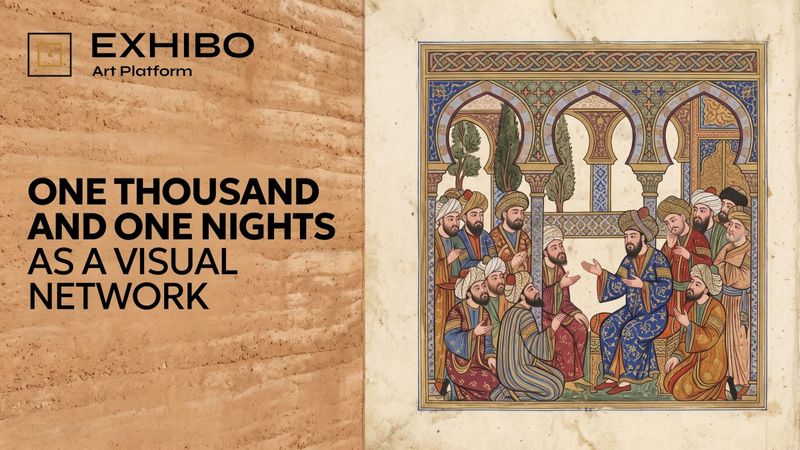
One Thousand and One Nights as a Visual Network
The book that taught Europe to picture the East arrived with no pictures at all. Three centuries of illustrators — Dutch, Egyptian, Persian, French, German, Iraqi — each gave it a face, and every face was a self-portrait.
Open Galland's Thousand and One Nights, the edition that conquered Europe, and there is nothing to look at: no genie, no lamp, not one illustration. The most visually imagined book in the world began blind — and because its text was never fixed either, no picture of it could ever be a copy.
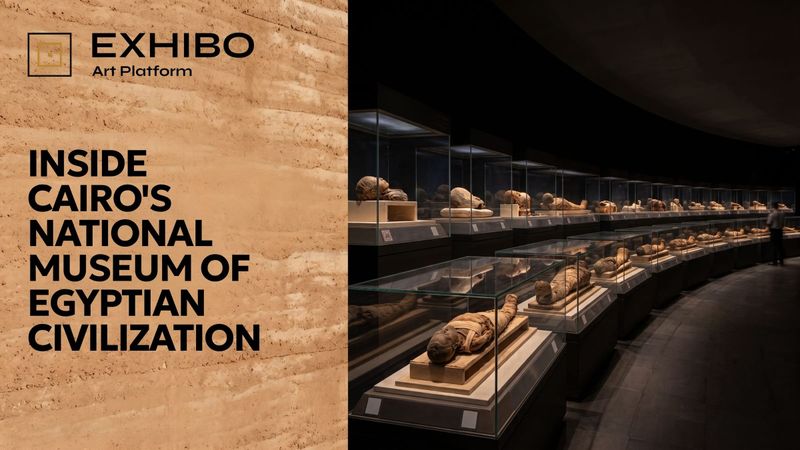
The Museum of Everything That Became a Tomb
Egypt built a museum to tell the story of an entire civilisation — seven thousand years of it, from flint tools to the present. The public knows it for one thing: the room where twenty dead kings lie in the dark.
In a black, hushed hall beneath the National Museum of Egyptian Civilization in Old Cairo lie the mummified bodies of Ramesses II, Hatshepsut, and eighteen other rulers of the New Kingdom — carried here in 2021 in a televised parade watched around the world.