Suq al-Ghazl Minaret, Al-Khulafa Mosque
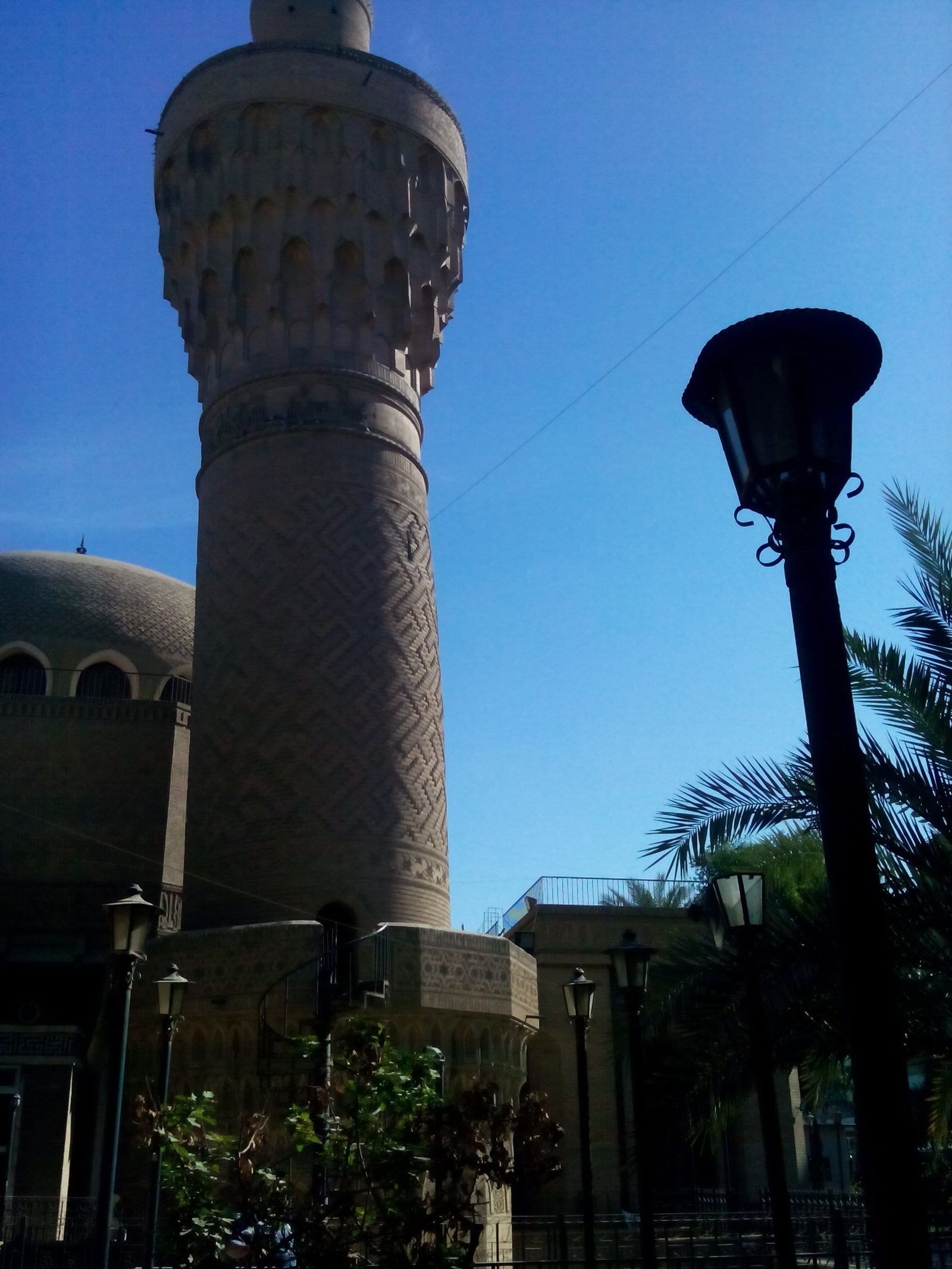
A carved brick minaret of 1279, the last standing piece of the Abbasid caliphs' palace mosque in Baghdad.
The caliphs' mosque
The Suq al-Ghazl Minaret rises over Al-Khulafa Street in old Rusafa, on the east bank of the Tigris. It stands on the site of the great Friday mosque of the Abbasid caliphs. The caliph al-Muktafi built that mosque between 902 and 908, beside the caliphal palace, so it was first known as the Palace Mosque and later as the Mosque of the Caliphs, Jami' al-Khulafa.
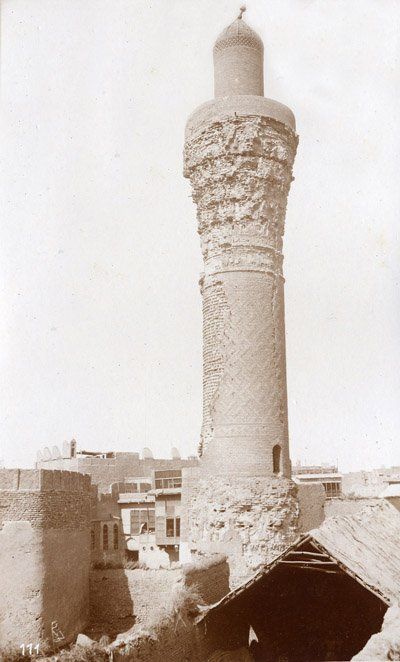
In 1258 the Mongol armies sacked Baghdad and the mosque burned. It was rebuilt in the 1270s, under Ilkhanid rule. The present minaret dates from 1279 (678 AH), probably raised on the orders of 'Ata Malik Juvaini, the Persian historian who governed Baghdad for the Mongols. Over the centuries the mosque around it disappeared. The minaret took its name from the yarn and cotton market, Suq al-Ghazl, which grew up to the east of the site.
Brick and muqarnas
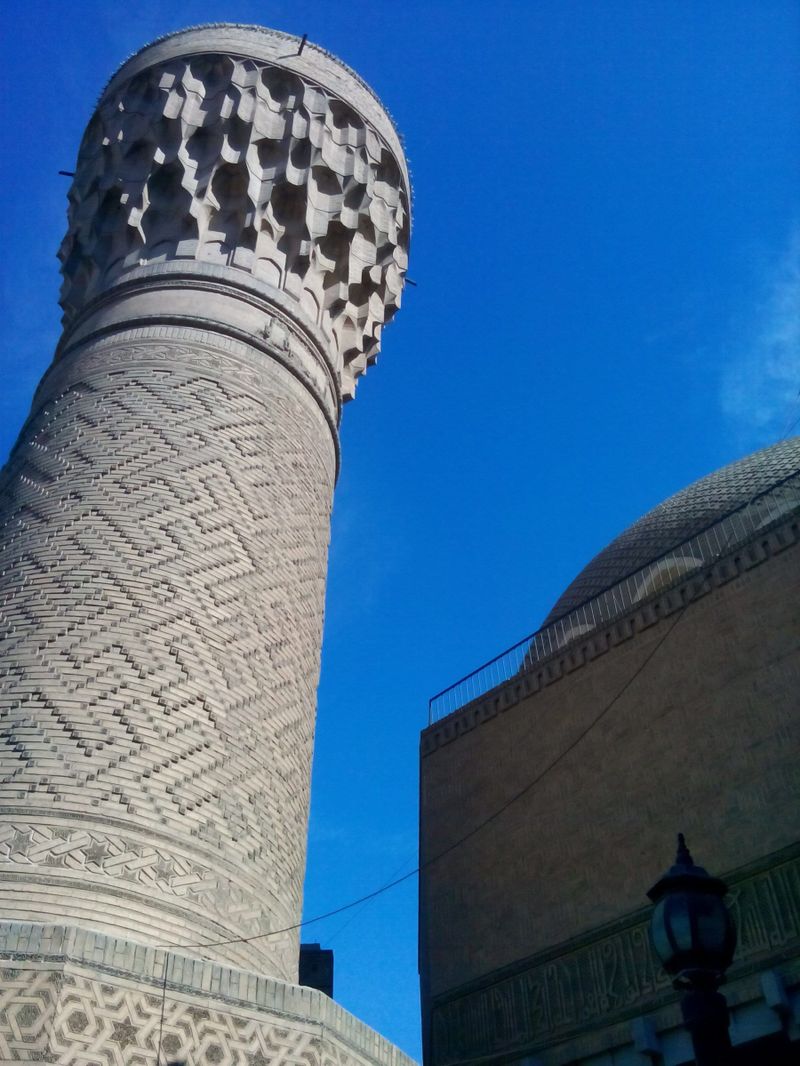
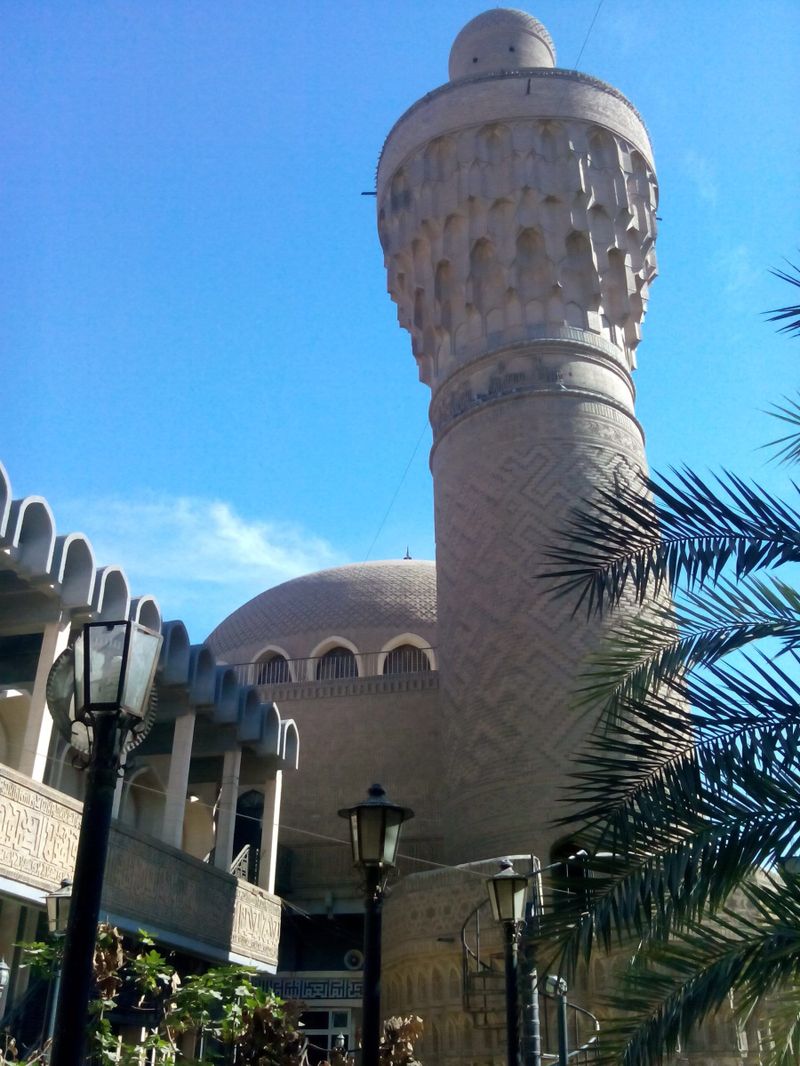
The minaret is built of fired brick. It rises from a twelve-sided base, the only one of its kind in Iraq. Four tiers of muqarnas, the stepped honeycomb vaulting of Islamic architecture, carry an enclosed passage above the base. From there the round shaft climbs, covered in a net of interlaced geometric brickwork with bands of Kufic inscription. Five more tiers of muqarnas swell out to support a circular balcony near the top. A slim upper shaft ends in a small pointed dome.
Makiya's mosque
After restoration work that began in 1917 and was completed in 1960, the Ministry of Religious Endowments asked the Iraqi architect Mohamed Makiya to build a new mosque around the minaret. It was his first major public building, completed in 1964. The plot was small and hemmed in by tall commercial blocks. Makiya later said he had to build a cathedral in an area suitable for a chapel.
He made the minaret the centre of the composition. It stands in a small sunken court in one corner of the courtyard. An octagonal prayer hall about 14 metres high is crowned by a dome rising another 7 metres, faced with yellow brick laid in geometric patterns to match the old tower. A black and white ceramic frieze of interlaced Kufic script runs round its base. High arcaded walls of yellow brick screen the courtyard from the traffic.
In 2020 a dangerous tilt was detected in the minaret. Restoration began in 2023. The mosque is a few minutes' walk from Al-Mutanabbi Street and the Al-Mustansiriya Madrasa.
Exhibo editorial
Almost nothing of the Abbasid capital is left above ground. The Round City has gone. So have the palaces. The House of Wisdom survives only as a name in books. This minaret is one of the few places where you can still put a hand on the caliphs' Baghdad, even if the tower itself was rebuilt by the city's Mongol governors.
Look up at the brickwork. Thin bricks are cut and set so that the whole shaft seems woven, like a basket. Then look at what Makiya did around it in the 1960s: a modern mosque that bows to the old tower instead of competing with it.
Gallery
How to find it
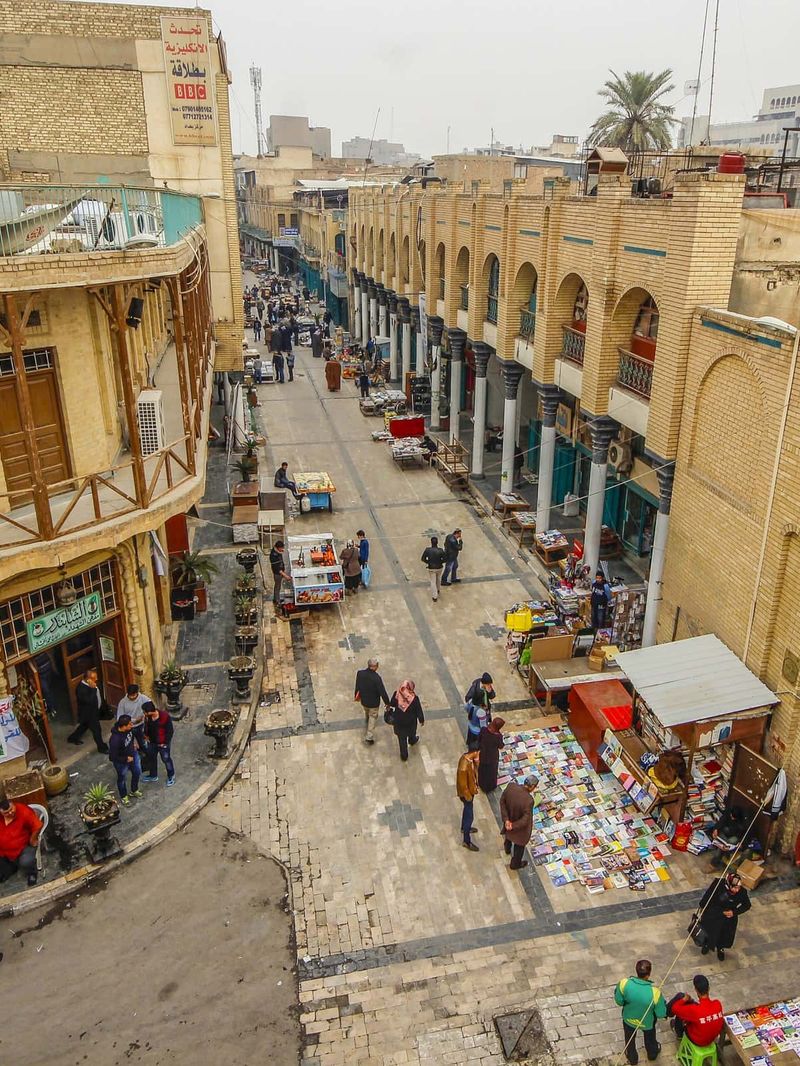
The mosque stands on Al-Khulafa Street in old Rusafa. The minaret is visible from the street through the railings. It is a short walk east from Al-Mutanabbi Street and the Mustansiriya Madrasa.
Similar places
All places
News by Exhibo
Editorial coverage on Exhibo
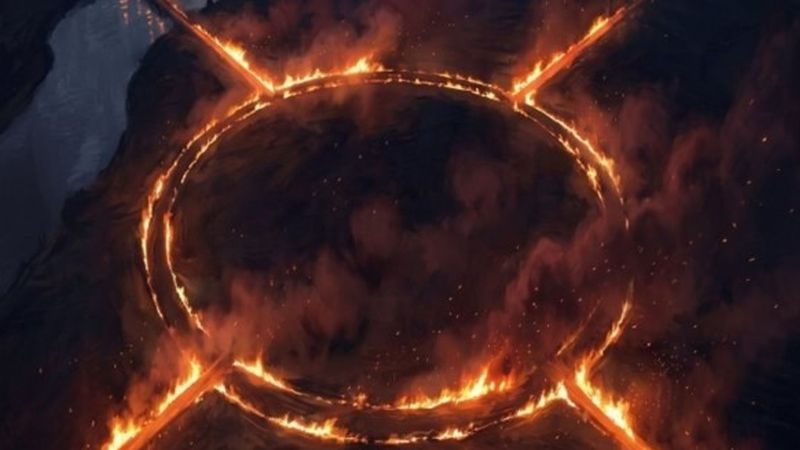
The City With No Ruins: What Is Left of Abbasid Baghdad
A caliph drew his capital in fire, the Mongols erased it, and a video game rebuilt it out of Isfahan and Samarkand. What actually survives of Abbasid Baghdad, where it is, and who else has tried to put it back.
Climb a viewpoint in Assassin's Creed Mirage and you see the Round City whole — double walls, four gates, the green dome at the centre. Nobody has ever seen that view. No excavated remains have been securely identified as any of it. This is what is actually left of ninth-century Baghdad, where you would have to go to stand in it, and why Ubisoft was the second team to rebuild a city that no longer exists.
The Civilisation That Bought Itself Back: A Field Guide to Collecting Arab Art
A field guide to collecting Arab and Middle Eastern art — who buys, what it costs, why prices lag cultural significance, and where collectors are looking now.
How the Arab world went from selling its art history to the West to building the fastest-growing market for Middle Eastern art on earth — who buys, why, what it costs, and where the smart money is looking now
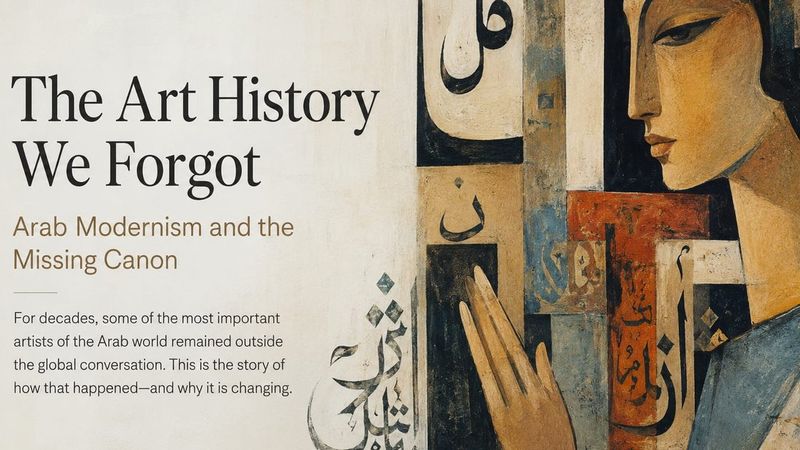
Arab Modernism 101: The Movement That Western Art History Forgot
An entire century of extraordinary painting, sculpture and radical thinking got written out of the global canon. Someone made that decision. And now the market — and the collectors who pay attention — are making a different one.
Great art does not become invisible by accident. Arab Modernism reveals how museums, markets and cultural institutions shape what the world sees — and what it overlooks. A story about artists, recognition and the blind spots that define art history.