
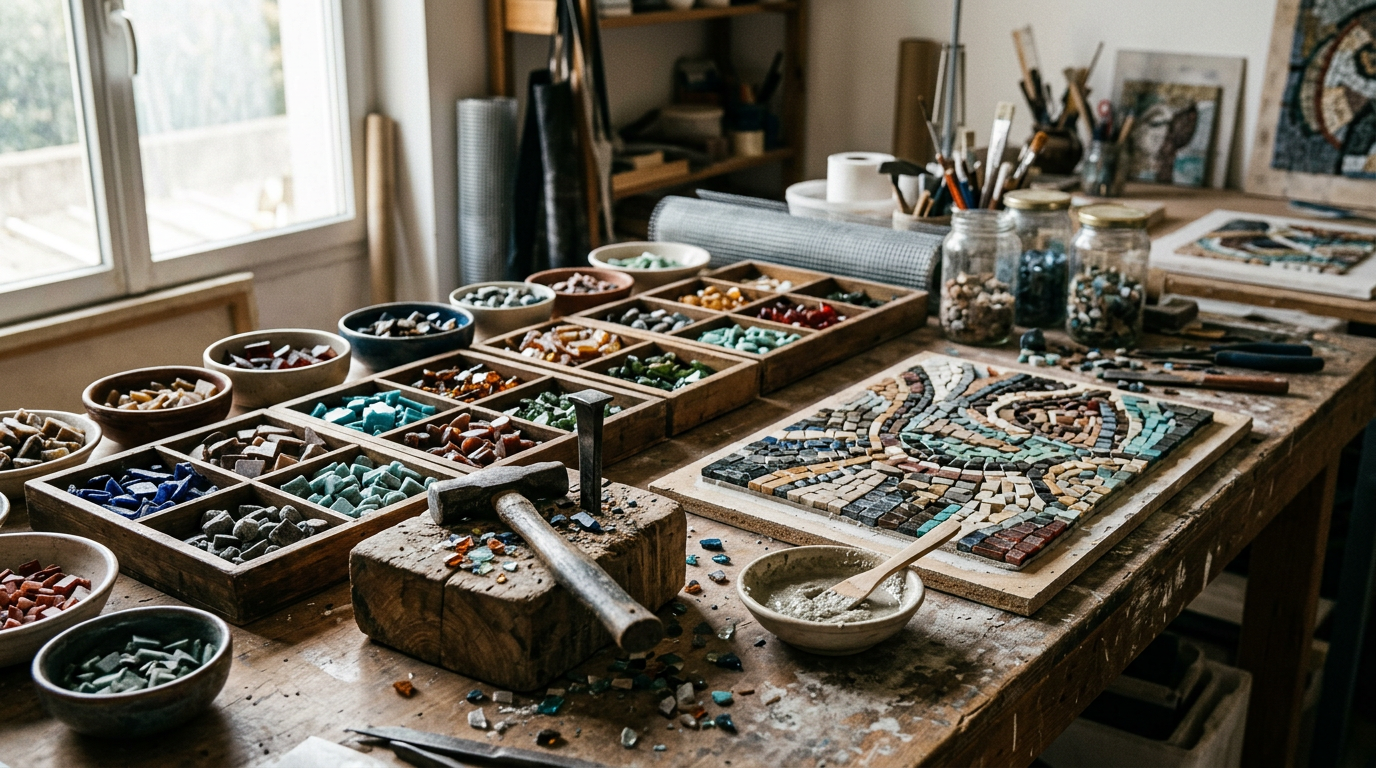
Exhibo Editorial
What Is Mosaic?
Tesserae, mortar, and andamento: how mosaicists build durable pictures in stone and glass, from Roman floors to Byzantine walls.
Mosaic in art is a picture or pattern made from many small set pieces, called tesserae, fixed into a bed of mortar, cement, or adhesive on a floor, wall, vault, or portable panel. The pieces can be cut stone, coloured glass, ceramic, shell, or modern factory tile. Seen from a step back, the gaps between them disappear and the eye reads colour and form. Seen close in, each cube catches light on a slightly different angle. That double scale is the technique’s signature.
Unlike collage, which usually glues flat fragments on a support, mosaic embeds its units in a structural layer meant to last decades outdoors or centuries indoors. Unlike painting, it has no wet blend on the surface: modellers build tone by packing adjacent tesserae of related hue. The rest of this guide follows the Art Techniques & Materials series order: what mosaic is, what it is made of, how it is built, how the method developed, who pushed it, how it fails, and what it costs to commission properly today.
What mosaic in art means
A mosaic is both an object and a method. As an object, it is a decorated surface: the Alexander Mosaic in Naples is a floor panel turned wall display; the Justinian panel in Ravenna is a wall procession frozen in glass and stone. As a method, it is the act of setting tesserae so that their collective andamento (the flow of their rows) describes a design. Britannica’s short definition, echoed in most museum glossaries, calls mosaic a form that decorates surfaces with closely set pieces of stone, mineral, glass, tile, or shell.
Scale separates mosaic from related crafts. Opus sectile cuts larger shapes from sheet material and inlays them like a jigsaw; Roman floors in coloured marble use it for geometric fields. Micro-mosaic (Roman micromosaic) packs minute glass rods into jewellery and small panels from the eighteenth century onward. Trencadís, the broken-tile skin Antoni Gaudí and Josep Maria Jujol used at Park Güell in Barcelona, is a modern Catalan variant: irregular ceramic shards set in mortar for curved benches and facades. All share the logic of part-to-whole assembly. Mosaic is the category name for the tessera-sized version.
Location matters historically. Floor mosaics in the Roman world took foot traffic; tesserae were often larger and the palette relied on durable stone. Wall and vault mosaics in late antiquity and Byzantium climbed vertical surfaces and domes; workshops shifted toward lighter glass, gold leaf sandwiched between glass layers, and lime mortars that could hold tesserae on a vertical bed. A student asking what is mosaic in art is usually picturing one of those architectural programmes. Studio mosaics on board or mesh are the same grammar at domestic scale.
Viewing distance is part of the definition. Mosaic has no continuous tone; it approximates it through dithering, the same logic a printer uses when it simulates grey from black dots. Stand inside San Vitale and the gold field reads as unbroken light. Press your face to a panel and the surface breaks into individual cubes, each slightly proud of its neighbour. Teachers sometimes confuse mosaic with pixel art. The analogy helps for colour mixing; it misleads on material. Tesserae have thickness, facet angle, and mineral or glass chemistry. Light reflects off the wall, passes through smalti, or bounces from gold leaf inside a cube before it reaches your eye.
Tesserae, mortar, and the materials mosaicists use
Every mosaic is a sandwich. The tessellatum is the visible layer of tesserae. Below it sits one or more bedding mortars: a fine setting coat into which the cubes are pressed, then coarser rudus and statumen layers in Roman floor construction, or a keyed scratch coat on a wall. Roman builders documented that stratigraphy at sites from Aquileia to Pompeii; conservators still match repair mortars to those layers so new material does not crack the old.
Tesserae themselves vary in size, material, and manufacture. Hellenistic and Roman luxury floors could drop to two millimetres for opus vermiculatum (“worm-like” rows that follow a figure’s contour). Byzantine flesh tones might use cubes of similar size but glass recipes chosen for translucency. Modern hobby tile is often ten to twenty millimetres square, cut from factory sheet with a wheeled nipper. The art-historical word tessera (plural tesserae; Italian tesserae) names the unit regardless of period.
Lime mortar binds most pre-modern work. Slaked lime (calcium hydroxide) mixed with sand and sometimes crushed tile (pozzolana) carbonates over months into calcium carbonate, knitting tesserae mechanically as crystals grow into stone pores. Roman nucleus setting beds could include marble dust for polish; wall beds at Hagia Sophia used lime with aggregates graded fine at the tessellatum interface. Modern thin-set mortars add polymers and Portland cement for faster cure on bathroom walls. Conservators warn that rigid cement patches on flexible lime substrates cause the very detachment they were meant to stop. If you read a museum label that says “lime mortar bedding,” it is naming that breathable stack, not generic “glue.”
Stone, marble, and pebble
The oldest mosaics used river pebbles and local stone. Greek pebble floors at Olynthus (destroyed 348 BC) arranged dark and light stones into geometric fields. Roman workshops imported coloured marbles: white from Carrara, yellow from Numidia, red and black for borders. The Alexander Mosaic in the Museo Archeologico Nazionale di Napoli (MANN) combines limestone, ceramic fragments, and coloured marbles in opus vermiculatum to mimic a Hellenistic battle painting. Geological surveys published in PLOS One (2024) mapped more than a dozen distinct stone types in that single panel, which measures about 5.83 × 3.13 m and may contain on the order of 1.9 million tesserae.
Stone tesserae weather foot traffic well. They dull under abrasion but do not craze like glass. On walls, stone is heavier and less luminous; Byzantine masters reserved it for faces in some programmes and glass for backgrounds, a division scholars such as Liz James have traced through compositional analysis of glass tesserae.
Glass, smalti, and gold leaf cubes
Glass tesserae (smalti in later Italian workshop language) gave Byzantine and medieval mosaics their glow. Craftsmen fused coloured glass, sometimes backed with silver or gold leaf between two glass layers. Gold cubes were often thinner than body colours and set at slight tilts so candlelight scattered rather than mirrored flat. The Deesis panel in Hagia Sophia’s south gallery (Istanbul, c. 1261) survives partly because Ottoman plaster covered it; the Byzantine Institute uncovered it in the 1930s. Whittemore’s preliminary report (1952) and later archaeometric papers describe millions of gold and coloured glass tesserae set in lime mortar, with flesh built from stepped hues rather than paint.
Medieval and Renaissance Venice developed smalti furnaces on Murano; modern art mosaics still order hand-cut smalti by colour from Italian suppliers. Industrial vitreous glass tile is cheaper, uniform, and cut with less labour. It suits bathrooms and public art budgets; it lacks the slight irregularity that catches light in historic work.
Ceramic, shell, and modern tile
Romans recycled broken pottery (testae) into floors. Shell appears in late antique work and in twentieth-century revivals. Gaudí’s trencadís uses glazed ceramic waste from local factories, pressed into curved mortar beds at Park Güell (1900–1914). Contemporary studio artists mix vitreous glass, porcelain, and found china. The chemistry question is compatibility: porous ceramic and non-porous glass expand differently when wet or frozen; exterior mosaics need matching adhesives and movement joints, topics studio guidelines from Maverick Mosaics and Mosaic Oasis repeat for commissioners.
How a mosaic is built: methods, beds, and andamento
Building a mosaic is a sequence of surface prep, layout, setting, and finishing. The choice between direct and indirect methods determines whether the mosaicist sees the image right-side up while working or reverses it for transfer. Andamento names the visual flow of tesserae rows; opus names the pattern those rows follow (opus regulatum grid, opus tessellatum brick offset, opus vermiculatum contour following, opus musivum flowing background fill). Roman writers did not always use the same Latin labels modern textbooks do, but the visual distinctions in Pompeii and Ravenna are clear enough to teach from.
Workshop time is dominated by cutting and placement, not design sketching. A Roman floor team might prepare the statumen (rubble base), rudus (coarse mortar), and nucleus (fine lime and sand setting bed) in one day, then set tesserae in sections before the top coat skinned over. Wall teams in Byzantium worked from cartoons on the wet scratch coat, often top to bottom on scaffolding, pressing cubes into fresh mortar so the bed keyed around each face.
A full floor campaign, ancient or modern, follows the same order even when materials change. Survey and stabilise the substrate. Build or repair the load-bearing layers. Transfer the cartoon at full scale ( chalk grid, string lines, or digital projection today). Cut and sort tesserae by hue into trays. Set in workable sections before mortar skins. Clean excess mortar from joints. Grout only where the design requires filled gaps (many smalti mosaics leave joints open for shadow). Seal exterior work only when the system supplier specifies breathability. Skip a layer or rush the cure, and the picture fails before the patron’s dedication date.
Direct method: setting face-up on the final support
In the direct method, tesserae are set visible-side up on the prepared substrate: a floor screed, a wall panel, a concrete bench, or a mosaic board in a studio. The worker buttered each cube or dipped it into mortar, then pressed it home. Roman floor mosaics in situ used this approach; so do most beginner classes and garden stepping-stone kits.
Advantages are immediate visual feedback and easy adjustment while the bed is open. Disadvantages show on large flat fields: slight height differences between tesserae can telegraph through grout, and gravity fights vertical work unless the mortar is stiff or supplemented with modern adhesives. Exterior direct mosaics today rely on flexible thin-set mortars and expansion joints specified by tile-industry standards, a different chemistry from ancient lime but the same logic of mechanical key.
Indirect method: reverse layout and transfer
The indirect method lays tesserae face-down on a temporary surface (paper, mesh, or film), then pours or trowels mortar over the backs before flipping the slab onto the wall or floor. Roman panel makers used variants of this for emblemata, central medallions lifted from a workshop table into a larger floor. The Alexander Mosaic’s painterly precision suggests workshop production on a horizontal bed before installation in the House of the Faun at Pompeii.
Modern studio practice often glues tesserae to brown paper with washable starch, inverts the sheet onto thin-set, then sponges the paper away. That yields a flatter plane than direct setting when cubes vary in thickness, which hand-cut smalti often do. Large architectural commissions frequently combine both: indirect panels for figures, direct infill for borders.
Andamento, opus, and keystoning
Andamento is the rhythm of rows. Opus vermiculatum sends a single contour line around a figure in tesserae of uniform size, then fills the surround with coarser opus tessellatum. Opus musivum extends those flowing lines across an entire background, as in some vault mosaics where gold tesserae ripple like water. Keystoning cuts adjacent cubes so their top and bottom edges meet along a curve without triangular gaps.
Classical mosaic treatises, revived in Renaissance Rome and codified in nineteenth-century restorations, treated andamento as a moral discipline: rows should not stutter, cubes should not align in visible grid lines across a cheek, and shadow colours should sit in the hollows of a face. Helen Miles and other contemporary teachers still drill those rules because broken andamento is the first sign of amateur work in an otherwise careful copy.
From Mesopotamian floors to Byzantine domes
Mosaic developed as architecture grew richer. Mesopotamian temples of the third millennium BC used coloured clay cones driven into mud brick in geometric friezes. Minoan Crete and classical Greece refined pebble mosaics. Macedonian and Hellenistic rulers commissioned pictorial floors that painters and mosaicists both claimed. Rome spread the craft across the empire; Byzantium turned it into a liturgical skin of gold; Islamic caliphates adapted glass mosaics to new building types. The technique did not evolve in one line. It forked by climate, patron, and surface orientation.
Roman floors and emblemata
Roman domestic mosaics peaked between the second century BC and the second century AD. The House of the Faun at Pompeii (built in phases from c. 180 BC) held the Alexander panel and smaller emblemata. Fishbourne Roman Palace in West Sussex (c. 75–80 AD) preserves early Romano-British figural floors with opus vermiculatum centres and geometric surrounds. MANN’s catalogue notes Alexandrian workshop influence in Campanian luxury houses.
Roman mosaicists graded labour: geometric opus tessellatum borders employed faster hands; central panels went to specialists who could model a face in stone tesserae alone, as in the dove mosaic from Hadrian’s Villa (copying a lost Hellenistic original attributed to Sosus). Floors spoke to guests in triclinia; walls still mostly held paint or marble veneer until late antiquity.
Byzantine walls, gold, and Ravenna
When empire and church moved display upward, mosaics followed. Hagia Sophia (532–537) originally carried figural programmes later plastered or destroyed; surviving fragments and descriptions set the template for gold-ground architecture. Ravenna’s UNESCO ensemble preserves more fifth- and sixth-century mosaic square metres than any other city. San Vitale, consecrated in 547 under Bishop Maximian, shows Justinian and Theodora in processional panels of glass and stone on gold fields, funded by the banker Julianus Argentarius at a documented cost of 26,000 gold solidi.
The Mausoleum of Galla Placidia (c. 430–450) and Sant’Apollinare Nuovo (504–526, reworked later) belong to the same circuit. Visitors comparing them learn how andamento and palette shift from western late Roman to Byzantine hieratic flatness. For holdings you can plan around, the museums directory lists institutions that hold Roman and Byzantine works in floor and wall form.
Islamic architecture: glass programmes and a fence
Umayyad caliphs of the early eighth century covered prayer halls with glass mosaics on gold grounds. The Great Mosque of Damascus (705–715), built under al-Walid I, once carried perhaps 4,000 square metres of vegetal and architectural landscape mosaics without human figures. Recent compositional analyses of nearly 1,000 tesserae (Journal of Archaeological Science, 2022) trace most coloured glass to Egyptian furnaces, revising older stories that assumed Byzantine export alone.
That programme belongs to the history of mosaic as a building technique. Contemporary Islamic geometric pattern as a living MENA craft tradition (Zellige tile, girih drawings, workshop apprenticeship today) is a separate editorial subject; Exhibo treats it in the craft series (E12), not here. If your search intent is current geometry workshops in Casablanca or Cairo, follow that line. This page stays with tesserae set in mortar on architectural surfaces across antiquity and the medieval Mediterranean.
Six named works read as technique
Textbook definitions rarely survive contact with a wall. The six works below are chosen because each makes one technical decision visible: pebble versus cube, floor versus wall, stone versus gold glass, direct trencadís versus indirect panel, modern conservation crisis versus ancient stability. Read them for how the surface was built, not only what they depict.
None of these replaces a full catalogue entry. They are anchors you can verify in museums or on site. When dates differ between guidebooks (San Vitale’s panels versus its 547 consecration, the Alexander Mosaic’s exact century within the late Hellenistic Roman range), the technique claims still hold: tessera size, bed type, and display history shape what you see today. Bring binoculars for high mosaics; bring raking light in your memory for floor panels behind glass.
Alexander Mosaic: stone imitating paint
The Alexander Mosaic (Battle of Issus), from the House of the Faun at Pompeii, is dated to the late second century BC and now in the Museo Archeologico Nazionale di Napoli. It measures about 5.83 × 3.13 m and uses roughly 1.9 million tesserae in opus vermiculatum, many only a few millimetres wide. Geologists identified more than a dozen stone types in a 2024 PLOS One survey: the palette is geological, not merely decorative. Shadows on Darius’s chariot are cooler greys packed beside warm flesh tones; the modelling follows contour lines the way a brush would, but each “stroke” is a row of cubes.
The panel was lifted in 1844 after twelve years of debate, carted to Naples on sixteen oxen, and displayed horizontally until 1916, when director Vittorio Spinazzola hung it vertically for museum viewing. GPR surveys in 2018 and 2020 (Applied Sciences) mapped voids and a twentieth-century wooden support whose details remain partly unclear. Swelling and tesserae detachment followed. MANN’s current conservation treats the object as a structural problem, not a flat painting. The lesson for technique: a masterpiece in tesserae still obeys mortar physics.
Ravenna panels: gold glass and imperial cartoons
The Justinian and Theodora processional panels in San Vitale, Ravenna, belong to the mosaic campaign completed for the basilica’s consecration in 547. They combine glass tesserae, stone, and gold grounds on lime mortar. Justinian stands centre, flanked by clergy and soldiers; Theodora mirrors the composition with her court. Ravenna’s tourism office notes that court cartoons were sent from Constantinople like imperial photographs, though scholars still argue over workshop travel and the precise moment Maximian’s name was inserted above the bishop’s head.
Purple tesserae mark imperial office; they are coloured glass, not imported Tyrian shell dye. Gold tesserae around the figures catch lamp light from multiple angles. Compare the two panels and you see the same liturgical props repeated (the pyx for the host, the model church in Ecclesius’s hand in the apse above). Technique serves theology: flat hieratic bodies read as eternal court, not as a street in Ravenna.
Hagia Sophia Deesis: flesh without paint
The Deesis in Hagia Sophia’s south gallery (c. 1261) survives from the knees upward because later builders raised the gallery floor. Christ, the Virgin, and John the Baptist form the intercession scene in gold and coloured glass set in lime mortar. The Byzantine Institute’s 1930s–1950s cleaning removed plaster overpaint while leaving Fossati repairs where no original tesserae remained underneath.
Faces are built from stepped hues: no sfumato, only adjacent cubes of slightly different temperature. Gold leaf sits between glass layers on the background, thinner cubes tilted to scatter light. Whittemore’s 1952 technical appendix lists tools conservators used to clean individual tesserae. For a viewer, the panel is the proof that mosaic could pursue naturalistic psychology without abandoning the cube.
Three further anchors
The Fishbourne Cupid on a dolphin (Fishbourne Roman Palace, West Sussex, c. 160 AD) is a provincial figurative panel: yellow and orange limestone, ceramic, chalk, and shale tesserae bend along the dolphin’s flank. It shows Roman Britain importing metropolitan methods, not just geometric borders.
The Great Mosque of Damascus mosaics (705–715) survive mainly as fragments and warehouse samples. Nearly 1,000 tesserae analysed in 2022 point to Egyptian glass furnaces supplying an Umayyad building programme of gold-ground vegetal landscape without figures. Technique history crosses empires; iconography follows new rules.
Park Güell bench trencadís (Barcelona, 1900–1914, Gaudí and Jujol) applies broken ceramic directly in curved mortar on site. Irregular shards demand andamento that follows the bench back’s shell geometry. Waste tile becomes structure; the method is ancient even when the politics and palette are modern.
Workshops, masters, and why mosaic rewards teams
Mosaic history is workshop history. Signatures are rare; patron and site names survive instead. Roman contracts (locatio conductio) recorded prices per square foot of pavement. Byzantine accounts credit emperors and bishops who paid for gold glass by the weight. Individual mosaicists (musivarius in Latin sources) appear in inscriptions at Ostia and Rome, but teams divided labour: one group laid borders, another cut smalti, another modelled faces.
Why teams? Throughput and skill depth. A single portrait medallion in opus vermiculatum could take a master weeks while apprentices prepared beds and cut filler cubes. Ravenna’s surviving monuments imply travelling squads connected to Constantinople’s court workshops, though scholars still debate whether San Vitale’s builders saw Hagia Sophia finished or only begun.
Later revivals tell the same story. Rome’s Vatican workshops restored ancient floors in the Renaissance. Victorian manufacturers mechanised ceramic tesserae for church floors across Britain. Twentieth-century Mexico City’s public mosaics (Juan O’Gorman’s UNAM library exterior, 1949–1952) employed teams mixing modern cement beds with traditional indirect panels. Contemporary studio artists such as Sonia King or Emma Biggs work solo on gallery-scale pieces, but architectural commissions still budget for assistants because hand-cutting remains the bottleneck.
Patronage shaped aesthetics. Roman homeowners bought mythological floors to impress diners. Justinian and Theodora advertised reconquest and orthodoxy in Ravenna’s gold. Umayyad caliphs displayed caliphal splendour without figural imagery in Damascus. Gaudí turned waste tile into civic furniture. In each case the technique served a message durable enough to outlast paint.
How mosaics fail, and what conservators do
Ancient mosaics look permanent until they are not. Failure moves from mortar to tesserae to whole panels. Archaeological Institute of America preservation notes (Roby, 2010) describe a crisis backlog: detached panels in storage, twentieth-century concrete backings corroding rebar, and lifted floors waiting for re-bedding. Roman floors fail differently from Byzantine walls, but water and incompatible repair mortars appear in both stories.
Conservators classify damage before they touch a surface. They map voids with ground-penetrating radar or infrared thermography, sample mortars for lime versus cement, and photograph lifting tesserae under raking light. The table below summarises Roman floor stratigraphy most guides omit; wall mosaics compress some layers but obey the same rule that the tessellatum is only as stable as the bed beneath it.
| Layer (Roman floor) | Typical materials | Function | Common failure |
|---|---|---|---|
| Statumen | Rubble, broken brick | Drainage and load spread | Subsidence, frost heave |
| Rudus | Lime, sand, pozzolana, aggregate | Structural bedding | Cracks from modern cement patches |
| Nucleus | Fine lime and sand | Key for tesserae | Debonding when too rigid |
| Tessellatum | Stone, glass, ceramic cubes | Visible design | Loss when nucleus fails |
| Wall variant (Byzantine) | Scratch coat + fine lime bed | Vertical key | Detachment at iron cramps |
Mechanical detachment and mortar mismatch
Mechanical detachment starts when bedding mortar loses adhesion. Lime mortars breathe and flex; Portland cement patches from the 1960s–1970s often do not. They trap moisture, crack, and push tesserae off. Wall mosaics suffer when iron cramps rust and swell, a problem documented in Hagia Sophia’s Fossati restoration and many Ravenna interventions.
Environmental and biological damage
Environmental damage adds cycles of wet and dry. Roman floors in unprotected sites lose tesserae to root growth and frost. Lichens and moss colonise lime joints at Italica (CSIC biodeterioration studies); vascular plants follow. Visitor centres that enclose mosaics without controlling humidity can accelerate salt efflorescence, as monitoring at Sirmium’s M34 mosaic (Sustainability, 2026) illustrates.
Lifts, displays, and overpaint
Human intervention ranks among the fastest destroyers. Vertical display of the Alexander Mosaic improved viewing but stressed its backing; MANN’s ongoing campaign aims to stabilise tesserae and reconsider orientation. Nineteenth-century lifts from Pompeii saved panels from traffic and volcanism but cut them from original beds. Fossati brothers in Istanbul plastered over gold mosaics for protection; later restorers had to decide what lay underneath paint.
Conservation today favours in situ stabilisation with lime-compatible grouts, micro-injection, and shelter or reburial on archaeological sites when display cannot be climate-controlled. Detachment is a last resort. Non-invasive imaging (ground-penetrating radar, infrared thermography) maps voids before touching a surface (Journal of Imaging, 2020). For readers, the practical lesson is simple: a mosaic’s enemy is incompatible mortar and uncontrolled water. Gallery labels that mention “consolidation” or “detachment” usually refer to those forces.
What mosaic costs to commission today
Historic mosaics traded in patronage budgets, not open-market price lists. Julianus Argentarius’s 26,000 solidi for San Vitale translates to a deliberate imperial statement, not a DIY quote. Modern commissioners buy labour by the square foot or metre.
Studio guidelines published in 2024–2025 cluster as follows:
| Tier | Typical scope | Materials | Labour band (USD per sq ft) | Notes |
|---|---|---|---|---|
| Hobby / class project | Stepping stone, small panel under 1 sq ft | Vitreous tile, PVA or thin-set | Materials under $50; class fee separate | Direct method; no structural substrate engineering |
| Residential decorative | Kitchen splashback, bathroom inset, 5–20 sq ft | Ceramic or vitreous glass | $120–$300 | Design fee often $100–$500; installation extra |
| Architectural / public art | Facade, pool, lobby feature, 50+ sq ft | Smalti, stone, custom glass | $200–$500 common; $80–$1,400+ quoted range | Substrate, waterproofing, and lifts billed apart |
| Fine-art portrait reproduction | Photo-realistic heads, high detail | Hand-cut smalti, mixed | $1,500–$3,000+ | Maverick Mosaics and peers price by detail, not area alone |
Figures come from published commission pages (Maverick Mosaics, Barbara Dybala, Dyanne Williams Mosaics, Tiffany Miller Mosaics, Mosaic Oasis Studio). They are US-dollar bands; UK and EU studios quote similarly in local currency. Design fees ($250–$2,500 on large jobs) are often non-refundable and separate from fabrication. Timelines run 60–90 days for small panels and months for site work.
Cost drivers match Roman ones: size, material rarity, and figure complexity. A geometric opus tessellatum border is fast; a face in opus vermiculatum is slow. Exterior work adds engineering. If a quote seems cheap, ask what mortar system they use and whether installation is included. Incompatible beds cost more to fix than to specify correctly the first time.
FAQ
What is the difference between mosaic and collage?
Both assemble prefabricated pieces into an image. Collage usually attaches paper, cloth, or flat objects to a surface with glue; mosaic embeds tesserae in mortar or tile adhesive so the piece structurally coheres. Exhibo’s collage guide covers cut-and-paste works on paper and canvas; this page covers stone-and-glass architectural technique.
What are tesserae?
Tesserae (singular tessera) are the small units of a mosaic: cubes or chips of stone, glass, ceramic, or shell. Size varies from about two millimetres in Roman opus vermiculatum to twenty millimetres in modern hobby tile. The word is Latin; Italian mosaicists still say tesserae in trade English.
What is andamento in mosaic?
Andamento is the directional flow of tesserae rows across a design. It affects how light moves across a surface and how figures read from a distance. Opus names the pattern (grid, brick, contour following); andamento names the visual movement those patterns produce.
What is the most famous mosaic in art history?
No single winner exists, but textbooks often cite the Alexander Mosaic (Naples), the Justinian and Theodora panels at San Vitale (Ravenna), and Hagia Sophia’s surviving figural mosaics including the Deesis. “Famous” depends on whether you mean floor painting in stone or gold-wall Byzantine work.
Are mosaics still made today?
Yes. Artists and studios produce architectural mosaics, public art, and gallery panels using direct and indirect methods. Materials range from industrial vitreous tile to hand-cut Murano smalti. Antoni Gaudí’s trencadís remains a visible modern tradition in Barcelona.
Why do old mosaics come loose?
Bedding mortar fails when water infiltrates, salts crystallise, or modern cement patches flex differently from ancient lime. Rusting metal cramps, plant roots, and frost on exposed sites accelerate loss. Vertical display without proper backing can also stress panels, as conservation reports on the Alexander Mosaic describe.
Did Islamic artists make mosaics?
Umayyad builders used glass mosaics extensively, notably at the Great Mosque of Damascus and the Dome of the Rock in Jerusalem. Contemporary geometric tile craft in the MENA region (Zellige, etc.) is related but distinct; Exhibo’s editorial craft series (E12) covers that living tradition rather than this technique page.
Is mosaic an element of art or a technique?
In school curricula, “mosaic balance” names an allover visual pattern with no single focal point, which belongs to composition vocabulary. Mosaic as a medium is a technique in this series: a way of making images from tesserae. Texture in painting is handled separately in the elements guides.
Mosaic is slow assembly that outlasts its makers when the bed is compatible and the water is managed. Stand close to see cubes; step back to see the picture. For neighbouring methods in this series, return to the Art Techniques & Materials hub; for collections that hold major floors and walls, use the museums directory and check the label for bed type and conservation history.
Related reading
Curating Tomorrow's Archive: Hamburger Kunsthalle Seeks Contemporary Collections Lead
A new permanent appointment will steer the museum's post-1960 holdings across paper, photography, and media formats.
The Hamburger Kunsthalle is inviting applications for a senior curatorial position focused on contemporary acquisitions, exhibition strategy, and digital collection management. Applications close October 2026 for a January 2027 start.
Whilst We Are Savages: Colonial Constructs and Atlantic Dialogues
A critical survey at TEA Tenerife exploring how colonial frameworks shaped identity, territory, and knowledge across Europe, Africa, and Latin America.
William Morris Gallery Reopens With Intimate Restoration and New Focus
A comprehensive overhaul at the Walthamstow venue explores the designer's contradictions through newly displayed archives and a domestic curatorial approach.