
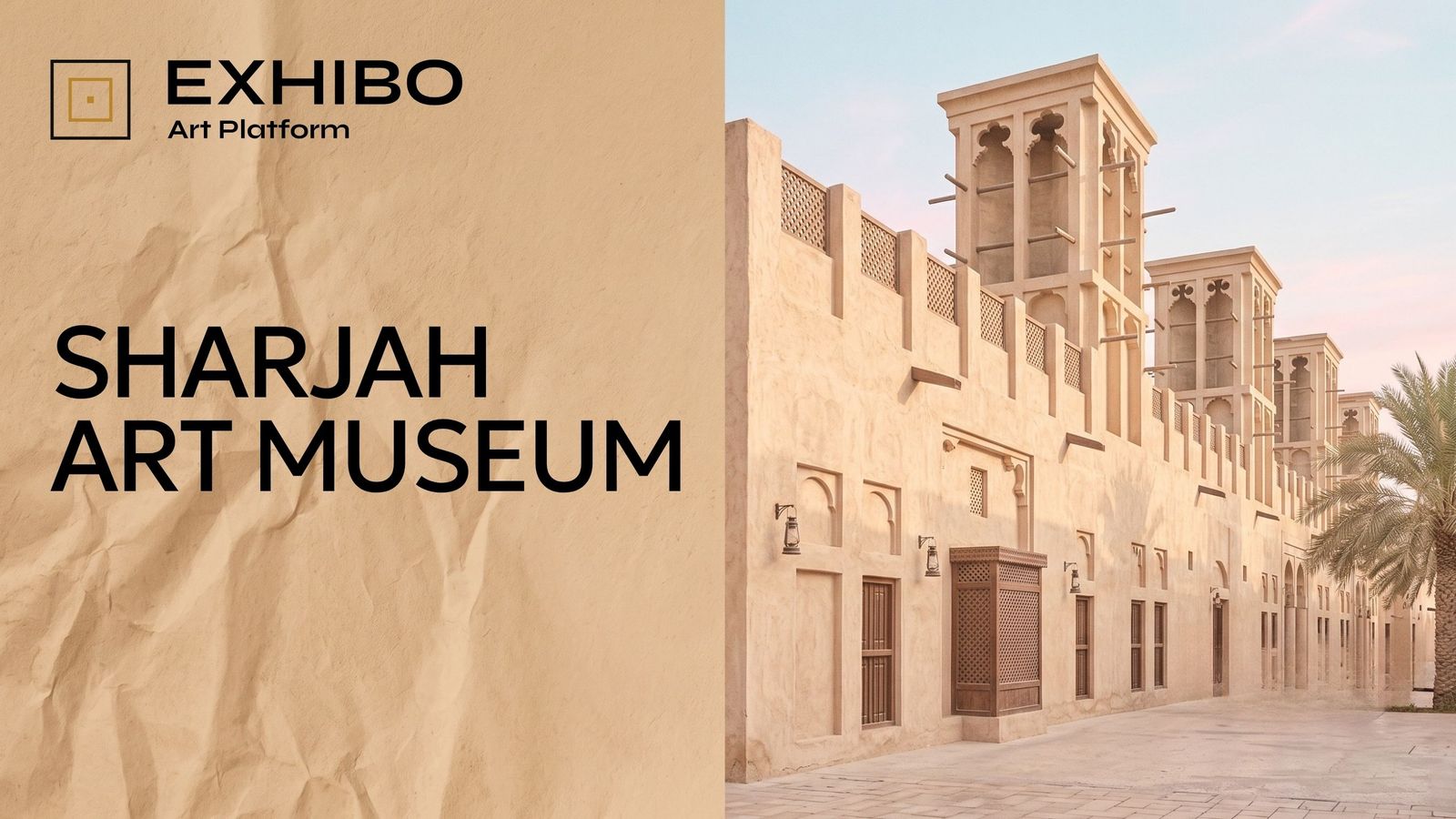
Sharjah · United Arab Emirates
Sharjah Art Museum: Who Gets to Draw the Arab World
Inside one of the Gulf's first dedicated art museums, the Western Orientalist pictures that once framed the East hang under the collection of the ruler who spent his life writing back against them
Start with a print on a wall, because one print explains the whole museum.
It is a lithograph of the great temple at Philae, on the upper Nile in what the nineteenth century called Nubia. Colossal columns, a scatter of small robed figures at their base for scale, the light handled so precisely that the sandstone looks warm to the touch. It was drawn on the spot by a Scottish painter named David Roberts, who toured Egypt and the Holy Land in 1838 and 1839, then spent the next decade in London working the sketches up with a lithographer, Louis Haghe, into a set of tinted plates so lavish that Queen Victoria subscribed to it before anyone else. The finished work — the six-volume folio The Holy Land, Syria, Idumea, Arabia, Egypt and Nubia, some 247 plates, reckoned among the finest lithographic works of the nineteenth century — helped feed the Egyptomania then gripping Britain.
Stay with the picture a moment before the argument arrives, because it rewards looking. Roberts was a former house-painter and theatre scene-painter, and it shows in the best way: he knew how to stage a space so that stone felt monumental and light felt like weather. His figures are small and reverent, his ruins vast and gold. The temples he drew at Philae are the ones that spent much of the twentieth century half-submerged by the Aswan dams and were finally dismantled block by block by a UNESCO campaign between 1972 and 1980 and rebuilt on the neighbouring island of Agilkia — so the plate is now, incidentally, a record of the temples on a shoreline they no longer occupy. It is the kind of image you could happily hang and never interrogate.
Which makes the next thing worth saying carefully, because the easy version overstates it. It is a beautiful object. It is also a European hand drawing a largely Arab and Muslim world — Egypt, the Levant, Nubia, the Holy Land — for a European audience, in the decades when Britain and France were steadily extending their reach across exactly that territory: France into Algeria from 1830, Britain deeper into Egypt and the Gulf across the century. The painting was not the empire, but it belonged to the same movement of confidence — the sense that this world was Europe's to see, catalogue, and eventually administer. And it hangs, now, in a public museum in an Arab emirate, on a wall paid for by the emirate's ruler — a man who spent his scholarly life proving that the same nineteenth-century Britain lied about his own ancestors to justify bombarding their coast.
That is the knot this piece is about. Not whether the pictures are good; they are. The question underneath the Sharjah Art Museum is older and sharper. Who gets to draw a place — and what happens when the people who were drawn buy the drawings back, and hang them where they, now, decide what the pictures mean.
The First Art Museum in the Gulf
The Sharjah Art Museum opened in its current building on 9 April 1997, during the third Sharjah Biennial — often described as the first purpose-built, dedicated art museum in the Gulf, though the claim turns on how narrowly you draw the terms. It had spent its first two years in Bait Al Serkal, a splendid nineteenth-century coral-stone mansion in the old Al Shuwaihean quarter — the same historic core the Sharjah Art Foundation would later restore, and where Bait Al Serkal now sits under the Foundation's wing. The collection outgrew the house and moved into a purpose-built home a few streets away, on the northern edge of what is now called the Heart of Sharjah.
The building was designed by the British architect Brian Johnson, of the Dubai firm Godwin Austen Johnson — the same architect behind the Dubai Creek Golf Clubhouse that appears on the UAE's twenty-dirham note. Johnson worked in a register that reads as regional rather than imported: barjeel, the Gulf's traditional wind-tower cooling shafts, folded into a modern museum shell, galleries stacked over multiple floors around courtyards. It runs to around 11,000 square metres across 68 halls, which on opening made it the largest art museum in the Arab Gulf states; the permanent collection is a body of modern and contemporary Arab art, weighted heavily toward artists of the region. Entry is free.
The timing was not incidental. Sharjah's first museum, devoted to archaeology, opened in 1993, the same year as the first Biennial; seven museums followed by the end of the decade, the art museum among them, alongside the Islamic museum that is now the Sharjah Museum of Islamic Civilization. In 1998 the city was named UNESCO Cultural Capital of the Arab World, the first Gulf Arab city to hold the title — and the museum's opening was one of the reasons the honour landed there. This was the decade in which a small, oil-modest emirate decided that culture, rather than commerce, would be its distinguishing claim, and built the institutions to make the claim hold.
The room people come for is upstairs, in the north wing, and it is the one that complicates everything.
What "Orientalist" Means, and Why Arab Rulers Now Collect It
For most of the twentieth century, a certain kind of nineteenth-century European painting sat in storage, unfashionable and cheap. Then a book changed how it was read, and a market changed who owned it.
As a genre, Orientalism means European art of the eighteenth, nineteenth and early twentieth centuries depicting the Middle East and North Africa — the mosque, the bazaar, the caravan, the harem — made by artists who travelled there, or who never left Paris and built the East from travelogues. Some worked from close first-hand observation; others accompanied diplomatic, scientific, archaeological or military expeditions; some simply invented it. Roberts belonged to the observational end — his obsession was Islamic architecture and pharaonic ruins, and his plates are prized precisely because they record, with near-archaeological care, monuments since damaged, restored, or lost.
In 1978 the Palestinian-American scholar Edward Said published Orientalism, and the word acquired a second, harder meaning. Said argued that the West's whole apparatus of knowledge about the East — its scholarship, its literature, its painting — was not neutral description but a system of representation that produced the East as exotic, backward, sensual, passive: precisely the sort of place that required European mastery. The picture was not innocent of the empire; it was part of how the empire explained itself to itself. After Said, the languid odalisque and the picturesquely crumbling mosque could not be looked at without also seeing the politics in the frame.
Which makes the next fact strange — and the strangeness is a coincidence of timing, not a cause. Because at almost the same moment, from the mid-1970s, the most avid new buyers of Orientalist painting were no longer Europeans. They were collectors from the Middle East, disproportionately from the Gulf, their fortunes lifted by the 1973 oil boom — a market already moving on oil money before Said's argument had begun to reshape the academic conversation. For years the genre had fetched modest sums; Young Woman Reading changed hands for just £1,900 in the 1970s. Then the prices climbed, and the record-setting holdings were assembled by Gulf money — the Najd Collection, formed in the 1980s by a Saudi collector, which Sotheby's sold in 2019 for £33.5 million across thirty-six works, setting ten artist records. What Sotheby's own specialists identify as the decisive change in the market is the advent of new buyers from the regions depicted, and the wider Islamic world. The genre Said had just diagnosed as the visual arm of colonialism was, over the same years, being bought at rising prices by the descendants of the colonised.
The art historian Nasser Rabbat, writing in Artforum, names the pattern without flattery: most major contemporary collectors of Orientalist painting are wealthy Muslims, mainly Gulf Arabs, to whom the paintings have a nostalgic appeal — a window into an imaginary world of beauty, simplicity and dignity, a reading, he adds pointedly, supplied and authenticated by art consultants with an interest in the sale. That sceptical account should stay on the table. Some of this is nostalgia, sold by dealers, dressed as reclamation.
But there is a second reading, and the curators building these collections make it themselves. The team planning Qatar's Lusail Museum — which now holds the largest collection of Orientalist art in the world — wrote, in a peer-reviewed journal, that their entire task is to present the work in a way that acknowledges Said's critique but challenges the confrontational idea of West versus East and the ethnocentric prejudice it implies. The move is not to hang the paintings the way the Victorians did. It is to seize the interpretation — to let the depicted decide what the depiction means. The literature has a name for it: post-colonial collecting, or "repatriation" — the drift of these works, as one account puts it, "back" to the Middle East, quotation marks and all, because the "back" is doing complicated work. The images were never in the East to begin with. What returns is not the object. It is authority over the object.
Inside the Collection: A Museum That Argues With Itself
The Sharjah collection is where that abstract argument becomes a set of specific frames on a specific wall.
For many years the upper north wing held the ruler's Orientalist holdings: Roberts's lithographs of Egypt and the Holy Land, alongside oils such as Ludwig Deutsch's Cairo (Al Azhar University) of 1890 and Franz Eisenhut's Marketplace in Morocco of 1888. In 2013 the museum drew on the collection for a major show — variously titled around the theme of Egypt seen through Orientalist eyes — of which 62 of the 67 plates were by Roberts, the remaining five by lesser-known travelling hands: August Osborne, Edward Angelo Goodall, Charles Head, Harry Fenn. The museum's own framing was telling — it presented the works less as art objects than as timeless records of Arab civilisation, an important source for historical scholars, a documentary reading that quietly turns the coloniser's picturesque into the colonised's archive. By the account of collectors who saw it, it was a much-lauded exhibition — and it made the ruler one of the very few Gulf collectors whose Orientalist holdings sat on permanent public view rather than hung privately at home, which is where most of this material in the region disappears.
The rest of the building answers that wing, and answers it at far greater length. The bulk of the museum is given over to Arab art telling its own story: the Sharjah Museums Authority describes the permanent holdings simply as a collection of modern and contemporary Arab art, and the long-term displays and temporary programme run overwhelmingly the same way. Its permanent displays run modern and contemporary work through a pan-Arab lens, the Sharjah Museums Authority's own artist list reaching from the Emirati Abdulqader Al Rais to the Syrian Louay Kayali and the Iraqi Faiq Hassan — the postcolonial and resistance threads of the region's own art history voiced by the region's own artists. There is also a gallery of watercolours of Sharjah by the local painter Ali Darwish: the emirate drawing itself rather than being drawn. And since May 2018 a whole wing has held around 100 modernist works on long-term loan from the Barjeel Art Foundation, rotated roughly every six months so the display keeps changing.
That Barjeel wing is worth dwelling on, because it sharpens the whole argument. Under an agreement between the Sharjah Museums Authority and the Barjeel Art Foundation, the display — titled A Century in Flux — ran from May 2018 for five years and gathered the canon of twentieth-century Arab modernism: Kadhim Hayder's Fatigued Ten Horses Converse with Nothing, work by the Sudanese master Ibrahim El-Salahi, the Lebanese sculptor Saloua Raouda Choucair, and Dia Azzawi — the very generation of Arab artists who, in the decades after independence, were building a modern visual language out from under the Orientalist one. Its stated aim was to make the modern works accessible for study by researchers, scholars, artists and curators — the region assembling, and interpreting, its own account of itself. The Barjeel Foundation that lent them belongs to Sultan Sooud Al Qassemi, a different Al Qasimi and a distinct project — the first and largest publicly accessible non-governmental modern-art collection in the Arab world, over 1,250 works. So under one roof, a few galleries apart, sit two collections making one argument: the European images of the East, and the Arab modernists who painted their way out of them.
The temporary programme has pulled in the same direction for a quarter of a century. The museum's hundredth exhibition, in November 2000, was 100 Years of Arab Art, 230 paintings tracing the region's own century from 1900 to 2000, opened by the ruler himself, the oldest canvas dated 1890. Its long-running Lasting Impressions series has given full-dress retrospectives to Arab artists who had rarely had them — the Emirati painter Abdul Qader Al Rais, the Emirati artist Najat Meky, the Syrian Esmail Al Rifai, and, in 2021, the self-taught Algerian modernist Baya Mahieddine, the first museum show of her work in the Middle East outside Algeria, a painter André Breton once called a queen and who befriended Picasso in the south of France. The museum has also examined the Orientalist question head-on, in partnership with the institution most identified with it. In 2009 Sharjah was the final stop of The Lure of the East: British Orientalist Painting, 1830–1925, a major survey organised by Tate Britain with the Yale Center for British Art that had already shown at Yale, at Tate, and at the Pera Museum in Istanbul. The show engaged directly with the debates around Orientalism in the wake of Said's book, and one detail says almost everything about where the balance of ownership had shifted: among the highlights Tate itself flagged was David Roberts's 1861 panorama of Baalbek, in Lebanon — lent to the London exhibition by the Sharjah Art Museum. The ruler's collection was lending British Orientalist masterpieces back to Britain.
Walk the whole building and the composition resolves, whether or not the wall text spells it out. The museum gives you the walk to feel it in. You move up through cool, top-lit galleries arranged around interior courtyards, the wind-tower shafts pulling the harsh Gulf daylight down and softening it before it reaches the canvases; the pace is unhurried because the building is generous with space and nearly always quiet. Upstairs, in one wing, the West draws the East — the Roberts plates, the Deutsch and Eisenhut oils, hung close and jewel-lit. Then you cross the building, and the register changes under your feet: through the rest of the halls, at much greater length and volume, the museum shifts the narrative to Arab artists working in their own visual languages, the Barjeel modernists a few rooms from the Orientalists so that the passage between them takes a minute at most. The two collections are near enough to hold in one visit, one after the other. One visitor guide puts the spatial logic more sharply than the labels do: the Orientalist gallery critically frames nineteenth- and twentieth-century European depictions of the Arab world — a pedagogical counterpoint to the Arab modernist narratives elsewhere in the building. Whether that counterpoint is a designed curatorial statement or simply the effect of the route, I can't say from the wall text alone — the museum doesn't announce it as a thesis. But the effect is there to be felt whether or not it was authored: walk from the wing where the West draws the East to the halls where Arab modernists work in their own languages, and the building reads as an argument having with itself the very debate this piece is about.
The Historian-Ruler Who Collected His Own Reflection
To understand why this ruler assembled this collection, you have to know what else he wrote — because the collection is continuous with it.
Sheikh Dr Sultan bin Muhammad Al Qasimi has ruled Sharjah since 1972. He is also, unusually for a sitting head of state, a working academic historian with a doctorate, and his most consequential book is an act of representational self-defence. In 1986 he published The Myth of Arab Piracy in the Gulf, the first book-length critique of the imperial narrative that justified British expansion into the Gulf. For a century, British histories had called the lower Gulf the "Pirate Coast" and cast his own ancestors, the Qawasim, as the pirates whose suppression required the Royal Navy's guns — the bombardments and treaties that delivered the coast into British hands. Al Qasimi went back into the colonial archive and read it against itself, arguing that the piracy threat was largely manufactured by the East India Company for commercial reasons: a pretext to break Arab traders and seize their share of the India trade.
Scholars take the work seriously. One survey of the field calls it unquestionably one of the key texts on Gulf piracy — arguably the fulcrum around which studies of the subject turn, noting how rare it is to find a hereditary monarch on a list of essential academic reading. It is also contested, as serious history should be: the historian Charles Davies weighed the same archive and came down, for the most part, against Al Qasimi's assertions — while still refusing to call the Qawasim pirates in the British sense, reading their raiding instead as a continuation of older Gulf traditions rather than the criminal carnival the British described. The debate is live. But the shape of the project, not the verdict, is what matters here.
And the shape is explicit in how his own institutions describe his life's work. The ruler's historical writing is presented, on his official website, as an effort at the recovery of historical truths obscured by partial or distorted narratives, history framed as a national and universal responsibility — a decades-long project of collecting, translating and publishing the colonial-era documents that describe his region, so that the region rather than the empire holds the record. That much is his stated programme, in his own frame.
The collection is where a reader has to be careful, because here the parallel is mine, not his. I have found no interview or catalogue in which Sheikh Sultan says he acquired the Orientalist paintings as an extension of that historiographic project; the connection is an interpretation the two facts invite, not one he has declared. But the invitation is strong. The book takes the words nineteenth-century Britain wrote about the Arab Gulf and wrestles the meaning back; the collection takes the pictures nineteenth-century Europe painted of the Arab world and places them where an Arab public, and an Arab curatorial voice, decide what they say. Same century, same imbalance of representation. It is easy — perhaps too easy — to read the collection as the visual companion to the book, the same instinct working in another medium: not to destroy the record but to own it, and to reframe it from the inside. Read that way, the ruler who refused to let Britain's word for his ancestors stand also declines to let Europe's image of his region hang unexamined. It is a reading the museum supports and the collector has not confirmed, and it is worth holding as exactly that.
Held that way, the Orientalist collection is neither a monarch's expensive hobby nor the simple nostalgia Rabbat warns of, but something the historian in him would recognise: a claim about who has the authority to produce knowledge of a place. That is really what the piracy book contested — not merely how the Gulf was depicted but who was licensed to describe it, to write the record that later counted as fact. The paintings raise the same question in a different key. A picture, like an archive, is a claim to have seen and understood; hanging it under your own labels, in your own building, is a claim to administer that understanding. This is close to what the art historian Carol Duncan meant in calling the public museum a place that confers authority — a stage on which a society enacts what it considers worth knowing and who is entitled to say so. Whoever controls that stage controls a small piece of how a culture is understood. This is the strongest reading of the museum. Honesty requires the weaker ones too.
The Honest Complications: What Was Taken Down
A reframing is still a framing, and this one has edges worth naming plainly.
The most concrete is a form of editing for local sensibilities, and it is documented — it attended the very same Lure of the East tour that ended in Sharjah. As the show moved from Yale through London and Istanbul toward the Gulf, journalists travelling with it reported that its steamier scenes would be removed to bring it into line with Islamic morality in the conservative emirate. The exact mechanism was not always outright removal — some works were simply not sent or not hung — but the effect was the same selective softening. A British Council curator was filmed trying to persuade an unconvinced all-female Emirati delegation that there was little scandal in the discreet nudity; the Sharjah curator was candid about the underlying policy: we have the culture thing, the religious thing; we have to be careful, because our museum is for everybody, the entire family.
Sit with what that leaves out. Orientalist painting's most notorious subject — the one Said cut deepest into — is the harem and the odalisque: the sexualised, available Eastern woman imagined for a Western male eye. A display that keeps those canvases off the wall is doing something more complicated than reclaiming the genre. It is curating the genre into respectability — keeping the archaeology and the architecture and the picturesque street, editing out the bodies. You can read that as a reasonable adaptation to a family audience in a conservative society. You can also read it as a second act of representation laid over the first, the depicted now choosing which parts of the depiction the public may see. Both are true, and they do not cancel. The reframing does not escape the problem of selection. It inherits it.
There is a subtler edge, and Sultan Sooud Al Qassemi — the Barjeel founder whose modernists hang a few galleries away — puts the underlying anxiety well. The reality is that 95 percent of exhibitions are about other places, he told a Culture Summit audience, arguing that the region has been "inundated all our lives with art from the West" and should push its own art outward in return. It is a friendly tension rather than a contradiction, but a real one: every wall a Gulf museum gives to a European picture of the East, however critically framed, is a wall it does not give to an artist of the East. Sharjah answers this better than almost anyone — the overwhelming bulk of the building is Arab art, and the Barjeel wing puts the modernists in direct conversation with the Orientalists — but the question sits under the whole enterprise of collecting Orientalism, and it is worth keeping in view rather than resolving too fast.
And there is the market fact, unglamorous but honest. The reappraisal that let this art be reclaimed as heritage is the same reappraisal that made it expensive, and the dealers who told the flattering story had every reason to. Christie's has noted that Gulf collectors tend to buy Orientalist work to display at home rather than as investment — which cuts both ways. It speaks to genuine attachment over speculation; it also describes a market in which a small number of very wealthy men set the price of the region's own image. Sharjah's decision to put the work in a public museum, free and open, is the meaningful departure from that pattern, and it is worth crediting precisely because it is the exception rather than the rule.
None of these edges dissolves the strong reading. They qualify it. A museum that hangs the coloniser's pictures in the colonised's house, and lets the house set the terms, is doing something genuinely new — and it is doing it with selection, with money, and with the same power to frame that it sets out to critique. Holding both of those thoughts at once is the honest way to stand in that upstairs gallery.
What the Gulf's First Art Museum Started
The Sharjah Art Museum reads, in hindsight, as a first move.
When it opened in 1997 it was among the first dedicated art museums in the Gulf, and for a time had few peers. That is no longer so, and the institutions that followed are visibly its descendants. Qatar Museums now holds the largest Orientalist collection in the world and is building the Lusail Museum to house it across four floors. One of the Louvre Abu Dhabi's signature works is itself an Orientalist painting — Osman Hamdi Bey's Young Emir Studying — though Hamdi Bey complicates the category beautifully: an Ottoman painter working in the Orientalist idiom, the East picturing itself in the visual language the West had built to picture it. The whole region is now working through a question Sharjah reached early: what does it mean to own the image of yourself that someone else made?
Sultan Sooud Al Qassemi, writing about the museum he grew up visiting, calls it the bellwether of Gulf art museums — the one that rang first and told the others what was coming. That is its real significance, more than any single canvas on its walls. A quarter of a century before the Louvre came to Abu Dhabi and the Orientalist museum rose in Lusail, a small emirate established that a Gulf institution could take the West's version of the East, hang it in public, set it beside the art the region makes about itself, and make the building itself the argument.
Which returns us to the print on the wall — Roberts's warm sandstone columns at Philae, drawn by a Scotsman for a queen, now hanging in an Arab emirate under lighting the emirate chose, beside labels the emirate wrote, in a building shaped like the Gulf's own architecture, a corridor away from the modernists who painted their way out from under exactly this way of seeing.
And here is the turn that keeps the whole thing from being tidy. Reclaiming the image does not dissolve the colonial gaze; it gives it a permanent home. The Sharjah Art Museum does not retire Roberts's way of seeing — it conserves it, lights it, insures it, and puts it on public salary. The frame changes hands, but the picture inside it is the same picture. And a museum, whatever else it does, is a machine for keeping: it exists to preserve, and it preserves whatever it is given, gaze and all. So the reclamation is also, unavoidably, a conservation of the very way of seeing it answers — now maintained, curated, and passed on by the descendants of the people once on the wrong end of it. That may be the truest form of mastery: to hold a thing so completely that you can afford to keep it on display. Or it may be a subtler kind of being held by it. The building does not settle the question, and is honest enough not to pretend it can.
The picture has not changed since 1838. Much of what changed is who controls it — though "control" is itself contested, pulled between the reading offered here, in which this is a reclamation of the authority to represent; the flatter reading, in which it is elite collecting given a public face; and the market's reading, in which a few very rich men set the price of a region's own image and a museum ratifies it. All three are in the room at once. What can be said plainly is narrower and still remarkable: the people who were drawn now hold the frame. What they choose to do with it — reframe the image, or simply keep it — is the question the next Gulf museum inherits.
Museums mentioned
Exhibitions mentioned
Artworks mentioned
Related reading
Sharjah Biennial 17 Unveils Curatorial Vision and Opening Schedule
Angela Harutyunyan and Paula Nascimento frame the 2027 edition around archival residue and spatial memory
Karen Ohanyan: Delicate Matter at the National Gallery of Armenia
Exploring concealment, materiality, and memory in new triptychs
Why Doha Is Full of Roundabouts
An old circle at a crossroads, sharpened by British road engineering, became the way an Arabian city found its way and remembered itself — and it took the bulldozers to reveal it.