
Dubai · United Arab Emirates
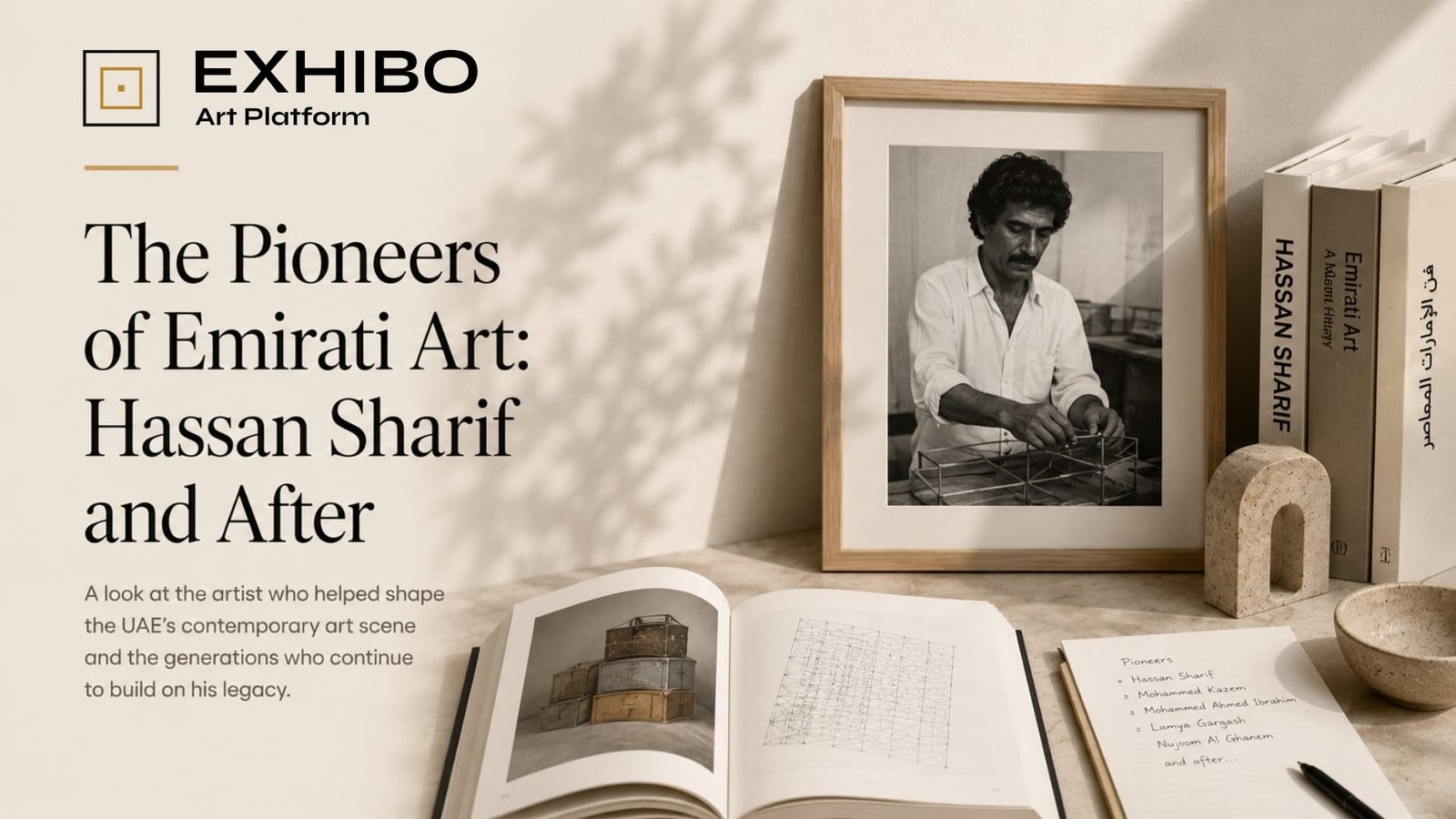
The Pioneers of Emirati Art: Hassan Sharif and After
How Hassan Sharif and the artists known as "the Five" built conceptual art in the UAE from nothing
In 1985, a small crowd gathered on the pavement outside Sharjah's Blue Souq to look at some rubbish. Four plastic water bottles, two lines of stuffed and knotted plastic bags, a few painted panels resembling oversized crossword puzzles, all arranged on the ground with obvious care. Some onlookers smiled. Some looked to their neighbours for a clue. Most simply stared, arms crossed, waiting for something to happen. What they were actually witnessing was the first contemporary art exhibition staged in a public space in the UAE — and the man who put the objects there, Hassan Sharif, was building something that, four decades on, would underpin one of the fastest-growing art scenes in the world.
This is the story of that generation: the artists who made conceptual art in the Emirates when there was no market for it, no museums to show it, and very little understanding of why anyone would arrange water bottles on a pavement and call it art. Hassan Sharif sat at the centre of the group, but he was never alone in it, and the scene the UAE celebrates today rests on foundations they laid together. Understanding them is the closest thing there is to understanding where Emirati contemporary art actually came from.
Who Hassan Sharif was
Hassan Sharif was born in 1951 and lived and worked in Dubai until his death in 2016. He is the figure almost every account of UAE art returns to, usually with the same shorthand: the father of conceptual art in the Gulf. The label is accurate enough, but it flattens a stranger and more interesting career than the title suggests.
Before he was an artist in any formal sense, Sharif was a satirist. Through the 1970s, from roughly 1973 to 1979, his caricatures ran in the UAE's young newspapers and magazines — sharp, outspoken cartoons that picked at the rapid industrialisation of the Emirates and the political deadlock of Arab nationalism. That instinct, to look hard at the society forming around him and comment on it plainly, never left his work. It simply changed form.
The turning point was London. Sharif studied at the Byam Shaw School of Art, now part of Central Saint Martins, graduating in 1984. There he fell under the influence of Tam Giles, who ran the Abstract and Experimental Department, and through him encountered two traditions that would define everything he did afterwards: the irreverent intermedia of Fluxus, and the systemic, rule-based making of British Constructionism. When he returned to the UAE, he brought both with him and set about something close to a one-man cultural project.
Rejecting calligraphy, choosing a different language
To grasp why Sharif mattered, you have to understand what he turned away from. In the 1970s, the dominant serious art discourse across the Middle East was calligraphic abstraction — work that drew on the visual heritage of Arabic script and treated it as the natural language for a modern Arab art. It was respectable, legible, and, to Sharif, a dead end.
He rejected it deliberately. Rather than refine an inherited visual tradition, he wanted a vocabulary that engaged with the world materialising around him: the consumer goods, the construction, the mass-produced objects flooding a country that had existed as a unified state only since 1971. Calligraphy spoke to heritage; Sharif wanted to speak to the present, and the present he saw was made of plastic bags, cardboard and cheap industrial wire.
This was not a popular choice. For most of two decades, Sharif and the artists around him worked in something close to obscurity, dismissed by the local establishment for an arch conceptualism nobody had asked for. The recognition came late, in the second half of the 2000s, as a growing arts infrastructure finally brought the international art world to the UAE and found these artists already there, decades deep into a body of work.
The Objects, the Semi-Systems and the performances
Sharif's output divides loosely into a few strands, and it helps to know them, because together they are the template much of the region's conceptual practice still works from. The best known are the Objects, a series he ran from the early 1980s right up to 2016. These were assemblages built from cheap, mass-produced or discarded materials — combs, slippers, cotton rope, copper wire, cardboard — bound and heaped together into dense accumulations. They handed the unglamorous by-products of a consumerist society back to that society as art.
Then there were the Semi-Systems, which came directly out of his London training. Borrowing from the British Constructionist Kenneth Martin's idea of "chance and order", Sharif invented sets of arbitrary or deliberately over-elaborate rules and then followed them to make line drawings and colour studies, usually plotted across a grid. He revelled in the slippages and errors that crept into the monotonous process, going so far as to say that "art is a result of errors". The work was not about the finished image so much as the engagement with the system.
His performances completed the picture, and they carried the clearest Fluxus charge. He tied ropes between rocks in the desert. He moved an oil barrel around Sharjah and recorded people's reactions. He documented the sentences he read in a newspaper at intervals along a journey, or spoke with his mouth full of bread and water, taping the sounds. The pointlessness was the point — a serious, sly irreverence about what art could be, owed in equal measure to Duchamp and to his own restless temperament.
A practice rooted in everyday material
What ties these strands together is a fixation on the ordinary object. Sharif did not paint the UAE's transformation; he gathered up its by-products and made them impossible to ignore. The plastic bags, the lengths of wire, the combs and zips and water bottles were the actual texture of a country remaking itself at speed, and he treated them as both subject and medium.
This was a quietly political stance, though it rarely announced itself as such. By weaving mass-produced goods into heaps and bundles, Sharif made visible the surplus and waste of a globalised consumer society that the UAE was rapidly becoming. The work asked what all this stuff was, where it came from, and what it said about the place producing and discarding it — questions a calligraphic abstraction could never reach.
It also made his art stubbornly accessible, even when audiences resisted it. A pile of slippers or a tangle of copper wire needs no specialist vocabulary to register; it is the same material a viewer handles every day, made strange. That accessibility was deliberate. Sharif wanted to provoke and engage ordinary Emirati audiences, not to flatter an elite, and his choice of the humblest possible materials was part of that democratic intent.
The institutions he built
Sharif understood something many artists never do: that individual work is fragile without the structures to sustain it. So alongside the art, he built institutions, and this organisational legacy is arguably as important as anything he made.
His role was never confined to making. Sharif moved constantly between artist, educator, critic and writer, and he treated translation as part of the work — rendering historical art texts and manifestos into Arabic so that local audiences could engage with contemporary art discourse on the page, not only in the gallery. He wanted to change how his own community thought, and he was willing to do the slow, unglamorous labour of building the means to do it.
The Emirates Fine Arts Society and the ateliers
The first cornerstone came in 1980, when Sharif became a founding member of the Emirates Fine Arts Society in Sharjah. It was the country's first art association, and just as importantly, it was the place where most of the artists who would form his circle actually met. It created social infrastructure — somewhere to gather, argue, exhibit and exchange ideas — that had simply not existed before.
In 1984 he founded the Al Mareija Art Atelier in Sharjah, a meeting place and workshop for a generation of younger artists. The Atelier was where he staged interventions like the now-famous One Day Exhibition, and where the loose creative community around him — which included poets and writers as well as visual artists — found a base. He later established an atelier in his native Dubai as well.
These were not grand buildings or funded programmes. They were modest, artist-run spaces held together by Sharif's conviction that contemporary art belonged in the UAE and needed somewhere to live. That conviction, more than any single venue, is what endured.
The Flying House and the archive
The most poetic of these structures came later. In 2008, his elder brother Abdulraheem — who had been documenting and storing the family's and other artists' work since the early 1990s — turned his former house into a non-profit space christened The Flying House, named by the Dutch painter Jos Clevers. Hassan lived and worked there from 2008 to 2013.
The Flying House was an odd, important hybrid. As the curator Maya Allison described it, art covered every surface of the house — the doors, windows, steps, walls and trees. It was not quite a gallery and not quite a foundation, but for the first time it gave curators a place to locate and see this work year-round.
That visibility mattered enormously. In Allison's phrase, the artists were finally "on the map" — findable, archived, present. When the international art world began arriving in the UAE in earnest, there was a physical place that could show it decades of serious practice, ready and waiting.
The Five: Sharif and his circle
Sharif is rarely discussed for long before another name appears: "the Five". It is the label attached to the core group of conceptual artists who gathered around him, and while it has become the standard frame for telling this history, it is worth handling with a little care.
The name came from outside. It derives from a 2002 exhibition titled 5 UAE, held at the Ludwig Forum for International Art in Aachen, Germany, which presented five Emirati artists as a group. The designation stuck, but it was an external convenience as much as a self-declared movement, and the real community around Sharif was looser, larger and more porous than a tidy number of five suggests — it included writers and poets, a Dutch painter, an Indian sculptor, and the group's one woman member, Ebtisam Abdulaziz.
What held them together was less a style than a shared predicament and a shared seriousness. A few threads ran through the whole circle:
A bet on the future. They worked, as Mohammed Ahmed Ibrahim later put it, as "each other's strengths" — largely misunderstood and isolated, deliberately placing their bets on the youth and on changing the minds of their own community.
Distinct practices, common sensibility. Each pursued a different medium and method, from land art to video to papier-mâché, but all shared a conceptual, process-driven seriousness and a taste for play.
Late, then international, recognition. Several have since represented the UAE at the Venice Biennale and entered major international collections — acknowledgement that arrived decades after the work was made.
The table below is an orientation to the core group and what each is known for.
Artist | Born | Known for |
|---|---|---|
Hassan Sharif | 1951 | The central figure; Objects, Semi-Systems, performances; assemblages from mass-produced materials. |
Hussain Sharif | 1961 | Hassan's brother; materiality and scale, working with cement, metal, wood and discarded construction matter. |
Abdullah Al Saadi | 1967 | Land art, notebooks and the systematic cataloguing of found objects; studied Japanese painting in Kyoto; represented the UAE at the 2024 Venice Biennale. |
Mohammed Kazem | 1969 | Video, sound, photography and performance; a student of Sharif's from age fourteen, now a leading figure in his own right. |
Mohammed Ahmed Ibrahim | 1962 | Papier-mâché and material experiments rooted in the landscape of Khor Fakkan; represented the UAE at the 2022 Venice Biennale. |
That bet on the future, Ibrahim noted dryly, paid off. The artists ridiculed for arranging objects on pavements became the foundation a national art scene would later claim as its origin story.
The retrospective that fixed his place
For all his influence, Sharif's full stature only became publicly legible after his death, through one enormous exhibition. In late 2017, the Sharjah Art Foundation opened Hassan Sharif: I Am The Single Work Artist, curated by the foundation's director, Sheikha Hoor Al Qasimi, and six years in the making.
It was vast — close to four hundred works drawn from a total output of around three and a half thousand, spread across all of the foundation's exhibition spaces, on a scale usually reserved for a biennial. Organised thematically rather than chronologically, in chapters named after Sharif's own words — "so I created a semi system", "I'm loyal to colour", "I'm an object maker", "Things in my room" — it even reconstructed the contents of his studio as if the room itself were a work. The title carried his own philosophy: that an artist who works through repetition is, across a lifetime, really making a single continuous work.
The show did not stay in Sharjah. It travelled to the KW Institute for Contemporary Art in Berlin, to Malmö Konsthall in Sweden, and to the MAMC+ in Saint-Étienne, France — the first time many European audiences had encountered the depth of his practice. By then his work already sat in collections including the Guggenheim in New York and Abu Dhabi, the Centre Pompidou, Tate Modern, M+ in Hong Kong, Mathaf in Doha and the Sharjah Art Foundation. The artist who had arranged water bottles on a Sharjah pavement to bafflement in 1985 had become, posthumously, the most institutionally validated artist the UAE has produced.
Why the pioneers still matter
It would be easy to treat this as settled art history, a closed chapter to be admired and filed. That underrates how directly the present scene runs on what these artists built.
The institutional inheritance
The most concrete link is institutional. The Sharjah Art Foundation and its biennial, the bodies that now anchor the region's most curatorially serious programme, grew out of exactly the soil Sharif tilled — the Emirates Fine Arts Society, the ateliers, the public interventions, the insistence that contemporary art belonged in the UAE and deserved an audience.
The younger members of his own circle are no longer protégés but established figures. Mohammed Kazem, Abdullah Al Saadi and Mohammed Ahmed Ibrahim have carried the UAE to the Venice Biennale and helped shape the institutions that train the next generation. The line from Sharif's atelier to today's national pavilions is short and direct.
Even the commercial scene owes him a debt. Gallery Isabelle van den Eynde, one of the longest-standing galleries in Dubai, built much of its early identity around Sharif and his circle, and continues to represent his estate. The market that now exists for Emirati conceptual art did not appear from nowhere; it was seeded by the artists who made the work when no market existed at all.
The inheritance of method
There is also a deeper inheritance, harder to measure but just as real. Sharif's central move — refusing an inherited, heritage-based visual language in favour of a vocabulary built from the actual material conditions of Emirati life — gave the country's artists permission to be contemporary on their own terms rather than by imitation.
His method of making art from found, everyday, mass-produced things, and of treating process and system as the work, runs visibly through Gulf conceptual practice today. When a young Emirati artist works with industrial detritus or builds a piece around a self-imposed rule, they are working in a lineage Sharif more or less invented locally.
For collectors and curators looking at the region now, the pioneers offer something the headline-grabbing new institutions cannot: a foundation. The Louvre Abu Dhabi, the galleries of Alserkal Avenue, the auction rooms newly opened in the Gulf all sit on top of a story that began with a handful of artists working in obscurity. Knowing that story is not nostalgia. It is the context that makes everything built since make sense.
Frequently asked questions
Who is considered the father of conceptual art in the UAE?
Hassan Sharif (1951–2016) is almost universally credited as the father, or godfather, of conceptual art in the UAE and the wider Gulf. After studying in London, he returned to the Emirates in 1984 and spent four decades making conceptual work, building art institutions and mentoring younger artists, at a time when there was no local infrastructure or audience for contemporary art.
Who were "the Five" Emirati artists?
"The Five" refers to a core group of Emirati conceptual artists who gathered around Hassan Sharif: Sharif himself, his brother Hussain Sharif, Abdullah Al Saadi, Mohammed Kazem and Mohammed Ahmed Ibrahim. The name comes from a 2002 group exhibition, 5 UAE, held in Aachen, Germany. The label was applied from outside; the actual community around Sharif was larger and included writers, poets and several non-Emirati artists.
What kind of art did Hassan Sharif make?
His practice ran across several strands: the Objects, assemblages built from cheap, mass-produced and discarded materials; the Semi-Systems, rule-based drawings and colour studies influenced by British Constructionism; and Fluxus-inflected performances, such as tying ropes between desert rocks or moving an oil barrel around Sharjah. He rejected the calligraphic abstraction dominant in the region at the time in favour of a contemporary vocabulary drawn from everyday life.
Where can you see the work of these pioneers today?
Their work is held in major collections including the Guggenheim (New York and Abu Dhabi), Centre Pompidou, Tate Modern, M+ in Hong Kong, Mathaf in Doha and the Sharjah Art Foundation, which holds Sharif's estate material and staged the landmark retrospective I Am The Single Work Artist. Living members of the group, including Mohammed Kazem, Abdullah Al Saadi and Mohammed Ahmed Ibrahim, continue to exhibit internationally, including at the Venice Biennale.
Why do the Emirati pioneers matter to today's art scene?
The institutions, methods and attitudes these artists established underpin the contemporary UAE art world. Bodies like the Sharjah Art Foundation grew from the associations and ateliers Sharif co-founded, and his approach — making art from everyday materials and treating system and process as the work — remains a live influence on Gulf conceptual practice. They provide the historical foundation beneath the region's newer museums, galleries and fairs.
Galleries mentioned
Museums mentioned
Related reading
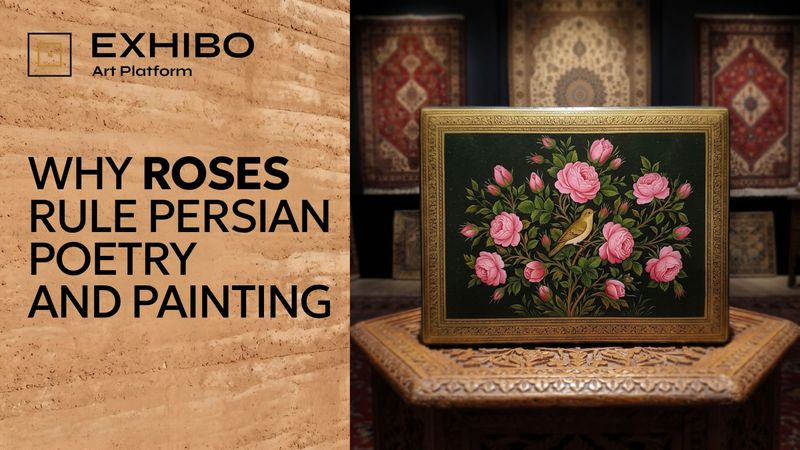
The Flower That Was Never Only Beautiful
The rose rules Persian poetry and painting — but under the sweetness sits a thorn, a bleeding bird, and a national emblem quietly assembled out of Chinese, European and Persian parts. A history of gol o bolbol, from a medieval still to a Dubai gallery.
Gol o bolbol — the rose and the nightingale — is among the most beautiful images in a thousand years of Persian art, and in modern Persian it also means sweet, empty talk. Under the tile, the picture is darker: a bird singing in blood for a flower that will not answer and will not last.
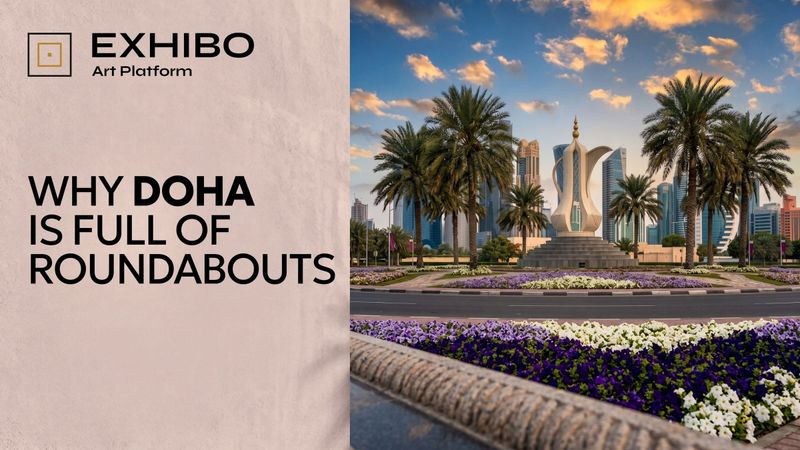
Why Doha Is Full of Roundabouts
An old circle at a crossroads, sharpened by British road engineering, became the way an Arabian city found its way and remembered itself — and it took the bulldozers to reveal it.
In a city where a landmark was more useful than an address, Doha's roundabouts became its navigation, its landscaping and its national image all at once. Now they're being torn out for signalled junctions — and the affection for them arrived, as one scholar put it, only posthumously.
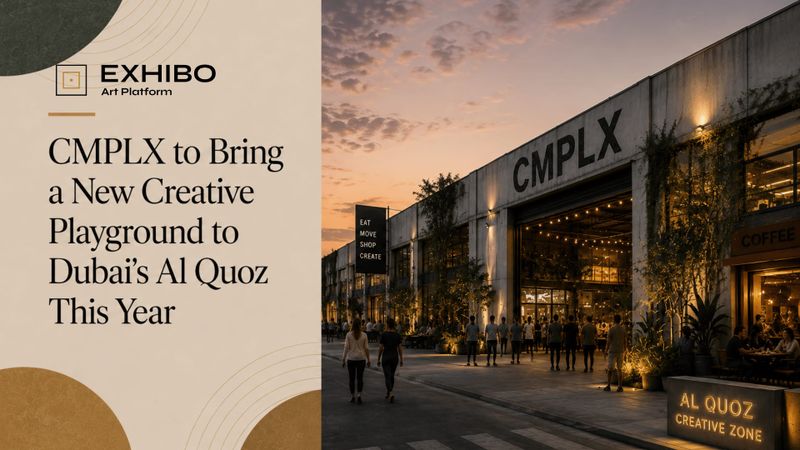
CMPLX to Bring a New Creative Playground to Dubai's Al Quoz This Year
A seven-warehouse lifestyle hub combining food, wellness, retail and creative studios is set to open in Al Quoz Creative Zone by the end of 2026, adding a new anchor to the neighbourhood built around Alserkal Avenue.
CMPLX, a new warehouse-style lifestyle destination combining food, wellness, retail and creative studios, is set to open in Dubai's Al Quoz Creative Zone by the end of 2026 — adding a fresh anchor to a neighbourhood already defined by Alserkal Avenue's galleries and cultural spaces.