Mohammed Bin Rashid Library
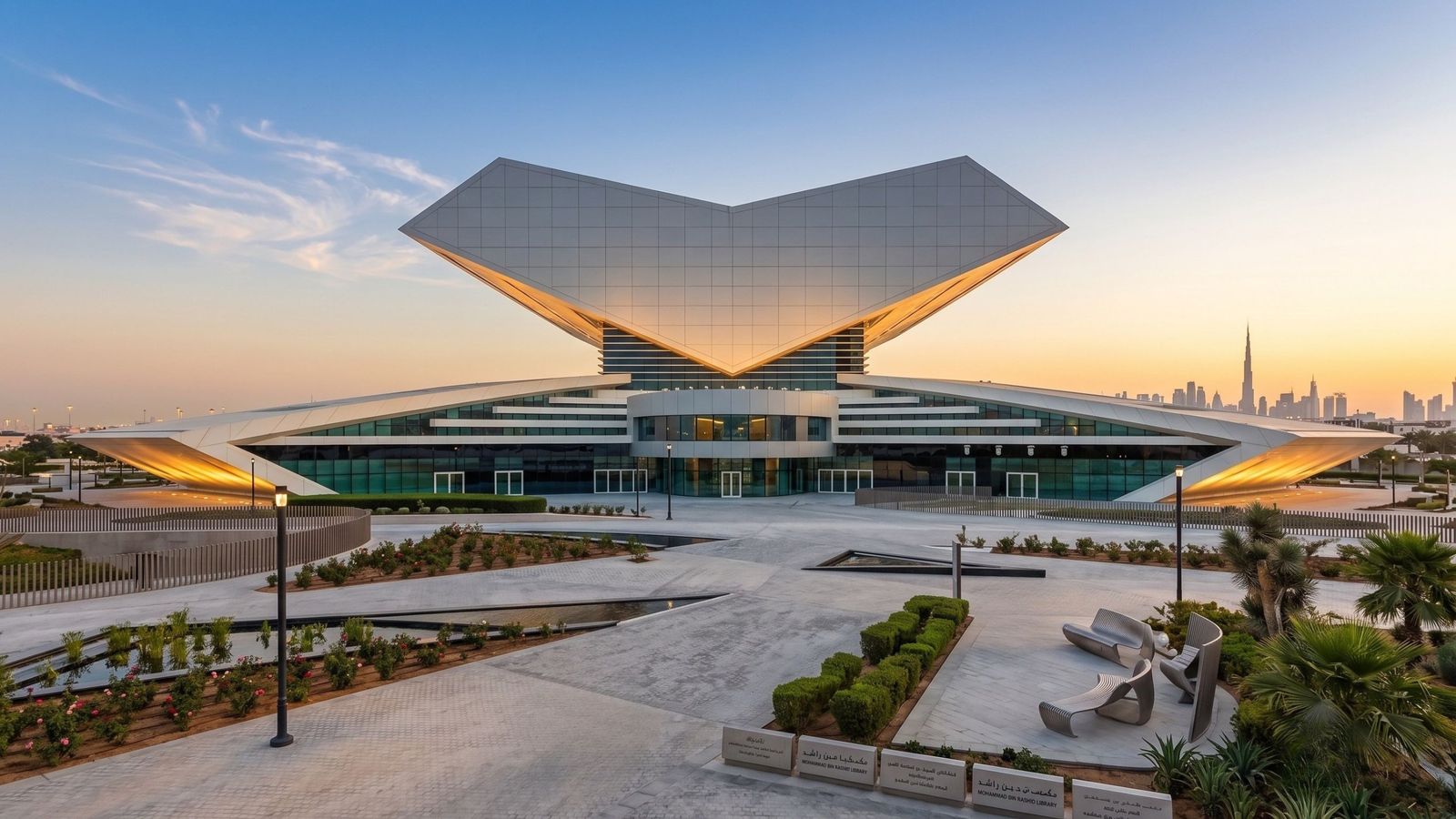
A seven-storey building in the shape of a rehal — the wooden book rest for the Quran — opened like a book above Dubai Creek.
The Mohammed Bin Rashid Library (MBRL) is a monumental public library in Al Jaddaf, overlooking Dubai Creek, that opened on 16 June 2022. Conceived by Sheikh Mohammed bin Rashid Al Maktoum during Dubai's 2016 'Year of Reading' and built at a cost of around AED 1 billion, it is the largest library of its kind in the MENA region. It was designed by a consortium of Architekten Stuttgart, Munich's Obermeyer, and the ACG Architecture Consulting Group, with ASGC as main contractor.
The building takes the form of a rehal (or rahle) — the traditional X-shaped wooden book rest used to hold the Holy Quran during recitation — scaled up to architecture, so the whole structure reads as an open book resting on a stand. The sculptural form is articulated as two cantilevered wings that terrace around an open central void: one wing devoted to Eastern literature, the other to Western, connected by bridges that symbolically and spatially unite the two cultures. The wings' steeply rising geometry funnels natural light down into the reading halls, while two semi-circular volumes lean toward one another at the base.
Across seven storeys and roughly 54,000 square metres, the library holds well over a million print, digital and audio titles — including rare manuscripts and first editions, some dating to the 13th century — arranged across nine themed libraries, alongside a museum, conference centre, a two-storey café, indoor and outdoor amphitheatres, and a 'languages garden' of pillars engraved with quotations. The design is environmentally driven: rooftop solar panels supply around 10 per cent of its energy, the facade insulates the interior against heat, and the form helps cut water consumption by up to half.
Exhibo editorial
It is not subtle, and it isn't trying to be. The Mohammed Bin Rashid Library is a book rest the size of a building — the rehal that holds the Quran, blown up until you can walk inside it — planted on the bank of Dubai Creek next to the yards where craftsmen still build wooden dhows by hand. Old trade on one side, a monument to reading on the other.
The part worth lingering on is the split down the middle: one wing for Eastern literature, one for Western, and bridges physically joining them across a central void full of daylight. It's an argument made in architecture — that these two libraries are two halves of one thing — and it lands more quietly than the building's enormous silhouette would suggest. Come for the shape from the outside; stay for the light pouring down between the wings.
Gallery


How to find it
The Mohammed Bin Rashid Library stands on the banks of Dubai Creek in Al Jaddaf, near the traditional dhow-building yards. The rehal form reads best on approach from the creek side and from the surrounding plaza and gardens. Enter at the base, between the two leaning semi-circular volumes; inside, the central void between the Eastern and Western wings is the architectural heart, with the reading halls terracing up around it.
Similar places
All places
News by Exhibo
Editorial coverage on Exhibo
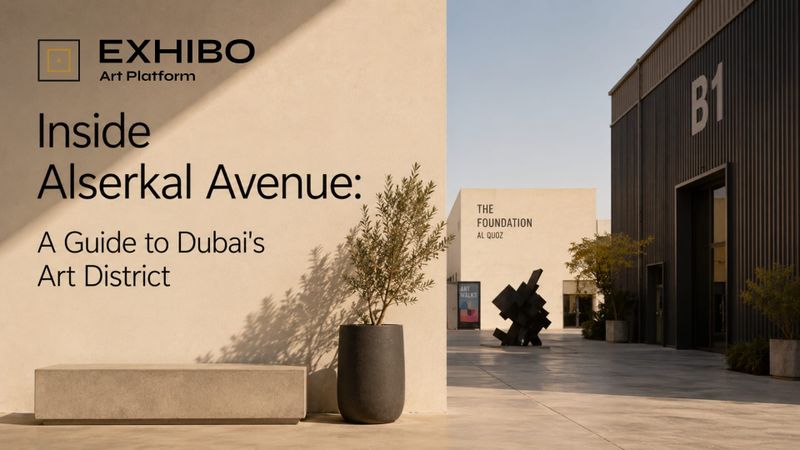
Inside Alserkal Avenue: A Guide to Dubai's Art District
How a row of Al Quoz warehouses became the most serious address in Gulf contemporary art — and how to navigate its galleries, foundations and programme.
Alserkal Avenue sits in Al Quoz Industrial Area 1 — a grid of concrete warehouses and marble workshops wedged between Sheikh Zayed Road and Al Khail Road — and it is, improbably, the most culturally credible square kilometre in the Gulf.
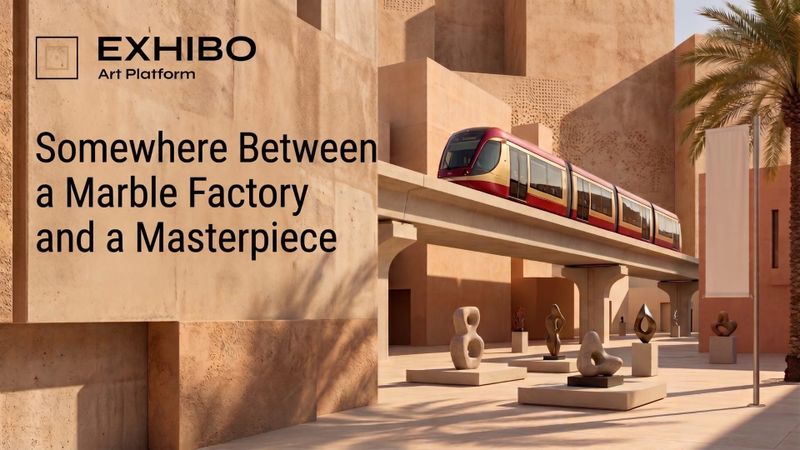
Somewhere Between a Marble Factory and a Masterpiece
On the art world's transparency problem, the extraordinary markets the world is only beginning to discover, and why we decided to build a map.
February 2026, Doha. Msheireb Downtown — the old business district that Qatar has been quietly transforming into something between a cultural quarter and an ur…
Filmed, but Not Recorded: The Arab World’s Missing Film Locations
Wikidata knows Gladiator was filmed in Morocco. It doesn’t know where.
Ouarzazate is the second most filmed place in the Middle East and North Africa, yet 25 of its 27 productions are recorded only in Wikipedia prose. We compared filming records worldwide and found that in the Arab world, Wikidata usually knows the country but not the place.