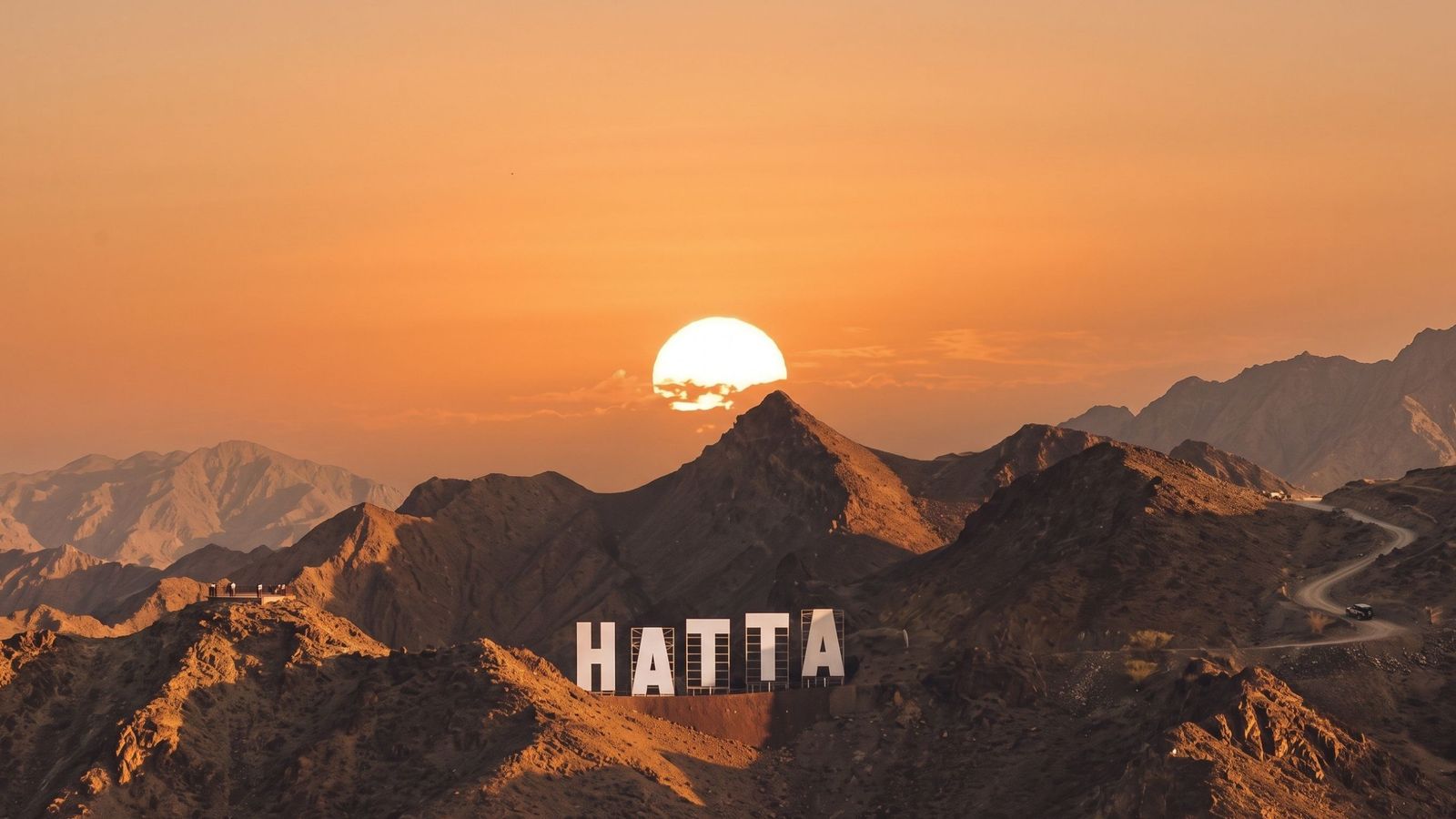
Hatta Sign
Giant 19.28-metre letters on a Hajar Mountain ridge — the world's tallest landmark sign, taller than Hollywood's, reachable only on foot.
The Hatta Sign is a monumental landmark installation by Dubai Holding, standing on a summit ridge of the Hajar Mountains above Hatta, Dubai's mountain exclave near the Omani border. Its letters rise 19.28 metres — taller than the Hollywood sign's 13.7 metres — and in 2023 it was awarded the Guinness World Records title for the Tallest Landmark Sign.
Visible to anyone entering Hatta and illuminated after dark, the sign was conceived as an emblem of the region's identity and of its transformation into a year-round outdoor destination under the Hatta Master Development Plan, part of the Dubai 2040 Urban Master Plan. Unlike most landmarks of its scale, it cannot be reached by road: access is on foot only, via a marked hiking route that climbs from the Hatta Wadi Hub activity centre, taking around 30 minutes to reach the sign, or roughly 5.6 to 6 kilometres and 250 metres of elevation gain on the fuller circuit. Wadi Hub anchors a network of more than 32 kilometres of hiking and mountain-biking trails, with routes graded by difficulty and guided hikes run by the Hatta Hiking Club under Hatta Outdoor Mountain Rangers.
From the ridge, the reward is a panorama across the wadis, valleys and mountain ridges of the Hajar range, stretching toward Oman. The sign has become the region's most photographed vantage point and a fixture of Hatta's hiking scene, particularly at sunset.
Exhibo editorial
Dubai built a sign taller than Hollywood's and then, unusually for Dubai, refused to make it easy. There's no road, no viewing platform, no valet — the Hatta Sign sits on a ridge in the Hajar Mountains and the only way to it is a half-hour climb from Wadi Hub, gaining 250 metres on your own legs.
That constraint is what makes it work. The letters are absurd, 19 metres of them, a piece of pure branding lifted onto a mountain — but you have to earn the photograph, and by the time you're standing beside them the view has taken over: wadis, ridges, Oman somewhere past the far edge. Go late in the afternoon in winter, carry water, and stay for the light going off the rock. The record is a footnote; the walk is the thing.
How to find it
The Hatta Sign stands on a ridge in the Hatta Mountain Conservation Area, reachable only on foot. Drive or take the Hatta Bus to Hatta (roughly 130km southeast of Dubai via the E44), park at Hatta Wadi Hub, where there is free parking, and follow the marked trail from the visitor centre — about 30 minutes' climb, or a 5.6–6km route with around 250m of ascent. Watch for mountain bikers on the lower section. Carry water, wear proper shoes, and go in the cooler months; guided hikes run from Wadi Hub.
Similar places
All places
News by Exhibo
Editorial coverage on Exhibo

Inside Alserkal Avenue: A Guide to Dubai's Art District
How a row of Al Quoz warehouses became the most serious address in Gulf contemporary art — and how to navigate its galleries, foundations and programme.
Alserkal Avenue sits in Al Quoz Industrial Area 1 — a grid of concrete warehouses and marble workshops wedged between Sheikh Zayed Road and Al Khail Road — and it is, improbably, the most culturally credible square kilometre in the Gulf.

Somewhere Between a Marble Factory and a Masterpiece
On the art world's transparency problem, the extraordinary markets the world is only beginning to discover, and why we decided to build a map.
February 2026, Doha. Msheireb Downtown — the old business district that Qatar has been quietly transforming into something between a cultural quarter and an ur…
Filmed, but Not Recorded: The Arab World’s Missing Film Locations
Wikidata knows Gladiator was filmed in Morocco. It doesn’t know where.
Ouarzazate is the second most filmed place in the Middle East and North Africa, yet 25 of its 27 productions are recorded only in Wikipedia prose. We compared filming records worldwide and found that in the Arab world, Wikidata usually knows the country but not the place.