
Deira Gold Souk & Spice Souk
Lattice-covered arcades where hundreds of shopfronts glitter with gold, and narrow lanes nearby spill over with saffron and frankincense.
The Deira Gold Souk is Dubai's historic gold market, set in the old trading district of Deira on the northern bank of Dubai Creek. Its origins trace to the 1940s, when Indian and Iranian traders settled in Deira to deal in gold and jewellery; the trade expanded through the 20th century and, under Sheikh Rashid bin Saeed Al Maktoum in the 1970s oil boom, Deira became the gold-trading hub of the Arabian Gulf. Today the souk gathers more than 300 retailers along covered walkways shaded by traditional wooden latticework, or mashrabiya, which filters the light and aids ventilation.
The merchandise runs from 18-karat to nearly pure 24-karat gold — rare in much of the world — alongside platinum, silver and precious stones. The gold rate itself is fixed and government-regulated, so bargaining focuses on the making charges and craftsmanship. Among the souk's landmarks is a Guinness World Record holder for the world's largest gold ring, displayed in one of the central arcades.
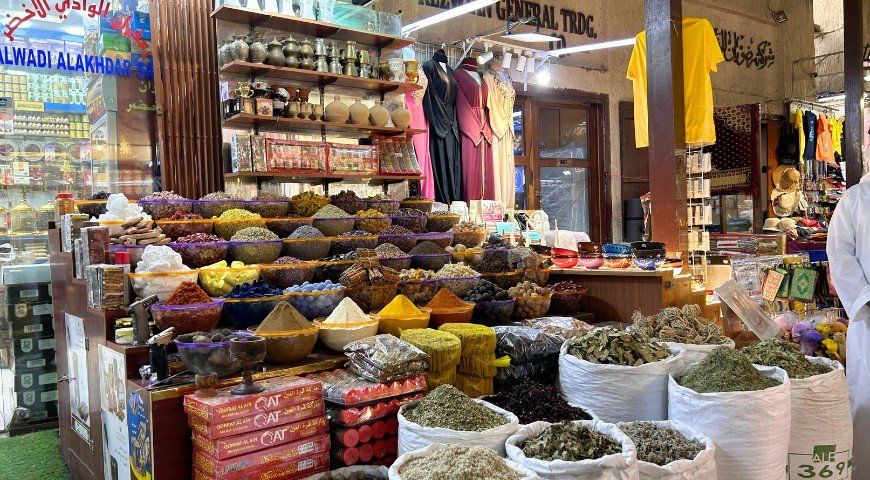
A short walk away, on Baniyas Street in Al Ras, the neighbouring Dubai Spice Souk fills a warren of narrow covered lanes with the scent of frankincense, myrrh, oud and bukhoor. Sacks and stalls overflow with saffron, cardamom, dried herbs, incense and traditional remedies, much of it competitively priced. Together with the Creek and the dhow wharfage where goods still leave by sea, the two souks form the living core of old Dubai's trading identity.
Exhibo editorial
The Gold Souk is theatre before it is a market. Shop window after shop window, hundreds of them, stacked with bridal sets and bullion under lattice roofs that throw the light around — a density of gold that's genuinely hard to process. The gold price is fixed, so the haggling is really about the craftsmanship, and the whole performance runs the way it has since traders swapped gold on wooden benches by the Creek in the 1940s.
Then turn a few corners into the Spice Souk and the sense that runs the show switches from sight to smell: frankincense, saffron, oud, whole sacks of it in narrow shaded lanes. Do them together, early in the day, and finish at the water where the dhows are still loaded by hand — the full arc of why this city exists, walked in under an hour.
How to find it
Both souks are in Deira on the north side of Dubai Creek. The nearest metro is Al Ras (Green Line); from there it is a short walk to the covered Gold Souk arcades on Sikkat Al Khail Street. The Spice Souk lies just south toward the Creek on and around Baniyas Street in Al Ras — follow the scent of incense through the narrow lanes. The most atmospheric arrival is by abra across the Creek from Bur Dubai, landing at the Deira Old Souk abra station.
Similar places
All places
News by Exhibo
Editorial coverage on Exhibo
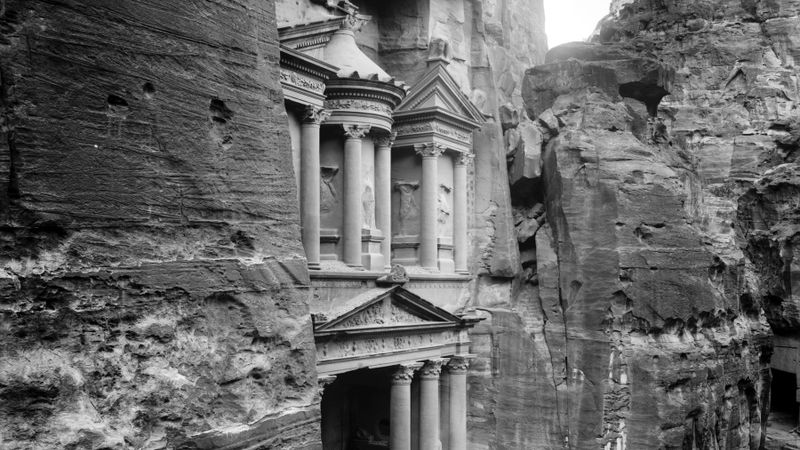
Filmed, but Not Recorded: The Arab World’s Missing Film Locations
Wikidata knows Gladiator was filmed in Morocco. It doesn’t know where.
Ouarzazate is the second most filmed place in the Middle East and North Africa, yet 25 of its 27 productions are recorded only in Wikipedia prose. We compared filming records worldwide and found that in the Arab world, Wikidata usually knows the country but not the place.
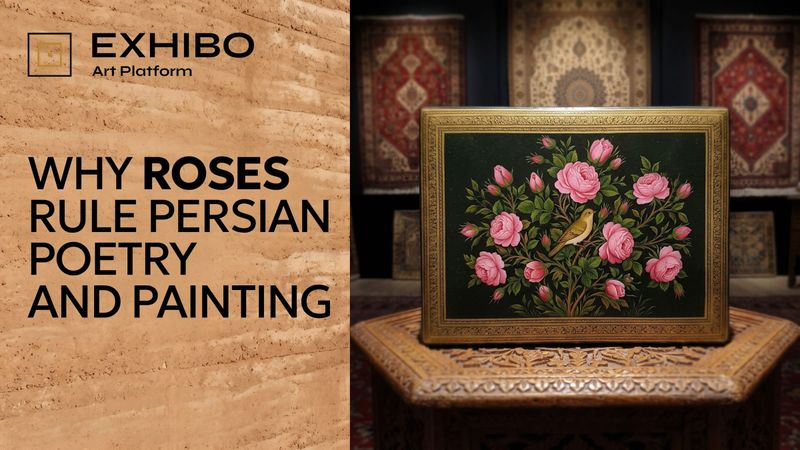
The Flower That Was Never Only Beautiful
The rose rules Persian poetry and painting — but under the sweetness sits a thorn, a bleeding bird, and a national emblem quietly assembled out of Chinese, European and Persian parts. A history of gol o bolbol, from a medieval still to a Dubai gallery.
Gol o bolbol — the rose and the nightingale — is among the most beautiful images in a thousand years of Persian art, and in modern Persian it also means sweet, empty talk. Under the tile, the picture is darker: a bird singing in blood for a flower that will not answer and will not last.
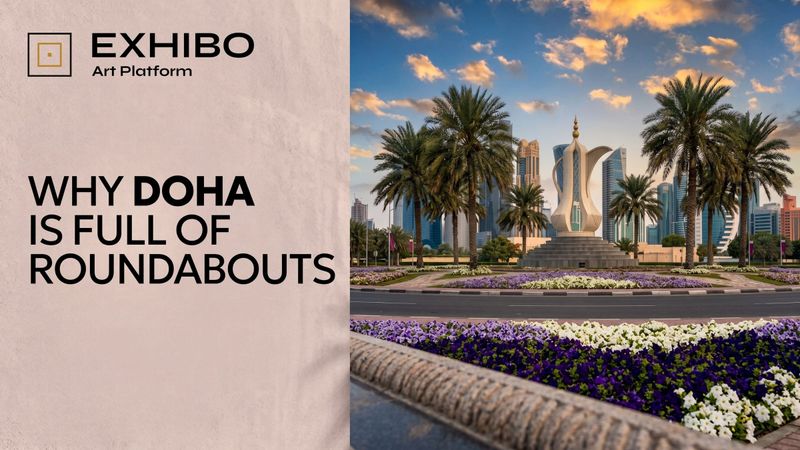
Why Doha Is Full of Roundabouts
An old circle at a crossroads, sharpened by British road engineering, became the way an Arabian city found its way and remembered itself — and it took the bulldozers to reveal it.
In a city where a landmark was more useful than an address, Doha's roundabouts became its navigation, its landscaping and its national image all at once. Now they're being torn out for signalled junctions — and the affection for them arrived, as one scholar put it, only posthumously.